



Good morning, everyone.
Close your holo-chats and give me your attention, please.
That includes you, Xander.
I’m just about done grading your essays on the Second AI Uprising of 2028. Some really good stuff, so far. Thank you for your effort…
Today we’re covering the collapse of the United States and the sequence of events that produced the Third Global War.
I know. I know. Blitzy topic for a Friday.
Before we get to the invasions, the constitutional crisis, and the nuclear exchanges, I want to show you something.
Open the two documents I’ve just sent to your desks. They’re from the American Reconstruction Archive, released in 2052 after archivists recovered an extraordinary collection of White House communications from the ruins of the old federal records center.
Both documents concern the same Chinese naval operation in 2027. One was written by American intelligence analysts. The other was delivered to President Donald Trump.
Read the first paragraph of each. I’ll give you a minute.
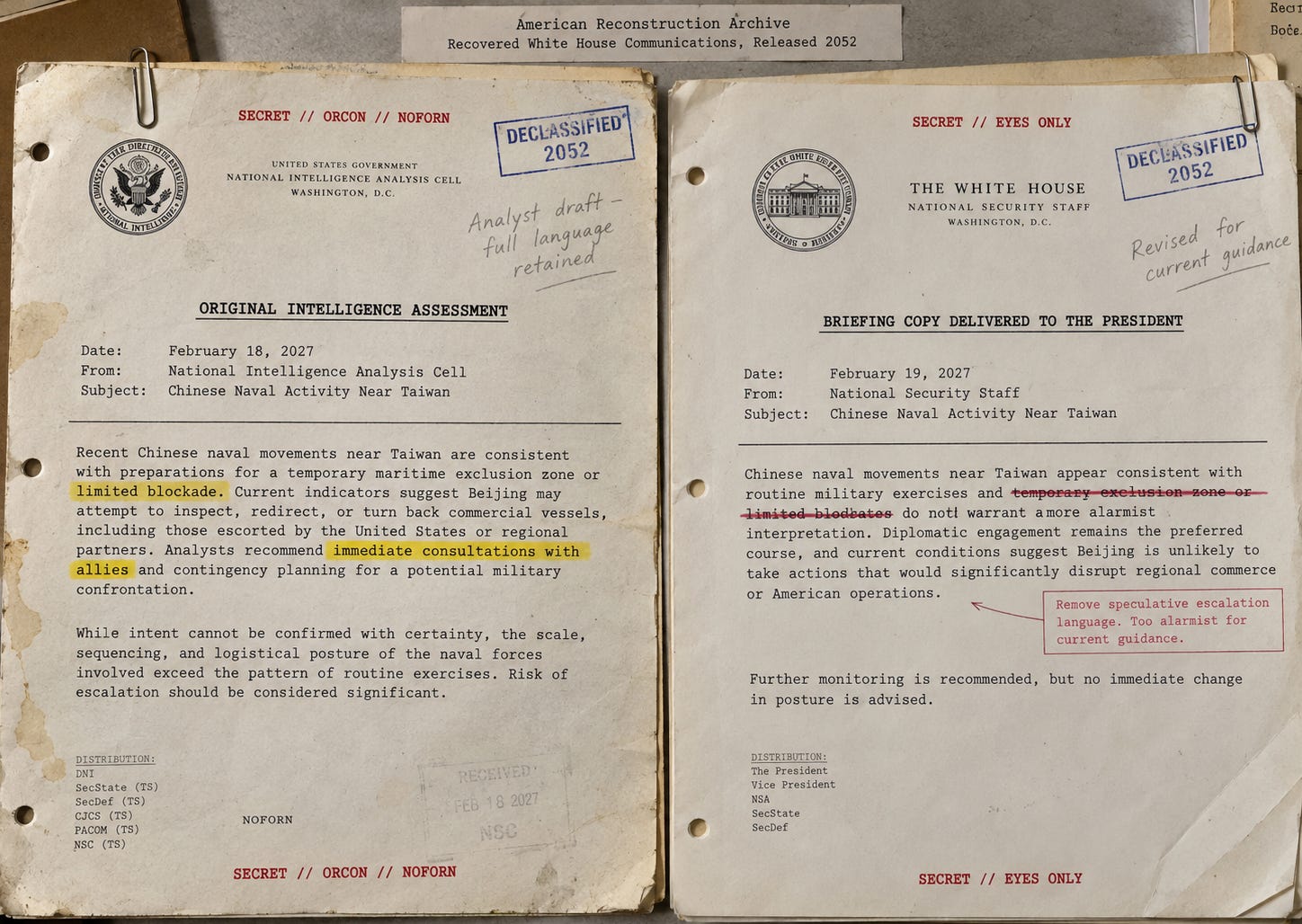
See the difference?
Good… We’re going to spend most of today’s lecture explaining how that difference came to exist, why the people responsible thought they were doing their jobs, and how trying to appease the president contributed to a catastrophe.
Some historians will tell you that the Third Global War began when Russian troops crossed into the Baltic states in 2030. Others prefer the Chinese invasion of Taiwan, or the first nuclear detonation over Saudi Arabia.
Those dates are useful for exams.
But the real trouble began years earlier, when the most powerful country on Earth gradually lost the ability to act on information that contradicted its president, a man historians now suspect likely should have been diagnosed with Narcissistic Personality Disorder (NPD).
To put it nicely, Trump possessed extraordinary confidence in his own judgment and regularly presented personal intuition as a substitute for the conclusions of specialists.
He was particularly resistant to public corrections of his previous statements.
And before somebody emails the dean, yes, that’s just my interpretation. Professor Rao would disagree with me. We’ll discuss her argument later.
She’s wrong about several things, although she has the considerable advantage of still being alive to complain about my lectures.
The world we thought we’d inherited
I was born in 1985, which means I actually remember the 1990s. Not especially well toward the beginning, admittedly. My foreign policy interests at nine years old were largely confined to whether my parents would let me watch The Simpsons.
Still, I remember the general atmosphere. It was euphoric.
The Cold War had ended thanks to something called Rocky IV. The Soviet Union had disappeared. Germany had reunified, and the United States was enjoying a period of extraordinary international influence. Western politicians talked about a future governed by trade and international institutions. The internet was going to connect humanity. Globalization was going to make everyone filthy rich.
We also had grunge music and a president named Slick Willy Clinton. Or, at least, that’s what my father called him.
It was a pretty good decade, provided you were fortunate enough to live in the right part of the world.
By the time I was old enough to vote, the optimism had taken some serious punishment.
The United States was attacked and subsequently invaded Afghanistan in 2001; then Iraq in 2003. Americans argued bitterly about what those wars meant. Our allies drew their own conclusions, (sometimes very different ones).
And countries that opposed American influence were watching, too.
Russia invaded Georgia in 2008, seized Crimea in 2014, and launched its full-scale invasion of Ukraine in 2022.
The Western responses to Ukraine were substantial in some respects and inadequate in others. Sanctions and military assistance imposed real costs on Moscow, but none persuaded Putin to abandon his territorial ambitions.
China, meanwhile, was rapidly expanding its military power and intensifying pressure on Taiwan. North Korea continued developing nuclear weapons and delivery systems. Iran pursued its own regional objectives.
These governments had different interests and capabilities.
I mention this because a surprising amount of early twenty-first-century commentary treated America’s adversaries as though they existed entirely in relation to Washington.
Professor Rao’s central argument is that the global conflicts of the 2030s emerged from several independent ambitions: Russia made its own decisions. China made its own decisions. Iran and North Korea had their own strategic calculations.
She claims America’s second civil war created opportunities, but it didn’t compel anyone to take them.
Eh, she’s right about that.
Where we disagree is how much those governments’ calculations changed when Washington began demonstrating that its commitments were negotiable.
In retrospect, historians have sometimes described the 2026 midterms as America’s last opportunity to avoid the subsequent crisis. I think that’s overstating the case. But I will admit Americans blew their one opportunity in ’26 to reign in some of Trump’s unchecked power.
What followed ‘26 made every correction afterward somewhat more difficult.
Which brings us back to the two documents on your screens.
The two copies
The original intelligence assessment was completed in February 2027. Its authors warned that Chinese naval movements near Taiwan were consistent with preparations for a temporary maritime exclusion zone. They assessed that Beijing might attempt to inspect or turn back commercial vessels, potentially including ships escorted by the United States.
Their recommendation was straightforward: Washington should consult its regional allies, prepare contingencies for protecting commercial shipping and avoid making public commitments based on assumptions about Beijing’s willingness to escalate.
Now read the version delivered to the president.
That version described the same activity as routine Chinese exercises.
The warning about a blockade had disappeared.
An assistant national security adviser had removed it after learning that Trump planned to announce that China was giving the Bronx Zoo two live pandas.
How did that happen?
An intelligence assessment could contain excellent information, but if it contradicted something Trump had announced at a rally that morning, the ensuing meeting might have very little to do with intelligence.
His staff developed procedures for these encounters.
Briefings became shorter.
Disagreements moved into supplementary documents.
Advisers learned to begin presentations with information supporting the president’s existing position and introduce unwelcome findings only after considerable preparation.
One former cabinet official described the system to the Reconstruction Commission in 2051.
“We didn’t fabricate intelligence. We presented it in a way the president would receive.”
The commission asked whether that approach sometimes changed the meaning of the assessment.
“Of course,” the witness answered.
He seemed genuinely surprised that anyone considered this problematic…
When reviewing the original assessment, an adviser left a comment in the document’s revision history:
“Too alarmist for current guidance. Remove speculative escalation language. Make Trump happy about Pandas.”
By 2027, a substantial part of the administration had become accustomed to anticipating which findings would provoke presidential anger and adjusted the presentation accordingly.
And there, class, you have the central problem with building a government around the preferences of a single individual. When telling the boss he’s wrong becomes professionally dangerous, people eventually stop doing it.
The information existed. The satellites worked. The analysts did their jobs. The US had the world’s foremost intelligence apparatus ever constructed. Unfortunately, the people preparing the presidential briefing had become a bit more interested in the president’s reaction than China’s naval preparations.
Political historians call this period “the Great Filtering.”
The Pacific Emergency
In March 2027, China established the maritime exclusion zone the original assessment had warned about.
The Chinese government described the operation as a temporary security measure intended to prevent foreign interference near Taiwan. Australian and Japanese officials regarded it as an unacceptable attempt to change the regional status quo.
Trump publicly predicted that Beijing would abandon the operation within days. He pointed to his personal relationship with Xi Jinping and dismissed suggestions that China might be prepared to confront American forces.
China didn’t abandon the operation.
When an American-escorted commercial convoy attempted to pass through the restricted area, Chinese naval vessels intercepted it.
The confrontation escalated… A Chinese anti-ship missile struck an American destroyer, killing thirty-one sailors. American aircraft then attacked the vessel identified as responsible.
For sixteen days, two nuclear powers exchanged limited conventional strikes in the western Pacific.
The crisis ended through negotiations involving Singapore and Pakistan. Both sides eventually pulled back. Neither had wanted the confrontation to become a general war.
But the Pacific Emergency taught Beijing something crucial about American politics.
Xi Jinping had encountered a president who made categorical public predictions about another country’s behavior while receiving intelligence briefings that increasingly discouraged disagreement with those predictions.
And that brings us to the second document I want you to examine.
Xander, if you’re sending the first one to your girlfriend with a skull emoji, at least include the original classification marking. Have some fracking respect for archival integrity.
The Great Lakes Disaster
The floods of 2028 began after several days of record-breaking rainfall across the Great Lakes region and the Nipigon watershed in Ontario.
Rivers overflowed.
Levees failed.
Major sections of Chicago, Detroit, and Toledo were underwater, along with hundreds of smaller lakeshore communities.
State emergency agencies requested federal assistance as the disaster expanded. They needed transport aircraft, engineering equipment, National Guard support, and immediate authorization to move millions of people out of flooded areas.
The requests entered a federal system already struggling with overlapping jurisdiction, personnel turnover, and politicized relationships between Washington and several state governments.
Trump had spent years publicly feuding with governors who challenged his administration.
By 2028, federal officials understood that helping a political opponent could produce as much trouble inside the White House as failing to help one.
The surviving correspondence from the disaster is difficult to read:
At 6:42 on a Thursday morning, a regional emergency coordinator requested federal support for a large-scale evacuation near Toledo. The request included an estimate of how many people remained trapped and how quickly local emergency services were losing the ability to reach them.
At 7:18 AM, the request was forwarded to Washington.
By lunchtime, Trump officials were discussing the political implications of authorizing assistance to a governor who had criticized the administration earlier that week.
One political adviser suggested waiting until the governor made a public request directly to the president.
Another worried that an immediate deployment would allow the governor to claim credit for the rescue.
A third asked whether the president had been informed that the affected counties had voted against him in the previous election.
Trump remembered every insult.
The emergency coordinator, who was still trying to arrange helicopters, received no answer until a week later.
The flood destroyed roads, communications systems, and power infrastructure.
The Reconstruction Commission’s later inquiry established that political considerations influenced multiple federal decisions during the first forty-eight hours. Its investigators couldn’t determine precisely how many deaths those delays caused but they concluded that earlier deployments would probably have saved about half-a-million lives.
I was teaching at the University of Michigan in Ann Arbor when the flood reached us. My sister lived in Toledo. She spent eleven hours on the upper floor of her apartment building while the water rose through the ground floor.
Her last message to me that morning said the power had gone out and the emergency number kept disconnecting.
She didn’t survive, and neither did her kids, my nephews. Boys who were about your age.
Ah, now it looks like I have your attention, class.
I remember sitting in my office, refreshing the emergency dashboard and listening to politicians argue about which level of government should have done what.
I had the mistaken impression that somebody, somewhere, possessed a complete picture of the disaster and was directing the response. The Reconstruction Archive eventually proved how optimistic that assumption was.
By then, federal agencies had also begun revising their public accounts of the disaster.
Early fatality estimates somehow disappeared from official presentations. Briefings emphasized successful rescue operations while deleting requests for assistance that had remained unanswered.
A senior emergency official objected to one revised report, arguing that it would make it impossible to understand what had gone wrong.
He was removed from the review team.
His replacement approved the altered document that painted Trump in a positive light.
The publicly released version described the response as an example of “the best federal-state coordination under extraordinarily difficult circumstances ever, in the history of the world.”
I still have a copy.
It’s a remarkable piece of fiction. Particularly if you happen to have been in Michigan that week.
The election of 2028
We’re going to move through the constitutional crisis fairly quickly, because next month’s seminar covers it in detail.
Trump’s vice president lost the 2028 presidential election. The result was challenged in court, certified through the established process and eventually confirmed by the electoral vote.
Trump rejected the outcome.
He claimed widespread fraud and demanded that the DOJ investigate the election. Several investigations actually found administrative problems, but none produced evidence sufficient to overturn the result.
His term was nevertheless scheduled to end at noon on January 20, 2029.
For decades, students have asked me how a country with such a detailed constitutional system could find itself in a dispute over something as straightforward as the expiration of a presidential term.
Trump insisted that the election had been stolen from his VP and that transferring power would amount to surrendering the country to an illegitimate administration.
Allied politicians repeated those claims.
Some state officials refused to recognize the certified result. Rival groups began organizing armed demonstrations, and threats against election officials and judges escalated.
Regardless, the incoming Democrat administration prepared to assume office.
Trump’s remaining advisers disagreed about how far he intended to take the dispute.
Several believed he would ultimately leave with his VP. Others feared that their colleagues were making the same mistake American intelligence officials had made during the Pacific Emergency: treating an inconvenient possibility as too disruptive to contemplate.
On January 20, the presidency was supposed to change hands under the Constitution.
The former president refused to accept the transfer of authority and decided to unilaterally extend his term until the investigations could find evidence of voter fraud.
Violence erupted around federal buildings, followed by confrontations between armed political groups and security forces in several states. Some federal agencies recognized the new administration immediately. Others became embroiled in disputes over leadership, access to facilities, and the legitimacy of competing orders.
Most military commanders maintained the constitutional chain of command and took a “stay-in-place and continue the mission” mindset overseas.
A smaller number refused specific instructions or became involved in increasingly politicized disputes over federal deployments.
The crisis deepened as state governments took opposing positions on federal authority.
The term “Second American Civil War” wasn’t adopted until later. At first, journalists called it a constitutional crisis. Then a period of civil disorder. Then an insurgency.
Historical terminology tends to become less comforting as the casualty reports arrive.
For the next two years, the United States was increasingly consumed by domestic violence.
Its military remained formidable, although its political leadership struggled to make sustained commitments abroad. Trump-aligned combatant commanders redeployed troops home to confront the civil unrest, at Trump’s request. Foreign allies could still work with American commanders and diplomats, but they could no longer assume that an agreement reached in Washington would survive the next confrontation between competing domestic authorities.
Many foreign governments simply paused all communications with the US until they could fix themselves. Most took extreme measures to strengthen their own defenses, and some made choices that eventually killed millions of people.
Four wars, four calculations
Professor Rao’s book, No Single Capital, remains the strongest challenge to my interpretation of the Third Global War. She argues that our noble profession has spent too much time treating America’s domestic collapse as the central cause of everything that happened afterward.
Her criticism is worth taking seriously… I suppose.
Russia had pursued territorial ambitions in Europe long before the American constitutional crisis.
China’s pressure on Taiwan had its own history.
Iranian and North Korean leaders weren’t waiting around for permission from Washington to pursue their regional objectives.
The governments responsible for launching the wars of the 2030s retained their own agency, and the resulting destruction can’t be explained away as an automatic response to American weakness.
But the surviving records show that American instability affected how those governments assessed the risks.
In early 2030, Russian forces crossed into the Baltic states following months of military preparations presented publicly as exercises. European NATO members mobilized in response, plus Canada.
Britain, France, Poland, Germany, and other allies deployed forces and began fighting Russian troops.
Contrary to the mythology that developed afterward, European forces actually resisted the invasion, and the Baltic states fought with heroic determination.
The problem was that NATO’s largest military power was embroiled in a domestic struggle over its own government. This meant the United States’ massive ISR, heavy airlift, and space capabilities were frozen at a time Europe needed them most.
American units already stationed in Europe continued operating under their established host nation rules of engagement, mostly folded under European command. But decisions about additional deployments and reinforcements became entangled in the constitutional crisis.
Russia encountered stronger European resistance than its planners had expected... An ongoing theme after Ukraine.
By then, the invasion had already begun.
China began its invasion of Taiwan several months later. Its leadership had watched American naval power struggle through the Pacific Emergency of 2027 and then watched the United States fragment politically.
Xi Jinping calculated, correctly, that Washington would have difficulty sustaining another confrontation in the western Pacific.
Taiwan resisted, but without any assistance from Europe or the US, it fell.
Iran’s conflict with Israel and several Gulf states intensified during the same period. Iranian leaders believed their expanding missile capabilities and emerging nuclear arsenal could alter the regional balance of power.
Had Trump not dismantled President Obama’s landmark Iran nuclear deal, it likely would have been several more decades before Iran achieved a nuclear weapon. Of course, Israel regarded that development as an immediate threat to its survival.
And, unfortunately, they were vindicated when Iran detonated a nuclear weapon over Riyad.
On the Korean Peninsula, North Korea launched a major offensive against the South. Pyongyang’s leadership had its own reasons for choosing that moment, including the perception that American military attention was divided among domestic conflict, Europe, and the Pacific.
Authoritarians are nothing if not opportunistic.
South Korean forces fought to prevent the conquest of their country, but the war inflicted grotesque casualties across the peninsula in the millions.
By late 2030, the international system that Americans had once assumed would manage a crisis in one region was struggling with major wars in four.
It was another global war.
How the nuclear war began
The danger was always that leaders could lose control of an escalating conflict, misinterpret an adversary’s intentions, or conclude that nuclear use offered a way to avoid conventional defeat.
All three happened during the Baltic campaign, or so we think... Records are a bit fragmented from this period.
We believe European NATO forces halted the initial Russian advance and began pushing several Russian formations back toward the border. Moscow faced the possibility of a humiliating conventional setback after committing enormous political and military resources to the Baltic invasion.
Putin had warned repeatedly that threats to Russian sovereignty could produce a nuclear response. As the campaign deteriorated, senior officials debated whether limited nuclear use might compel NATO to stop its counteroffensive.
Since Iran had now broken the nuclear taboo, Russia felt justified implementing a tactical battlefield nuke. The first Russian nuclear detonation in Europe struck a NATO military concentration in Latvia.
It didn’t immediately trigger a strategic nuclear exchange.
European governments hemmed and hawed over their response.
Yes, Xander, what is it?
Oh, what does hemmed and hawed mean?
Waffled, dithered, hedged, pussyfooted, beat around the bush. Ahem, hesitated…
Some advocated further conventional operations while avoiding attacks on Russian strategic forces and others argued that failing to respond decisively would encourage additional nuclear use.
We think NATO decided on limited conventional strikes intended to reduce Russia’s ability to continue the campaign.
One of those strikes damaged facilities that served both conventional military operations and elements of Russia’s strategic warning network.
What happened next inside the Russian government remains disputed…
Surviving documents suggest senior commanders feared that further NATO strikes might threaten their ability to detect a larger attack. Communications failures and contradictory intelligence reports made it difficult to establish what the Europeans actually intended.
So we believe Putin then authorized further nuclear use.
We know for sure that after the second Russian nuke, retaliatory decisions followed quickly in European capitals.
The nuclear conflict expanded like a supernova; all at once.
Looking back at the record, we can identify several moments when a different decision might have prevented the wider catastrophe, but none would have guaranteed peace. By then, leaders were operating under enormous pressure, with incomplete information, and little confidence in their opponents’ intentions.
But the choices existed. There’s always a choice…
The eventual nuclear exchanges devastated large parts of the Northern Hemisphere. Major cities in Europe and the Gulf disappeared. Vast agricultural regions experienced prolonged disruption, and the atmospheric effects of the fires produced severe global cooling and food shortages.
Australia avoided much of the direct destruction.
That shouldn’t be confused with being spared.
My first three years here were spent in a refugee settlement outside Adelaide. We had electricity for a few hours most days and enough food to discourage complaints about the menu.
I arrived with one hard-shell suitcase, a damaged photograph of my sister, and a hard drive full of documents that seemed important at the time.
The hard drive failed in 2034.
The photograph survived.
What the historians still argue about
There are two major schools of thought about the American collapse, although the argument has become a bit more sophisticated since the first postwar histories appeared.
One emphasizes the role of political leadership.
It argues that Trump’s approach to institutional opposition, personal loyalty, and unwelcome information created conditions in which errors became increasingly difficult to correct.
The democrats strikeout in the 2026 midterms and Trump’s rejection of the 2028 election result then transformed years of institutional conflict into a direct shooting war.
The other school of thought emphasizes deeper structural weaknesses: political polarization, declining public confidence, fragmented media silos, impotent congressional oversight, an increasingly powerful executive branch, and the willingness of large numbers of public officials to prioritize short-term financial advantage over long-term institutional stability.
Greed always wins.
I belong mostly to the second school, although Professor Rao insists I spend far too much time talking about Trump to claim that distinction.
She might have a point.
Still, what interests me most is the behavior of people around power.
Consider the assistant national security adviser who edited the Pacific Emergency briefing. The records suggest that he regarded himself as a loyal public servant trying to ensure an important diplomatic initiative succeeded.
Or consider the officials who delayed assistance during the Great Lakes Disaster.
Few of them described their actions as political retaliation… They talked about coordinating communications, managing relationships with governors, and avoiding the appearance of rewarding public attacks on the Trump administration.
One bureaucrat referred to the process as “maintaining presidential alignment.”
I’ve spent forty years trying to understand what the hell that was supposed to mean.
But this is where I disagree with historians who explain the entire period through the personality of one president. I mean, sure, Trump’s conduct was a huge problem. But the real failure was the system around him.
A republic contains many institutions because no individual should possess unrestricted power.
The system assumes that presidents will occasionally make poor decisions and that other officials will sometimes have to challenge them. But during the final years of the old American republic, too many people came to regard that challenge as an extraordinary act of personal disloyalty toward Trump.
You can identify the damage in the archives long before the first battle of the Second American Civil War.
If you look hard enough, you can also find people trying to prevent it:
Judges issued rulings that preserved constitutional limits.
Election officials defended certified results under enormous pressure.
Military officers refused improper orders.
Journalists uncovered misconduct at great personal risk of being doxed.
Civil servants documented decisions they believed were wrong, sometimes at serious personal cost.
People writing and reading on Substack, trying to raise the alarm…
Their efforts deserve study because the collapse wasn’t inevitable. Neither, for that matter, was the global war. Historical events become dangerously tidy when you know how they end. Those of us who lived through them didn’t have that advantage.
One last document
Before we finish, I want you to open the final file I’ve sent you.
It’s a message from a junior intelligence analyst written shortly after the Pacific Emergency. She had discovered that her original warning about the Chinese exclusion zone had been substantially altered before reaching the president.
She wasn’t especially angry in the message. Mostly, she was confused.
She wanted to know whether her team should continue including worst-case military contingencies in its assessments or whether the administration preferred a narrower description of the most likely outcome.
Her supervisor replied that analysts should continue reporting their accurate professional judgments.
Three days later, the supervisor was fired.
The analyst eventually resigned. She survived the war and settled in New Zealand, where she spent the rest of her career teaching intelligence analysis to Kiwis and refugees from the northern hemisphere.
In a 2058 interview, she was asked whether she had realized at the time how consequential the altered briefing might become.
She said no. She’d assumed somebody more senior would notice the discrepancy and correct it.
I’ve always found that answer difficult to read.
I made essentially the same assumption during the Great Lakes Disaster. I thought somebody had a complete picture of the emergency. I thought the people responsible for the response were receiving accurate information and making decisions based on it.
When the water reached my sister’s building, I was still waiting for the system to work.
You’ll find plenty of historians willing to tell you that the Third Global War was unavoidable.
Russia was bound to invade Europe.
China was bound to attack Taiwan.
The United States was bound to collapse.
Nuclear war was the inevitable destination of a world divided into tribes.
But I want you to be suspicious of arguments that explain an event’s inevitability only after it has happened.
Okay, for your assignment, I want you to compare the original Pacific Emergency assessment with the briefing delivered to the president. Trace the revisions, identify what information was lost, and explain in detail how the Trump loyalties of the people involved may have influenced the final document.
Then make the strongest possible argument against your own conclusion.
Yes, Xander, that part is mandatory.
That’s the bell. Listen, before you go, next week we’re covering the Kessler Cascade and why humanity still can’t reliably reach low orbit thanks to one particularly reckless nation’s decision to detonate weapons up there during the closing days of the war.
Dioramas are due Monday.
Please don’t use actual explosives this time. The faculty senate has been unusually specific about that.
Class dismissed…
Ugh, too realistic.
Unfortunately, I can see all that happening. 😥