


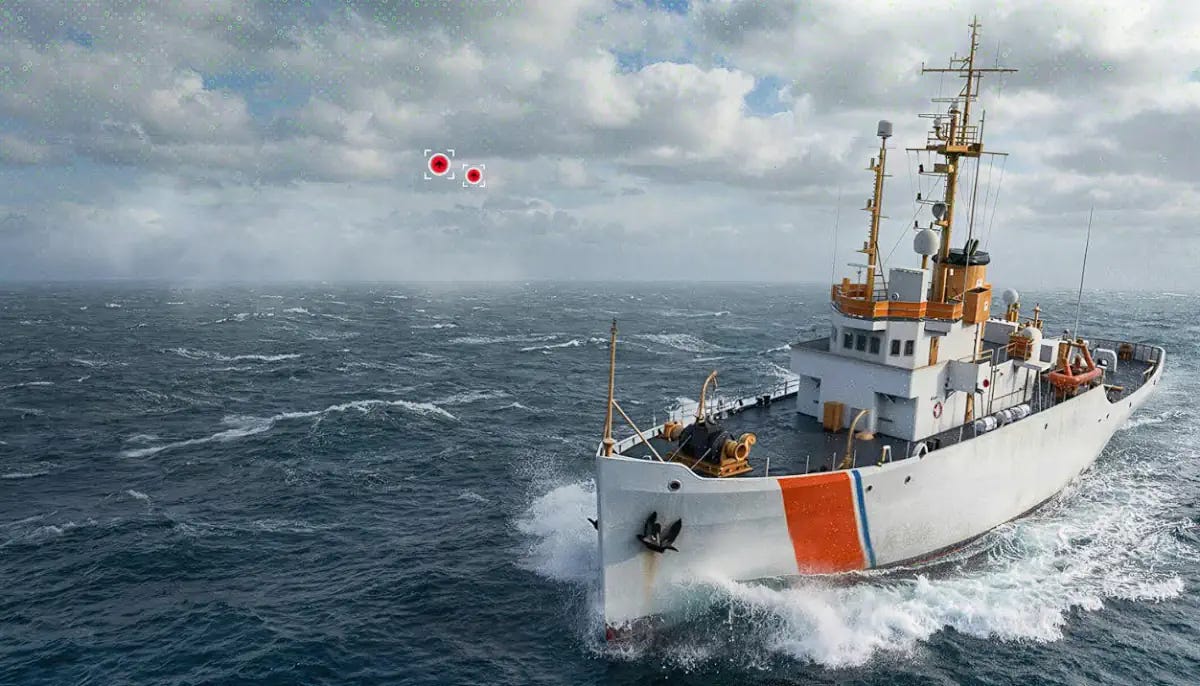
This article is one of three weekly exclusive articles (Sundays, Mondays, and Wednesdays) for my paid subscribers. Thank you for continuing to support independent, approachable military analysis with a heavy dose of pro-Ukrainian sentiment and a side of anti-authoritarian humor.
Hey friends, you know I can’t pass up a good radar development, given my background on the AWACS. I’m actually in the process of sourcing a neon sign that says “Radar Love” to be in the background of my YouTube videos. And yes, the Dutch rock band Golden Earring got a lot of plays in my squadron.

Anyways, the sea has a drone problem now. And Robin Radar Systems, a Dutch company that has spent years teaching machines to tell a quadcopter from a sparrow, just announced IRIS OTM at Sea, a counter-drone radar built specifically for that ugly new reality.
CEO Siete Hamminga says, “the drone threat is no longer confined to the battlefield or to land, and the Strait of Hormuz showed how vulnerable maritime corridors become the moment things get unstable.”
Now, one clarification. This is Robin’s IRIS, not the German IRIS-T.
Completely different beast. Same European habit of naming defense systems like somebody tied a Scrabble bag to the tail of a Dutch cat, blasted an air horn, and wrote down whatever letters fell out. Fucking insanity, I tell you.
Anyways, here’s the important thing to understand up front. IRIS OTM (OTM stands for “On The Move” or just “Oscar Mike” in the US military) finds the drone, tracks it, figures out what it actually is, and hands that information to whatever system is supposed to respond. In the kill chain, it’s the eyes that tell everyone where to look.
And on a pitching ship surrounded by clutter, being the eyes is a genuinely hard job; just ask Frederick Fleet.
Let me walk you through why.
How the Radar Sees
IRIS is a 3D X-band FMCW radar, and every piece of that label matters, so let me translate it.
X-band refers to the slice of the radio spectrum it operates in, roughly 8 to 12 GHz. It’s a sweet spot for this work: high enough frequency to resolve small objects with decent precision, while still behaving well over practical distances.
This is the band a lot of fine-grained tracking radars live in, for good reason.
FMCW stands for frequency-modulated continuous wave, and it’s the clever part.
A traditional pulse radar shouts one big burst of energy into the sky and then shuts up to listen for the echo, like yelling into a canyon and waiting.
FMCW does something smarter. It transmits continuously, but it constantly slides the frequency of that signal up and down in a known pattern. When the signal bounces off something and comes back, the radar compares the frequency of the returning echo against what it’s transmitting at that exact instant.
The difference tells it range. The way that difference shifts over time tells it speed. You get continuous, precise range and velocity data instead of intermittent snapshots, which is huge when your target is small, fast, and trying not to be seen.
The “3D” part is the piece people underestimate. A basic radar plot tells you something is out there at a certain bearing and range. A 3D radar adds height.
For counter-drone work, height is the whole shebang. A drone can skim low over the water, pop up near its target, loiter beside a crane, or hide its approach under the radar clutter thrown off by bigger objects.
If your radar can’t place the contact in three dimensions, you might know something is moving without knowing whether it’s a threat at 50 feet or a fishing boat’s mast return at sea level.
The hardware itself is modest by military radar standards. Robin’s spec sheet lists the IRIS head at around 25 kilograms, roughly 554 by 623 millimeters, with 360-degree coverage in azimuth, 60 degrees of elevation, a one-second update rate, and a standard instrumented range of 5 kilometers.
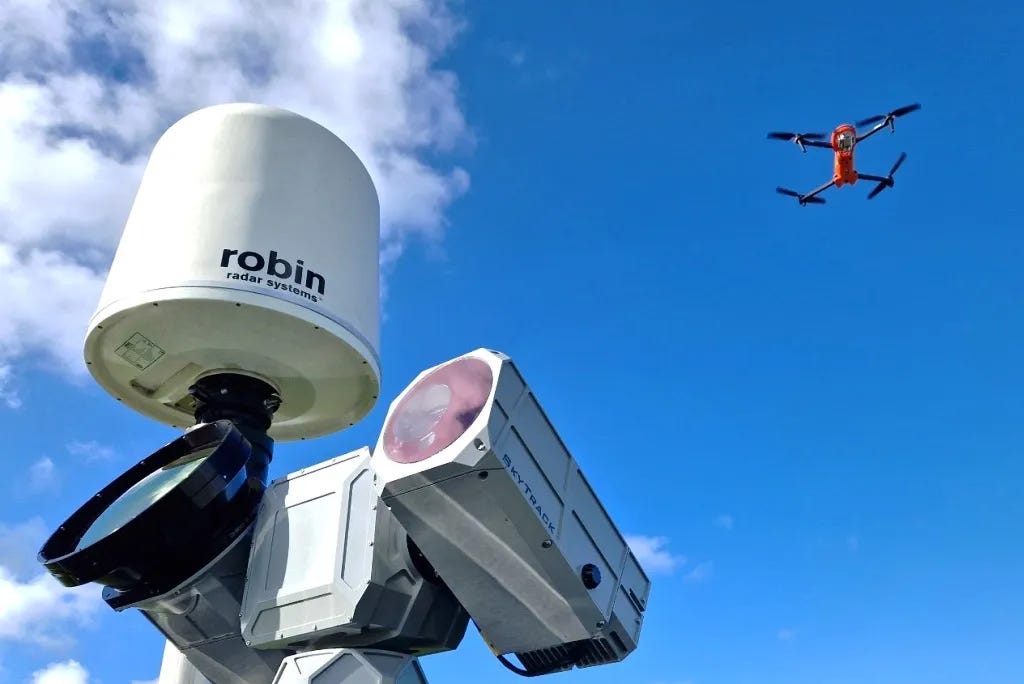
Small enough to bolt onto a vehicle or a ship’s mast. Which is the whole point.
By the way, Robin Radar just deployed more than thirty IRIS land-based systems at the World Cup. I thought that was cool.
Telling a Drone From a Bird
Here’s the problem that separates a useful counter-drone radar from an expensive anxiety generator: small drones and birds look almost identical to radar.
Both are small. Both move through the air. Both have a similar radar cross section. A system that screams “drone” every time a gull commits suspicious behavior near a ship is worse than useless, because it trains the human watch team to ignore the alarm right before the real one arrives.
IRIS solves this with a combination of micro-Doppler analysis and a deep neural network classifier, and this is the genuine magic trick, so stay with me.
Regular Doppler tells you how a whole object is moving toward or away from the radar. Micro-Doppler looks deeper, at the tiny internal motions within a target. A spinning drone propeller throws off a fast, repeating, highly regular frequency signature. A bird’s flapping wings produce a completely different pattern, slower and more irregular and organic. A wave has motion but no propeller. A crane has a strong return but no flight at all.
Those micro-motions are like fingerprints, and IRIS reads them.
Then the deep neural network does the sorting. It’s been trained on enormous libraries of these signatures until it can look at a return and assign a probability: that’s a quadcopter, that’s a fixed-wing drone, that’s a bird, that’s clutter.
Why Doing This at Sea Is So Much Harder
The land version of IRIS OTM already solved a hard problem: tracking drones while the radar itself moves at highway speed, up to 100 km/h. (I know jets have radar and move much faster than that, but the clutter problem at ground level is much worse.)
On a moving vehicle, the radar knows it’s moving, so the software has to subtract its own motion from everything it sees. Otherwise every stationary tree looks like it’s racing toward you and every real target gets smeared into your own movement.
At sea, that problem gets nasty, because a ship doesn’t just move forward. It pitches, bow rising and falling. It rolls side to side. It yaws, swinging off heading. It heaves straight up and down on the swell. It vibrates. It changes course and speed. I’m getting sea sick just writing this.
The radar is bolted to a platform that is never still. So, before the software can say anything confident about what a drone is doing, it first has to work out what the boat is doing and mathematically cancel it out.
The radar has to understand its own chaos before it can describe anyone else’s.
Then comes sea clutter, and water is a miserable radar neighbor. Waves reflect energy back. Whitecaps move in ways that mimic targets. Spray scatters the signal. Add a coastal environment and you pile on cranes, buildings, moored ships, antennas, buoys, and birds, all throwing returns.
A low-flying drone skimming the waterline can vanish into that mess completely. Robin says the maritime software is built specifically to filter heavy sea reflections and environmental clutter to isolate small threats near the surface.
In practice that means a few things working together. The system builds a picture of what the environment normally looks like and learns to reject returns that behave like waves.
It keeps a track alive through brief moments when clutter swallows the target.
It cross-checks Doppler, altitude, motion consistency, and classification all at once before it commits to calling something a threat.
And above all, it has to avoid drowning the operator in false alarms, because operator fatigue is the real enemy here. A system that cries drone every three minutes gets ignored, and then the actual loitering munition arrives to a very relaxed audience.
