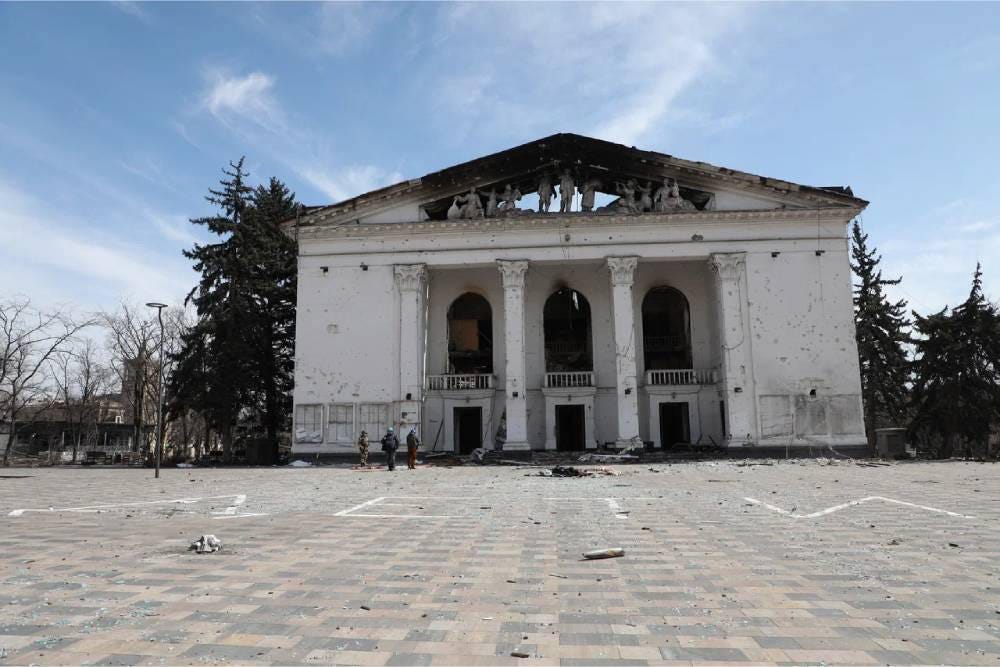
A Stage, a Shelter, and a Russian War Crime
A book review of James Verini’s “The Theater”

I remember exactly when Ukraine stopped being just “another headline” to me: It was early 2016, and I was catching up on the excellent field dispatches of then-Vice journalist Simon Ostrovsky and his series called “Russian Roulette.”
By the way, it is absolutely worth a watch, even today, because this is the playbook that Putin would use in Estonia or Latvia tomorrow. The series covered Putin’s “little green men” invasion of Crimea and the Donbas.
A year later, in 2017, I would be interviewing five Ukrainian soldiers who were actively fighting against Russian separatists in Donetsk. Many friends of mine, who were still serving on active duty in the US military, spent training rotations at Joint Multinational Training Group-Ukraine, based at Yavoriv, to get their army more doctrinally aligned with NATO.
Then, on a late winter morning in 2022, I was scanning feeds like a good geopolitical junkie trying to get my fix when something in a grainy, user-posted video stopped me.
A full-scale Russian invasion of Ukraine.
Civilians, not soldiers, scrambling through rubble. Mothers holding children in the back seat of a car with shattered glass glittering like snow. Russian invaders intentionally driving tracked vehicles over civilian cars with Ukrainians still inside.
This didn’t make any sense. Why attack civilians? My US military programming for ‘protecting civilians’ had plastered over my education in Russian language, Soviet history, and culture.
I should have known better, and yet my brain had difficulty understanding how a modern army would intentionally target unarmed civilians…
In the US Army and Air Force, we went to great lengths to protect civilians.
It’s not a perfect system; sometimes civilians get hurt, sometimes they die, and many others get displaced. But I can personally attest to the steps we take to protect the lives of the innocent people impacted by war. Or… at least we used to, before Trump’s newest reality TV series, “Keeping Up With the Ayatollahs.”
When Russia targeted civilians in Ukraine, my first reaction was shock, followed by analysis: Are the Russians attacking civilians because they are incompetent at warfighting? Or just have a lower value for human life more generally?
The answer turned out to be a little bit of both, with a dash of lingering Soviet-era culture (a lesser value of life over state) sprinkled in for good measure.
Since then, my interest has never been casual. Ukraine is the moment where history, morality, and the future of the international system all collide in one place.
The Kremlin’s sequence is always the same:
Destroy the place.
Deny the crime.
Pave over the ruins.
Russia has run this playbook across occupied Ukraine with the overconfidence of an institution that has never once been held accountable for anything.
The Donetsk Regional Academic Drama Theater in Mariupol was supposed to follow that script:
Bombed on March 16, 2022. Check.
Reconstructed under occupation by 2025, its skeletal remains wrapped in storm fencing printed with portraits of famous Russian playwrights. Check.
Russia erasing a war crime and replacing it with Russian culture, as if the building had simply been waiting for the right Tsarist landlord all along. Double Check.
James Verini’s The Theater is a direct argument against allowing that sequence to complete.
The Donetsk Regional Academic Drama Theater was a functioning civic institution, built between 1956 and 1960 in the style of Soviet Monumental Classicism. With 800 seats and 143 seasons, it was the only professional theater in Mariupol.
When Russia’s full-scale invasion began and the city came under siege, the theater became something else: a shelter for hundreds of civilians who had nowhere left to go. Women, children, elderly residents, actors, cooks, doctors, teachers, and refugees crowded into a building designed for performance.
Someone painted the word “дети” (children) in large letters on the ground outside, visible from the air, in Russian, so there could be no confusion about who was inside.
Russian aircraft bombed it anyway with two 500-kilogram bombs.
Ask yourself what kind of Russian pilot sees the word “children” clearly identified near a structure and releases the weapon anyway.
Amnesty International concluded the attack was a clear war crime committed by Russian forces. Separately, the International Criminal Court issued an arrest warrant for Vladimir Putin in 2023 over the alleged unlawful deportation and transfer of Ukrainian children from occupied areas of Ukraine.
Russia’s position, maintained to this day, is that Ukrainian saboteurs did it.
The Book Verini Wrote
Verini reported from Kharkiv, the Donbas, and Kherson during the war, and then spent 2023 and 2024 conducting extended interviews with theater survivors across Ukraine and Europe; some lasting hours, some stretching into days.
The resulting book is not military history; there are no unit designations, no command decisions, no analysis of Russian strike packages. Those elements exist only as pressure: the shelling outside, the siege tightening, the math of whether staying put is less fatal than trying to run.
What Verini builds instead is a portrait of the people inside the building:
Verini writes that Nadia Navka, the theater’s scullery chef, once dreaded her shifts at Azovstal, but in the theater kitchen she worked late into the night because the labor helped keep people alive.
He also describes “The Searchers,” scavenging crews who moved through Mariupol looking for food and supplies.
In the book he recalls Dr. Olena Matiushyn’s Soviet medical education, where political instruction could matter as much as anatomy.
What’s more, Verini writes that the theater’s children reacted in wildly different ways, from shutting down to acting out to taking reckless risks during shelling.
This is the mission: restoring the individuals that war always flattens into statistics.
The people inside the Mariupol theater had no supply chain, no operational plan, and no doctrine for managing hundreds of displaced civilians in a building under siege.
What they had instead was a theater full of terrified people and the professional instinct that comes from decades of making something out of nothing on a state budget.
Verini draws that parallel carefully. I’m paraphrasing here: “The theater’s actors and administrators had spent their careers working with improbable scenarios on limited resources, teasing performances out of untrained talent, solving problems the moment before they became catastrophes. The siege of Mariupol was simply the largest, most lethal version of a problem set they had been rehearsing for years. The difference was that they could never leave the stage, and there was no telling when the run would end.”
Verini writes that Olha eventually settled on Queen’s “The Show Must Go On” as an anthem for the theater’s situation.
Folk songs. Hymns. Whatever came to mind first. They would sing until the noise of destruction stopped. That’s a functional coping mechanism that also happens to be a profound act of defiance, and Verini understands the difference.
The Honesty That Makes This Work
Too many war books turn civilians into saints because sainthood is easier to process than reality.
Verini doesn’t do that. He acknowledges that the theater also contained people who parroted Russian propaganda, who blamed Ukraine for the siege, and who would not spare firewood for a freezing grandmother.
War reveals character in all directions.
It made some people genuinely heroic and others petty, brittle, and cruel. The full spectrum was present in one building, and Verini doesn’t look away from the ugly end of it.
That honesty is what separates serious war reporting from trauma tourism.
The publisher’s materials compare The Theater to John Hersey’s Hiroshima. That’s bold. Hiroshima is one of the most important works of war journalism ever produced, and you don’t casually walk into that neighborhood unless you brought serious credentials.
But after reading The Theater, I think the comparison clarifies the intent: Verini is trying to make one atrocity impossible to forget, compressing it into human scale before the godforsaken machinery of news fatigue and geopolitical abstraction can process it out of memory.
Russia’s bet, in Mariupol and everywhere else, is that the world will eventually exhaust itself and look away.
The Theater is a refusal to allow that.
If you’re a ‘Wes O’Donnell’ subscriber, then this book belongs on your reading list. I know my audience.
Verini’s stated goal is simple: he wants readers to get some sense of what it was like to be there.
That sounds modest until you recognize what it requires… To make a distant reader feel the lived reality of Mariupol in March 2022 is to fight abstraction at the most fundamental level.
It’s to insist that the people inside that building were not targets or refugees or statistics. They were cooks, doctors, actors, children, parents, technicians, and volunteers trying to stay human while the city collapsed around them.
Verini found them, sat with them for hours, and wrote their story down before it could be paved over and repackaged with portraits of Russian culture.
Memory is one of the few weapons civilians have after the rubble sets and the empire starts repainting the walls.
The Kremlin wanted Mariupol’s memory erased.
The Theater says no.
Слава Україні!
The Theater: Courage and Survival in the Defining Atrocity of the Ukraine War releases on May 19th. You can find the book here on Amazon or here at Barnes & Noble.
Author James Verini writes for The New Yorker, The New York Times Magazine, and National Geographic, among other publications. His journalism has received a National Magazine Award and a George Polk Award. He is the author of They Will Have to Die Now, about the battle that brought down ISIS.
Check out his recent article today in The Atlantic.