An F-15E WSO Says He Saw Iranian Drones Flying Like a Jellyfish – Right Before He Was Shot Down
Is Iran flying a MESH aerial minefield made of drones?
Hey friends. I could have sworn the fighter air crew at the center of this story was female. I’m not sure why I thought that because everything I see publicly reported uses “he/him.” So, I reluctantly do the same here.
Imagine getting shot down twice in five weeks.
The first time, your own side does it.
On March 1, the second day of Operation Epic Fury, three US F-15E Strike Eagles get blown out of the sky by Kuwaiti air defenses who mistook them for Iranian.
You eject, you survive, you dust yourself off, and you go back to work, because that’s the job.
Then, thirty-three days later, you do it again. On April 3, on the 34th day of the campaign, your F-15E gets hit over southwestern Iran, and this time you punch out into hostile territory with a concussion rattling around your skull.
And in those last seconds before you eject from a dying jet, you look out and see something that makes you tell intelligence officers, days later, one of the more quotable things ever to leak out of a classified debrief:
“Real alien shit.”
That’s the quote.
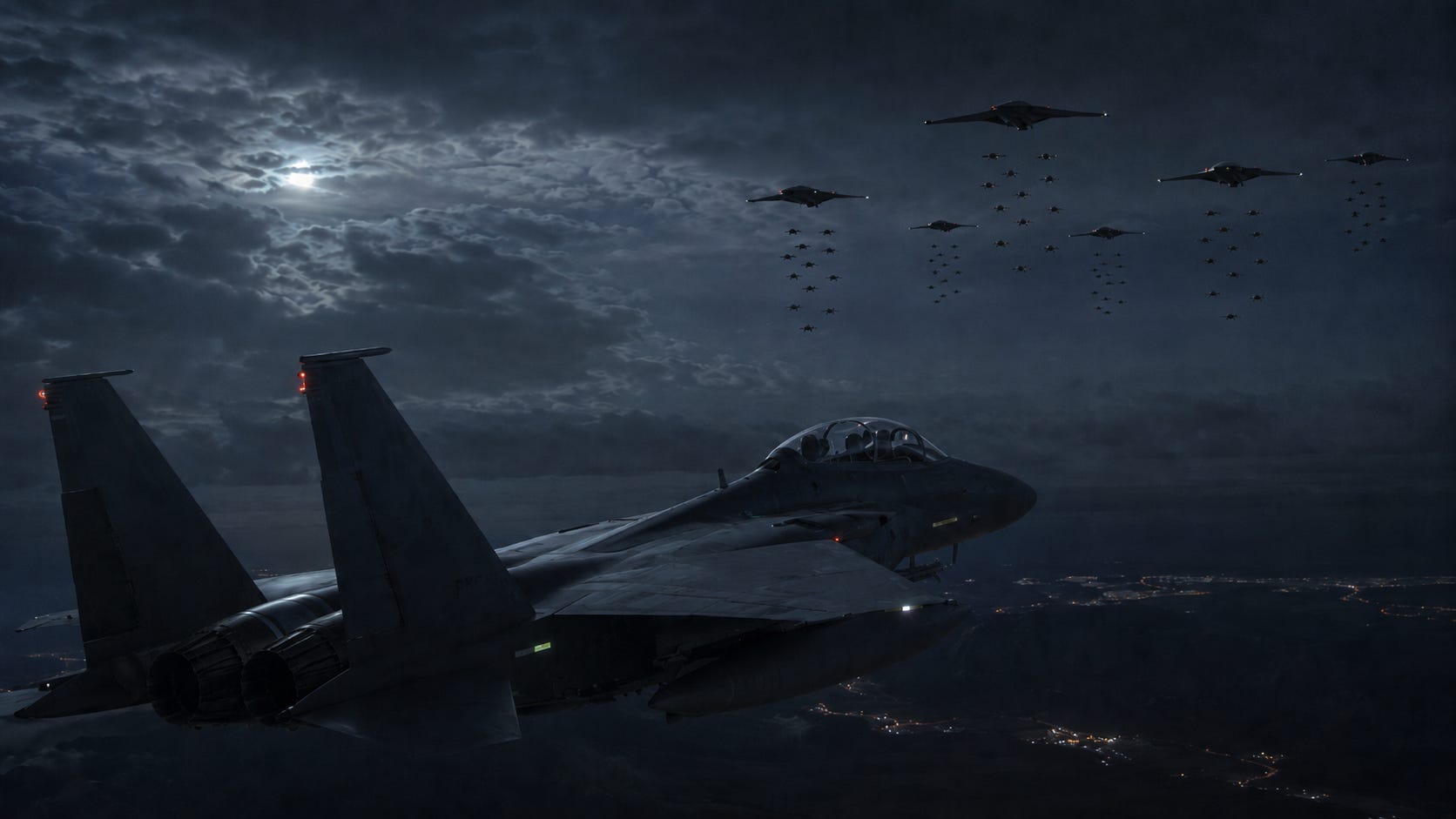
According to a CNN exclusive that landed today, the aircrew described a cluster of Iranian drones moving together as one, larger drones up high with smaller ones strung beneath them like dangling legs, in a shape he compared to a jellyfish.
Another source said he called it a “minefield of drones.” And the account kicked off a fight inside the US intelligence community that still isn’t settled.
So, let’s simmer down and work the problem, as my squadron commander used to say.
There’s a real and genuinely alarming signal buried in this story. There’s also a concussed man at night, mid-ejection, after the worst five weeks of his life, and those two things have to be acknowledged at the same time.
Let’s separate what we know from what we’re guessing.
I’m a one-man operation over here, so I have to pick my topics carefully. Admittedly, I don’t spend a lot of ink on Middle East War IV: Keeping Up with the Ayatollahs. Ukraine and NATO keep me pretty busy. But just because I don’t write about it often doesn’t mean that I’m not flooded by Iran news in my OSINT dashboard.
So, if you haven’t been tracking this one closely, here’s the skinny: By the time Dude 44 went down on April 3, US forces had reportedly flown more than 10,000 combat sorties and struck over 13,000 targets, which is an enormous tempo of operations packed into about a month.
There’s now a ceasefire, and the US and Iran are inside a roughly 60-day window trying to turn that pause into something that holds.
Iran’s drone program is not formally on the negotiating table, even though American officials privately treat Tehran’s drones and its ability to threaten the Strait of Hormuz as some of the most durable problems in the region.
The human story that will someday be a movie directed by Clint Eastwood
The F-15E, call sign Dude 44, belonged to the 494th Fighter Squadron out of RAF Lakenheath in England. It was brought down by what Trump described as a shoulder-fired heat-seeking missile, a MANPADS.
NBC later reported the missile was likely Chinese in origin. Remember that detail too.
The jet carried two men. The pilot up front, call sign Dude 44 Alpha, and the weapons system officer in back, Dude 44 Bravo, a colonel, the guy who runs the sensors and weapons while the pilot flies. Both ejected and landed miles apart in enemy territory.
The pilot got pulled out about seven hours later in a daylight rescue.
The HH-60W helicopter that grabbed him was, in the words of the chairman of the Joint Chiefs, engaged by basically every Iranian within range who owned a gun.
One of the A-10 Warthogs flying cover, call sign Sandy, took so much fire that the pilot had to nurse the wrecked jet out over the Persian Gulf and eject. That’s the “second aircraft” you might have seen mentioned. A whole separate plane lost just trying to bring the first guy home.
Warthogs can take real punishment, so if it had to be abandoned, it must have really taken a pounding.
And the F-15E WSO, the back seater Dude 44 Bravo, had it worse. Bleeding, with an ankle wrecked on ejection, he evaded Iranian search parties across the Zagros Mountains for more than a day, treating his own wounds and hiding in a rock crevice while Tehran put a bounty on his head.
MQ-9 Reaper drones orbited overhead and fired on Iranians closing in on his position. When the second rescue finally launched, it ran on 155 aircraft, B-1 bombers cratering the roads with two-thousand-pound bombs to keep Iranian reinforcements out, and a ground team that included SEAL Team 6.
They got him.
I’m not a psychic, but I foresee a very lucrative speaking career and book deal in Dude 44 Bravo’s future after retirement. Two ejections, (which itself is harrowing), shot down behind enemy lines, and “real alien shit.”
Owen Wilson, eat your heart out.
That’s the man who, somewhere in the middle of all that, says he saw a jellyfish made of drones.
He has more than earned a careful, respectful hearing. He’s also exactly the kind of witness a good analyst handles with both hands.
Why killing an F-15E is supposed to be hard
Here’s a thing civilians don’t always appreciate. Swatting down a Strike Eagle is a completely different sport from knocking a Mario Cart-engine drone out of the sky.
An F-15E is fucking fast, moving hundreds of knots. It’s flown by a trained two-person crew specifically watching for threats. It carries electronic warfare gear to jam and confuse, flares and countermeasures to seduce heat-seeking missiles, and the raw speed to simply leave most things behind.
It’s not stealthy, but shooting one down is still the aerial equivalent of hitting a speeding sports car with a thrown rock, in the dark, while the car actively tries to make your rock chase a different car.
Which is why the leading explanation has been a lucky shoulder-fired missile, with Trump saying the Iranians “got lucky” and the missile got, ahem [clears throat], “sucked into the engine.”
okay…
That’s the baseline story. The jellyfish account asks whether something more organized was going on.
The jellyfish, and why the intel weenies are arguing
The intelligence officials running the debrief weren’t immediately sold.
They reportedly asked him “are you sure you saw what you’re saying you saw?” And they had reasons: the pilot was concussed, and this was, again, the second time he’d been shot down in the same war.
I want to be clear that this is not calling the man a liar or a fool. Trauma, adrenaline, darkness, and a head injury do strange things to perception and memory.
A single eyewitness under those conditions is where investigations start, not where they end. You verify. You go pull every scrap of sensor data and old footage you can find and you see if the physical world agrees with the man. That’s not disrespect. That’s how you honor a witness, by taking him seriously enough to check.
Also, did the pilot, Dude 44 Alpha, not corroborate Dude 44 Bravo’s jellyfish description? The leaks don’t say, but based on the intelligence officials’ statements, it sounds like the answer is no.
Some reports are interchanging the word “pilot” to describe the WSO or Weapons Systems Officer (the guy in the back seat) which adds to the confusion.
So, what was the jellyfish? Here are the five most plausible things he could have actually seen.
My five explanations
Drones, possibly carrying air-to-air weapons. A formation of larger drones spreading out and firing missiles at the jet directly. I rate this least likely. Iran has shown drones that carry weapons, but a drone trying to score an air-to-air kill on a Strike Eagle moving at combat speed is a genuinely hard problem nobody has convincingly solved. Possible someday. Probably not what happened here.
A relay drone with babies underneath. One larger drone acting as a flying command-and-relay node, with several smaller drones hanging below it, connected not by wires but by data links, the way your phone talks to your earbuds through the air. At night, with no fixed reference points, that vertical stack could absolutely read as one jellyfish-shaped organism. Plausible. It explains the “legs.”
A networked picket line, or aerial minefield. This is my pick. Picture a chunk of airspace seeded with drones at staggered altitudes, sitting and waiting. The jet flies into the box, the drones detect it, one passes the targeting data along, and a missile crew that never even lit up its own radar gets a clean shot. The aircrew’s own “minefield of drones” phrase fits this far better than the jellyfish does. He may have flown into a trap that was already wired and humming.
Hell, you don’t even need the drones to cue up a ground missile. The quadcopters themselves, assuming there was enough of them, could create an air hazard that would kill an F-15E trying to fly through them. Like a bird strike on steroids.
Shaheds. Almost certainly not, and explaining why shows the work. The Shahed-136, the cheap one-way attack drone you’ve seen all over Ukraine, is big, loud, fast in a straight line, and about as maneuverable as a sliding plate glass patio door. A pack of Shaheds holding tight synchronized formation would be bizarre, because that’s simply not what they’re built to do.
Maybe armed Shaheds? Like the Russian Geran drones with a piggyback R-73 missile that Ukraine has found?
Eh, maybe. But if Iran fielded something coordinated, it was likely smaller surveillance and relay drones mixed with larger command drones, not a flock of buzzing lawnmowers.
Finally, number five: real aliens. Sorry, I had to…
What an “assisted” kill actually looks like
Okay, so the Strike Eagle rolls into the area at speed. A drone loitering up high, quiet and small, picks it up on a sensor. That drone passes the jet’s position and heading across a data link to the network.
A surface-to-air missile crew on the ground, sitting cold with its own radar switched off so nothing warns the pilot, receives a firing solution handed to it by the drones.
Other drones in the box muddy the picture, maybe bait a countermeasure, maybe just clutter the crew’s situational awareness at the worst possible moment. The crew gets the cue, lights up at the last second, and fires. The jet eats a missile it barely saw coming.
In that version, the drones never fire a shot. They’re the eyes. They turn a lucky MANPADS or SAM into an organized ambush, and that’s a meaningfully scarier thing, because it’s achievable with technology that exists right now.
But here’s where I stop being a skeptic. Strip off the jellyfish drama and you’re left with two words the aircrew used: moving as one. And that, friends, is precisely the thing every serious military on the planet is trying to build.
CNN’s sources gave it a name: one-to-many meshed networking, where a single operator commands a whole group of drones at once and they share information and behave like one coordinated organism instead of a crowd of individuals.
“We will spend huge, huge dollars, like a lot of blood and treasure, protecting ourselves from something that can coordinate like that,” Emma Bates, a drone warfare and defense modernization expert who founded the company Cachai, told CNN, referring to the threat posed by meshed networking capabilities for drones.
Chinese drones already do this quite well; ever see one of those drone shows where hundreds of airborne quadcopters coordinate to make shapes in the sky? You need distributed sensors sharing data and acting on it together, fast.
The unsettling part is that a swarm doesn’t have to be smart to spoil your flight, it just has to be cheap, numerous, and have a mesh antenna, which is the one combination American weapons-buying has never once managed to deliver.
I’ve been watching this build in Ukraine for a year
Here’s the part longtime readers will recognize, because we’ve already been down this road on the other side of the world.
Mesh networking is simple in concept… Instead of every drone talking back to a single operator on its own fragile leash, the drones talk to each other. Each one acts as a relay for the next, passing signal down the chain like a bucket brigade. Shoot one down and the connection just reroutes through the survivors, which is exactly what makes it so hard to kill. It also stretches an operator’s reach far past the horizon, well beyond simple line-of-sight.
Back in 2025, I wrote about Ukrainian electronic-warfare specialist Serhiy “Flash” Beskrestnov pulling a Chinese-made mesh networking router out of the guts of a downed Russian Gerbera decoy drone, a cheap off-the-shelf part you’d normally find running warehouse security cameras.
Since then, Russia has been bolting mesh modems onto Shaheds and relay drones to build airborne command chains reaching deep into Ukrainian rear areas.
Now let’s connect the dots. The missile that likely downed Dude 44 was reportedly Chinese. The drone-coordination capability that’s spooking US intelligence is the kind China and Russia are believed to already have, and Iran reportedly got help from both building its program.
The same Chinese electronics quietly humming inside Russian drones over Kharkiv may now be humming over Iran. The supply chain doesn’t care whose war it is.
The hardware and the know-how move across borders. The little guy gets the big guy’s toys.
And here’s what keeps me up about this one, jellyfish or no jellyfish.
Iran is sanctioned, isolated, and improvising. If Tehran has fielded even a crude, ugly, half-working version of one-to-many networking, then that comfort is gone for good. It means the tech really is proliferating and a regime as tech savvy as the Iranians can come up with clever ways to knock down American fighter jets without switching on their radars.
That changes the sky for every pilot, everywhere, going forward. And doctrine changes move at geologic speed in the US. Especially compared to enemy technological advancements.
The American aviator climbing into a cockpit five years from now will be watching for a quiet, cheap, networked cloud that sees him before he sees it, and hands his location to someone with a missile.
As for Dude 44 Bravo, well, the man who looked out of the F-15E and reached for the word “alien” may have been concussed and wrong about the shape. Or he may just have been the first American to see the next war’s opening move, and not had the vocabulary for it yet.
USAF, consider yourself warned. The jellyfish are coming.
Слава Україні!


i just love your writing and detailed overview of both ukraine and iran wars (though obviously i wish they never happened which never get reported on by us msm. thank you for your insight and your service.
I wasn’t aware that jellyfish can fly.