


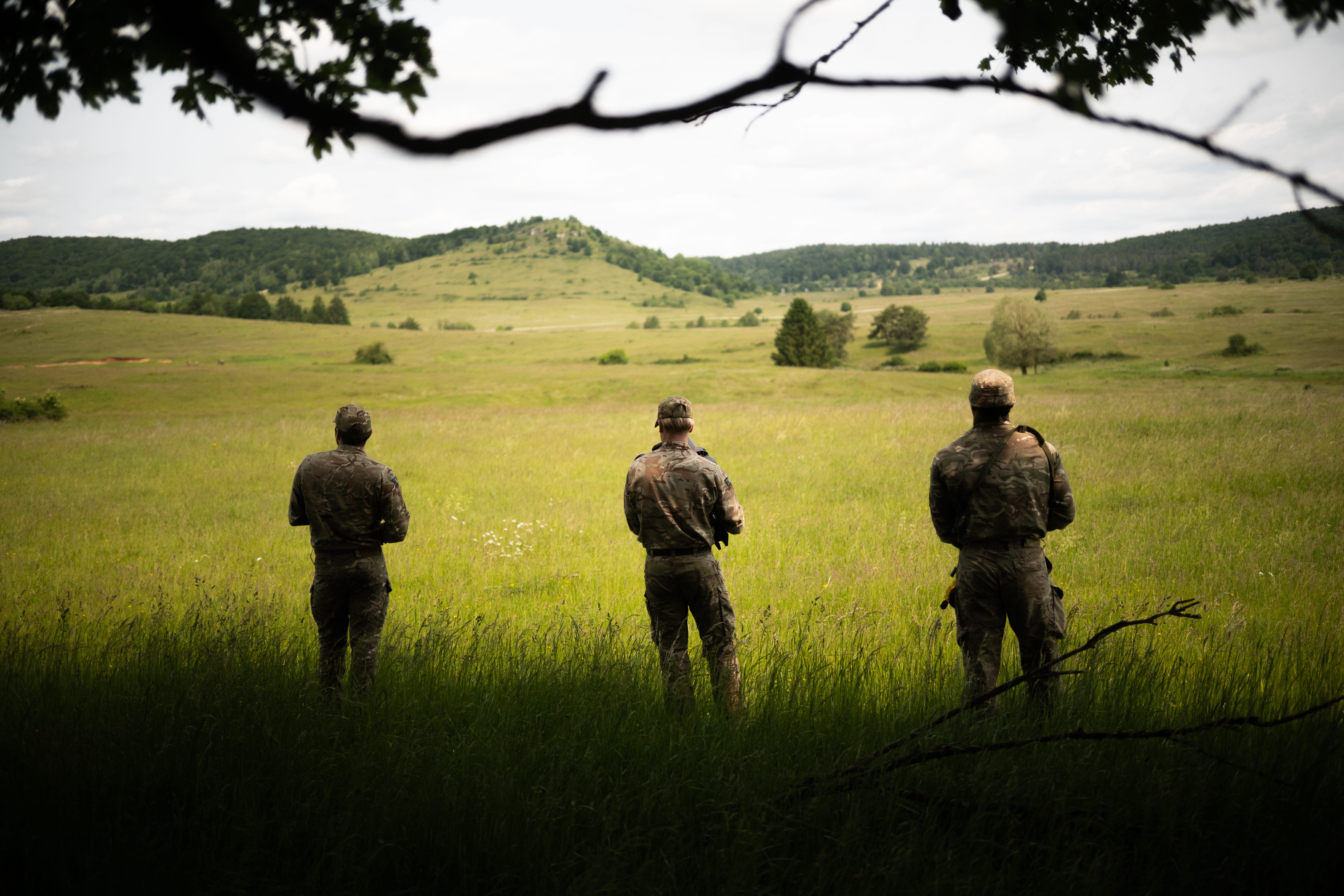
Let’s take a fresh look at some old news:
In late February 2024, a group of German Luftwaffe officers held a sensitive operational discussion over Webex. You know… Webex, the conference-call equivalent of off-brand cereal in a plastic bag. It works, technically, but nobody involved feels respected.
This time, Russian intelligence was listening.
The 38-minute recording, passed directly to RT editor-in-chief Margarita Simonyan and released on Telegram, was confirmed authentic by Germany. And buried inside the predictable Kremlin propaganda response (Dmitry Peskov breathlessly announcing it proved the “direct involvement of the collective west”) was something worth examining seriously.
Luftwaffe chief Lt. Gen. Ingo Gerhartz, discussing how Britain supports Ukraine’s Storm Shadow employment, said this: “They do it completely in reachback. They also have a few people on the ground.”
Six words. A few people on the ground.
Not an admission of war. Not proof of SAS operators personally selecting Russian targets from a bunker in Zaporizhzhia. But also not nothing.
What “On the Ground” Actually Means in a Modern War
Let’s slow our roll, because sloppy framing does real damage.
The Kremlin wants you to picture British commandos sitting at a terminal in Ukraine, personally authorizing missile strikes on Russian soil. That framing serves Moscow’s narrative that NATO is a co-belligerent and that Russia is justified in whatever escalatory response it dreams up next.
The British government’s preferred framing, reinforced by a decades-old policy of neither confirming nor denying special forces operations, is essentially: please disperse, nothing to see here, move along, as the fireworks factory explodes in the background like that scene from Naked Gun:
Former junior defense minister Tobias Ellwood told the BBC the leak was embarrassing to Berlin, while implying Russia probably already knew about any British presence anyway given the depth of its espionage activities.
Both framings are evasions.
As my paternal grandpa used to say, as he was guarding German POWs in Texas as a military police officer, “there are two sides to every story… then there’s the actual truth.” The honest picture sits in between, and it’s actually more strategically significant than either cartoon version.
Modern long-range strike employment, the kind that puts Storm Shadow warheads on Russian logistics nodes 150 miles behind the front, is not a simple pull-the-trigger operation.
It’s a kill chain. And that chain includes target development, intelligence fusion, route planning, electronic warfare assessment, collateral damage review, mission data preparation, and weapons-system integration.
A British officer who spent years working in RAF strike mission planning, now advising Ukraine on how to run that same process for a weapon the UK donated, is doing operationally decisive work from a room that might be in Kyiv or might be in Buckinghamshire.
Gerhartz’s word, “reachback,” is important. Reachback describes how deployed forces draw on rear-echelon expertise and systems. But he immediately followed it by saying the British approach also includes people on the ground. Which implies two simultaneous lines of effort: remote support and in-country presence.
That’s a senior NATO air commander describing a layered support architecture.
The Evidence Ladder
Let’s walk through what’s actually confirmed, what’s strongly indicated, and what remains in the fog.
Confirmed:
The UK ran Operation Orbital from 2015 to February 2022, training Ukrainian forces inside Ukraine. After Russia’s full-scale invasion, that mission shifted to Operation Interflex on British soil, which by June 2025 had trained more than 56,000 Ukrainian soldiers.
Billions in military support have followed. The UK government has publicly acknowledged a small number of defense personnel remain in Ukraine for “capability development” work.
That last point became tragically concrete on December 9, 2025, when Lance Corporal George Hooley died in Ukraine. The Ministry of Defense confirmed Hooley was a serving British soldier observing Ukrainian forces test a new defensive capability, specifically, a drone system, away from the front lines.
