Canada Announces HUGE Armored Vehicle Package for Ukraine
Over 400 armored vehicles heading east!
I know, I know. My newsletter is starting to feel like a Canadian news site recently; I say that because Canada has been the focus of a lot of my topics over the past month or so.
Let’s recalibrate for my newer subscribers: Generally, one country doesn’t dominate the news cycle here. This is a military technology newsletter first, with a heavy focus on Europe and North America, and moderate anti-authoritarian undertones. Clearly, Ukraine is the center of gravity at the moment, and I won’t stop covering them until they win.
As the newsletter continues to grow, I plan to handpick some more diverse writers to contribute to the paid newsletter side of Eyes Only to ensure that my paying subscribers are getting their ‘bang for the buck.’
Finally, after all of this Canadian news, Mark Carney better make me an honorary Canadian citizen. Just saying.
Okay, enough throat clearing… What’s this about Canada, ehh?
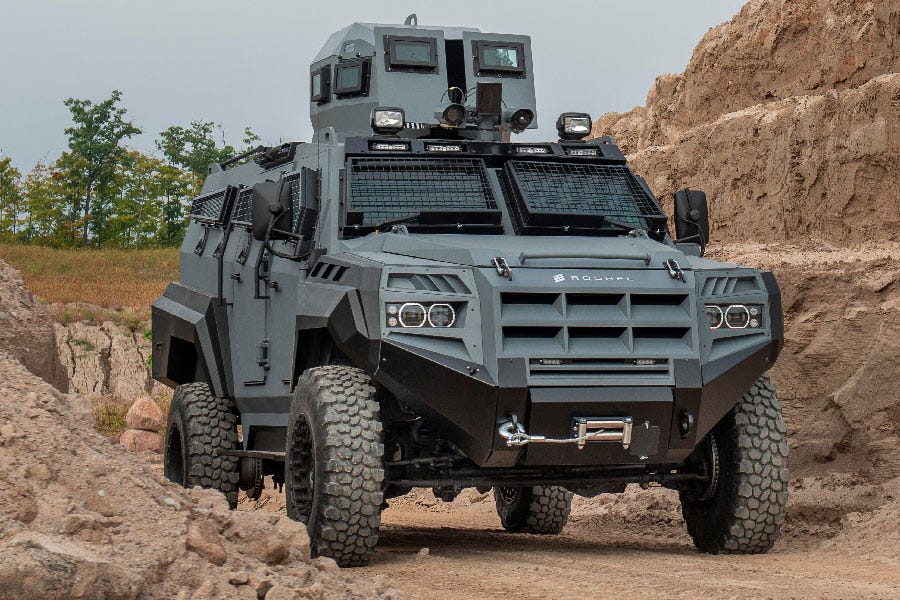
Canada just announced what amounts to a protected-mobility surge for Ukraine, and the center of gravity in the package is a number that should make Russian drone operators groan out loud: 383 Roshel Senator armored vehicles, bundled inside a broader “over 400” vehicle donation that also includes 66 LAV 6s!
Of course, this incredible news dropped right in the middle of my Bar exam, when I had no comms with the outside world, so I had to sit on it until I got back home. (It’s hard to explain, but there is an urgency for writers and YouTube creators like me to be the “first” to publish. But that’s just my ego talking.)
In reality, my defense colleague and LinkedIn buddy Dylan Malyasov over at Defense Blog moved fast on the story, and Ottawa followed with official language that confirms the scale.
Reuters, meanwhile, framed the week’s announcements in the larger financial package: Canada is providing C$300 million in new military aid as part of a previously announced C$2 billion envelope, and it’s adding sanctions on 100 vessels tied to Russia’s shadow fleet.
Boom shaka laka!
If you want the tactical translation, it’s this: more Ukrainian soldiers will move in armored trucks instead of in pickup beds. More wounded will get pulled out in something with blast protection instead of in a minivan. More units will have the ability to relocate under drone threat without treating every road as a potential obituary.
That may sound mundane. But it is exactly why it matters.
This war has turned “getting there alive” into a primary combat function. Both sides have built an entire industrial habit around punishing movement: FPVs on roads, mines on likely routes, artillery on intersections, and drone reconnaissance to cue strikes.
Ukraine’s answer has been layered defenses, deception, dispersion, and a constant hunt for more protected mobility.
Canada’s latest package, and why it’s shaped this way
The Canadian government’s own release is unusually specific for wartime aid language. It explicitly names the “383 Senator Armored Vehicles (Roshel)” and “66 Light Armored Vehicles 6s (General Dynamics)” inside the “over 400” total. That matters because it tells you Ottawa is leaning into two very different layers of mobility.
Interestingly, after my last video about Roshel’s donation to Ukraine, Roshel’s CEO Roman Shimonov connected with me on LinkedIn to keep the door open about the future of the company. By the way, I love media-savvy CEOs; they recognize that one of the fastest ways into the public sphere isn’t an email to the director of PR and a press release. Instead, it’s having defense folks like me and Dylan Malyasov on LinkedIn speed dial.
Anyways, it wasn’t just the Senators…
The LAV 6 is a true armored fighting vehicle family, heavier and more capable in the classic mechanized sense. The Senator is the other end of the tool kit: a mass-producible, wheeled armored workhorse that can be spread across units quickly.
The LAV 6 is the fourth generation of the Light Armored Vehicle (LAV) family of armored personnel carriers, and is based on the LAV III.

This matches how Ukraine actually fights. Not every unit needs a Bradley IFV. Every unit needs something that can move people and supplies without losing half its passengers to a mine and an FPV combo.
This also fits Canada’s broader posture: money and sanctions, plus equipment that Ukraine can field quickly. Reuters notes the C$300 million new military aid and the shadow fleet sanctions, which are part of a wider Canadian support line. If you’re trying to make Russia bleed economically while also making Ukrainian logistics harder to kill, this is a coherent package.
Right now, there’s no public, official delivery schedule for the 383 Senators (or the 66 LAV 6s).
Canada’s announcement confirms the donation and the quantities, but it does not give a “by X date” timeline.
What we can infer, carefully, is that these kinds of vehicle donations usually arrive in tranches over months, depending on production slots, refurbishment (if applicable), transport routing, and handover logistics.
That’s consistent with how Canada handled its earlier Senator donation, where a 200-vehicle order was expected to be delivered by summer of that year.
If Roshel gets back to me with more information on this, I’ll update the article.
So, Canada didn’t just discover Roshel this week. Ottawa has been feeding Senators into Ukraine for years, starting with small numbers and scaling up as the vehicle proved itself and as the war’s drone-and-mine reality became the defining threat.
Canada’s Department of National Defense has a public ledger of its military support. In that list, Canada notes it donated eight Roshel armored vehicles delivered in May 2022, then later donated 200 additional Senator vehicles announced January 18, 2023. That 2023 announcement, made during a ministerial visit to Kyiv, framed the 200 as responding to a specific Ukrainian request and pegged the package value at over $90 million CAD.
That was the official Canadian channel.
The other channel has been global procurement and partner financing. Roshel’s CEO has said the company has delivered more than 2,000 Senator vehicles to Ukraine since the full-scale invasion began, a number echoed in multiple defense outlets.
The implication is blunt: Canada’s direct donations are a minority of the total fleet, while the overall Senator pipeline has become one of the largest single sources of protected mobility in Ukrainian service.
That matters for two reasons.
First, it explains why “another 383” is not a drop in the bucket. It’s a deliberate decision to keep feeding a platform that Ukraine already knows how to operate, maintain, and integrate into units.
You don’t introduce complexity for FUNSIES in wartime. You reinforce what works.
Second, it shows how war production actually scales now. It’s not only “aid.” It’s a hybrid of state funding, direct procurement, and industrial ramp-up anchored in a proven vehicle line.
Okay, so since we’re all tech nerds here (I presume), what is the Roshel Senator, exactly?
Roshel sells more than one Senator variant. That’s where casual reporting gets sloppy, because people use “Senator” the way people say “Jeep.”
Ukraine has used both the APC-style Senator and the MRAP-style Senator, and the geometry differences matter.
The Senator APC, described as a multi-purpose vehicle, is a 4x4 platform with a 6.7L diesel V8 producing 330 horsepower and 750 lb-ft of torque, paired with a 10-speed automatic transmission. It has seating for up to 12.
The Senator MRAP lists the same engine and drivetrain figures, seating up to 10.
This is a heavy-duty, commercial-rooted armored platform, optimized for the most common and most lethal threats in this war: fragments, small arms, mines, and drones.
Protection is the entire point, and the Senator is designed around it.
Defense industry press has also described the Senator MRAP passing NATO-level ballistic and blast testing, with specific references to STANAG 4569 and blast test weights, including 6 kg under-wheel and under-body scenarios, which is the MRAP world’s baseline vocabulary.
Ukraine’s war has introduced variables that no STANAG table fully captures: FPVs that strike at odd angles, tandem charges improvised in garages, mines stacked or placed in unpredictable patterns, and artillery fragments raining down in volumes that overwhelm any vehicle if the crew sits still long enough.
That’s why the best evidence of the Senator’s utility is not a certification line. It’s repeated battlefield use, and repeated survivability anecdotes that keep coming out of Ukraine.
A platform doesn’t become “one of the most numerous armored mobility assets” in a war zone by being the polite Canadian trope. It becomes numerous because units keep asking for it, and because the people inside keep living long enough to request another one. Roshel’s CEO saying “more than 2,000 delivered” is the scale indicator.
You don’t need to memorize the STANAG codes to understand the operational meaning. A Senator is built to get hit and keep the people inside alive.
In Ukraine, that translates into a vehicle that may be knocked out, burned, or crippled, yet still does its primary job: it keeps bodies from becoming statistics.
This is why it keeps showing up in the ugliest kinds of videos.

How Ukraine has used Senators, and why they want more
Ukraine doesn’t use the Senator as a front-line assault vehicle in the classic sense. It uses it the way a modern army uses protected mobility when drones dominate the air and artillery dominates the earth.
It uses it for troop movement between positions where visibility is high and time exposed is deadly.
It uses it for logistics runs, because drones don’t care whether you’re delivering ammo or bread. They only care that you’re on a road.
It uses it for medevac, both formal and improvised, because the “golden hour” has been getting strangled in drone-saturated zones.
It uses it for special units that need a vehicle that can absorb punishment and still move.
That last piece is not theory. Roshel’s CEO has publicly highlighted footage from Ukraine showing a Senator taking a drone strike and continuing to move long enough for the occupants to dismount safely.
Independent reporting has also highlighted a Senator surviving a mine blast badly enough to lose a wheel and still moving to evacuate soldiers, which is an image you can’t buy with marketing spend on Meta’s ad platform.
This is the Senator’s war in a nutshell. It is not about being indestructible. It is about buying seconds and preserving lives.
But, Ukraine’s problem is not only enemy fire. It’s the geometry of exposure.
Every time a unit moves, it creates a signature. Thermal, visual, electronic, pattern-of-life. Drones spot. Artillery and FPVs punish. Mines finish the job.
The Senator’s value is that it raises the threshold for the enemy’s “easy kill.”
A soft-skinned truck that hits a mine turns into a mass casualty event.
A Senator that hits a mine becomes a recovery problem and a mobility problem. That is still awful. But it’s also the difference between a platoon being combat ineffective and a platoon being angry, shaken, and still alive.
The mine story is worth lingering on because it shows exactly what the Senator is built for. Ukraine has documented incidents where Senators hit mines and the occupants survive. There is public reporting and widely circulated footage around PTM-3 mine strikes involving Senators, with crews dismounting and surviving.
Here’s my video on that blast from last year:
If you’ve ever driven roads under threat, you know mines are psychological warfare as much as physical. They make every movement feel like a coin toss. Protected mobility is how you weigh that coin slightly back in your favor; to land more frequently on heads than tails.
Readers see “383” and “400” and mentally file it under “aid headline.” The battlefield reads it differently.
A few dozen armored vehicles can equip a few key units.
Hundreds reshape an army’s daily habits.
At scale, protected mobility changes how you hold ground, how you rotate, and how you recover. It lets commanders move people in daylight more often. It lets logistics run with less improvisation. It lets medics plan evacuation routes with something sturdier than optimism.
It also changes morale.
That sounds soft, yet it’s not. Soldiers who believe they have a chance to survive movement fight differently. They make better decisions. They take less stupid risks out of fatalism. In a war where drones punish hesitation and panic equally, that matters.
The strengths are clear. Wheeled platforms are fast, simpler to maintain, and easier to field in large numbers. Commercial-rooted drivetrains mean parts availability is better than for exotic military-only designs.
The vehicle can be produced quickly, and production can be scaled, which is why Ukraine ended up with the Senator in the first place.
Roshel’s own specs, with common engine/transmission packages and consistent dimensions, reinforce that this is a standardized product, not a bespoke unicorn.
The limits are also clear.
This is not a tank with a cannon and heavy armor. It is vulnerable to anti-armor weapons, heavy artillery hits, and the kind of close-range FPV strikes that can place a shaped charge precisely where it hurts most. It is also constrained by terrain in the way all wheeled vehicles are, especially when the battlefield becomes mud season.
So why do they work anyway?
Because the Senator is fighting the most common threats, not the most cinematic ones.
Most casualties in this war come from drones, artillery, mines, more drones, and fragments. A vehicle that raises survivability against those hazards pays for itself in preserved manpower.
In 2026, Ukraine’s job is to keep fighting a war of attrition while also building a force that can survive the next phase of Russian adaptation.
Russia keeps pushing drones down the cost curve. Ukraine keeps pushing survivability up the curve. Those two lines meet on roads, in trenches, and at medevac points.
A few hundred more Senators won’t win the war.
But they will reduce the number of avoidable deaths.
They will improve unit mobility under threat.
They will let Ukraine keep its manpower, which is a strategic resource in a country fighting for survival.
And they send a message, too.
Canada is building a pipeline of tangible equipment that shows up on the front, gets filmed, gets hit, and still does its job. In a war where propaganda is constant, the most persuasive argument is a vehicle that survives long enough for the crew to walk away.
That’s the Roshel Senator story in one sentence: it’s a machine built for the ugly middle of war, where movement kills, and surviving movement is a form of combat power.
Put that on your next brochure, Roman. “Buying Seconds. Preserving Lives.”
Thanks for reading, friends. For those of you interested in how I fared on the bar exam, I’m writing that article immediately after I publish this one… suffice-it-to-say, I have some sarcastic thoughts and I want to talk about it while it’s fresh.
Stay frosty.
Слава Україні!


Thank you for frequently underlining Canada's contribution and its approach that seems very specific in the way it targets areas that can help fighters fight safer and more comfortably. The first 8 Roshel armoured vehicles were no doubt a test and more kept being sent as Ukrainian fighters appreciate them. The same with many other pieces of equipment Canada continuously provides to Ukraine, apparently mundane things like Canadian winter uniforms and clothing including socks, gloves and boots both for frozen and wet winter conditions and now newly redesigned uniforms and protective equipment for women soldiers. Things that can make a difference in confidence, the ability to fight and survivability, as you mention.
https://www.canada.ca/en/department-national-defence/campaigns/canadian-military-support-to-ukraine.html
Thanks for this excellent article. When inundated with so much news/propaganda, it’s so difficult for a military novice like myself to know when an announcement is real or just performative. So glad in this case your enthusiasm lets me know Canada is on the right track with its support to Ukraine.