Canada’s Gripen Temptation Is About Control, Not Just Fighters
Ottawa was supposed to buy 88 F-35s. Now it's reportedly looking at keeping 30 and buying 60 Swedish Gripens instead.
Inside a Lockheed Martin conference room somewhere in Bethesda, Maryland, two executives stare at a Canadian procurement briefing with abject horror visible on their faces.
“Tell me again how we lost part of an F-35 order to Sweden,” the first executive said.
“We didn’t lose it to Sweden,” the second executive muttered. “We lost it to Swedish aircraft, Canadian jobs, industrial sovereignty, Arctic security, and whatever the hell ‘strategic autonomy’ means.”
In the corner, a junior McKinsey consultant starts furiously flipping through a dictionary.
The first executive rubbed his temples. “So Sweden.”
“Basically Sweden.”
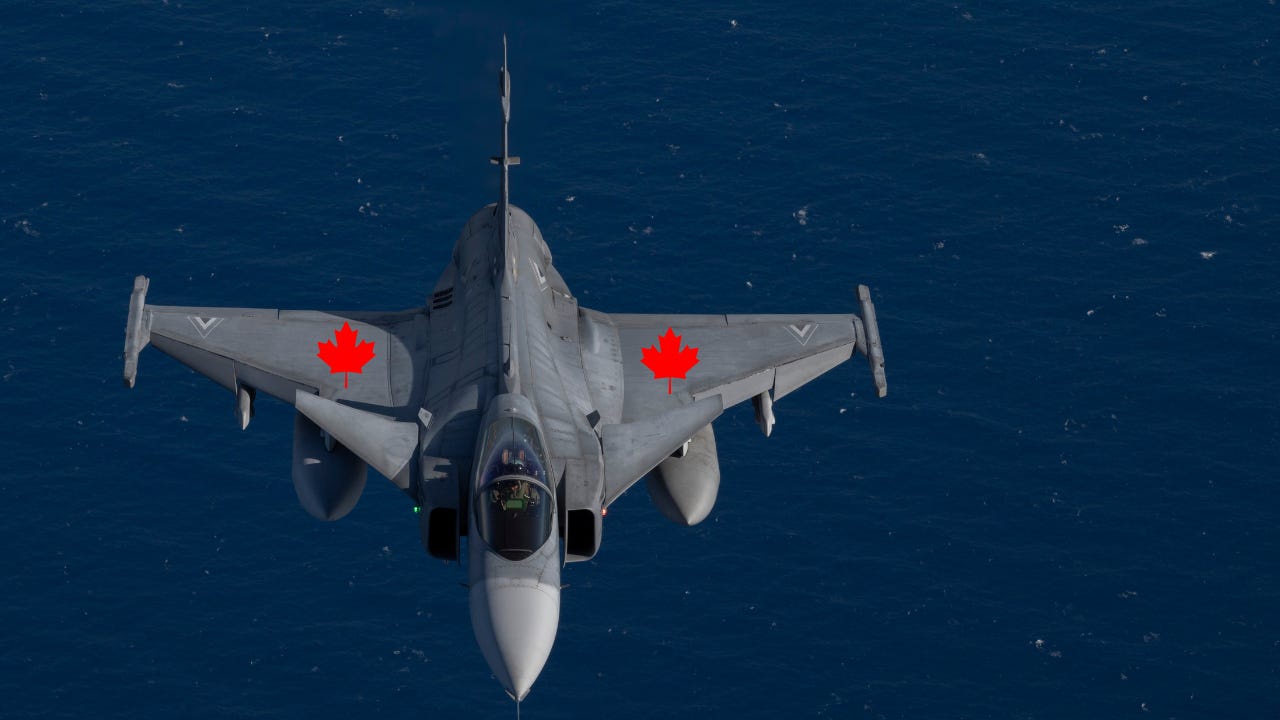
On the screen was a photo of the Saab Gripen E, looking mean, small, practical, and irritatingly affordable. Next to it was a list of Canadian industrial benefits long enough to require its own air defense system.
“Canada was supposed to buy eighty-eight F-35s,” the first executive said. “Eighty. Eight. That’s a beautiful number. That’s a production-line number. That’s a shareholders-call number.”
“And now?” the second executive asked.
“Now Ottawa is apparently flirting with keeping thirty F-35s and buying Gripens for the rest.”
The room went quiet in the way defense contractors go quiet when billions of greenbacks get dumped into an active volcano.
The second executive looked down at his notes. “We need to send a delegation north. Collins! Didn’t you just get back from holiday in St. John’s, Newfoundland?”
From the far end of the table, Collins straightened. “Uh, yes sir. Their ridiculous painted houses drove me nuts.”
“I agree, every home should be monotone and builder-grade,” the second executive said. “But that’s not the point. You have the most experience with them. I assume you speak Canadian?”
“Sir, I think they speak English… Mostly. Occasionally French for some reason?” Collins hesitated. “So you want me to go to Ottawa?”
“To wherever Stephen Fuhr is having lunch.”
“The defense procurement guy?”
“The defense procurement guy. Or better yet, that a-hole McGuinty.”
The first executive leaned back. “Fine. We wine him. We dine him. We explain fifth-generation sensor fusion. We say ‘NORAD interoperability’ until his fucking head explodes.”
“We bring charts?” Collins offered.
“Of course we bring charts, Jesus Collins, I know you’re a Yale man but try to keep up!” the first executive yelled. “We’re Lockheed. We don’t enter a room unless there’s a graph and a retired two-star general within arm’s reach.”
And if that doesn’t work?” Collins asked.
The first executive sighed. “Then we remind them the F-35 is still the best aircraft for high-end combat, stealth penetration, and integrated allied air operations.”
“That sounds reasonable,” Collins said.
“I know. That’s how desperate we are.”
Collins glanced at another slide, this one showing Saab’s promise of Canadian assembly, sovereign maintenance, local software work, and jobs in Quebec.
“I just had a thought… Saab’s not just selling a fighter,” he said.
“No,” the first executive cut him off. “They’re selling a national aerospace strategy with wings. Bastards brought a factory to a knife fight.”
Another pause.
“Should we call the White House?” Collins asked.
The first executive stared at him. “The White House is why we’re in this shit show.”
“Right.”
“From now on, nobody in this building says ‘51st state’ within earshot of a Canadian, a microphone, a trade delegation, or Ryan Reynolds.”
“That includes the president?” Collins asked.
The first executive picked up his mocha Frappuccino horchata and looked back at the Gripen slide.
“Especially the president. And for God’s sake, somebody hide the Greenland binder before Denmark buys Rafales.”
Canada was supposed to buy 88 F-35As.
Nice clean number. Very NATO. Very Lockheed.
Now, according to a May 30 report in La Presse that’s been picked up across the defense press, Ottawa is reportedly leaning toward something messier and far more interesting: keep roughly 30 F-35As, and replace the rest of the planned fleet with about 60 Saab Gripen E fighters.
A split buy. A mixed fleet.
Sources cited in the reporting say support for exactly that outcome has been growing inside the Canadian government, with an official announcement possibly held until after the US midterm elections in November 2026.
Current polling shows Trump on track to be defanged and declawed in the midterms. Delicious.
But before anyone fires up the “Gripen beats F-35” Stephenie Meyer fan fiction, let me be clear about something.
The F-35 is the better aircraft for penetrating defended airspace. It isn’t close. When Canada ran its original fighter competition, the F-35 scored 57.1 out of 60 points, a 95 percent.
The Gripen E/F scored 19.8, a 33 percent.
By the actual evaluation criteria the Royal Canadian Air Force used, the F-35 lapped the field.
So why is Ottawa reconsidering an aircraft it scored at one-third the value of the winner?
Because Canada doesn’t have a fighter problem; it has a sovereignty problem.
Canada has to defend the northern approaches to North America alongside the United States, intercept long-range Russian aviation probing the Arctic, and plug into the integrated air-defense system that covers the continent.
The United States will tell you this mission demands stealth, sensor fusion, and deep interoperability with the US Air Force, which flies the F-35 as the backbone of its Alaska-based air defense.
If stealth is the primary requirement, the Gripen is disqualified by default.
I think we could have a lively discussion about NORAD operations and how important stealth is in the defensive role, but that’s not this article. Suffice-it-to-say, it’s debatable. Stealth is largely an offensive capability.
The F-35 is built for the ugly part of airpower: penetrating contested airspace, surviving advanced radar networks, finding targets, and sharing that picture with everyone else. That’s offensive counterair and strike territory.
NORAD defense is a different animal. Canada’s main job is not to sneak into Russian airspace every Tuesday. It’s to detect, intercept, identify, and if necessary, destroy aircraft and missiles approaching North America.
For that mission, stealth helps, but it isn’t the center of gravity. The center of gravity is the sensor network, the tanker plan, the runway plan, the missile loadout, the command-and-control architecture, and the number of fighters Canada can actually keep flying.
Physics still matters. So does the maintenance bill.
But Canada needs at least some F-35s, or risk NATO expeditionary credibility. When Canada deploys fighters to Europe to reassure allies and deter Russia, those aircraft have to survive in modern, heavily defended airspace and operate seamlessly with allied air forces.
Stealth matters here. So does being inside the F-35’s shared data ecosystem, which is increasingly the connective tissue of allied air power.
But the biggest issue here has nothing to do with which plane is better… Canada wants, no, deserves, industrial sovereignty. Canada deserves more domestic defense work, more control over its own technology, and dramatically less dependence on a southern neighbor whose trade policy lately has the consistency of a Game of Thrones character arc after season six.
For decades, roughly 75 percent of Canadian defense procurement spending has flowed to American suppliers.
Canada’s new defense industrial strategy reportedly wants to flip that, targeting something like 70 percent Canadian content in future contracts and nearly half a trillion Canadian dollars in defense investment over the next decade. Good. I’m American and I have no problem with this.
That’s the tension the whole debate runs on. The F-35 is the aircraft Canada wants when things get ugly. The Gripen may be the aircraft Canada wants when things get expensive, political, and Canadian.
Be Fair to the F-35
Let me spend a section defending the airplane Canada is thinking about buying less of, because the case is real and I don’t want to wave it away.
The F-35’s stealth is the difference between flying into a modern integrated air-defense system and flying into a modern integrated air-defense system and coming back.
It brings sensor fusion that turns a pilot from a person reading six gauges into a person reading one coherent picture.
It brings electronic warfare, allied data-sharing, and integration with the US-led fifth-generation combat network that no fourth-generation fighter, however good, can fully replicate.
The Gripen E is an excellent aircraft. It’s my personal favorite 4.5th generation fighter actually. But it’s not a stealth aircraft, and on the hardest nights, that gap is the whole game.
Also, Canada has also already sunk years and billions into the Joint Strike Fighter program: infrastructure, training pipelines, sustainment prep, program participation.

Walking away entirely would create legal, industrial, and diplomatic headaches that range from expensive to genuinely dangerous. The US ambassador to Canada warned earlier this year that backing out of the F-35 deal could put the NORAD partnership itself at risk, even floating the idea that the US might need to fly its own fighters in Canadian airspace to cover the gap.
This was so shocking at the time, I had to make a video about it. The US was basically saying, “buy the Gripen and we’ll operate over your airspace with impunity, without permission, and there’s nothing you can do to stop us.”
Sounds like war to me. But let’s burn that bridge when we come to it.
Look, Trump is not going to be in power forever. At some point, the US will presumably have a leader again who recognizes the amazing value of having allies. Maybe that future mystery leader should give Canada Michigan’s upper peninsula as a sign of good faith; it’s practically Canada anyways. (But you can’t have Mackinac Island; that’s mine.)
But here’s the nuance that makes the split buy possible. Canada is legally committed only to the first 16 F-35As, the ones already in production with deliveries starting this year.
The remaining 72 aircraft of the planned 88 were never covered by a signed production contract. Public perception says Canada bought 88 jets. The contract says Canada bought 16 and reserved the right to buy more.
That distinction is the entire escape hatch, baby.
Canada doesn’t have to cancel the F-35. It just has to stop at 30. Wham, bam, thank you ma’am. Bob’s you’re uncle.
The Gripen’s Actual Pitch: Sovereignty Per Flight Hour
So, what does the Gripen bring that keeps pulling it back into the conversation despite that brutal test score?
Long distances. Brutal weather. Thin infrastructure. Forward bases scattered across an Arctic that’s getting more contested every year.
The Gripen E was designed by a country, Sweden, that spent the Cold War assuming its airbases would be bombed in the first hour of any war, so it built a fighter that could operate lean and dispersed.
It’s almost as if the Gripen E was custom made just for Canada’s terrain and mission set.
It can fly from road bases as short as 800 meters. It can be turned around for another air-to-air sortie in roughly ten minutes by a small ground crew, including conscripts if needed. And Saab estimates operating costs somewhere around 7,000 to 10,000 US dollars per flight hour, a small fraction of common F-35A estimates.
It’s not a toy, either. The Gripen E carries the Meteor long-range air-to-air missile, IRIS-T, AMRAAM, the Taurus cruise missile, and a full range of precision-guided munitions.
For air policing, Arctic defense, NATO support, and the daily grind of guarding sovereign airspace, that’s a serious combat capability at a price Canada can actually sustain across a large fleet.
Here… Copy and paste the following sentence into any American article’s comments section proclaiming the vast superiority of the F-35 for Canada:
“Canada’s geography punishes expensive aircraft, and the Gripen is the rare modern fighter that doesn’t punish back.” -Wes O’Donnell, 2026.
GlobalEye Changed the Political Weather
I’ve got a full YouTube video coming tomorrow (Wednesday, June 3) on Canada’s airborne early-warning decision, so I’ll keep this tight so I don’t undermine my views on that video.
The relevant point for the fighter debate is that Canada just chose Saab’s GlobalEye early-warning aircraft over Boeing’s E-7 Wedgetail, in a program worth more than five billion Canadian dollars, expected to create over 3,000 local jobs and built on a Canadian-made Bombardier Global 6500 airframe.
To be clear, Carney selected Saab as a “preferred supplier” and opened formal negotiations. In procurement terms that’s an engagement ring, not a marriage. No contract has been signed yet and defense deals have died at this stage before.
Still, Prime Minister Mark Carney framed the choice around Arctic defense, domestic production, and Canada taking more responsibility for its own northern approaches.
That decision did something a sexy Saab brochure never could. It made the company credible inside Canada’s defense-industrial conversation. Once Ottawa was willing to pick Saab for the eyes of its air-defense network, the idea of picking Saab for part of the teeth stopped sounding exotic.
GlobalEye opened the door. The Gripen is now standing in the hallway, pretending it wasn’t waiting there the whole time.
Not to mention the Gripen and GlobalEye work together like Starsky & Hutch.
Like Mork & Mindy.
Like Laverne & Shirley.
You get the point…
The Factory Might Matter More Than the Fighter
Here’s the heart of it.
Saab’s pitch to Canada isn’t really “buy our cool jet, bro.” It’s “build your aerospace future with us.”
The company’s “Built for Canada by Canadians” campaign offers domestic final assembly, sovereign maintenance, local software development, engineering work, broad technology transfer, and a Canadian research and development center.
Saab projects somewhere between 6,000 and 12,600 Canadian jobs over the life of the program.
That’s the political gravity well that’s bending this entire decision. It’s a gravity well so strong, it’s overcoming the pull of Canada south toward Washington DC.
Because Canada isn’t only asking which fighter flies better. By that measure, the review ended at 95 to 33 and everyone went home. Canada is asking a different question, one that doesn’t fit cleanly on a capability scorecard: which fighter leaves more Canadian capability behind once the contract is signed?
The F-35 leaves Canada as a sophisticated customer inside the most advanced air-combat ecosystem on Earth, with the supply chain and the software keys held in Fort Worth and Washington. The Gripen offers to leave behind a factory, an engineering base, and source-code-level control that Lockheed and the US government will never package into a foreign military sale.
Stealth is something you buy. Industry is something you keep.
Just to add to the Gripen conversation, Ukraine is now tied directly into Saab’s future production. Sweden and Ukraine have agreed that Ukraine will acquire 20 new Gripen E fighters, with 16 older Gripen C/D aircraft donated in 2027 and the new jets expected by 2030, on top of a previously signed letter of intent for up to 150 Gripen E aircraft over the long term.
The UK has already agreed to produce a meaningful share of the Gripen work tied to Ukraine under the Sweden deal.
Aviation Week reported that a Saab executive sees a possible role for Canadian industry in Ukraine’s Gripen acquisition, including the planned initial batch of up to 20 Gripen E/F fighters.
If Canada chooses the Gripen and builds the domestic production base Saab is offering, Canada wouldn’t just be buying fighters for the RCAF. It could become part of the long-term industrial pipeline arming Ukraine’s air force.
A Canadian fighter purchase that doubles as a production line feeding Ukraine’s rearmament is a genuinely different proposition than a standard procurement.
Somewhere in Ottawa, a procurement officer just felt a pang of patriotic excitement. In this sense, Donald J. Trump has done more for Canadian nationalism and pride than Celine Dion.
Canada’s fighter review was never just about replacing the CF-18. It’s deciding whether Canada wants to remain a customer inside someone else’s defense ecosystem or become a larger producer inside its own.
The F-35 keeps Canada plugged into the most advanced air-combat network on the planet.
The Gripen offers more Canadian control, a factory floor, and possibly a hand in arming Ukraine for the next decade.
After GlobalEye, that argument has teeth.
The Gripen would make it harder to dismiss as a one-off Swedish win.
It would signal that Canada is done treating defense procurement like a Best Buy loyalty program for US contractors. Ottawa still needs the F-35 for the hardest missions. But it may want the Gripen for something just as important: control.
Слава Україні!


As a middle power, Canada really doesn't need the offensive capability the F-35 promises. Operationally, the Grippen has more availability and lower maintenance requirements, and is simply better for Canadian requirements. A dual fleet of F35s and Grippens will allow us to to fulfill our NATO commitments, while keeping our limited defense budget in check, as we are simultaneously building out our destroyer and submarine fleets, while rebuilding our army requirements. Oh, and yes, we've had our fill of being a captive customer of the US defense industry.
And…the topping, is being in on the ground floor development of the NEXT generation of jets.