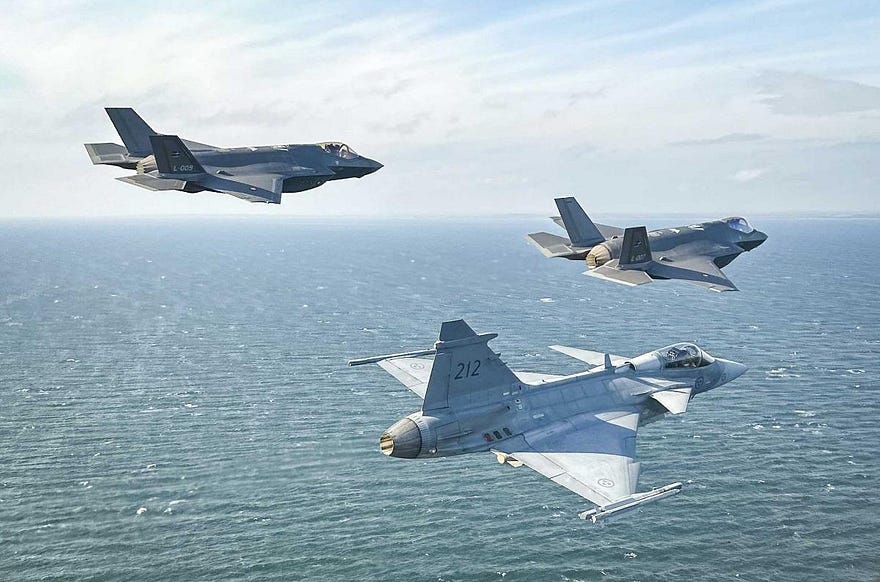
Canada's Mixed Fleet of F-35s and Gripens Would Actually Be a Big Advantage
'One fighter to rule them all' is a vulnerability

I know, I know… There are over 130 armed conflicts raging worldwide at this exact moment and I’ve been devoting a lot of ink to my Canadian neighbors to the north. But I find their reaction to Trump’s middle-school-bully-style of diplomacy fascinating.
I wrote recently about Canada reportedly weighing a split buy, keeping around 30 F-35s and adding roughly 60 Saab Gripens instead of the original all-F-35 order of 88.
Most of the commentary since then has focused on the fact that trying to maintain a mixed fleet of different aircraft is hard. And it is hard. But the hardness, ahem, is the easy part of the argument to make, which is probably why everyone keeps making it.
The more interesting case is the one almost nobody is putting on the table: a mixed fleet, under the right conditions, it’s a strategic advantage Canada should want.
If this were a video, I would do a spit take.
Wait, what! Why would Canada want to add complexity to the already herculean task of defending vast stretches of arctic land and the sea approaches around it!?
Well, let’s get into it…
The Critics Are Right About the Pain
I have to start by giving the critics their due, because they’re not wrong about the costs. A mixed fleet creates real, measurable problems.
Canada would need two pilot training pipelines, two maintainer pipelines, two simulator systems, two spare-parts inventories, two depot support models, two software support relationships, two technical cultures, and two long-term upgrade roadmaps. Every one of those is a cost, a complication, and a potential point of friction.
A small air force feels that pain far more acutely than a large one. News flash: The Royal Canadian Air Force is not the US Air Force. It cannot casually absorb complexity with 300 spare pilots, five extra wings, and a logistics apparatus large enough to qualify for its own seat at the UN.
For a force Canada’s size, splitting the fleet means splitting attention, splitting expertise, and splitting a budget that was already doing yoga to stretch far enough.
That’s the strongest argument for buying 88 F-35s and calling it a day. It’s clean. But here’s my problem with it. Clean is not the same thing as resilient.
Here’s the conceptual hinge of my whole argument:
Commonality is genuinely good when it reduces waste. Standardizing your bolts, your fuel, your radios, your training, all of that strips out cost and friction.
Nobody sane argues against “efficiency” as a principle.
But commonality crosses a line when it stops removing waste and starts removing alternatives. At that point it isn’t efficiency anymore. It’s monoculture.
Farmers understand this in their bones. A field planted with a single crop is the most efficient field you can plant. It’s also the field that one disease, one pest, one bad weather event, or one supply disruption can wipe out completely. Diversity in a field looks inefficient right up until the moment it’s the only reason you still have a harvest.
An air force has the same structure of risk. A single-type fleet is easier to run and concentrates every danger into one basket. The question Canada actually faces isn’t “is a mixed fleet more complicated?”
Obviously, it is. The real question is whether Canada wants every fighter it owns tied to the same airframe design, the same sustainment system, the same software ecosystem, the same foreign government, and the same political relationship.
That’s a lot of eggs in one big stealth basket. Commonality is wonderful, right up until the common part breaks.
So let me walk through the five specific ways it can break and then we’ll chat about how the Gripen and F-35 can actually work together like Ebony and Ivory, living together in perfect harmony.
Vulnerability One: The Grounding Event
Take it from an AWACS radar technician… Every aircraft type has technical problems.
That’s not an F-35 insult, it’s just what machines do. Aircraft occasionally discover novel and humiliating ways to break, and the more complex the aircraft, the more creative the failure.
At the risk of losing my immortal soul, we maintainers very much believed in a “machine god” who required blood sacrifices. Anytime one of us would bust our knuckles open or cut ourselves while working on the Sentry, it would magically start working flawlessly. I can’t explain it. A drop of blood and suddenly both radar chains, main and redundant, are fully-mission-capable. Weirdest shit I ever saw.
The thing that matters here is scale. If Canada flies one fighter type and a critical component triggers a fleet-wide grounding for inspections, the entire Canadian fighter force takes a knee at the same moment.
Sure, maybe it’s just for a few weeks. Maybe only certain production blocks. But in a crisis, a short pause can be exactly long enough to hurt, and crises do not schedule themselves around your maintenance calendar.
A mixed fleet doesn’t necessarily eliminate that risk, but it does compartmentalize it.
If the F-35 fleet gets grounded for ejection seat malfunctions, the Gripens keep flying quick-reaction alert, Arctic patrol, training, and homeland defense. If the Gripens hit a snag, the F-35s remain available for the high-end work.
Canada never has to watch its whole fighter force become a hangar display because someone found a fleet-wide defect in the oxygen supply hose on a Friday.
A single fleet fails together. A mixed fleet fails in compartments. That’s the entire argument in one line, and everything else is just elaboration.

Vulnerability Two: Sustainment and Spare Parts
Not going to sugar-coat it… The F-35 is a brilliant stealth aircraft and sexy enough in the looks department to be my desktop wallpaper for the better part of four years.
Unfortunately, its sustainment record has been considerably less sexy. The program has wrestled for years with spare-parts shortages, repair backlogs, limited depot capacity, heavy contractor dependence, and mission-capable rates that have refused to match the Lockheed brochure.
That’s not a hit piece, despite what my hate mail says. It’s just the documented public record, and the US Government Accountability Office has written about it more than once.
For Canada, this collides with geography that already punishes aircraft availability.
Enormous distances. Brutal weather. Arctic operating demands. Thin northern infrastructure. A small fleet to begin with.
A second sustainment ecosystem is an insurance policy against that. The Gripen’s pitch was never that it out-F-35s the F-35. It doesn’t and it won’t.
The pitch is that it gives Canada a second, independent way to keep combat aircraft in the air, one that doesn’t run through the same global supply chain, the same prime contractor, the same engine pipeline, or the same foreign-controlled sustainment architecture.
What I find mildly amusing (and tragic) is the fact that Trump refused to, or rather was incapable of, giving any forethought to what insulting and threatening Canada would do to American companies who do business with Canada…
Did he believe that Canadians would take a knee and embrace becoming America’s 51st state? I doubt he thought that far ahead. But I guarantee he’s thinking about the consequences now because he’s likely getting phone calls from the many American CEOs whose interests he just shit on.
Vulnerability Three: Software Sovereignty
The F-35’s greatest strength is its integration of sensors, mission-data files, electronic warfare, datalinks, logistics, and deep ties into allied combat networks. That integration is exactly what makes it so formidable in a high-end fight.
It’s also exactly why dependence on it carries a hidden cost.
I’ve written about this in the past, but let me state it here: technically, the US does not have a so-called “kill switch” inside its export hardware. It doesn’t need one… Here’s why:
When an aircraft’s combat performance depends on mission-data files, regular software updates, encrypted systems, and a US-managed support structure, the operator gains access to a genuinely remarkable machine. The operator also accepts real limits on control. You’re flying it, but you don’t fully own the keys to it. The good ole, U, S of A doesn’t need a kill switch when it can just refuse to update your jet’s firmware.
For the hardest NATO missions, that trade is probably acceptable.
But should every single Canadian fighter depend on the same software pipeline and the same political ecosystem?
Saab is openly selling a different kind of relationship on the Gripen: more local maintenance, more domestic industrial participation, more control over upgrades, more room for national customization. My argument is not that Canada should abandon the American ecosystem. That would be strategically foolish given NORAD and geography.
My argument is narrower: Canada shouldn’t make the American ecosystem the only door into Canadian airpower. The F-35 gives Canada access to the best air-combat network on Earth. The Gripen gives Canada more room to hold its own wrench.
Vulnerability Four: Political Dependency
This one hits differently in 2026 than it would have a few years ago.
Canada’s fighter decision is happening during a period when US trade policy, NATO policy, and defense politics have all become, let’s say, noticeably less predictable.
Canada cannot relocate its geography. The United States will remain its most important defense partner whether Ottawa likes the current weather in that relationship or not.
But partnership and dependency are not the same word.
An all-F-35 fleet deepens Canadian reliance on the United States for sustainment, upgrades, training, weapons integration, software, parts, and the political permission structures around all of it. Most of the time, that works fine. The trouble is that “most of the time” is not the standard you use when you design a national defense. You design for the bad day, not the average one.
A Gripen fleet wouldn’t make Canada fully independent; the Gripen still has Western components, weapons dependencies, and even an engine with US lineage. We’re not talking about a magic Swedish sovereignty wand, here.
But what it would do is diversify the political risk: a Swedish industrial partner, a European supply relationship, a domestic Canadian production and maintenance path if Saab’s offer is accepted.
Coercion rarely looks like a dramatic kill switch. It looks like delayed approvals, slow-walked export licenses, spare-parts friction, and software bottlenecks that arrive precisely when you need the aircraft most. Canada doesn’t need to assume the United States will become an adversary. It only needs to notice that allies can become difficult suppliers when politics gets insanely stupid, as they did in 2025 and now 2026.
Vulnerability Five: Tactical Predictability
Okay, so this is the big one and I actually made the same case last year against the EU fielding the exact same APC across every country. In that case, it was the CV-90.
A single-type fleet hands an adversary one aircraft to study.
One radar signature family.
One electronic-warfare behavior set.
One tactics ecosystem.
One basing model.
One set of assumptions to build an entire counter-air plan around.
Nobody should pretend Russia can simply “solve” the F-35. But adversaries adapt over time. They build radar networks, passive detection systems, electronic-warfare libraries, infrared-search tactics, and missile-engagement doctrines around the specific aircraft they expect to face.
Give them one target to optimize against, and over years, surprise, surprise, they optimize.
A mixed fleet forces them to solve two problems at once. F-35s and Gripens present different signatures, different tactics, different basing models, different weapons loads, and different sortie rhythms.
The stealthy sensor-fusion aircraft for the hardest nights, and the dispersed, road-operable, fast-turnaround fighter for everything else. That makes Canada’s air force considerably less predictable.
An enemy can plan against one pattern. Two patterns make him work for it, and I’m generally in favor of making Russian planners work. It cuts into their vodka time.
Where They Stop Competing and Start Teaming
Here’s the part that almost never makes it into the mixed-fleet debate, because everyone gets stuck arguing about which aircraft is better and forgets to ask what they do together.
The F-35 and the Gripen, when paired correctly, form a hunter-killer team where each one covers the other’s biggest weakness. That’s the logic behind a concept militaries have been circling for years: pairing a stealthy fifth-generation sensor aircraft with a cheaper, heavily armed fourth-generation shooter.
The Air Force jargon for this is “high-low teaming.”
The idea is older than the jargon.
Start with each aircraft’s actual limitation. The F-35’s superpower is that it can go where nothing else can: penetrate defended airspace, stay nearly invisible, and build a detailed picture of the battlespace using sensors that would make a spy satellite slightly jealous.
Its weakness is the magazine. To stay stealthy, the F-35 carries its weapons internally, and internal space is finite. In a stealth configuration it’s carrying a modest number of air-to-air missiles. You can bolt more onto external pylons, but the moment you do, you’ve hung a bunch of radar-reflecting hardware off a stealth jet, which is a bit like sneaking into a building in a ghillie suit while dragging a wind chime.
The Gripen has the opposite profile. It isn’t stealthy but it’s a missile truck with a serious radar, a genuinely excellent electronic-warfare suite, and the ability to carry a heavy load of weapons externally, including the Meteor, whose effective reach is in a different class from the AMRAAM that most of the West has been flying for decades.
Now put them on the same team and watch Putin soil his big boy pants.
The F-35 pushes forward, quiet and unseen, and finds the enemy aircraft. It doesn’t necessarily have to fire. It passes the target track back to Gripens holding well behind it, outside the threat envelope. The Gripens launch Meteors using that targeting picture, from a distance, and the enemy suddenly has long-range missiles inbound from an aircraft it can see but that’s too far away to be the obvious threat, cued by an aircraft that’s much closer and nearly invisible.
The shooter and the sensor are two different planes, in two different places, and the enemy has to solve both problems at once while missiles are already in the air.
That arrangement fixes both weaknesses simultaneously. The F-35 gets the deep magazine it lacks, because the Gripens behind it are carrying a wall of Meteors. The Gripen gets the sensor reach and survivability it lacks, because the F-35 out front is doing the dangerous looking.
One aircraft brings the eyes. The other brings the fists. Neither is as lethal alone as the two are together.
But I’ll be honest about the catch, because there is one here. The deepest, stealthiest data-sharing the F-35 uses is a closed, US-controlled system designed for F-35-to-F-35 talk, and a Gripen isn’t getting full access to that.
Realistic Canadian teaming would run over Link 16, the common NATO datalink, which works fine but is more detectable than the F-35’s private channel. So the silent, perfect, invisible kill chain is more aspiration than current reality. But even the achievable version, F-35 as forward sensor feeding Gripens as the standoff arsenal over standard datalinks, is a genuinely potent combination, and it’s the kind of thing the RCAF could actually train into doctrine.
The US Air Force is already building this pairing out using their own F-15Es as the missile truck and the F-35 being the forward-deployed sensor.
There’s a quieter strategic benefit too, and it’s about preserving the expensive aircraft. F-35 airframe hours are precious and the sustainment is demanding. If Canada burns those limited hours on routine intercepts and Arctic patrols, it’s spending its most valuable and hardest-to-maintain asset on missions a Gripen could handle for a fraction of the cost. A mixed fleet lets Canada save the F-35 for the nights that require an F-35, and use the Gripen for everything else, which means that when the hard night finally comes, the stealth fleet is rested, available, and not halfway through a fatigue inspection.
You don’t ride your racehorse to the grocery store. You save her for race day.
And the electronic-warfare angle compounds it. The Gripen E was built around survival through electronic warfare rather than stealth, with a jamming and spoofing suite specifically designed to confuse the systems hunting it.
The F-35 brings its own EW strengths.
Operating together, the two present an enemy air-defense network with two completely different problems at the same time: a target it struggles to see at all, and a target it can see but that’s actively scrambling its sensors. Defeating either one is hard. Defeating both, simultaneously, from different directions, is the kind of problem that makes an air-defense commander reconsider his post-college choices.
So, the resilience argument I’ve been making isn’t only about what happens when one fleet gets grounded or one supplier gets difficult. It’s also that on the good days, when both fleets are flying, they’re worth more as a team than as two separate forces. The mixed fleet isn’t just insurance against the bad day. It’s a combat enhancer on the good one.
That’s the part the commonality crowd leaves off the slide.
The Catch: You Have to Do It Right, Canada
Far be it for me, an American sitting in Michigan, to lecture Canadians about the future of their own defense… But, I’m going to do it anyways because I have a platform: this only works with discipline, and you Canucks have to be honest about that going in.
The RCAF must create clear roles, F-35s for the high-end fight, Gripens for homeland defense, Arctic sovereignty, alert duty, and dispersed daily readiness, with no mission drift in either direction.
It needs common communications standards, shared data links where possible, compatible weapons where achievable, and a single command-and-control architecture so the two types fight as one air force rather than two tribes glaring at each other across the flight line.
And critically, it needs enough aircraft in each fleet to actually matter. A tiny boutique F-35 fleet paired with a tiny boutique Gripen fleet would hand Canada all of the complexity and none of the mass.
That’s the opposite of resilience. That’s procurement performance art, and it would give every defense analyst in Ottawa simultaneous acid reflux.
Done badly, a mixed fleet is the worst of both worlds. Done with discipline, it’s an air force that’s harder to ground, harder to coerce, harder to predict, and harder to knock out with a single problem.
So, the case for the mixed fleet was never that two aircraft are easier. They aren’t. The case is that Canada’s actual security problem isn’t easy either and matching a tidy solution to a messy problem is how you end up with something that looks great in the hangar and fails on the one day it counts.
Commonality is efficient in peacetime. Diversity is irritating in peacetime.
But in wartime, irritating has a funny way of looking a lot like foresight.
Stay frosty, Canada.
And as always, Слава Україні!


Wes - this is the most balanced, non- emotional piece on what we should be doing and why. I don’t think we were ever going to cancel the paid for F-35s. The current story making the rounds is an almost balanced fleet of Gripens and F-35s. Used as you suggest will give us real options and reduce our dependency for decades to come. Thanks for a thoughtful and candid essay.
Terrific analysis. Thanks Wes