


This article is one of three weekly exclusive articles for my paid subscribers. Thank you for continuing to fund independent military analysis with a moderate dose of pro-Ukrainian/ anti-authoritarian humor.
April 26, 1986.
April 26, 2026.
Forty years apart. And the same reactor is still in the news.
There’s a dark symmetry to the fact that, on the exact anniversary of the worst nuclear disaster in human history, we’re having a serious conversation about whether Russia is deliberately attacking Chernobyl and using the area as a flight corridor for hypersonic missiles.
While many are spending today holding memorials, reading retrospectives, and watching documentaries about liquidators who sacrificed their lives to contain the uncontainable, Ukraine’s chief state prosecutor is briefing Reuters about 35 Kinzhal missiles tracked flying within 12 miles of the Chernobyl site, and three of them falling within six miles of the Khmelnytskyi nuclear facility after malfunctioning mid-flight.
The cause of those failures? Unknown. The debris showed no signs of interception. They just... fell.
Russian junk.
Where We Left Off
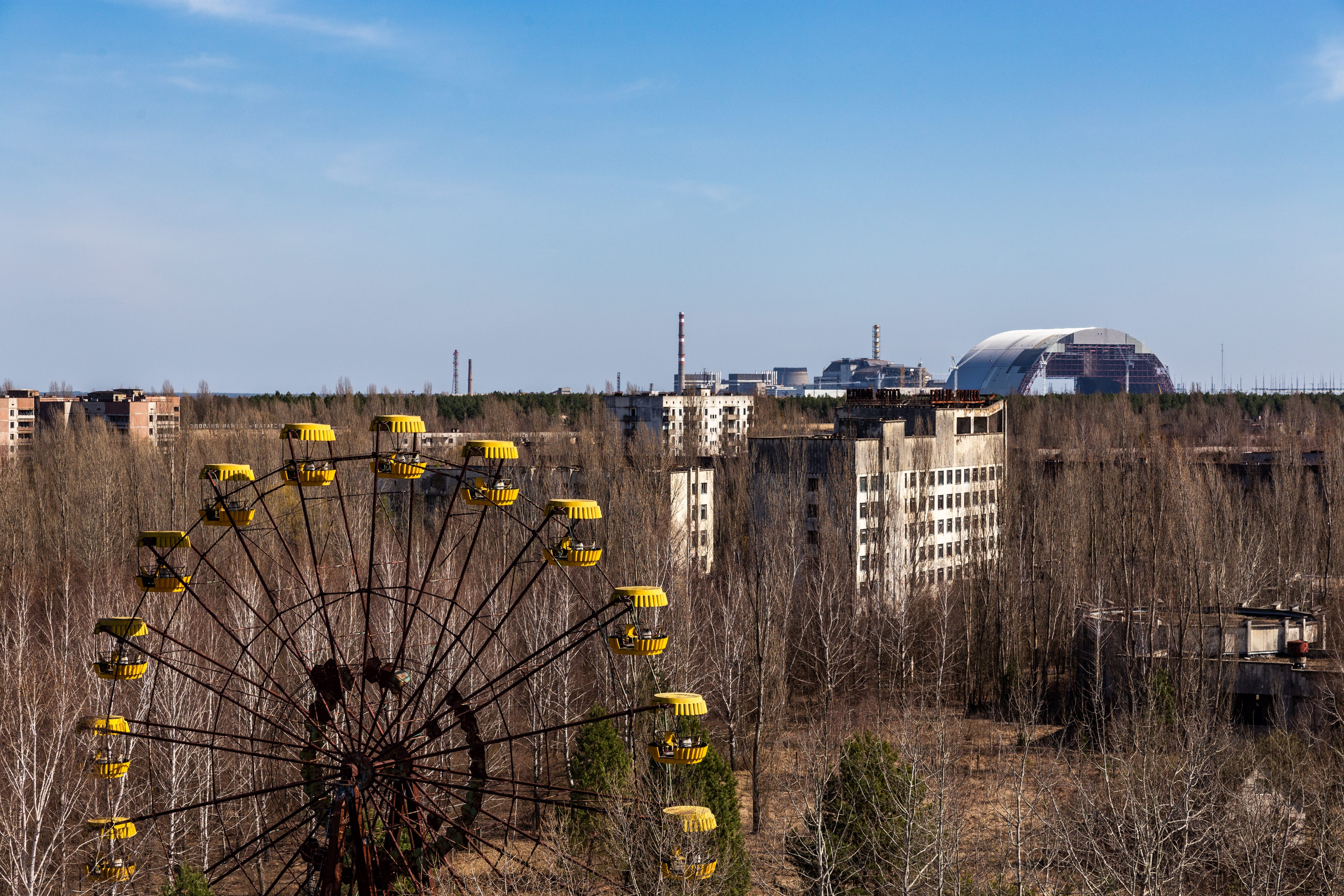
If you’re a long-time subscriber, you may remember my piece from May last year when a Russian kamikaze drone punched a hole through the New Safe Confinement; the $2 billion steel arch that sits over the radioactive ruins of Reactor 4, containing 200 tons of corium, graphite, and cesium-137.

The New Safe Confinement is a pressure-managed envelope; the interior is kept 5 to 8 pascals below outside atmospheric pressure so that any air movement flows inward, not outward.
Think of it as the same logic as a biohazard isolation ward. As long as the shell is unbroken, radioactive particulates stay inside.
Russia broke the shell.
A drone, slow-moving, GPS-guided, programmable, struck the arch, tore through both walls of its double-layered steel skin, ignited the waterproof insulation lining, and burned for nearly three weeks.
Emergency crews had to punch new holes into the structure to reach spreading fire. Every access point became a new potential escape route for radioactive dust.
The negative pressure differential? Gone. The containment logic? Compromised.
The question of the hour is this: Did Russia intentionally strike the New Safe Confinement structure? Or is the Russian military just incompetent?
I’ve struggled with this question since early 2023, when it became obvious that Russia was targeting civilian apartment complexes and other non-military targets.
So, they’re either world-class assholes or woefully unable to strike military targets at long range, (the best they can hope for is terror strikes against civilians).
I’ve since come to the conclusion that it’s actually both.
The Russian military, and the Muscovite culture more generally, have a lesser regard for human life than the West. One needs only look at the atrocities of Bucha to see that reality in all its horror.
But I also think that their kill chain is fundamentally broken; specifically, the Russian military’s ability to find, fix, and track military targets that are on the move. There are a few reasons for this, but they mostly come back to a half-functioning ISR capability. They don’t fly AWACS in Ukraine, obviously, and their poor-quality satellite ISR is delayed by up to 72 hours; by the time they have targeting coordinates, the Ukrainian military targets have relocated.
So, what’s a nuclear regional power with diminishing precision munitions to do? Use them against big, stationary, civilian targets. We can’t miss!
Anyways, back to Chernobyl, the European Bank for Reconstruction and Development now puts the minimum repair bill at €500 million, roughly $675 million, and warns that without urgent action, “irreversible corrosion” of the structure could begin within four years.
Four fucking years.
What the New Data Actually Tells Us
Ukraine’s chief state prosecutor, General Ruslan Kravchenko, has been systematically documenting what Russia’s doing in the airspace above Ukrainian nuclear sites, and his findings are worth reading slowly.
Thirty-five Kinzhal hypersonic missiles have been tracked passing within approximately 12 miles of either the Chernobyl site or the Khmelnytskyi nuclear facility in western Ukraine.
Eighteen of those passed near both locations in a single mission.
These aren’t subsonic Shaheds limping toward a target at 115 mph. The Kinzhal is a hypersonic ballistic missile capable of carrying a warhead up to 500 kilograms. It travels at speeds exceeding Mach 10.
At those velocities, even a “near miss” of a nuclear facility is a detonation waiting for a slightly different GPS coordinate.
And since July 2024, when Russia really intensified its drone campaign against Ukrainian infrastructure, 92 Russian drones have been tracked operating within three miles of the Chernobyl containment structure.
