China and Russia Love Trump’s New "Battleship" Idea
Sometimes, you just want a good ole fashioned rant…
A new “battleship” is the kind of idea that sounds tough in a Mar-a-Lago ballroom and sounds insane the moment you try to pay for it.
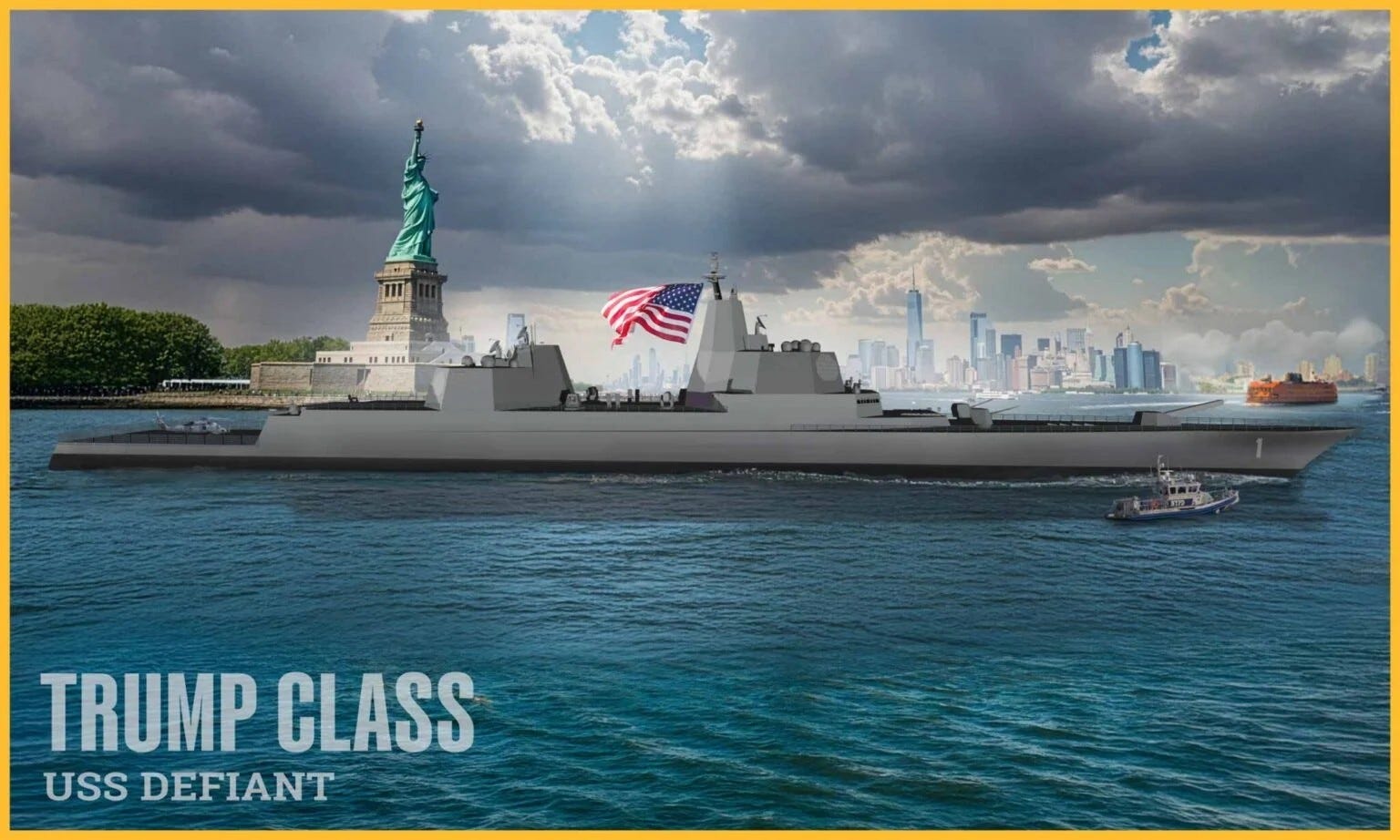
Trump recently pitched a Trump class “battleship,” the USS Defiant, as the centerpiece of a Golden Fleet. Typically the first ship in a class is named after the class, so the first ship should be called the USS Trump. Odd they chose “Defiant.”
Wait, golden fleet? Is that what we’re calling it?
He promised hypersonic missiles, nuclear cruise missiles, railguns, lasers, artificial intelligence, command and control for crewed and uncrewed systems, and a ship so intimidating it would make Chinese ports tremble in fear.
That pitch has one big problem: The modern ocean does not care about ego.
It cares about sensors, missiles, submarines, logistics, and how many hulls you can keep at sea for how long. The Trump class concept is a greatest-hits album of Navy buzzwords stapled onto a giant target. It looks like a throwback to battleship mythology, but it acts like a 35,000-ton spreadsheet error.
Look, I am not a Navy veteran, just an Army infantry and an Air Force veteran with a couple of degrees in things like international relations, business, and law. But I did stay at a Holiday Inn express last night which qualifies me to talk about battleships.
So, here’s the paradox:
This Trump plan looks at the Navy’s real problem, which is not enough ships, and answers with fewer ships, bigger ships, later ships, and more expensive ships.
If you want a symbol of power, this plan nails it.
If you want combat power in the 2030s, this plan starts to look like a self-inflicted railgun wound.
Let’s break it down.
First, what are we actually talking about?
The Trump class is described as a large surface combatant in the 30,000 to 40,000-ton range. The Navy later briefed a more specific picture: at least about 35,000 tons, 840 to 880 feet long, with a beam between 105 and 115 feet, and a top speed above 30 knots.
It gets called a “battleship,” even though battleships historically meant huge armor and gun-centric firepower. The last real US battleships, the Iowa class, left service in the early 1990s after heavy upgrades. Those ships displaced around 57,540 tons at full load and carried armor and 16-inch guns that belonged to a different era.
The Trump class is not an Iowa reboot. It is closer to an “arsenal ship” idea; a missile-heavy surface platform meant to throw large salvos and act as a command node. The renderings show large vertical launch arrays, several 5-inch guns, and a flight deck and hangar sized for a V-22.
The official armament list is a mix of real and aspirational.
The ship is supposed to carry 128 Mk 41 VLS cells split between bow and stern.
It adds a separate 12-cell launcher for Intermediate-Range Conventional Prompt Strike hypersonic missiles.
It carries a 32-megajoule railgun, which, by the way, doesn’t exist yet. (Although Japan just tested a railgun that looks pretty sexy).
It carries two 5-inch guns.
It carries Rolling Airframe Missiles for point defense and 30mm cannons.
It carries two directed-energy lasers in the 300 to 600 kilowatt range, plus four ODIN dazzlers.
It also claims two dedicated counter-drone systems.
It gets an SPY-6 radar and SEWIP Block III electronic warfare. It calls itself a command and control platform for crewed and uncrewed systems, with unspecified AI capabilities.
Now let’s ask the adult question: What problem is this ship actually solving?
The Navy does have a looming missile capacity issue. The Ticonderoga cruisers with 122 VLS cells are headed out the door by the end of the decade. The four Ohio-class guided missile submarines, the SSGNs, offer massive missile volume and they are set to retire before 2030.
Those retirements create a real “VLS cell gap.”
So, the Trump class tries to answer that with a big VLS battery and hypersonic strike.
That sounds rational until you do the maths and you remember the ocean is not a firing range.
Start with the VLS count:
A Ticonderoga cruiser carries 122 cells. The Trump class carries 128 cells.
That is six more cells on a ship that displaces roughly three and a half times as much as a cruiser and takes far longer to build, crew, and maintain.
An Arleigh Burke destroyer carries 96 cells in many variants, and the newest ships are in that family. A Trump class gives you 32 more cells than a Burke, but it does it by taking you into a far larger hull with a much bigger crew requirement.
The Navy itself expects 650 to 850 personnel for this battleship.
That is not a rounding error. That is a manpower crisis waiting to happen.
The Navy already struggles with recruiting and retention, and it already strains to man the fleet it has. A ship that needs hundreds more sailors than a destroyer is not just a budget line, it is a lifestyle tax on the Navy.
Now look at the price. We do not have an official cost, but the reporting range floating around is brutal: $5 to $15 billion per ship. A Gerald R. Ford carrier costs about $12.8 billion.
So, we are talking about a ship that could cost as much as a carrier, without being a carrier.
Then compare that to the alternative the Navy already knows how to build: For $10 billion you could build roughly four to five Flight III Arleigh Burkes. That would mean 384 to 480 VLS cells total, instead of 128 on a single hull.
That is not a subtle difference. That is a different kind of warfighting.
And it gets worse when you remember that not every cell is a land-attack missile. A huge portion of VLS capacity gets eaten by air defense missiles, anti-sub missiles, and the mixed load you need to survive. A battleship-sized ship with 128 cells does not magically become a 128-missile land-attack monster. It becomes a ship that must protect itself, protect others, and still have enough offensive punch left to justify the cost.
In the video above, US Navy VLS cells firing. Public domain.
Now let’s talk survivability, because this is where the “battleship” branding gets people in trouble.
People hear “battleships” and they imagine armor.
They imagine an Iowa taking hits and staying afloat.
The Trump class is not described as an armored dreadnought. It is described as a modern combatant with missiles, sensors, and fancy power-hungry weapons.
In a peer fight, a 35,000-ton surface ship is not hard to find. It is hard to protect.
It becomes a magnet for every anti-ship missile, every submarine, and every long-range targeting chain the enemy has.
The political value of hitting it would be enormous.
The military value of disabling it would be enormous.
China and Russia would circle it like sharks, because it is the sort of target you plan a whole campaign around.
That means the ship will demand escort, defensive missiles, electronic warfare, decoys, and constant protection. It will also demand time in port, because large complex ships spend an impressive amount of their lives not fighting.
This is one of the most underappreciated truths in naval warfare: a ship can only be in one place at one time, and it is often in port.
In the video above, the US Navy’s railgun program before they abandoned it. The Navy spent roughly $500 million over about 15 years developing its electromagnetic railgun program, with BAE Systems being a major contractor, before cutting funding due to technical challenges (like barrel wear) and the rise of cheaper hypersonic missiles.
If you build a small number of extremely expensive ships, you get a fleet that looks powerful on paper and disappears the moment maintenance schedules collide with reality. You also get a fleet that cannot cover enough ocean at once.
That is the core paradox again.
The Navy says it needs more surface warships overall, not a handful of super-ships.
Now we get to the most dangerous part of the proposal: the technology stack.
A 32-megajoule electromagnetic railgun sounds like the future. But the Navy halted its most recent public railgun work in the early 2020s.
The ship is supposed to carry two lasers in the 300 to 600 kilowatt range, plus four ODIN dazzlers. Lasers have real promise for drone defense and for blinding sensors, but “promise” is not the same thing as a mature shipboard weapon that works reliably in salt air, rough seas, bad weather, and combat damage.
Then comes the power problem.
The plan says the ship uses gas turbines and diesels to drive an electrical grid like the DDG(X) and Zumwalt ideas.
That is an integrated power system concept.
That still means fuel.
That means logistics.
That means a ship that burns through supply chains to feed its weapons and sensors.
The plan does not describe a nuclear-powered battleship, so your “free shots” are not free. Every laser engagement and railgun shot runs on a ship that must be fueled and sustained.
And if you are going to build a ship whose selling point is power-hungry weapons, you better have the power generation nailed, and you better have the cooling, storage, safety, and maintenance nailed too.
Now add the program risk.
We already have a track record for what happens when the Navy chases ambitious designs with small production runs.
Zumwalt was supposed to be 32 ships. It became three ships, and the capability changed dramatically.
The unit cost ballooned and the program became a cautionary tale.
The Constellation frigate program turned into a boondoggle and got axed.
Now we get a battleship program that does not start construction until the early 2030s, with a six-year design period of performance sitting right there in the contracting language. That means the ship must survive multiple elections, multiple budgets, multiple leadership changes, and multiple inevitable “re-evaluations.”
It could die on the vine after billions of dollars are spent on design studies.
If you have ever watched the Pentagon light money on fire with requirements churn, you know exactly how this movie ends.
And then there is the industrial base reality.
Only two American yards have real experience building large-displacement surface combatants: Bath Iron Works and Huntington Ingalls.
If you want more ships, you invest in shipyard capacity, workforce training, supply chain depth, and predictable production lines. You do not jam a mega-program into a strained industrial base and pretend it will come out clean.
Now, I know what you’re thinking… But Wes, this battleship will create shipbuilding jobs!
Actually, Trump said the ship would be built by robots… I’m not kidding.
Now let’s address the emotional core of this proposal. This is about symbolism.
Trump explicitly talked about battleships as “unmistakable symbols of national power.” The Secretary of the Navy talked about awe in foreign ports. Trump even said he would be involved in design because he is “a very aesthetic person.”
[Audible sigh…]
Wars are not won by photogenic hulls pulling into port. Wars are won by platforms that can fight, survive, and keep showing up day after day when the enemy tries to break your tempo.
Okay smart guy, what should the money buy instead?
Well, if your goal is lethality, survivability, and deterrence in the 2030s, you spend money where it changes real outcomes.
You build more destroyers and you fix the production rhythm so they arrive on time.
You extend the life of critical ships where it makes sense and you avoid capability gaps you cannot fill.
You invest in submarines, because submarines remain the most terrifying problem in naval warfare, and Russia has always planned to counter surface formations with subs.
You invest in munitions stockpiles, because a fleet without missiles is a fleet with expensive radar.
You invest in shipyard capacity and workforce, because a Navy that cannot build is a Navy that cannot deter.
You invest in uncrewed systems that add scouting, decoys, and strike options without adding hundreds of sailors per hull.
You invest in layered air defense and electronic warfare, because the side that survives the missile salvos gets to keep fighting.
If you want a real “Golden Fleet,” you make sure your existing ships can deploy, fight, and sustain operations without cannibalizing parts and praying that the supply chain shows up.
The Trump class, as described, concentrates risk. It concentrates cost. It concentrates political attention. It concentrates operational value into a small number of targets that your enemy will prioritize on day one.
And it arrives late.
But… I recently watched an interview with a Navy admiral who I genuinely respect; and he supports this battleship. It stands to reason that a Navy admiral knows much more than I do about what the Navy needs. So, let’s play devil’s advocate.
The upside
If you squint at the Trump-class concept and assume perfect execution, this ship does offer a few real advantages that are worth acknowledging.
Power generation.
Modern naval combat is increasingly about electricity.
Radars like SPY-6 draw enormous power. Electronic warfare suites are power hungry. Lasers and railguns, if they ever mature, demand sustained energy output.
A large hull gives you room for generators, cooling, redundancy, and future growth.
That’s not trivial.
One of the Zumwalt’s real strengths, despite its problems, is its integrated power system.
The Trump-class would build on that logic.
Command and control.
Big ships make good brains. A large surface combatant can host staff, coordinate unmanned systems, and serve as a command node for distributed operations.
In theory, this ship could act as a floating battle manager, coordinating destroyers, submarines, aircraft, and drones.
If the Navy genuinely leans into distributed maritime operations, there is an argument for having a few heavyweight coordinators.
Then there’s survivability, at least in one narrow sense.
Bigger ships can absorb more damage.
They have more compartmentalization. More redundancy. More margin before a single hit becomes a mission kill.
Against lower-end threats or limited engagements, that can buy time.
And finally, deterrence and signaling.
This is the least technical but most politically relevant point. Big ships send messages.
When something that looks like a modernized battleship pulls into port, it makes headlines. It reassures allies. It intimidates smaller adversaries.
Navies have always understood that part of their job is theater.
So yes. There are reasons someone might look at the Trump-class and say, “I get it.”
But here’s the problem.
Every one of those advantages comes with a brutal tradeoff.
Missile capacity concentrated in one hull means fewer hulls overall. Power generation does not matter if the ship cannot survive in contested waters. Command and control nodes become priority targets. Survivability against yesterday’s threats does not guarantee survivability against tomorrow’s missiles.
And deterrence built on a handful of ultra-expensive ships only works if they are actually deployable, available, and numerous enough to matter.
Which brings us back to the core issue.
The US Navy does not have a capability problem. Make no mistake; the US Navy is the most powerful navy the world has ever seen. It has a quantity problem.
China is building ships faster than the US can replace them. Russia still designs its doctrine around sinking large surface combatants. Missiles keep getting cheaper while ships keep getting more expensive. In that environment, betting tens of billions of dollars on a small number of massive hulls is not bold.
It is fragile.
If the Trump-class were one tool among many, maybe.
If it were cheap, maybe.
If it were fast to build, maybe.
But it is none of those things.
So yes, there are reasons people like the idea of a battleship.
They are understandable. They are emotionally satisfying. They are even strategically defensible in isolation.
They just collapse when you zoom out and look at the real constraints of modern naval warfare.
And that’s why the question isn’t “could this ship do impressive things?”
It’s “what did we give up to build it?”
And that is the question China and Russia would very much like us not to ask.
China would love for the United States to build a handful of $15 billion battleships while China builds more hulls, more missiles, and more distributed sea power.
Russia would love it too, because it gives Moscow a smaller set of high-value targets to plan around, and Russia has always dreamed of cracking big surface formations with submarines and long-range missiles.
A giant ship does not solve the problem of modern naval warfare. It concentrates the problem into a single hull and then dares the enemy to take the shot.
So, when people ask, “Should the Navy bring back battleships,” I answer with a question of my own.
Do you want a ship that wins wars, or do you want a ship that massages the president’s ego?
If you want to deter China, keep sea lanes open, protect allies, and fight through missile salvos, you need more ships that actually get built, actually deploy, and actually show up when it counts.
You do not need a floating monument that arrives in the early 2030s with a railgun the Navy already gave up on once.
Rant over, for now-
Wes
Слава Україні!


Just a casual observer here, but haven’t we already acknowledged battleships are obsolete? Since we’re here, jet fighters too?
Perhaps not today, but very soon, and if not before the next shootout on the high seas, definitely before any new ships are built.
To this untrained eye, battle ships are massive targets that will be overwhelmed by drones. Thousands of drones, if that’s what’s required.
Ever been in a forest and swarmed by black flies? The little monsters one size up from “no see-ums”? They make mosquitoes seem like a picnic.
I’m from Northern Canada, where black flies are the most insidious pest in the bush. They will make you insane, literally.
I imagine battleships like I remember myself in the forest, “ignoring” a swarm of black flies. It’s a compromise that can be maintained for a short time, if you’re slathered in Deet, or wearing a net, or both. Ultimately, there’s no solution. No escape. Just insanity or death.
But again, untrained observer. 😯
I would suggest that this clunky expensive monster be called The Titanic. It's got a ring to it.
Failing that, he could call it the Moskva, another winning name.
In either case, it would enable Trump to dress up as a Lord High Admiral with lotsa gold braid. And, of course, it would have a below-decks ballroom for major events.
Or it could be called The Gump, with the winning slogan "stupid is, as stupid does."