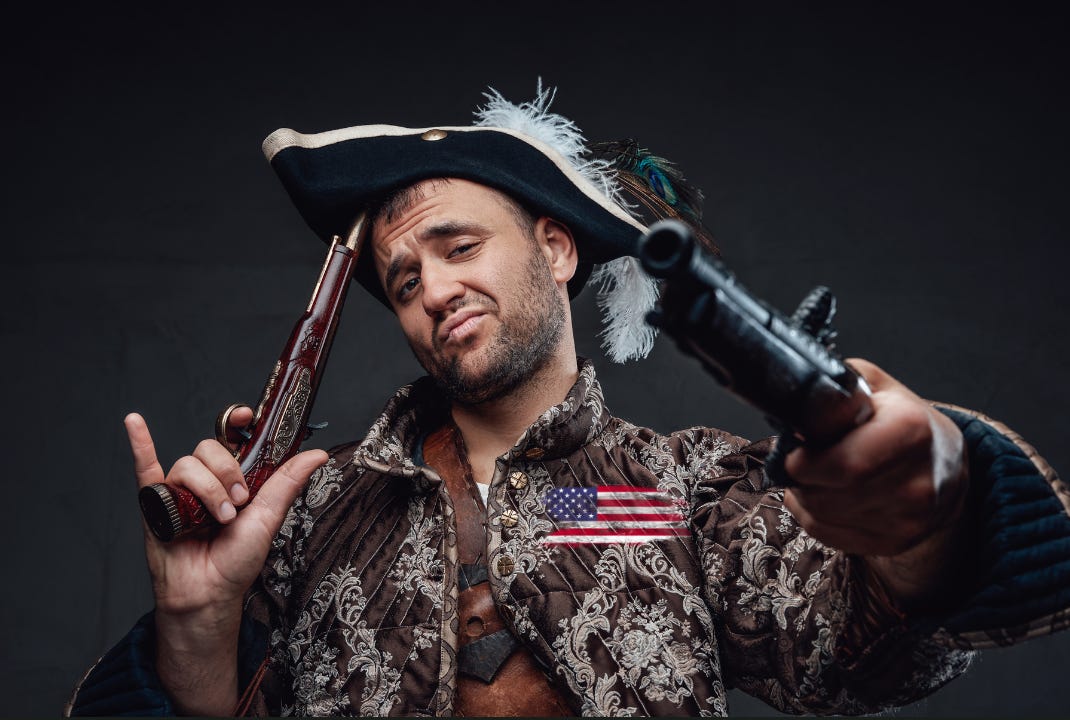
Congress May Bring Back Legal Pirates – I’m Not Kidding
Ah, privateering... piracy with paperwork. Buccaneering with a letterhead. Maritime violence, but make it federal.
Argh, mateys, gather round and let ole Captain Wes tell ya’ a tale about narco-terrorism, congressional improvisation, and America’s hidden pirate kink.
But first, do you have fantasies of swashbuckling on the high seas, answerable to no one except your crew and His Majesty King Trump?
Do you dream about booty, rum, and Port Royal, Jamaica?
Do you have Disney’s Pirates of the Caribbean DVD box set proudly on display in your home and watch it at least once a year?
Well then… Your ship has finally come in, because you’re not going to believe this shit.
There is a pirate bill moving through congress at this very moment that would allow private citizens to board and seize vessels belonging to “enemies of the United States.”
First, let’s call it a letter of marque and reprisal, because the Founders had better vocabulary than today’s branding consultants and definitely fewer concerns about search engine optimization.
Basically, this would be a government permission slip that lets private citizens capture enemy ships, seize property, and collect lavish rewards without being hanged by the neck until dead.
Wait, what do 21st Century pirates even look like?
Pirates with paperwork.
Pirates who invoice.
Pirates who need a Yale-trained maritime lawyer, a Starlink connection, a moderately competent insurance broker, and a Trump-trained accountant who has absolutely seen shit at Epstein Island.
That’s the strange little constitutional ghost now drifting back into public view because Sen. Mike Lee and Rep. Tim Burchett introduced the Cartel Marque and Reprisal Authorization Act… a bill that would allow the president to commission private operators to go after cartel-linked people and property outside US borders.
Before you start recruiting a crew and sailing off to the Strait of Hormuz, you should know that the bill targets cartels, not Iran.
Also, it probably won’t leave committee.
And yet, it’s sitting there on the table like a loaded flintlock.
This isn’t normal.
It is, however, very on-brand for America in 2026.
What a Letter of Marque Actually Is
A letter of marque was, at its core, licensed predation. The government issued a commission. The privateer, a private ship captain, not a Navy officer, was then legally authorized to attack enemy commerce: seize vessels, capture crew, take cargo.
What happened next went to an admiralty court, which sorted out prize claims, took a percentage of the proceeds, and generally maintained the polite fiction that this was all civilized.
The privateer kept the plunder.
The state got deniability, force projection it hadn’t paid to build, and a geopolitical effect it couldn’t easily attribute to itself.
Privateering was a deliberate outsourcing of violence.
During the American Revolution, the Continental Navy was a rounding error compared to the Royal Navy. There was no realistic path to matching British sea power hull-for-hull. So, the colonies leaned on privateers hard.
Private vessels commissioned under letters of marque eventually captured roughly three times as many British ships as the American Navy did. That’s a strategic asymmetry the Founders recognized, built into Article I, Section 8, Clause 11, and used aggressively.
The War of 1812 repeated the pattern. Small public fleet, massive British opponent, privateers filling the gap.
When the Founders put letters of marque in the Constitution, they were solving a real problem with a real tool.

The 1856 Declaration of Paris ended it, formally, for the signatories. Britain, France, Russia, Prussia, Austria, Sardinia, and the Ottoman Empire agreed that privateering be abolished, and that neutral flags and neutral goods would be respected at sea.
It was a post-Crimean War attempt to make maritime conflict slightly less chaotic.
The United States didn’t sign.
Washington’s stated objection at the time was that abolishing privateering benefited major naval powers at the expense of smaller nations.
The US wanted to preserve the option precisely because it might need it again the way it needed it in 1812.
What actually ended privateering in American practice was the normative shift toward professional military force.
Uniformed soldiers under command authority.
Clear rules of engagement.
Accountability structures.
Courts-martial.
The understanding that when a government commits violence, someone specific is responsible for how it’s conducted.
Privateers didn’t fit that model. They operated for profit.
The current White House loves to pitch privatization as the cure for governmental “inefficiency.”
Need a highway? Toll-road it.
Need a weather satellite? Ask SpaceX.
Need to keep fentanyl out of Kansas? Hire contractors with a letter of marque and tell them to send the receipts to IRS Accounts Payable.
That playbook assumes corporations do everything better than government because they “innovate” and “move fast.” What actually happens is that corporations optimize for share price, not public interest, and their idea of “fast” often means cutting the safety wire and hoping nobody investigates until after the quarterly earnings call.
We’ve seen this play out in uniform.
Blackwater’s convoy shooters turned a Baghdad traffic circle into a kill zone in 2007, torched US credibility, and handed every jihadist propagandist a recruitment video.
Wagner Group did the same on Russia’s dime from Donbas to Damascus, free-agent warlords with shitty judgement and no accountability. Both outfits bragged about doing the job government forces “couldn’t” do.
Handing cartel interdiction to privateers is that same logic in an Old Navy Hawaiian shirt.
Sure, a contractor fleet could nab a few drug barges quicker than the Coast Guard’s deployment cycle.
They could also decide the risk premium isn’t worth it halfway through a pursuit and peel off to protect their insurers; something uniformed crews can’t do because they swear an oath to the US Constitution, not a service-level agreement.
Deregulation fans call this “market discipline.” In practice it means the taxpayer funds a private gun deck, the shareholder creams off a healthy margin, and the public absorbs the diplomatic blowback when a misidentified fishing trawler ends up ventilated.
The chain of blame loops through shell companies, nondisclosure clauses, and Cayman Islands P.O. boxes until Congress finally realizes it just outsourced sovereignty to Delaware LLCs with shitty AI-generated logos.
Professional soldiers wear name tapes and answer to courts-martial.
Privateers wear whatever the contract allows and answer to whoever writes the bonus checks.
Pretending those two systems are interchangeable is how you wake up one morning and discover your foreign policy has a ticker symbol.
But maybe that’s what Trump wants?
The Bill
The Cartel Marque and Reprisal Authorization Act, introduced in the Senate by Lee in December 2025 and in the House by Burchett the prior February, would authorize the president to commission “privately armed and equipped persons” to seize cartel members and cartel-linked property outside US borders, on land or sea.
Operators would be required to post a security bond. The bill specifies targets as individuals the president “determines” to be cartel members or cartel-linked conspirators “responsible for an act of aggression against the United States.”
Burchett envisions the “pirates” as retired “top-tier” SEALs, Special Forces, Marine Raiders working as private contractors. Lee said, “cartels have replaced corsairs in the modern era.”
Elon Musk replied to Lee’s post on X: “This would work incredibly well, as it has throughout history.” Donald Trump Jr. called it an “effective, efficient, DOGE-compliant way to combat Mexican drug cartels.”
The bill is currently sitting in committee. House version: Foreign Affairs. Senate version: Foreign Relations. Neither is moving at the moment.
Where the Legal Seas Get Rough
Let me run the kill chain on this, because the practical problems stack up fast once you work through even one operational scenario.
Let’s start with sovereignty. The bill authorizes seizures outside US borders. That means operating inside other countries’ territorial waters or on their soil without their permission. Mexico, where most cartel activity is concentrated, has not invited American privateers.
The legal framework for what happens when a privately commissioned American operator seizes a cartel member inside Mexico City doesn’t exist. It would have to be invented in real time, after something goes very wrong.
Then there’s the identification of the bad guys. The president determines who qualifies as a cartel member. That’s a presidential determination, not a judicial finding.
The privateer then acts on that determination in a foreign environment with incomplete intelligence. Cartel networks are deliberately opaque. They use intermediaries, cutouts, and civilians who don’t know what they’re working for.
Mistaken identity in this context is a dead civilian and an international incident.
What about cartel retaliation? Cartels aren’t pirate crews from the 18th century. They have surveillance capabilities, counter-intelligence operations, and a demonstrated willingness to kill people’s families.
Private operators working against cartels without the force protection infrastructure of a military unit are exposed in ways that active-duty special operations forces are not. And unlike military personnel, their families are not on a guarded installation.
The bill says privately armed persons can seize “persons.” Okay. Then what? Who takes custody? What legal process governs detention? Where are they held? What are the rights of the detainee? Is this an extradition? An extraordinary rendition? A citizen’s arrest that crosses an international border under a congressional commission?
Every military lawyer I’ve ever encountered would have a fucking brain aneurysm.
Evidence handling is not to be trifled with. If the point is eventually to prosecute cartel members in US courts, evidence gathered by private operators working under a letter of marque exists in a legal category that nobody has mapped. Chain of custody, admissibility, coercion standards? The discovery phase alone would be a decade of litigation.
When a private operator with a letter of marque commits a war crime, and statistically, someone will, who is responsible? The president who issued the letter? Congress that authorized the authority? The contractor?
If the answer is “mostly just the contractor,” then we’ve built a perfect vehicle for plausible deniability, which is exactly what critics of private military companies have been arguing against for thirty years.
What This Actually Tells Us
The bill will probably not pass. The jurisdictional and legal problems are severe enough that the committee memberships with oversight know it can’t survive serious scrutiny.
And the Trump administration, which has been perfectly willing to use the military kinetically against drug trafficking operations, hasn’t publicly championed the Lee-Burchett approach.
But the bill’s existence is the point worth examining. It shows an administration, cheered on by the deregulate-everything crowd, that’s ready to treat centuries-old legal curiosities as policy pilots.
Expedience over doctrine, results over guardrails.
That urge should worry every sober strategist.
A letter of marque hands lethal authority to contractors who answer to investors first and courts maybe. It bypasses clear chains of command, sidesteps judicial review, and mortgages America’s credibility (whatever we have left) on the promise that profit will align with national interest.
History says it rarely does.
Want bold thinking?
Fine. Fund the Coast Guard, fix inter-agency intel, tighten export controls, pressure the money men who launder cartel cash. Those moves are hard, public, and accountable.
Unfortunately, these are some of the other weird bills making their way through Congress:
A House proposal has suggested adding Donald Trump’s likeness to the Mount Rushmore National Memorial.

A $250 Bill with Trump’s Image: Legislation was proposed to mint a new denomination of US currency featuring Donald Trump to coincide with the nation’s 250th anniversary in 2026.
Also, proposals have been made to compel the US Department of State to establish a “Trump Peace Prize” award.
But “Pirates” might take the taco, so to speak. When lawmakers start rummaging through the constitutional attic for exotic weapons, remember what happens after the novelty wears off.
The contractors go home and the taxpayer has to mop up the diplomatic spill.
The bill’s mere existence should remind us that the next time frustration meets nostalgia, Congress might actually pull the trigger.
So, here we are. Congress has found the dusty chest labeled, “Things We Probably Shouldn’t Bring Back,” pried it open with a cutlass, nearly grabbed human slavery or Scarlet fever, but grabbed piracy instead.
Yo, ho, ho… Batten down the hatches, hide the booty, and keep one eye on the horizon.
Слава Україні!


Why am I not surprised? What will they do when another country issues letters of marque against US shipping? If this goes through, that will happen. Do we end up with private navies going at each other?
The bill probably won't go through... this time. But next time?