


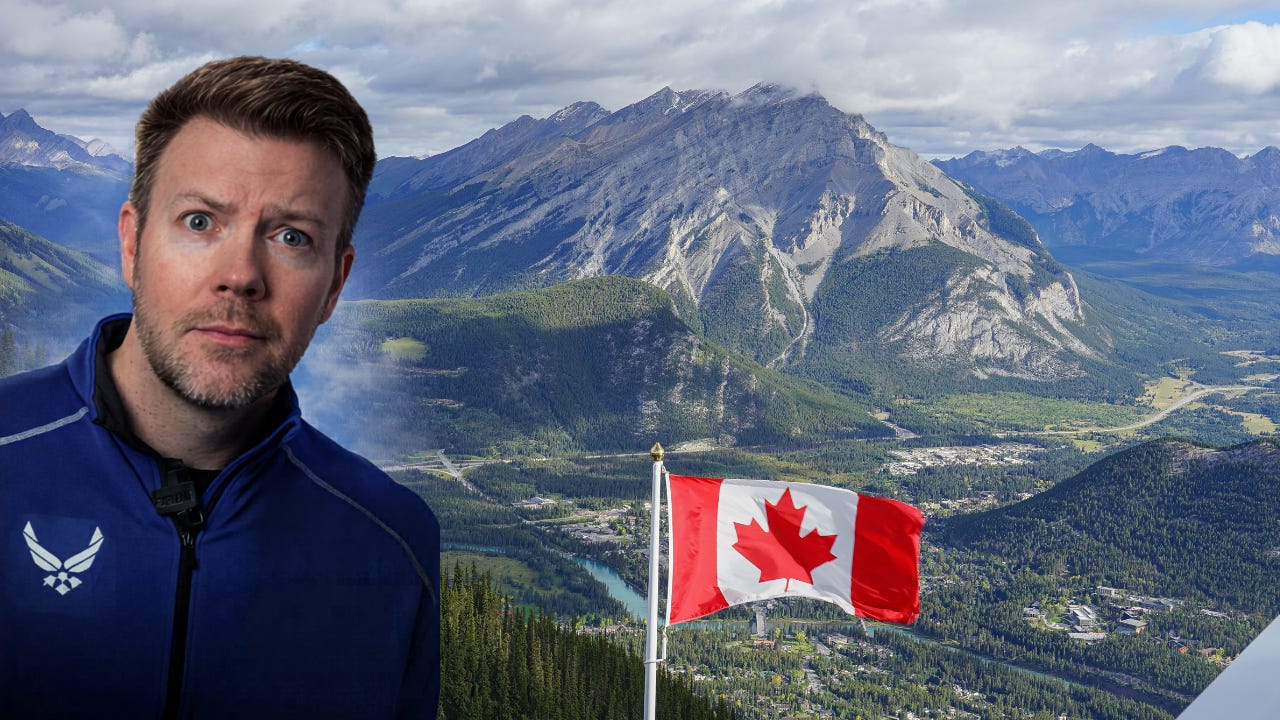
I know some Americans who heard some variation of this on the news: “Conservative Alberta is sick and tired of doing all the hard work while the liberals in Ottawa reap the financial reward! So, Alberta is holding a vote to leave Canada!”
WHOA, easy there. Let’s not give Texas any ideas; those muppets will look for any excuse to become a republic again.
Through the American lens, the Alberta vote can come across as somewhat confusing to the average Chicago commuter.
So, allow me to break it down for my fellow Yanks.
Wait, Wes! Why are you, of all people, qualified to discuss Canadian politics?
I’m glad you asked… I did stay at a Holiday Inn Express last night. Oh, and somewhere along the way I picked up a bachelor’s degree in international relations. Plus, I can practically see Canada from my house…
Actually, when I was a nineteen-year-old private first class in the US Army, my new wife and I drove to Niagara Falls, from her parent’s house in Michigan, through Canada, to the Canadian side of the falls.
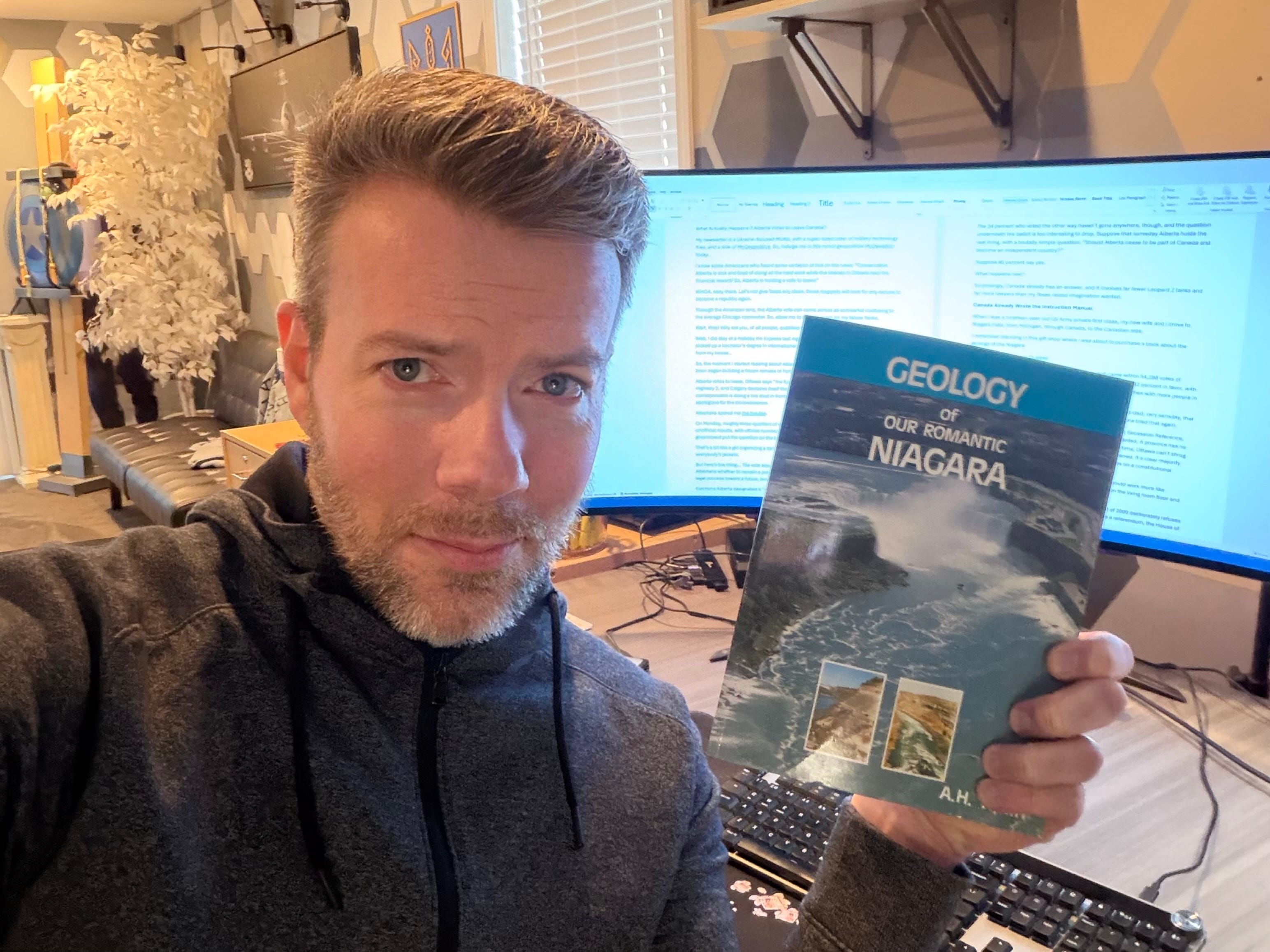
I remember standing in this gift shop where I was about to purchase a book about the geology of the Niagara Escarpment.
I still have the book. One sec…
Anyways, the young high school girl at the checkout, not much younger than me at the time, was studying American history after 1865. I recognized the book. And I said “Oh, American history? That’s a super interesting time period: reconstruction, Jim Crow, the Gilded Age.”
She looked up from her book with a studious gaze: “Americans I take it?”
“Yep.”
Then she said something that caught me by surprise. “Do you study Canadian history in the US?”
And today, years later, I still feel bad about what happened next.
I laughed. Involuntarily…
It wasn’t a laugh of superiority.
It wasn’t some laugh-in-her-face-like-a-maniacal-psychopath situation.
It was just an uncontrollable chuckle because my infantry brain couldn’t comprehend the absurdity of it. American high school is already filled with enough asinine bullshit to fill the plunge pool at Niagara; we certainly didn’t need any more.
(Actually, those of us who attended school in Texas were exposed to TWO FULL YEARS of Texas history, which is itself intertwined with Mexican history, so we Texians actually know far more about our southern neighbor…)
Years go by and this episode, (and my immature reaction), haunted me. I made it a point to learn Canadian history and politics in honor of this woman. I hope she’s living her best life somewhere warm.
Fast forward to this year, and the moment I started reading about Alberta’s independence movement, my American brain began building a frozen remake of Fort Sumter…
It went something like this:
Alberta votes to leave, Ottawa says “the fuck you are…” somebody rolls a Leopard 2 onto Highway 2, and Calgary declares itself the capital of a new republic. Before long, a CBC correspondent is doing a live shot in front of a roadblock while everyone involved apologizes for the inconvenience.
Albertans spared me the trouble.
On Monday, roughly three-quarters of voters chose to stay in Canada, according to unofficial results, with official numbers due October 29. Premier Danielle Smith, whose government put the question on the ballot in the first place, voted to remain too.
That’s a bit like a girl organizing a bar fight and then spending the whole night holding everybody’s jackets.
But here’s the thing… The vote also wasn’t really about leaving. Question 10 asked Albertans whether to remain a province of Canada or to have their government start the legal process toward a future, binding referendum on separation.
Elections Alberta designated it “nonbinding.” Nobody was going to wake up Tuesday morning in the Republic of Alberta, standing in line for new license plates.
The 24 percent who voted the other way haven’t gone anywhere, though, and the question underneath the ballot is too interesting to drop. Suppose that someday Alberta holds the real thing, with a simple question: “Should Alberta cease to be part of Canada and become an independent country?”
Let’s say 60 percent say yes.
What happens next?
Surprisingly, Canada already has an answer, and it involves far fewer Leopard 2 tanks and far more lawyers than my Texas-raised imagination wanted.
Canada Already Wrote the Instruction Manual
Canada already has a history with secession.
On October 30, 1995, Quebec voted on sovereignty and came within 54,288 votes of leaving Canada. The final count was 50.58 percent against and 49.42 percent in favor, with a staggering 93.52 percent turnout. I’ve been to college football games with more people in the stands than the margin that kept Canada in one piece.
Canada looked at how close it had come to breaking apart and decided, very sensibly, that maybe somebody should write the instructions down before anyone tried that shit again.
In 1998, the Supreme Court of Canada handed down the Quebec Secession Reference, and the ruling is a masterpiece of not giving either side what it wanted.
A province has no constitutional right to simply announce it’s leaving. At the same time, Ottawa can’t shrug off a clear democratic vote for independence as if nothing happened. If a clear majority votes for secession on a clear question, the rest of Canada takes on a constitutional obligation to negotiate “in good faith.”
So an independence vote wouldn’t really work like a light switch. It would function more like somebody dumping an enormous box of constitutional Legos on the living room floor and telling every government in the country to start sorting.
Parliament then made it more interesting still.
The Clarity Act of 2000 deliberately refuses to say that 50 percent plus one equals independence. Before a referendum, the House of Commons decides whether the question itself is clear.
After the vote, it decides whether the result amounts to a “clear majority,” weighing the margin, the turnout and anything else it considers relevant. Squeaking out 50.1 percent on a question written like a cell phone contract probably wouldn’t get Alberta very far. Sixty percent on “Should Alberta become an independent country?” would be a lot harder for Ottawa to wave away.
If both the question and the majority pass the clarity test, negotiations begin.
That’s when this gets wonderfully, almost lovingly Canadian…
Everyone Gets a Lawyer
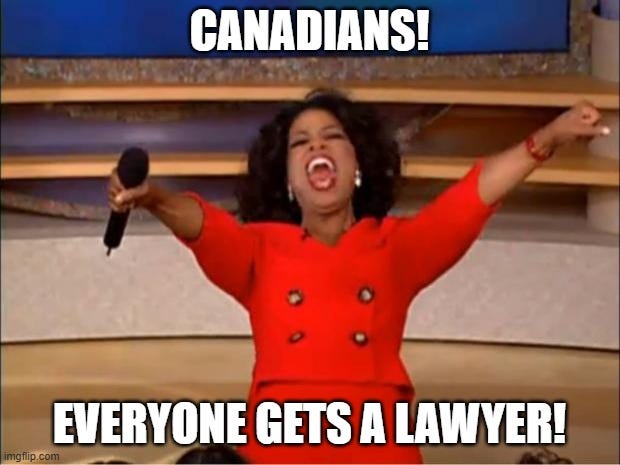
Okay, we’ve established that a successful referendum wouldn’t make Alberta independent. It would give Alberta a mandate to negotiate independence, and those negotiations would end in a constitutional amendment involving the federal government and, under the Clarity Act, every provincial government too.
Picture the nightmarish agenda… Somebody has to divide the national debt, then the federal assets. Then come pensions, citizenship, currency, banking, customs, borders, federal employees, airports, pipelines, and military bases.
Eventually, around day 417, somebody in Ottawa realizes nobody has decided who owns a particular weather radar outside Medicine Hat, and the whole room fucks off for lunch.
I say this as a guy with both a DD-214 and a law degree: you don’t want to know how long it takes a roomful of lawyers to agree on who owns a weather radar.
The Clarity Act also says the negotiations must address the division of assets and liabilities, minority rights, the rights and territorial claims of Indigenous peoples, and possible changes to provincial borders.
That last one stopped me cold, because it means Alberta’s outline on the map isn’t guaranteed to survive an independence deal intact.
Alberta is home to 48 First Nations covered by Treaties 6, 7 and 8, plus eight Métis Settlements. Those treaties were signed with the Crown, not with Edmonton, and Section 35 of Canada’s Constitution recognizes and affirms existing Aboriginal and treaty rights. Edmonton couldn’t simply declare that everything inside today’s provincial boundary now belongs to a new country and tell everybody to update Apple Maps.
We don’t even need a hypothetical here.
In May, Alberta’s Court of King’s Bench struck down a separatist petition because its organizers hadn’t properly consulted Indigenous peoples, treating that consultation as a constitutional requirement because separation would affect treaty rights.
Treaty 8 First Nations publicly backed legal action against separation, and First Nations leaders across Alberta and Saskatchewan vowed to oppose it.
So, some of the questions in that negotiating room wouldn’t have tidy answers.
Some First Nations could insist that their treaty relationship with the Crown keeps their lands in Canada. Ottawa might support that argument. In the strangest version, an independent Alberta could emerge with pockets of Canadian territory inside it.
Nobody can answer those confidently, because Canada has never actually done this. The law does tell us nobody could just ignore them.
The negotiation could decide what Alberta actually is when it walks out the door, and I find that endlessly fascinating.
Then there’s the oil, because every Alberta independence conversation reaches petroleum within about 6.2 seconds. Alberta sits on enormous energy reserves, and that oil is the foundation of its economic and political clout.
Owning oil underground isn’t the same as owning a road to the ocean, though.
An independent Alberta would be landlocked. Every barrel bound for a Canadian coast would cross a foreign country, the pipelines that are domestic infrastructure today would become international infrastructure overnight, and a refinery shipping gasoline into British Columbia would suddenly be an exporter dealing with customs, transit fees, and potential tariffs.
None of that makes independence impossible, because countries negotiate these arrangements all the time. But it does mean “we have the oil” answers only half the question. Somebody still has to move the stuff, and that somebody would be living in a different country.
Who Gets the Keys to Cold Lake?
This is the part that first sent me down the rabbit hole, because there’s a lot of Canadian military in Alberta.
The province hosts 3rd Canadian Division Support Base Edmonton, the Army’s big training area at CFB Wainwright, CFB Suffield (home to military testing and British Army training on the prairie) and 4 Wing Cold Lake, one of Canada’s two main fighter bases.
Somewhere north of 10,000 Canadian service members live and work in the province.
None of it belongs to Alberta.
Section 91 of the Constitution Act gives Parliament exclusive authority over “Militia, Military and Naval Service, and Defence.” (It took a great deal of intestinal fortitude to force myself to spell “defence” like you freakazoids. You’re welcome…)
If Alberta voted for independence, the troops at Edmonton wouldn’t wake up as the Alberta Defense (I refuse to do it a second time) Force. They’d still be Canadian soldiers in a Canadian chain of command, and the CF-18s at Cold Lake would stay Canadian jets until Canada agreed otherwise.
Any infantryman who’s ever signed for a piece of equipment knows how this goes.
Government property changes hands when the right person signs the right form, and if you’ve ever tried to clear out-processing with one missing canteen cup, you know the federal government will find you wherever you go.
The Air Force was actually more gracious with letting airmen keep their stuff on separation. If the Army wanted every single paperclip back before you left, the Air Force let me walk out the door with a $700 Gore-Tex field jacket that I still use today in Michigan’s abysmal lake-effect winters.
In a negotiated separation in Canada, the bases would get sorted like any other asset. Canada might pull out completely, Alberta might buy some facilities, or Ottawa might lease a few for a transition period.
Equipment would move or be sold, and personnel would face choices about postings, residency, and eventually citizenship.
It’s boring in the best possible way. The dangerous version starts when somebody skips the negotiation.
The Midnight Declaration Scenario
But let’s take this to the extreme… Like an early 2000s Slim Jim commercial.

Imagine Alberta holds the real referendum and 60 percent vote yes. Ottawa accepts that it now has to negotiate, and talks begin.
Then they bog down: The debt split turns nasty, Indigenous territorial claims harden, pipeline access becomes a hostage, and the two sides start fighting over military property.
Months become years.
Eventually an Alberta government runs out of patience, and at midnight on some future July 1 (Canada Day, just for maximum pettiness), Edmonton announces that negotiations have failed and Alberta is now an independent state.
Under Canadian law, that declaration wouldn’t do a thing. The Supreme Court and the Clarity Act both make clear that unilateral secession isn’t allowed and a constitutional amendment is required. From Ottawa’s point of view, Alberta would still be Canada, and that changes everything that follows.
Federal authorities still operating in Alberta wouldn’t see themselves as invading a foreign country. They’d see themselves as continuing to govern Canada.
Federal taxes would still be owed, Canadian passports would still be valid, federal employees would still answer to Ottawa, and the Canada Border Services Agency would still consider the 49th parallel its border.
The Bank of Canada wouldn’t mail Edmonton a box containing its share of the monetary system with a nice card wishing everyone luck.
At first, almost all of the fighting would happen in courtrooms, ministries, and police headquarters. Ottawa would ask the courts to strike down the declaration and refuse diplomatic recognition, while Alberta tried to exercise powers Ottawa still considered federal.
Sooner or later, somebody would have to decide who holds the keys to Cold Lake.
That’s where the temperature starts to climb. If Alberta authorities tried to occupy a base or seize Canadian aircraft, they’d be taking federal military property.
If provincial officers set up their own checkpoints at the US border, two governments would be claiming the same international frontier.
If the RCMP kept enforcing federal law while Edmonton told provincial police to stop them, you’d have officers standing on the same stretch of highway taking orders from two different sovereigns.
None of that guarantees gunfire. It does put armed officers with conflicting orders on the same roads, which is how constitutional theory starts becoming a security problem.
So, when would the Canadian Armed Forces actually get involved?
I don’t see Mark Carney sending armored columns toward Calgary because 55 percent of Albertans voted for independence. Canada built its secession framework specifically so that democratic separatism wouldn’t be treated as rebellion.
The military really enters the picture only once somebody starts trying to enforce competing sovereignty with force.
Canada’s Emergencies Act defines a national emergency to include threats to the federal government’s ability to preserve Canada’s “sovereignty, security and territorial integrity,” but it comes with legal thresholds and parliamentary oversight attached. The National Defense Act lets the military assist civil authorities when riots or disturbances exceed what police can handle.
The normal trigger, though, is a request from the provincial attorney general, which gets awkward fast when the provincial government is the one in open confrontation with Ottawa.
Ottawa would have every incentive to keep soldiers out of it as long as humanly possible.
Courts, police, injunctions, and locked gates at federal property are all cleaner tools, and nobody in Ottawa wants a photograph of Canadian soldiers facing down Albertans over a constitutional argument.
The real nightmare is a slow slide into confusion about who’s in charge.
Picture Edmonton deciding its mandate to negotiate already makes it sovereign, while some First Nations refuse to be included. Federal agencies keep operating, Alberta stands up its own border service, Ottawa refuses to pull the RCMP, and Canadian personnel at Edmonton, Cold Lake, Suffield and Wainwright keep taking orders from Ottawa. Provincial police get told one thing, federal officers get told another, and two governments claim to legitimately rule the same ground.
History is full of places where that sentence ended in a shit show.
That doesn’t mean Canada would ever get there. Everything about its post-Quebec legal architecture is designed to stop it.
What I find remarkable, as an American, is how deliberately Canadians built an off-ramp.
My country settled its secession question in the 1860s at a cost of somewhere between 620,000 and 750,000 lives. Canada came within 54,288 votes of its own existential crisis and responded with legislation and an instruction manual.
It also guarantees that the people whose rights predate the province itself get a say in what happens to their land.
There’s something in that worth envying, especially right now, watching my own country barrel uncontrollably toward Civil War II – the Empire Strikes Back.
The Canadian answer to “what if we break up?” turned out to be “then we’ll argue about it, in order, under rules we agreed to ahead of time.”
So, if Alberta ever does vote clearly for independence, don’t watch for Canadian tanks first. Watch the lawyers. They’ll get there long before the Army does, and they’ll bill by the hour the whole way.
The True North strong and free.
-Wes
Fun! Now do the US! What if New England wants to separate?
I love your {semi} tongue in cheek sense of humor, mixed in with a bunch of interesting facts.