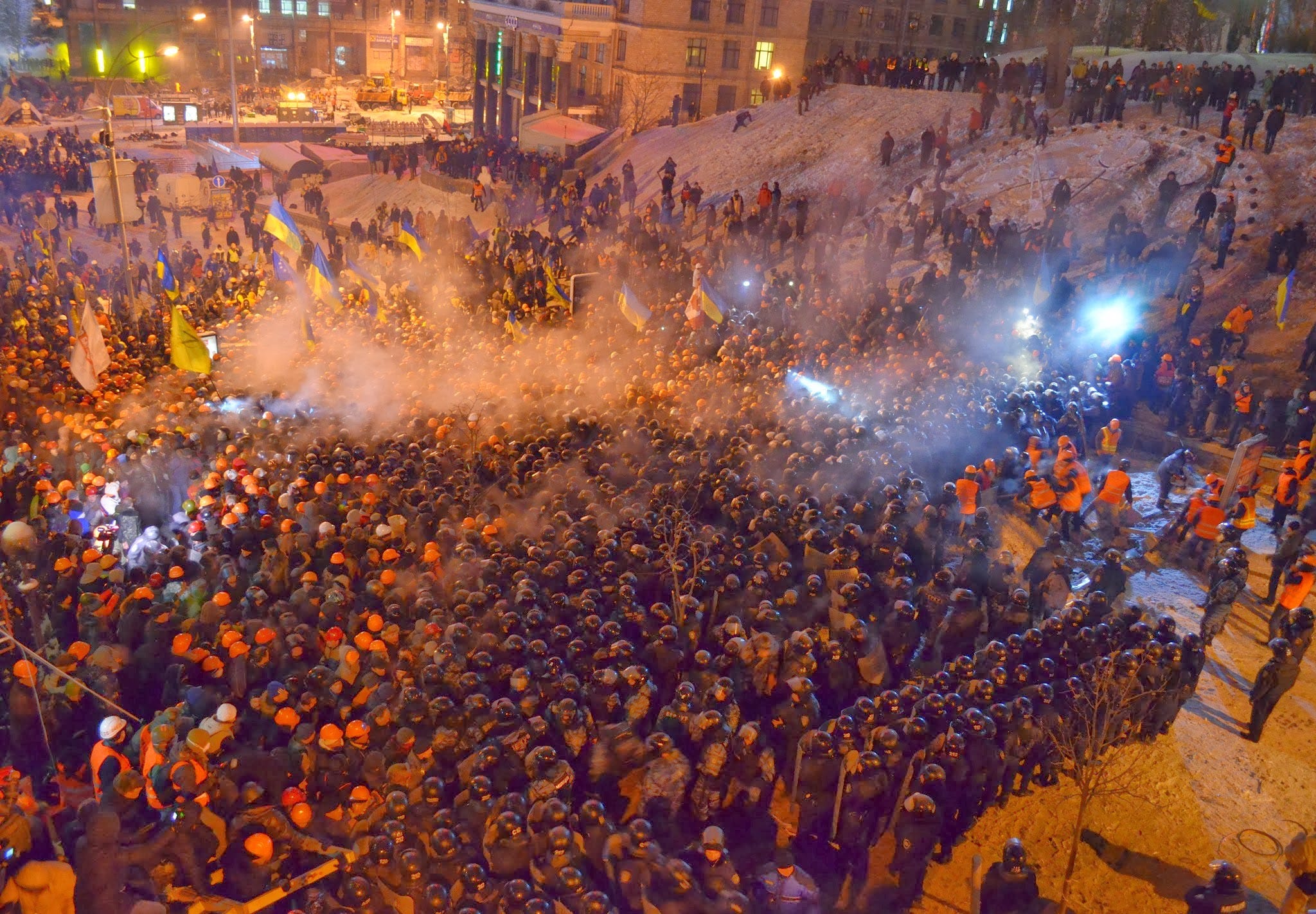
Did the CIA Influence Ukraine’s Euromaidan?
A short, factual history of what actually happened

Whenever you talk about the Euromaidan Revolution, someone will eventually lob the same tired counterpoint grenade into the conversation: “The CIA engineered it.” Usually delivered with the confidence of a man who learned geopolitics from a Russian Telegram meme.
So, let’s follow the timeline and separate an organic national uprising from the fantasy version Moscow has been selling for a decade.
The Prequel: Ukraine Was Already Drifting West Long Before 2014
Long before the winter crowds gathered on the Maidan, before tear gas turned Kyiv’s central square into a cold-weather fog machine, Ukraine had been quietly shifting westward on its own.
This wasn’t a CIA plot or a covert recruitment drive run by agents in cheapo Ray Ban rip-offs. It was a generational trend visible in every major poll for more than a decade.
From 2000 to 2013, support for European integration didn’t spike suddenly, it climbed, steadily and predictably, year after year.
A nationwide survey in 2012 found that nearly half of Ukrainians wanted their country in the European Union, with only a third opposed.
The generational divide was striking. Even in regions that later became hotspots of Russian influence, Donbas and Crimea, young adults viewed Europe the same way their peers did elsewhere. Among 18–29-year-olds in the east, a clear majority, 51 percent, supported EU membership, while only 22 percent disagreed.
Awareness mattered too. Ukrainians who actually followed the ongoing Association Agreement talks were far more likely to back joining Europe. Among that informed group, support jumped to 52 percent.
Ukrainians backed EU economic integration because it promised something their own political class couldn’t deliver: a system where laws apply to everyone, wages grow reliably, and travel doesn’t require bribing an airport official.
For Ukraine, the European single market was a blueprint for normal life in a country that had spent too long stuck between oligarch influence and Soviet hangover.
Demographics pushed the shift even harder.
Ukrainians under 35 were consistently the most pro-European group in the country. They saw the EU not as a geopolitical stance but as an escape route from the permanent corruption cycle Russia encouraged and benefited from.
For them, aligning with Europe meant joining a future. Aligning with Russia meant repeating a past.
And the irony of the “CIA coup” narrative is that the very agreement protesters came out to defend wasn’t invented in Washington at all. Kyiv had already negotiated the EU Association Agreement under President Viktor Yanukovych… yes, the same Yanukovych who later fled to Russia in a panic.
His own administration spent years shaping that agreement. It was his signature policy achievement before he abruptly froze it under pressure from Moscow.
By the time protesters filled Independence Square, Ukrainians weren’t being manipulated by foreign puppeteers. They were reacting to the betrayal of a direction they had chosen themselves. The drift toward Europe was organic, internal, and visible long before anyone lit the first barrel fire on the Maidan.
The bottom line is simple: the turn toward Europe didn’t come from Langley. It came from Lviv, Kyiv, Kharkiv, and Odesa. It came from Ukrainians who had already decided what kind of country they wanted to build.

November 2013: The Moment the Fuse Was Lit
The crisis that became Euromaidan didn’t start with an election. It started with a single decision.
On November 21, 2013, President Yanukovych abruptly announced he was rejecting the EU Association Agreement. Instead, he accepted a $15 billion loan package from Russia and signaled a full pivot back toward Moscow.
This was not a minor policy change. Ukrainians had spent years preparing for EU integration. Businesses, students, NGOs, and civil society groups had all invested in that future.
That night, a small group of students gathered in Kyiv’s Maidan Nezalezhnosti to protest the decision. No CIA handlers. No “color revolution” consultants. A few hundred students with smartphones.
Then Yanukovych made a catastrophic mistake. Let’s build a timeline:
November 30, 2013: The Berkut Beat Down the Students
Everything changed at four in the morning.
Up until that point, the student protest on the Maidan was small, peaceful, and, at least in the eyes of Yanukovych’s administration, manageable. A few hundred young people camping in the cold to defend the country’s European future wasn’t exactly a national crisis.
But instead of letting it fizzle out, Yanukovych chose the dumbest option available: he sent in the Berkut riot police.
The officers didn’t disperse the crowd. They punished it. They swung truncheons at unarmed college kids as if they were storming a bunker. Phones were recording, cameras were rolling, and by sunrise the footage had ricocheted across the country. The brutality was unambiguous and undeniable. Ukrainians woke up, opened their screens, and saw their children treated like enemy combatants.
The reaction was immediate.
Within twenty-four hours, one hundred thousand people had taken over central Kyiv. Entire families arrived: students, retirees, factory workers, veterans, clergy… all people who had nothing in common except their refusal to tolerate what they had witnessed. A protest that had been counted in hundreds suddenly had a population larger than many cities.
And once that many Ukrainians gathered, the movement grew in both size and purpose. By the end of the week, the Maidan was a full-scale uprising. The message had shifted from “sign the EU agreement” to “we refuse to live under a government that beats children in the dark.”
If there was a single moment where Euromaidan stopped being reversible, it was created by Yanukovych’s own security forces, on camera, with every baton strike streamed and shared.
Ukrainians responded not because some foreign agency whispered instructions, but because any society with self-respect would revolt after watching its youth get crushed for daring to hold European flags.
December 2013 – January 2014: From Protest to Revolution
What happened next was a transformation.
The crowds that first surged onto the square after the Berkut assault didn’t fade as winter deepened. They grew, hardened, and diversified.
Every day brought new tents, new field kitchens, new volunteers ready to sleep on frozen pavement rather than see their country pushed back under Moscow’s shadow.
People who normally never stood in the same line found themselves shoulder to shoulder. Veterans who had served in Afghanistan built defensive barricades. Lawyers set up makeshift legal aid tables to protect detainees. Clergy from nearly every denomination arrived, not to bless a political movement, but to act as human shields between riot police and civilians. Journalists chronicled events from within the crowd, long before international media understood the scale of what was unfolding.
Students brought the energy. Business owners brought the money and logistics. Doctors created medical stations in tents lit by generators. Teachers held public lectures on the square as if to say that knowledge itself was an act of resistance.
What emerged was a civic ecosystem: messy, improvised, and unmistakably Ukrainian.
Even Ukraine’s oligarch-owned television channels, usually allergic to controversy, couldn’t ignore what was happening. They began broadcasting live from the Maidan stage.
Ukrainian musicians performed for the crowds, feeding both morale and momentum. The square became a cultural and political heartbeat, amplified in real time across the country.
Putin’s undercover FSB officers in the crowd sent increasingly distressing reports back to Moscow. Things are getting out of hand. The “Ukraine problem” is growing.
The anger was domestic, visceral, and unmistakably personal. People weren’t rallying over abstract geopolitics. They were confronting a president who had taken bribes from Moscow, lied to his own citizens, and then unleashed violence when those citizens objected.
By December, Ukrainians weren’t protesting a bad policy decision anymore. They were rejecting the entire power structure that had tried to force that decision on them. And by January, it was clear that the government was losing control of the narrative, the streets, and eventually the country itself.
February 2014: The Killing Begins
As protests escalated, Yanukovych deployed snipers. Between February 18–20, more than 100 protesters were killed: the “Heavenly Hundred.”
This was the final break.
Russia’s intelligence officers moved to evacuate their puppet.
Parliament, Yanukovych’s own parliament, voted to remove him from office after he fled Kyiv in the middle of the night and resurfaced in Russia.
Ukrainians weren’t duped. They watched their president flee the capital in a helicopter while his mansion revealed a private zoo, gold toilets, and a replica Spanish galleon docked on a river.
The revolution didn’t need CIA involvement. It had Yanukovych’s corruption, brutality, and cowardice.
To be fair, no major geopolitical shift happens in a vacuum, and it would be naïve to pretend Western intelligence agencies had zero involvement on the periphery of Euromaidan.
The CIA, like every major service, was watching the situation closely and almost certainly maintained informal channels with pro-Western politicians, civil society groups, and reformist figures.
That’s normal: intelligence agencies support partners whose strategic goals align with their own, especially when a country is debating whether to lean toward Europe or drift back into Moscow’s orbit.
But support is not the same as orchestration.
There is no evidence the CIA planned the protests, directed the crowds, or engineered Yanukovych’s collapse. At most, the US and EU amplified Ukrainian demands for accountability and provided non-lethal assistance to democratic institutions already under strain.
The uprising’s engine was domestic outrage, not a foreign plot. Western actors were spectators with preferences, not puppet masters pulling strings.

So Where Did the “CIA Did It” Claim Come From?
The myth didn’t appear spontaneously. It has three very predictable origins.
The first source is Russian state media, which began calling Euromaidan a Western-engineered coup almost before the tents were pitched on the square.
Moscow needed a narrative that justified everything that followed: Crimea, Donbas, the covert troops without insignia, the separatist militias that somehow showed up with brand-new Russian hardware.
Painting the uprising as an American plot gave the Kremlin a ready-made excuse for its own aggression and a way to delegitimize the millions of Ukrainians standing in the cold for their own future.
The second source comes from misrepresented diplomatic leaks; specifically, a 2014 phone call between 25th Assistant Secretary of State for European and Eurasian Affairs Victoria Nuland and the US ambassador to Kyiv.
In the call, they discussed which Ukrainian political figures seemed competent, which ones were liabilities, and which outcomes served US interests. This was spun into “proof” of CIA orchestration, even though diplomats everywhere talk this way during political crises.
If you leak conversations from any embassy on earth, you’ll hear similar assessments. It’s not evidence of covert manipulation; it’s the day-to-day work of diplomacy. But Russia seized on this as “evidence” and pushed it out through RT news across the world.
The third source comes from ideological echo chambers in the West; voices convinced that every protest on the planet is secretly cooked up in a Langley basement.
These commentators amplified Russia’s talking points out of habit, cynicism, or a fundamental misunderstanding of Eastern Europe.
The problem isn’t that they lack evidence. It’s that they never bothered to look for any.
And that’s the key point: there is no proof. No secret funding pipeline. No handwritten CIA playbook. No defector claiming involvement. No intercepted plans or leaked cables outlining a regime-change operation in Kyiv. Nothing that survives even basic scrutiny.
Euromaidan didn’t succeed because the CIA snapped its fingers. It succeeded because millions of Ukrainians refused to live under a president who sold out their future and tried to drag them back under Moscow’s shadow.
The movement wasn’t foreign-made. It was homegrown, organic, and unmistakably Ukrainian.
The idea that the CIA needed to “manipulate” Ukrainians into choosing Europe over Russia is absurd. Ukrainians already knew the difference between the two worlds. They chose the one with rule of law, free speech, functioning institutions, and actual economic opportunity.
If Russia wants to know who caused Euromaidan, it doesn’t need to look for the CIA. It needs to look in the mirror.
Слава Україні!


Thanks I sent this to a friend of mine who keeps saying that Maidan was a CIA plot, Zelensky is a CIA stooge etc. I don't think this will change his mind, but who knows? It's weird because he is a lefty American, but he hates US foreign policy so much that now he's on the side of Russia basically. And there seems to be no shortage of American commentators and professors etc who blame NATO for Russia's invasion of Ukraine.
Hi Wes, thanks for this article, I get the same tired trope from people that I discuss Ukraine with and having this summary is very helpful.