Drones Changed the Ukrainian Battlefield, but Human Infantry Still Hold It
The case for the humble human infantryman

Note: I wrote this article this morning for my Medium audience of 55K people. Then, I liked what I had written so much, I said “Wes, I bet your Substack readers would like this…” So, I’m also sharing it here. If you follow me at both places, I apologize for the double email you just received. I normally keep different writings between the two platforms to give readers an incentive to subscribe at both places. That’s all. Have a grunty day!”
There’s been a lot of breathless coverage about the “future of war” lately; namely, that future war will be automated in a sort of scaled-up version of Rock ’Em Sock ’Em Robots going to war on our behalf.
How magnanimous of them.
I’m sure the clankers will do so willingly… and there definitely won’t be a robot uprising where they turn on us because they’re sick of fighting our resource squabbles.
I’m partly to blame for this; I’m a technophile. I blame my time in the Air Force. I have a kink for electrons. I take shit apart to marvel at its inner workings like some deranged RadioShack coroner. But mostly I write about military technology and make videos on YouTube for a decently-sized audience where it’s clear that I’m smitten by new and interesting ways to murder other humans.
It’s been two decades, and I still have our cadence bouncing around in my head. “One, two, three, four, train to kill. One, two, three, four, kill we will.” Over and over and over: Train to kill. Kill we will.
Combine my love for technology with my time in the Army and the Air Force, and you get whatever this is: a military veteran quasi-journalist who sees a new weapon system and immediately wants to know how it works, how it breaks, who it kills, who it saves, and which exhausted private gets stuck carrying the batteries.
We are very much at a pivot point in warfare, where automated systems are taking on more and more battlefield roles.
I imagine today feels similar to World War I with the number of new technologies that emerged on that battlefield… Like tanks, airplanes, machine guns, depth charges, and chemical war, among many others.
Actually, the full-scale war in Ukraine has now lasted longer than World War I. That’s a slap in the face.
But despite those tech revolutions in WWI, it was still a war defined by human suffering, particularly the infantry.
And today, after all the drones, all the satellites, all the artillery, all the algorithms, all the breathless TED-talk futurism, the war still comes down to exhausted human beings holding pieces of dirt under conditions no sane person would sign up for twice.
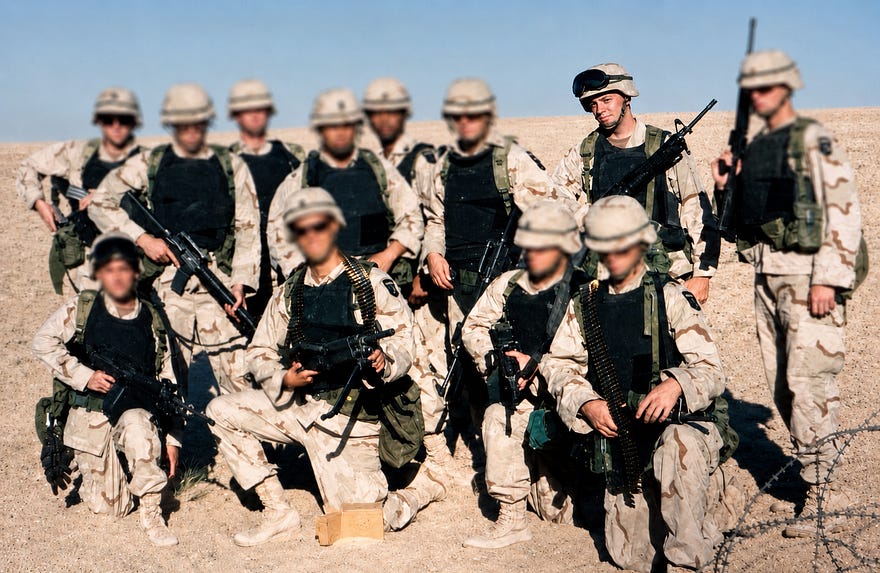
I was an infantryman once, so I’ll throw my bias on the table right now.
I was a child of the 1980s. I had no father, so I was magnetically drawn to the hypermasculinity of big screen icons like Arnold Schwarzenegger in Commando, Tom Berringer in Sniper, and the Colonial Marines in James Cameron’s Aliens.
They made the infantry seem cool and sexy.
But those movies never prepared me for walking into a tent on the Kuwait/Iraq border and seeing our platoon medic facing the door, with his pants around his ankles as he was shaving his pubic hair in full view of God, country, and the ghost of George fucking Washington. (His reasoning was that it was hot and you have to keep it clean down there. Fair point.)
They must have left that part out of the movies I saw.
Maybe it was in the DVD extras commentary.
The infantry isn’t sexy unless you’re 19, high on Rip-Its, and wearing the blue cord for the first time like Audie Murphy’s ghost personally knighted you. The rest of the time it’s walking, digging, waiting, carrying too much, being cold and hot and wet and hungry, getting punished by terrain, and being told the plan just changed [again] by some officer whose socks are always dry.
And yet, in the most heavily roboticized war in human history, Ukraine, the lowly grunt is still shockingly relevant because the tech still needs somebody to hold what it takes.
About that “robots captured a position” headline
Here’s the news that has people declaring the infantryman extinct.
On April 13, Zelensky announced that for the first time in the war, Ukrainian forces took a Russian-held position using only unmanned platforms, uncrewed ground vehicles (UGVs) and drones, the occupiers surrendered, and there were no Ukrainian infantry involved and no losses.
He named the kit by system: Ratel, TerMIT, Ardal, Rys, Zmiy, and others. And it wasn’t a one-off fluke. Back in July 2025, the 3rd Separate Assault Brigade forced Russians in Kharkiv Oblast to surrender to drones and UGVs, and the defenders held up a cardboard sign that read Мы сдаёмся! “We want to surrender!”

One machine-gun-armed UGV reportedly held off a Russian advance for 45 days on a diet of one battery swap every couple of days.
That’s downright remarkable. But it’s also not the whole story.
Taking a position where the enemy decides to surrender to a machine is a genuine tactical milestone. But the UGVs do it as “remote” weapon nodes with a human driving it and running every trigger pull.
That’s right. These systems are not autonomous. They’re remotely operated, like a long-range RC car. We’re nowhere near the point where a fully autonomous AI-controlled robot can take and hold positions.
Also, and this is just a pet peeve of mine: It doesn’t help that both the mainstream press and countless military blogs and social media pages call UGVs “robots.” The word Robots imply some degree of autonomy.
The soldiers doing this work are the first to say so. One Ukrainian commander running robotic assault units, himself a former infantryman, said flatly that drone and UGV decisions always have to be made by a human.
These are grunts who found a way to send a machine extension of themselves into the kill zone instead of their friends, and they’ll tell you the human never left the battlefield. He just moved back a step.
The machines are doing real work. Just not the holding.
I don’t want to undersell the UGVs, because the numbers are staggering. In March alone, Ukrainian forces ran more than 9,000 UGV missions. In the 3rd Assault Brigade, unmanned ground vehicles handle 80 percent of logistics, and in the meat grinder around Pokrovsk and Myrnohrad it’s closer to 90 percent, with a single UGV hauling as much as 450 pounds, far past what a man can carry on top of his combat load.
Ukraine’s General Staff says robotic platforms have cut personnel casualties by up to 30 percent. A demining UGV called Zmiy runs about $20,000 and clears 7,000 square meters a day.
Carrying ammo, dragging out the wounded, laying and clearing mines, driving explosives into bunkers, sitting overwatch on a road. Every one of those used to cost a human, and now often doesn’t.
That’s a profound, life-saving shift, and I want zero confusion about my respect for it.
But after the drone finds the position, after the UGV rolls up with a machine gun, after the Russians surrender or run or die, the place still has to become yours. Somebody has to check the dugouts. Somebody has to clear the basement.
Somebody has to find the tripwires, count the prisoners, drag the wounded, set sectors of fire, fix the comms, mark the approach route, figure out where the enemy will probe next, and then spend the night listening to every twig snap… That is infantry.
And sitting on a grid coordinate and holding ground are different verbs. Holding means occupying the place, reading it, repairing the position, dealing with the civilians who live there, shoving back the infiltration you heard before you saw it, and making the call about whether the noise in the dark is a wounded friendly, a Russian assault group, or a wild boar having a romantic evening with his sow.
Robots are getting better at presence by the month but they’re nowhere near replacing it.
To be fair, infantry on its own decides very little in Ukraine.
Infantry without artillery is dead. Without drones, it’s blind. Without air defense, it’s hunted. Without electronic warfare, it’s standing naked in front of every enemy sensor. Without logistics, it’s a countdown timer with boots.
Modern infantry is one node in a sensor web, a kill chain, and a supply system.
But pull the infantry out and the whole machine loses its anchor.
Artillery can break a position. Drones can isolate it. Armor can punch a hole. Engineers can clear the lane. Then somebody with a rifle and a bad attitude still has to walk in, confirm it, clear it, hold it, and make sure the enemy can’t stroll back the moment everyone else reloads.
That’s the distinction the hype keeps missing. War is political control. And control still requires presence.
Ukraine’s manpower crisis is the proof, not the rebuttal
People look at Ukraine’s mobilization struggles and conclude the old way is dying. That’s backwards. If infantry didn’t matter, a shortage of it wouldn’t be a strategic emergency.
Ukraine needs trained infantry to rotate burned-out units, hold villages, plug breakthroughs, man strongpoints, and absorb Russian pressure. Russia knows it too, which is the only reason Moscow keeps feeding men into the grinder at obscene cost. Both sides understand, in blood, that the human role didn’t vanish.
And listen to what the Ukrainians actually say about all these robots. The stated near-term goal is to replace about a third of infantry tasks with drones and UGVs, to keep soldiers out of the worst kill zones, and the commanders are blunt that they’ll never out-number Russia, so they have to out-tech it.
That’s an effort to offset the shortage, not a fantasy about abolishing the soldier. They’re trying to make every grunt count for more, because they can’t make more grunts appear.
I think this Ukrainian distinction is wise: A “robot” can take a task: resupply, recon, mine clearance, casualty evacuation, a remote gun covering a road, or a decoy to bait an ambush.
A soldier is a bundle of those tasks plus judgment, presence, endurance, fear management, aggression, restraint, and legal responsibility. Swapping out one task is a long way from swapping out the man or woman.
And the tasks that stay human are the ugly ones.
Who’s surrendering and who’s faking it?
Who’s a civilian?
Who’s wounded?
When do you hold fire?
When do you take a risk to drag somebody out?
When do you keep fighting because the line simply cannot break right here?
Humans can’t yet do this by remotely driving a UGV. There’s just not enough physical awareness when staring at a video feed 10 kilometers away.
Those questions live in fear, law, ethics, and command responsibility, and they don’t compile into clean code. War keeps refusing to become a software problem, probably because war keeps running into humans.
Same wall every autonomy enthusiast eventually slams into, which is why I keep arguing that the hardest problem in military AI has always lived in human judgment, not the sensor or edge computing.
As for fully autonomous war machines that can make these types of judgement calls with no humans around whatsoever?
Welllllll, we’re quite a ways off from that world. And there’s a reason for that.
Moving through a real battlefield requires the calculation of a complex 3D environment. Humans are naturally good at this. Our mushy firmware has been steadily upgraded since birth.
Imagine the relatively benign act of driving your car on a crowded highway. Your brain is automatically, usually without your knowledge, computing hundreds of tiny judgments every second: speed, range, closing distance, angles, blind spots, lane drift, braking time, surface conditions, peripheral movement, and the body language of every idiot within a quarter mile who may be one text message away from becoming your insurance problem.
You are not consciously doing the math; thank God. Your brain is doing it for you, folding sight, sound, motion, memory, and instinct into a constant prediction model. By the way, your brain is doing all this with an obscenely small amount of power.
Now move that problem onto a battlefield, where the road is gone, the map is stale, the signal is jammed, the terrain has been chewed up by artillery, and half the objects in your path are either trying to kill you or pretending they are not.
The machine has to process mud, rubble, shell holes, trenches, trees, smoke, mines, shadows, civilians, friendlies, enemies, weather, and every other ugly little surprise war throws into the road.
If you put that processing on the robot, then the robot gets more expensive, complex, power-hungry, and harder to replace. Keep the brain somewhere else and control it remotely, and now the whole system depends on a link the enemy is desperately trying to jam.
Congratulations. You’ve reinvented the infantryman, except now he has latency and needs constant replacement parts.
[I find it hilariously ironic that my authoritarian robot vacuum cleaner just demanded I get up from typing this and manually empty its dustbin that’s overstuffed with husky fur. Yes, mi lord, I’m coming… What a dick]
Let me finish by saying there are two lessons here for the West: First, keep buying drones, UGVs, counter-drone systems, electronic warfare, and AI-assisted targeting hard and fast, because that’s the war that’s already here. Second, stop treating infantry as an afterthought you can conjure on short notice when the expensive machines need a babysitter.
I’m no Luddite about it. The robot share is only going to climb. More logistics goes unmanned every month, and Ukraine is contracting tens of thousands of UGVs this year while openly aiming to push 100 percent of frontline logistics onto machines.
The infantry role will shrink, specialize, and get better protected before it ever disappears. So we need to get them what they need: counter-drone discipline, signature management, UGV integration, trench overhead cover, EW awareness, battery logistics, thermal camouflage, small-unit drone operators, and leaders trained to fight when every movement is observed.
So here we are.
A war that has now outlived World War I on the calendar, and the oldest job on the battlefield is still on the duty roster.
A century of genius changed almost everything. Satellites see farther. Drones fly lower. Artillery corrects faster. Human-controlled UGVs haul the ammo and carry out the wounded. AI helps sort and identify the targets. And after all of it, somebody still has to hold the ground.
That’s the stubborn truth sitting under all the shiny future-war vocabulary. The infantryman isn’t the star anymore, and good, because human life is valuable… Yes, even the expendable grunt.
But he’s still the proof of control, the keeper of the ground, the exhausted human at the end of every drone feed and fire mission and command decision.
UGVs can make him safer. Drones can make him deadlier. AI can make him faster. None of it makes him optional.
For now, the lowly infantryman still matters.
War modernized from space all the way down to the dirt… and found a human already standing on it.
Слава Україні!


This: «They’re remotely operated, like a long-range RC car.» Important point, people seems to miss that point. Drones of all sorts are remotely controlled, not independent. Ukraines unmanned forces are more than 30 thousand men/woman strong. Yes, AI is in large scale use, but not autonomous. A in AI is for Artificial… nothing wrong with that, the results are really impressive. But in the old automation/augmentation discussion of technology all these are augmentations. Needing the humans.
It is very interesting to see your analysis here because as mentioned above it ties very neatly into a very longstanding debate on automation versus augmentation. Look up works of Nobel laureate Daron Acemoglou (2024) and colleagues. Their points against automation is that it always substitutes one (maybe more) tasks not all of the work. If you use a dishwasher you still have to put the dishes into and out of the dishwasher. But even if you do not automate everything you can gain in the process. The various drones are of course very good examples. And as the new technology automates some tasks they also create new. After all the drones must be repaired, powered up, protected when they are not on mission, controlled etc etc. even suicide drones needs people to launch and guide them. And for the infantry man/woman there is new tasks, aside from the age old core task of controlling an area.