


Hey friends, I outlined three different article ideas over the weekend that would only work on Substack. My Medium audience, the vast majority, are laser focused on Ukraine War news. If I drift too far from that admittedly important topic, I’m “punished” with low views, and thus low money.
But on Substack, I’ve exposed my readers to a variety of military technology, geopolitical, and cultural topics, so there’s less pushback when I go “off script.” Plus, Substack doesn’t use the view model. Writers are paid only by premium memberships (and apparently Substack will soon start letting writers put “sponsored ads” in their writings… That sounds like hell, to be honest.)
So, what were the three ideas, and which one did I choose today?
The first idea is a deep dive into the Bristol 188 jet, which was supposed to support development of the Mach 3 Avro 730. Nicknamed the “Flaming Pencil,” its only job was to get very fast, stay very fast, and let engineers measure what prolonged aerodynamic heating did to an aircraft structure.
The second article examines an obscure US Navy recruiting ad from 2006 that challenged people to find the hidden Navy Seals in the image. In 2006, America’s special operations forces were stretched thin by the Global War on Terror (GWOT). This ad is iconic and gives us a great window into alliance warfare, clever marketing, and a special forces organization that had not yet become famous.
The third article is the one I chose for today; the one that you’re about to read…
Some of these will be free on Substack, some of them will necessarily fall on paid days (Wednesdays and Sundays), so if you’re reading today’s paid subscriber article as part of your free preview, I encourage you to become a paid subscriber to support independent journalism. I’m quite bad at promoting the paid side of Eyes Only as I almost never do any “marketing.”
Hmm, it just occurred to me that all three of these ideas are historical in nature.
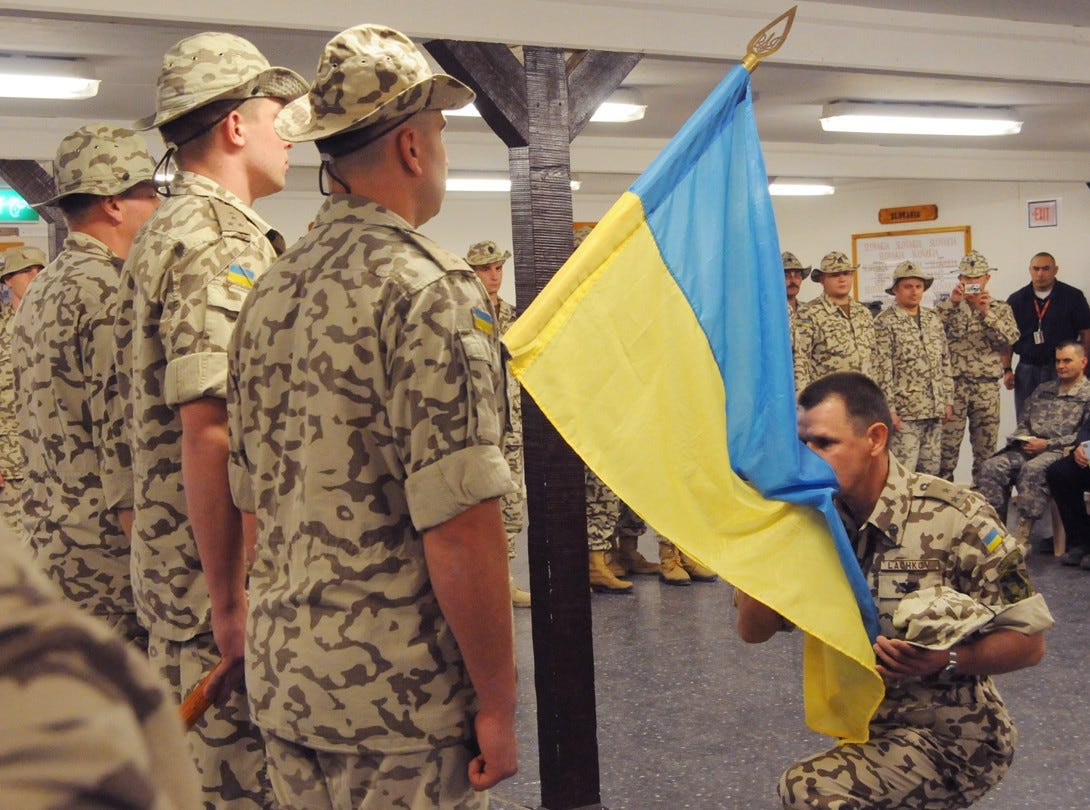
Perhaps I was in the military history mood when I came up with these? Anyways, I’ll write the first two of the next couple of days, but for today, let’s talk about the Ukrainians who fought alongside US soldiers in the GWOT.
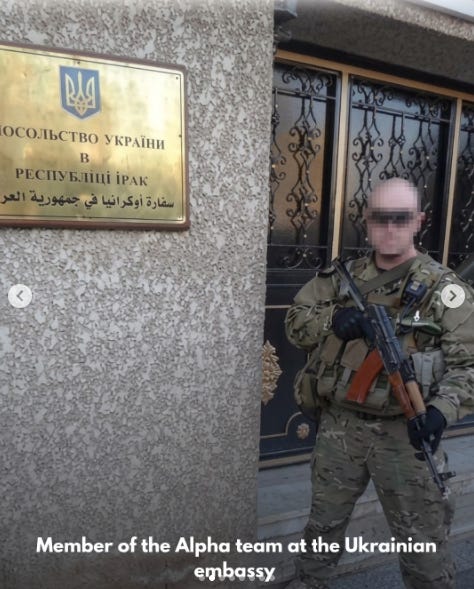
In early April 2004, a Ukrainian armored personnel carrier sat on the bank of the Tigris River in Kut, a dusty city of a few hundred thousand people about 100 miles southeast of Baghdad.
Muqtada al-Sadr’s Mahdi Army had risen up across southern Iraq, and Kut was burning.
Inside that APC was Ruslan Androshchuk, a soldier in the reconnaissance company of Ukraine’s 6th Mechanized Brigade, from a village in the Zhytomyr region. According to his comrades, he spotted a militant on the far bank lining up a rocket-propelled grenade. He put his machine gun sights on the man and asked for permission to fire.
The answer came back: ні. (No)
The rocket hit the side of the APC a moment later, and the shaped charge killed him.
“Only after Ruslan was killed were we finally allowed to open fire,” one of his fellow soldiers later recalled.
Androshchuk died in an American-led war, in a country his own government had no quarrel with, as part of a coalition his nation had joined at Washington’s request. Ukraine wasn’t a NATO member, and it had no treaty obligation to be there. Nine out of ten Ukrainians told pollsters back home they opposed the war, and he went anyway.
On Tuesday, standing in the Oval Office, the President of the United States said this about Ukraine: “We’ve given a lot to Ukraine. We’ve gotten absolutely nothing back except grief, death, tremendous monetary loss.”
Grief and death, he said. I can think of 18 Ukrainian families who know a little something about grief and death in America’s wars.
A Non-Member Who Showed Up Anyway
Let’s set the scene, because a lot of Americans either never knew this or forgot it somewhere between the Bush surge and the launch of the first iPhone.
When the United States invaded Iraq in March 2003, most of the countries Washington considered its closest friends stayed home. France and Germany said no loudly, and many others said no quietly. The Bush administration cobbled together what it called the “coalition of the willing,” and one of the more surprising names on the list was a former Soviet republic barely a decade into independence.
On March 18, 2003, two days before the invasion began, Ukrainian President Leonid Kuchma signed a decree sending Ukraine’s 19th Nuclear, Biological and Chemical (NBC) Protection Battalion to Kuwait.
The US military expected Saddam Hussein to use chemical weapons, (as he had done before against the Kurds) and Ukraine sent specialists trained to deal with exactly that, people whose country had learned more than it ever wanted to about contamination after Chernobyl. US Marines later described the Ukrainian NBC soldiers working alongside an American-led task force as bona-fide experts.
In June 2003, Ukraine’s parliament voted 273 to 450 to send a full brigade. By September, the Ukrainian 5th Mechanized Brigade was in Iraq, based in Wasit province with its headquarters at Kut, operating as part of the Polish-led Multinational Division Central-South.
At its peak, Ukraine kept about 1,650 troops in Iraq, depending on whose count you trust.
That made it the third- or fourth-largest contingent in the entire coalition. The US Army ranked it third. More than 6,000 Ukrainian soldiers rotated through Iraq and Kuwait before the last of them came home in December 2008.
They patrolled, guarded convoys, cleared explosives, protected infrastructure and trained Iraqi army and police units.
They also bled.
