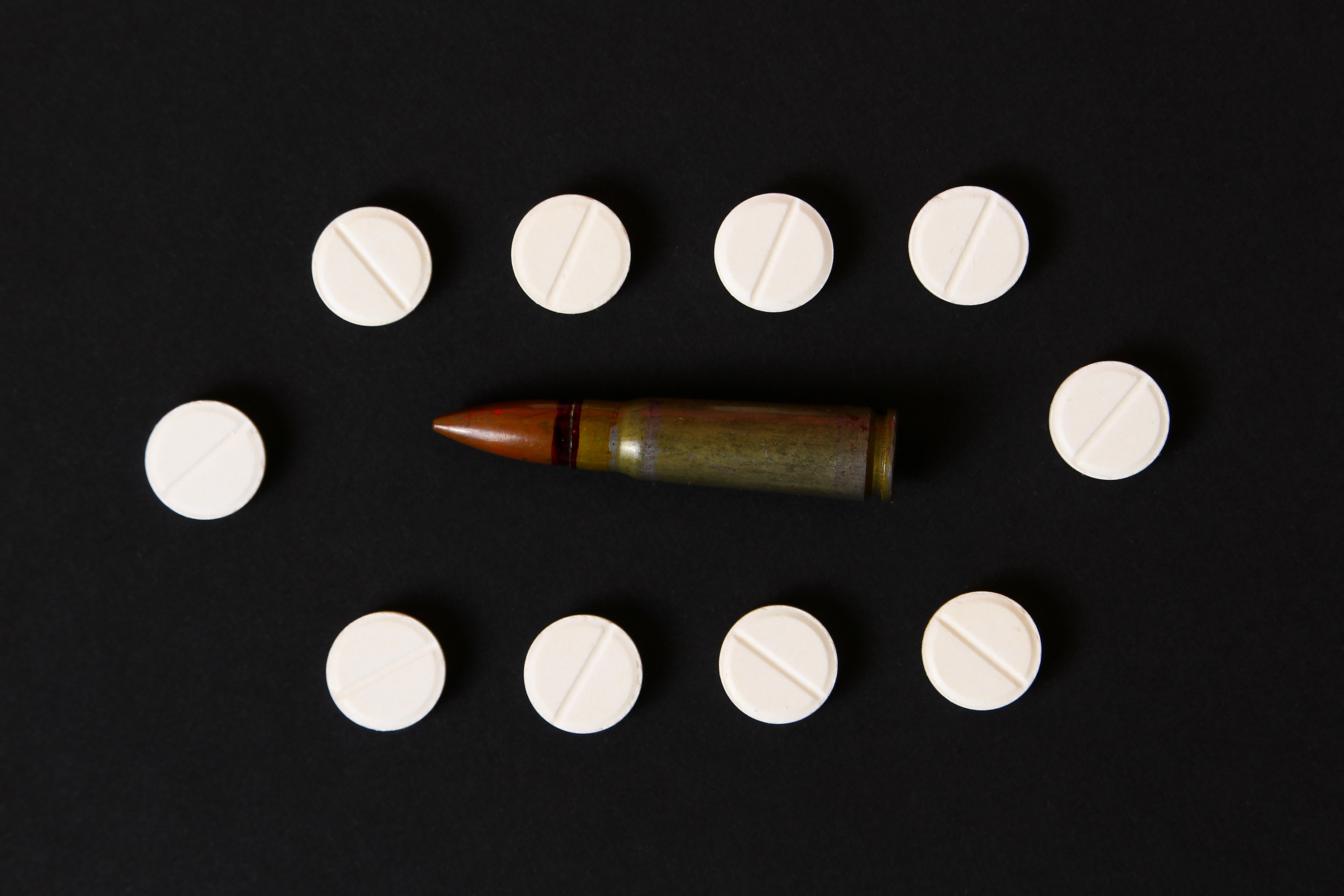
Fentanyl in the Russian Trenches
What Ukraine’s intel says about Russian morale, and why armies keep reaching for chemical courage
The call starts like a bad joke, except nobody’s laughing.
A Russian soldier, somewhere in the meat grinder, asks his buddy if he has anything “in reserve.”
Not cigarettes. Not socks. Not even the usual battlefield currency of instant noodles.
He’s asking for opioids: trimethylfentanyl, phenadone, dolophine. He says he needs something to “brighten up” the combat days because it’s “psychologically terrifying already.”
That’s an exact quote…
Ukraine’s military intelligence says that kind of desperation is becoming routine, driven by constant Ukrainian fire, massive casualties, arbitrary command decisions, and zero belief that anything will improve.
That is the part Russia can’t propaganda its way out of. You can lie about territory. You can lie about losses. You can even lie about “NATO mercenaries” with a straight face on state TV. You can’t lie your way out of a nervous system that’s breaking.
I wrote about drugs in war before, because war has always had an unofficial supply chain.
Some of it is shockingly sanctioned. Some of it is smuggled. Some of it is opportunistic. All of it is predictable once you accept the ugly truth: combat stress doesn’t wait for peacetime clinics, and armies, especially failing ones, will medicate the problem one way or another.
The only surprise here is the specific flavor.
This isn’t “go pills” for pilots trying to stay awake.
This isn’t a rum ration to quiet the shakes.
This is opioid talk in a trench war where the main emotion is dread, the main mission is survive, and the main strategic plan appears to be “walk forward until something stops you.”
And that brings us to the real story: why opioids show up when a force starts to rot from the inside, what that says about Russia’s manpower model in 2026, and what it means for Ukraine and everyone else watching a major army chemically self-soothe in real time.
War and chemistry have always been roommates
If you want a clean through-line, let’s start with boredom and fear. War is not constant action. It’s long stretches of waiting, punctuated by moments that compress your lifespan into a few seconds. Human beings aren’t built for that rhythm. So, they do what humans always do. They reach for something that changes the way the moment feels.
For most of history, that “something” was alcohol. Not because alcohol makes you a better fighter, it usually doesn’t. Because alcohol makes you care less that you might die.
Many governments rationed “liquid courage” that would make the fighting more bearable and alleviate the boredom that accompanies war.
For example, Roman soldiers and gladiators drank wine before battle.
The British issued rum rations to the Royal Navy.
The Soviet Red Army issued vodka.
The German military drank beer.
Even the young American government issued alcohol during the Civil War.
What kind of alcohol? Whiskey, of course.
Modern industrial war added a new requirement: endurance.
Not courage, endurance. The ability to stay awake, focused, and operational while your body begs you to stop. That’s where stimulants enter the chat.
World War II is the canonical example. Germany’s Pervitin use is widely discussed in the literature.
In his book Blitzed: Drugs in the Third Reich, author Norman Ohler describes a Nazi war machine that was flush with “cocaine, opiates, and, most of all, methamphetamines, which were consumed by everyone from factory workers to housewives to German soldiers.”
But the Germans weren’t the only European country seeking to create super soldiers through creative pharmacology.
In the UK’s Second Battle of El Alamein in North Africa, General Bernard Montgomery’s 8th Army won a decisive victory against the Germans and sent Field Marshall Erwin Rommel’s troops into a retreat into Tunisia.
However, not many people know that Gen. Montgomery distributed 100,000 amphetamine tablets to his troops just before the battle.
American bomber pilots often had Benzedrine tablets (popularly known as “bennies”) in their emergency kits for times when being especially alert was a matter of life or death.
Vietnam turned the volume up, because Vietnam mixed jungle stress with institutional chaos and a massive draft-era force.
Illicit use was a mirror. If morale collapses, drugs fill the gap. The same logic applies in any conflict where the individual soldier starts to believe he’s expendable and leadership is either incompetent or indifferent.
When the army stops feeling like a team, self-medication becomes the team.
According to a report by the Department of Defense, 51 percent of the Vietnam-era armed forces smoked marijuana, 31 percent used psychedelic drugs (such as LSD, mescaline, and psilocybin) and an additional 28 percent used hard drugs (such as cocaine and heroin).
Not often mentioned were the drugs that commanders issued to specialized US units.
According to a report by The Atlantic, long-range reconnaissance units “infiltrating Laos for a four-day mission received a medical kit that contained, among other items, 12 tablets of Darvon (a mild painkiller), 24 tablets of codeine (an opioid analgesic) and six pills of Dexedrine.”
The report went on to say, “Before leaving for a long and demanding expedition, members of special units were also administered steroid injections.”
Then there are conflict-specific drugs.
Khat in Somalia is the famous modern example. It’s local, accessible, culturally normal in that environment, and it produces alertness and a sense of boldness that can look like fanaticism to an outside observer.
In Mogadishu, American troops I’ve interviewed described adversaries who seemed to ignore pain and keep coming. Whether that’s khat, adrenaline, desperation, or all of the above, the point is the same: you can’t evaluate battlefield behavior without acknowledging what people are putting in their bodies to keep moving.
The modern Western version tried to professionalize the whole thing. “Go pills” and “no-go pills.” Controlled dosing. Medical oversight. The Air Force openly used fatigue-management pharmaceuticals in certain contexts because long-duration missions are a math problem. You either manage fatigue, or fatigue manages you.
For the good ole USAF, this was Modafinil to go, and Ambien to no-go.
Modafinil is a wakefulness-promoting drug similar to amphetamines but without many of the side effects.
Strangely enough, the drug became popular after the release of the 2011 Bradley Cooper movie “Limitless.”
In the movie, a man takes a pill that “unlocks” parts of his brain that were previously unused, essentially making him the smartest person on the planet.
The fictional pill in the film, NZT-48, was based on Modafinil (brand name Provigil), which the US Air Force has been not-so-secretly issuing to pilots since 2003.
Modafinil is available in the United States by prescription only and is often used off-label for cognitive enhancement by “neuro-hackers” and life extension aficionados.
In a report by ABC News, scientists deprived 16 healthy subjects of sleep for 28 hours. The subjects were then expected to sleep from 11 a.m. to 7 p.m. for four days and stay awake each night.
Those on Modafinil did significantly better on cognitive tests than those on a placebo. Which is probably why they used Modafinil as the model for NZT-48 in the movie.
The French government admits to issuing Modafinil to its Foreign Legion troops.
The Indian and British Ministries of Defense also approved Modafinil for their respective armed forces.
Even the Canadian government reports that modafinil is used by its astronauts on long-term missions aboard the International Space Station.
As for the USAF, modafinil has been approved for certain Air Force missions as a “go pill” for fatigue management. For example, during Operation Enduring Freedom, some Air Force bomber pilots would fly 44-hour missions from the US to Afghanistan and back.
The difference between that world and Russia’s world is control.
A professional military tries to keep drug use inside a doctrine-shaped box. Russia, in Ukraine, looks like it’s letting drug use leak out of the box and into the mud.
What these opioids actually are, and why that matters
The intercepted call uses a grab bag of opioid language, and it tells you something important right away: these guys aren’t talking like medics with a controlled supply. They’re talking like people hunting for relief by name, the way civilians talk when they’ve had too many nights with too much pain.
Trimethylfentanyl is often used colloquially to refer to fentanyl analogs, including extremely potent variants.
Methadone is also in the mix here, which matters because methadone is strongly associated with opioid substitution therapy in many countries. It’s used medically, it has legitimate roles, and it’s also exactly the kind of drug a desperate person might seek if they’re trying to blunt psychological distress or stave off withdrawal.
That is a key distinction. Stimulants show up when armies want performance. Opioids show up when armies want escape.
Stimulants say: keep going.
Opioids say: make me not feel this.
That is not a great sign for an army attempting sustained offensive operations.
Ukraine’s intelligence has pushed a broader narrative that non-combat deaths, including overdoses, are rising among Russian forces.
Business Insider, citing Ukraine’s HUR, reported figures that include 143 drug-poisoning deaths in 2024 and 112 in the first half of 2025 among a specific Russian district’s forces, while also noting the obvious limitation: these claims are hard to independently verify in wartime.
Even if you treat the numbers as directional rather than precise, the trendline is plausible.
The Russian army has a recipe for misery: high casualties, coercive discipline, low trust in leadership, poor medical and administrative care, and a war that offers very few psychological off-ramps.
Add easy access to black-market substances and you get exactly what we’re seeing: soldiers who are trying to chemically edit reality.
Why opioids show up when armies start to crack
An opioid wave in a fighting force usually means at least one of three things is happening.
First, pain is unmanaged. Battlefield medicine can keep people alive and still leave them in constant pain. If a unit lacks reliable medevac, lacks proper analgesic control, or has commanders who treat injuries as moral weakness, then the informal pharmacy steps in.
Second, trauma is unmanaged. Opioids do not fix trauma. They mute it for six hours. In a war of artillery, drones, and constant surveillance, trauma is not an occasional visitor. It moves in permanently. If soldiers can’t sleep, can’t regulate fear, and can’t imagine a future, they will seek anything that buys a few hours of quiet.
Third, discipline and supply chains are degraded. Armies with tight logistics and tight military policing can still have drug problems, but they’re usually compartmentalized.
Armies that are hollowed out, corrupt, and improvising tend to get the full black-market experience. Drugs become part of the informal economy.
Someone always knows someone.
Russia’s war structure makes all three likely.
Russia has leaned hard on mobilized manpower, penal units, coerced contracts, and what amounts to an industrial approach to human replacement.
When you treat soldiers as consumables, you also remove the incentives to care for them like long-term assets. That is how you end up with soldiers asking for fentanyl analogs to get through another week.
It also fits the “zombie” descriptions that floated around earlier in the war, especially in heavy Wagner-era assaults. In my earlier writing, I argued that low morale and drug use tend to travel together, and that battlefield observers often misread drug-driven persistence as “fanaticism” when it’s sometimes chemistry plus coercion.
The difference now is that the coping drug appears to be shifting from the speculative stimulant narrative toward the openly discussed opioid narrative, which is darker.
A stimulant-fueled assault is quite terrifying. An opioid-fueled army is tragic in a different way, because it implies the soldiers have mentally checked out and are just trying to numb the hours until they’re either rotated, wounded, or dead.
Opioids don’t create super-soldiers. They create liabilities.
The tactical problem for Russia: opioids don’t play well with modern war
If you want to be clinical about it, opioids degrade the exact things Russia already struggles with.
They degrade alertness, especially under fatigue.
They degrade reaction time.
They increase risk-taking and poor judgment in some users, and lethargy in others.
They complicate command and control because impaired soldiers misinterpret orders, forget tasks, and lose initiative.
They increase accidental injuries, negligent discharges, vehicle accidents, and friendly-fire risk.
That is before you even get to addiction and withdrawal, which are not “after the war” problems. Withdrawal happens on the front line.
A force with unreliable resupply can’t guarantee steady dosing, and an addicted soldier who can’t get his drug isn’t merely unhappy. He’s compromised. He’s distracted. He’s desperate.
This is where the strategic picture turns ugly for Russia. An army can sometimes limp along with alcohol abuse for a long time. Alcohol is socially integrated, and the effects are somewhat predictable. Opioids are different. They break the soldier’s relationship with pain and fear in ways that become operationally relevant fast.
In a drone-saturated battlespace, the margin for error is already thin. If you’re slow to react to a quadcopter buzz, you die. If you miss a warning that artillery is walking in, you die. If you forget that the road is mined because you’re fogged, you die.
In other words, opioids are not just a moral or medical problem. They are a tactical self-harm.
Propaganda can fake confidence at the national level. It can’t fake confidence at the platoon level.
A soldier asking for methadone isn’t talking about victory. He’s talking about survival, fear, and mental collapse. That call, by itself, is a better morale report than a thousand patriotic billboards.
And when morale collapses, second-order effects follow.
Recruitment and retention suffer, even under coercion.
Desertion pressure rises.
Discipline gets harsher, which creates more stress, which drives more self-medication.
Unit cohesion erodes as soldiers stop trusting each other.
Officers start lying upward, because admitting the truth is career death.
This is how a military starts to look functional on paper and rotten in practice. It can still kill people. It can still take ground. It can still launch missiles. It can also be in a slow-motion internal collapse at the human level.
Ukraine’s intelligence framing is designed to highlight exactly that: Russian propaganda “no longer works” as a morale tool in some units, and narcotics become the substitute.
That’s not merely dunking on Russia. It’s a statement about time. Ukraine is fighting for time. Russia is spending lives to buy time. If Russia’s soldiers are now spending opioids to buy psychological time, that’s an army burning through its human capital at multiple levels at once.
Ukraine, disinformation, and the need to be careful
Any discussion of drugs in the Ukraine war gets weaponized fast.
Russia has run persistent disinformation claiming Ukrainian soldiers are all on cocaine or methadone, often with zero evidence, often to smear Ukraine’s legitimacy and portray its forces as unstable. If you repeat those claims casually, you’re doing Moscow’s job for it.
So the proper approach is asymmetrical skepticism.
If Ukraine releases an intercept, treat it as plausible and useful, because Ukraine has a track record of releasing real intercepts. Also acknowledge the obvious limitation: we don’t have full chain-of-custody the way we would in a courtroom.
If Russia makes broad claims about Ukrainian drug use without documentation, treat it as likely information warfare unless independently substantiated.
That doesn’t mean Ukrainian forces are chemically pure angels. War is messy. Painkillers exist. Morphine exists. Tramadol exists. Stress exists. The difference is scale and institutional pattern. Russia’s manpower model and internal coercion create a far more fertile environment for widespread destructive self-medication.
If opioid use is rising among Russian troops, the next chapters are depressingly predictable.
First comes normalization. More guys use. More guys trade. More commanders look away.
Then comes institutional coping. Someone will try to control it by punishing it, which usually drives it deeper underground. Someone else will try to control it by quietly tolerating certain substances because it keeps soldiers “stable.” Neither approach solves the underlying cause: the war itself and the way Russia fights it.
Then comes the post-war wave. Russia already has deep substance abuse issues. A generation of traumatized veterans returning with opioid dependency is not a social policy challenge, it’s an internal security challenge.
It breeds crime. It breeds corruption. It breeds radicalization. It also breeds a state that leans even harder on repression to manage the consequences of its own choices.
This is where the “sins of the fathers” line actually belongs, and Russia wrote it for itself.
Ukraine’s advantage is that it doesn’t need Russia to collapse in one dramatic moment. It needs Russia to degrade, to spend itself, to bleed capability at the edges until the center can’t hold.
When Russian soldiers are asking for fentanyl analogs to get through another day, that is degradation you can’t repair with a new mobilization order.
Wars are rarely fought sober. That was the title from my article several years ago.
The updated version for 2026 is uglier: wars are rarely fought sane, and opioids are what you reach for when sanity is what you’ve already lost.
Stimulants are a performance story. Opioids are a collapse story. And Russia, in Ukraine, is giving us a live demonstration of how an army looks when it’s trying to anesthetize a war it can’t morally or psychologically survive.
Слава Україні!


A reminder to non-subscribers: This newsletter and I are biased and pro-Ukraine. I am not a journalist. I write my opinion. Trolls and Putin supporters get banned. Have a great day.
Lot of us smoked pot in Vietnam, not during combat but since I was in an Aviation unit back at the base, beer too. Amphetamines were easy to get, because sleep was not.
Long flight hours, constant missions and no downtime meant speed was at times helpful. As a crew chief I rarely had downtime . Every 100 hours of Huey engine time, which was a major maintenance period, you got a little break, You helped on the 100 hour job but just regular hours, regular hours in the First Cav of course.