France Claims Two-Thirds of All Ukraine Intel Now Comes From Paris
Macron’s statement is France telling the room, and the continent, “We can keep Ukraine’s eyes open even if somebody else blinks.”
Sacré bleu!
France’s President Emmanuel Macron walked up to a room full of uniformed personnel and dropped a line that made half of Europe sit up straighter in their chairs: two-thirds of the intelligence Ukraine gets now comes from France.
If you’re reading that and thinking, “That’s either a flex or a misunderstanding,” congratulations, you’re still doing ‘skepticism’ correctly.
Because “intelligence” isn’t just one thing. It’s imagery, signals, cyber, human reporting, targeting packages, pattern analysis, missile warning, battle damage assessment, and the unglamorous connective tissue that turns raw data into something a commander can use before the target moves.
When leaders talk about “two-thirds,” they’re usually compressing a complicated pipeline into one clean talking point.
Still, the claim matters, even if it’s a little fuzzy at the edges…
NATO has been watching a shifting transatlantic mood, Ukraine has been watching Washington’s political weather, and Europe has been quietly trying to prove it can do more than issue sternly worded communiqués.
Macron’s statement is France telling the room, and the continent, “We can keep Ukraine’s eyes open even if somebody else blinks.”
So where does that confidence come from?
It comes from satellites.
Real ones.
Expensive ones.
And it comes from a very French idea that goes back to Charles de Gaulle: strategic autonomy. Not isolation. Not “America bad.” Just the hard-headed belief that if you can’t see for yourself, you can’t decide for yourself, and you definitely can’t fight for yourself.
That’s the theory. Ukraine is the test range.
France’s optical backbone, CSO, and what “35 centimeters” really means
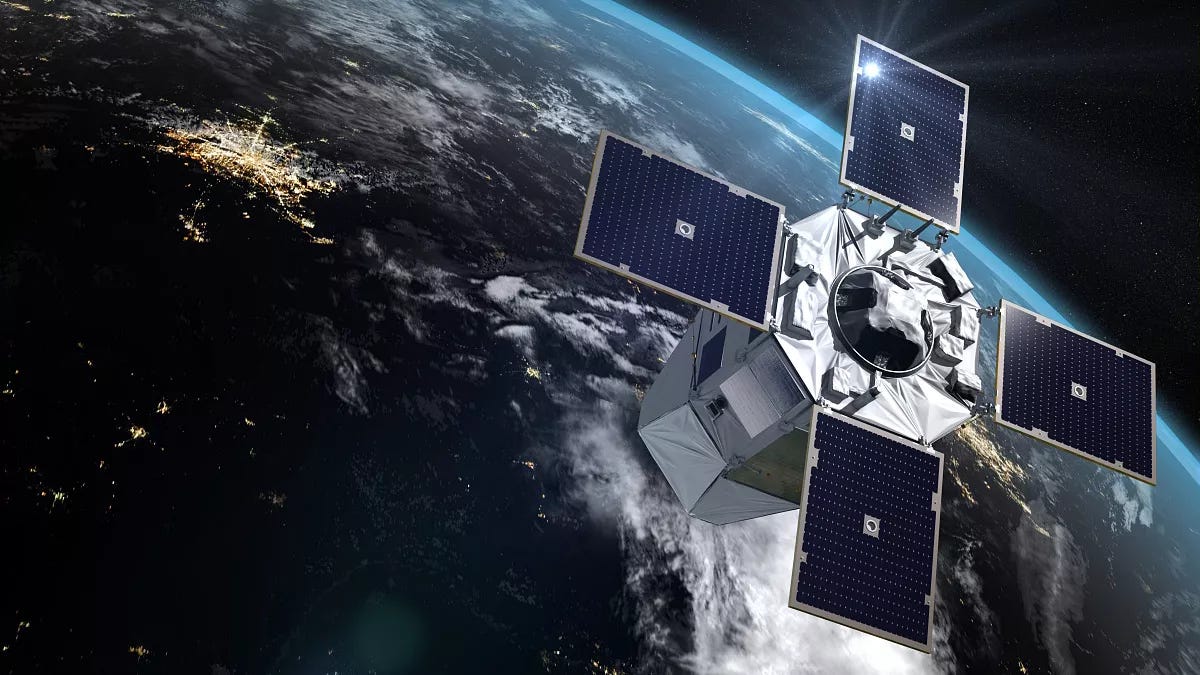
France’s crown jewel is the CSO constellation, short for Composante Spatiale Optique. It’s military optical reconnaissance, built for serious work, not for satellite nerds posting pretty pictures of airports on social media.
The CSO system has been rolling out across multiple launches, and France describes it as the successor to earlier French military imaging satellites, with a clear focus on higher resolution, faster tasking, and better revisit cadence.
The constellation is structured with one satellite optimized for broader-area work at higher altitude, another flying lower for sharper imagery, and a third used to tighten revisit windows.
A “35 cm per pixel” class image means each pixel represents roughly 35 centimeters on the ground, under good conditions, after the system does its processing, and once analysts account for the fact that real imaging has blur, noise, angle effects, and atmosphere.
Still, at that class of resolution, you can do a lot. You can identify vehicle parks. You can count aircraft on ramps. You can spot fresh revetments and new earthworks. You can see the geometry of camouflage nets, and you can notice when decoys are arranged like oddly staggered lines, the way the Russians do.
At the sharper end, the “around 20 cm per pixel” class is where the imagery becomes identification-grade instead of just detection-grade.
That’s where you stop asking “Is that a tank battalion?” and start asking “Which variant is that, and are those add-on armor blocks real?”
That’s also where you can catch the little tells that separate a real system from a prop: tracks that don’t match weight, shadows that don’t match geometry, and “air defense batteries” that look suspiciously like inflatable career decisions.
This is also where “revisit rate” becomes a weapon.
Revisit rate is the rhythm of a constellation. It’s how often you can see the same patch of ground.
In Ukraine, that’s not a nerd metric. It’s a clock on the wall. If a railhead is unloading, if a SAM battery is repositioning, if a missile unit has to shoot and scoot, you need frequent looks.
One clean picture every three days is a postcard from the Donbas. Multiple looks per day becomes operational awareness.
That’s the difference between “Russia has an S-300 somewhere in this region” and “Russia has an S-300 here, now, and if it moves, we’ll catch the tire tracks.”
The commercial layer, Pléiades, and why “commercial” doesn’t mean “casual”
When I was a kid, I would watch Carl Sagan’s Cosmos on PBS then I would then crawl onto my roof in Texas and stare at the stars. The Pléiades star cluster was always a favorite of mine.
France also has the Pléiades cluster, albeit manmade, including the more modern Pléiades Neo satellites. These are commercial systems in ownership and business model, but in practice they sit in the same ecosystem of national security tasking, especially when a government is a priority customer.
This is where people sometimes get cute and say, “Oh, commercial imagery is basically the same as military now.”
Sometimes that’s true in raw pixel terms. It is not true in access, tasking priority, latency, and the legal chain of custody.
Military constellations exist so a government doesn’t have to beg, wait, or negotiate when it needs an answer fast.
That said, commercial imagery is still a combat enhancer for Ukraine, because it provides volume. It provides redundancy. It gives you more looks, more angles, and more chances to catch movement.
The biggest edge is latency and tasking speed, tied to Airbus’s SpaceDataHighway concept, which uses laser links to relay satellites so data can get down faster than waiting for a satellite to pass over a ground station.
That matters because in war, “I saw it” is less useful than “I saw it and you can shoot it before it leaves.”
If a system can be tasked less than an hour before a pass and imagery arrives within minutes, you’re closing the loop.
You’re compressing the sensor-to-shooter timeline.
You’re giving Ukraine a chance to turn observation into destruction, or at least into a warning, while the target is still vulnerable.
It also changes behavior. When Russia believes it’s being watched frequently and quickly, it burns time on concealment, deception, and relocation. That doesn’t sound dramatic, but it’s corrosive. It steals tempo from an army that already struggles to generate tempo without a kick from Moscow.
Now we get to the part that scares Russia’s electronic warfare crowd.
CERES, France’s SIGINT constellation, and why triangles matter
Optical imagery tells you what’s physically present. Signals intelligence tells you what’s emitting.
In modern air defense and electronic warfare, emission is often the signature that gives you away, because you can hide the launcher, but it’s hard to hide the fact that your radar is shouting into the sky.
France’s orbital SIGINT capability is centered on CERES, the Capacité de Renseignement Électromagnétique Spatiale constellation, launched as a three-satellite system.
The architecture France described is the classic approach for geolocating emissions from orbit: multiple satellites in formation, measuring differences in signal arrival time and phase. Put simply, if you hear the same radar pulse at slightly different times from three points in space, you can triangulate where it came from.
This is geometry and it’s brutally useful.
If CERES detects air defense radars operating, it can help map where those systems are, and in some cases help classify them based on their emission characteristics. If it detects certain communications patterns, it can help infer where command nodes are, especially when those nodes are sloppy with discipline.
But there’s a ceiling on what a low Earth orbit SIGINT system can do.
A LEO SIGINT satellite only sees what it flies over. It’s not “always on” over a region the way geostationary SIGINT platforms can be. It’s powerful in bursts, in passes, and in windows, which means it’s best as part of a broader architecture: ground-based listening, airborne collection, allied feeds, and then the fusion that turns raw intercepts into actionable points on a map.
That’s a good moment to underline the point Macron is probably making.
France doesn’t need to replace every American capability to keep Ukraine fighting. It needs to replace enough of them, enough of the time, to keep Russia from achieving a decisive intelligence blackout.
That’s a different standard. It’s also a more realistic one.
So, what does France likely mean by “two-thirds”?
If you force this claim into a spreadsheet, it’s going to fight back. A lot depends on how “intelligence” is counted.
Is it volume of reports?
Percentage of imagery products?
Percentage of actionable alerts?
Percentage of “high-value” products?
Or is it the share of strategic intelligence that reaches national leadership, versus tactical feeds that go straight to units?
Macron’s framing suggests a political story more than a technical audit. It’s a signal that Europe has depth, and that Ukraine’s intelligence lifeline doesn’t run through a single valve in Washington.
And there’s a second audience here: European publics.
If Europeans believe Ukraine’s survival depends entirely on the United States, then European aid always feels optional, always feels secondary, and always feels like charity.
Macron is trying to flip that psychology. He’s arguing that French capabilities are part of Europe’s security, therefore part of Ukraine’s ability to keep fighting, therefore worth paying for.
This is also where France’s defense messaging has been consistent. It’s time to move away from the United [Authoritarian] States.
SAR, the weather-proof eye, and Europe’s patchwork solution

Optical satellites are incredible until they hit their oldest enemy: clouds.
Ukraine has weather. Ukraine has smoke. Ukraine has winter. Optical coverage is often degraded at the worst possible times, which is why synthetic aperture radar is such a big deal.
SAR can see through cloud cover and at night, and it’s excellent for detecting changes in terrain, movement patterns, and disturbed ground.
France does not field its own dedicated SAR constellation at the same level as its optical assets. Instead, it relies on exchange arrangements with partners like Germany and Italy, which have their own radar imaging capabilities and have structured cooperation across European intelligence frameworks.
This matters for Ukraine because SAR fills the gaps when optical can’t. It can confirm whether a trench line was expanded, whether a bridge repair is underway, whether tracks appear on a road that was supposedly empty yesterday.
There are two other SAR channels with direct relevance to Ukraine: Canada’s RADARSAT services in the past, and access via ICEYE imagery.
That’s the modern reality of intelligence support. It’s not one pipe. It’s a braided river of national systems, allied exchanges, and commercial products, flowing toward the same fight.
So where does the remaining “one-third” come from?
If Macron’s ratio is even directionally true, then the remaining slice is a blend of American support, other European contributions, and commercial and contracted services that Ukraine pays for.
So, is Macron’s claim believable?
As a literal, audited number, I wouldn’t bet my mortgage on “two-thirds” without seeing definitions.
As a strategic signal, it’s plausible in spirit.
France has high-end optical intelligence. It has a modern SIGINT constellation. It has the ability to task, receive, and distribute imagery quickly, especially when commercial systems can be folded into national tasking pipelines. It also has the political will to treat intelligence support as a core part of European security, not an optional add-on.
And here’s the point that matters more than Macron’s percentage.
Russia’s nightmare isn’t that Ukraine gets intelligence from one country. Russia can pressure one country. Russia can threaten one country. Russia can gamble on one election.
Russia’s nightmare is that Ukraine gets intelligence from an ecosystem.
An ecosystem is hard to intimidate. It’s hard to blackmail. It keeps working even when one node weakens. That’s what Macron is really bragging about, whether he meant to or not.
If France and Europe can keep Ukraine “seeing” at a high level, it changes the war’s ceiling.
It makes deep strikes harder to stop because Ukraine can better plan, confirm, and assess.
It makes Russian air defenses more vulnerable because emissions can be mapped, repositioning can be tracked, and decoys can be called out.
It makes logistics nodes less safe because movement patterns can be watched.
It also changes European politics. If Europe can credibly say it holds major pieces of the intelligence picture, then Europe’s role in Ukraine’s survival isn’t symbolic. It’s operational. That has consequences for how Europe views its own security posture, and how it bargains with Washington in moments of tension.
Macron framed this as strategic autonomy working.
Ukraine frames it more simply: keep the feed coming, keep the war machine moving, keep Russians dying instead of Ukrainians.
Both frames can be true.
And if you want the final irony, it’s this.
France built these capabilities to avoid dependence on allies. Now those capabilities are helping a country fight for its survival against a state that assumed Europe would stay dependent, timid, and slow.
Russia planned for a Europe that needed permission to see.
Ukraine is getting support from a Europe that decided it would rather build eyes than beg for eyesight.
That won’t win the war by itself. Nothing in space can substitute for people in trenches, interceptors in launchers, and shells in tubes.
But if Macron’s statement does anything useful, it’s reminding everyone that intelligence is a form of combat power, and that Europe isn’t as blind as Moscow hoped.
Слава Україні!


At the moment we (Italy) have an overabundance of COSMO-SkyMed SAR satellites as the four from the original constellation are still in orbit and working, while of the four COSMO-SkyMed Second Generation satellites three are already been launched (the first one on a Soyuz from Kourou!), with two already operational.
So probably part of those two-thirds come from data exchange between Italy and France.
vladimir vladimirovich, PUPPA!
And now it looks like latest sat tech can tell the difference between a banana and a mobile phone. Ouch!