


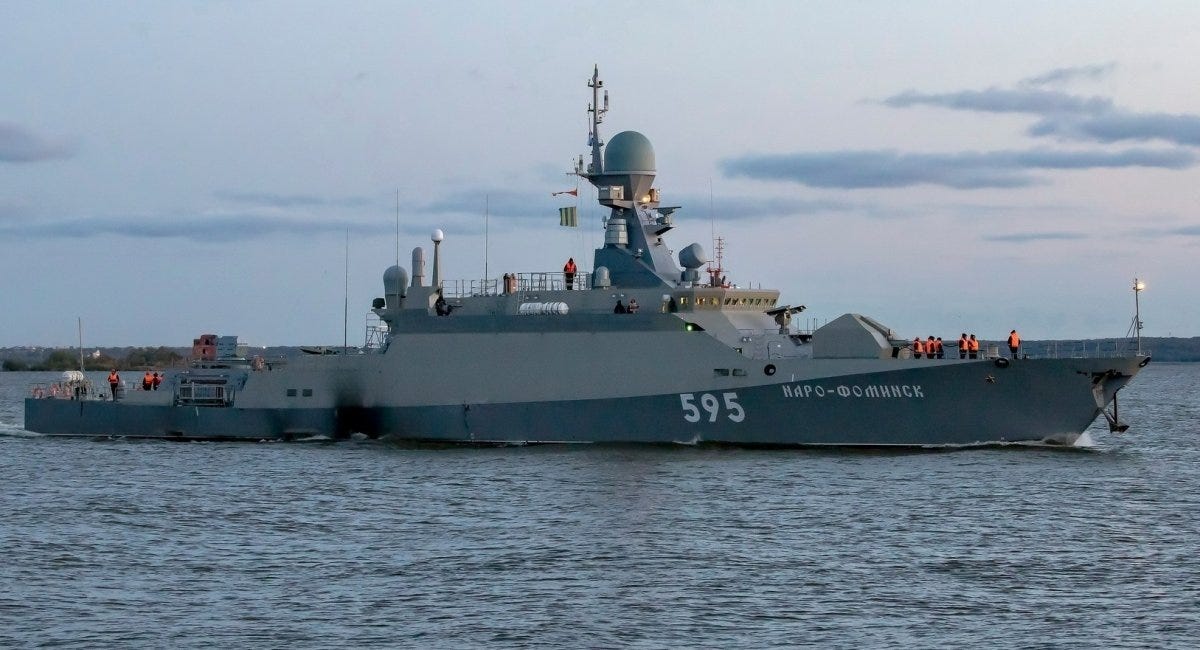
Somewhere in the Gulf of Finland, a Russian warship carrying enough firepower to strike targets more than a thousand miles away just got jacked like Wesley Snipes in New Jack City.
And Ukraine did the jacking.
Stop me if you’ve heard this one: Why does the new Russian navy have glass-bottomed boats?
So they can see the old Russian navy!
[Thank you, tip your servers.]
On November 11, Veterans Day in the States, Ukrainian drones struck the Naro-Fominsk, a Russian Buyan-M-class missile corvette operating in the Gulf of Finland near the Russian-controlled island of Gogland.
Hitting a Russian warship has become something of a Ukrainian specialty. The Black Sea Fleet can certainly attest to that. But this particular attack caught my attention for two reasons:
First, the Naro-Fominsk was operating in the Baltic Sea, a significant distance from Ukrainian territory. (The ship was also moving when the attack occurred.)
Second, the Estonian military says the vessel sustained more than three drone hits, suffered casualties, and eventually lost the ability to continue toward St. Petersburg under its own power.
Ukraine’s Security Service, the SBU, claimed responsibility and Finland’s military independently confirmed detecting a strike against a Russian warship in the area.
But naturally, Ukraine hasn’t identified the specific drones used in the attack or explained how they located the ship. Still, Ukraine has become exceptionally good at sending long-range attack drones into Russia to destroy oil refineries, ammunition depots, and industrial facilities.
But those are stationary targets.
An oil refinery’s location is listed on maps from thirty years ago.
A warship underway in the Baltic Sea is a harder engineering problem. So how did Ukraine manage to hit this one repeatedly?
Cruise missiles on a riverboat
The Naro-Fominsk belongs to Russia’s Project 21631 Buyan-M class, a family of relatively small missile corvettes originally developed for operations in coastal waters, rivers, and enclosed seas. The engineers took a compact warship, gave it a shallow draft so it could operate in shallow waters, and installed an eight-cell vertical launch system capable of firing Kalibr cruise missiles.
The Naro-Fominsk measures approximately 74 meters long, displaces around 950 tons fully loaded, and has a maximum speed of about 25 knots. For comparison, an American Arleigh Burke-class destroyer displaces roughly ten times as much.
And yet this small Russian vessel can carry the same family of Kalibr land-attack missiles used by much larger Russian warships and submarines. In October 2015, Russia demonstrated the concept when Buyan-M missile ships operating in the Caspian Sea launched Kalibr cruise missiles at targets in Syria.
The missiles traveled huge distances, crossing Iranian and Iraqi airspace before reaching their targets.
It was actually an impressive demonstration of distributed naval firepower for a military with the recent competence of Ronald McDonald.
This ship, the Naro-Fominsk, joined the Baltic Fleet in December 2023, giving Russia another platform capable of launching long-range cruise missiles from northern European waters.
The Buyan-M was built primarily to carry offensive firepower. Its relatively small hull leaves less room for defensive weapons than you’d find aboard a modern frigate or destroyer.
But she does have some impressive anti-aircraft hardware.
The Buyan-M carries an AK-630M-2 Duet close-in weapon system.
The Duet combines two six-barrel 30mm rotary cannons in a single naval mounting, producing a massive volume of fire against aircraft, missiles, and other nearby threats like, ahem, attack drones.
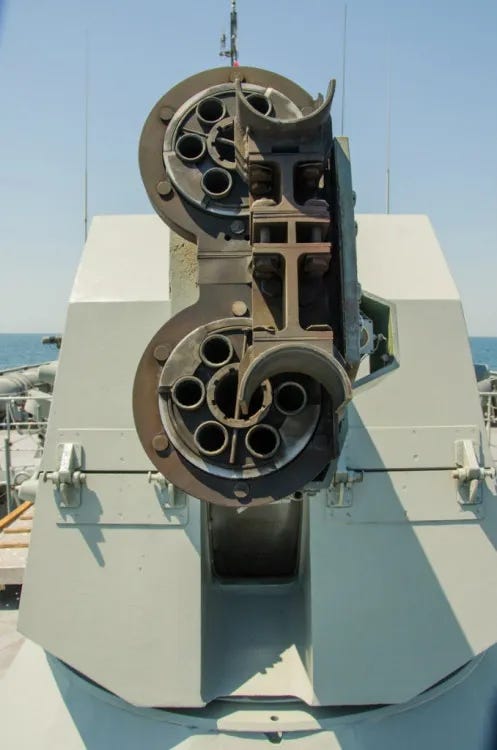
It’s basically Russia’s answer to the American Phalanx CIWS (Close-in Weapon System, pronounced See-Wiz) concept, although the systems differ in their fire-control architecture and mechanical design. The ship also carries short-range 3M-47 Gibka surface-to-air missile launchers equipped with missiles from the Igla family.
There’s a 100mm A-190 naval gun up front, plus additional machine guns.
So, the Naro-Fominsk wasn’t sailing around defenseless.
But a close-in weapon system depends on detecting the approaching threat, establishing a useful track, and bringing its weapons to bear before the target reaches the ship.
Twelve barrels sound impressive, and the Duet can throw an absolutely obscene amount of 30mm ammunition into the sky. Unfortunately for the Russians, the guns still have to know where to aim.
An approaching drone has to be detected, identified, tracked, and engaged before it reaches the ship. The smaller the target and the later the detection, the less time the system has to work. If several drones arrive close together, the crew may have to deal with more targets than it can comfortably engage in the available time.
We don’t know whether the Duet actually fired during the attack, so I’m reluctant to blame the gun itself. But having twelve barrels doesn’t accomplish much if the rest of the defensive system can’t put them on target.
Estonian Colonel Aron Kalmus offered an interesting assessment during a November 13 defense briefing: He explained that the corvette was designed mainly for long-range strike missions.
He also confirmed that several Ukrainian drones had successfully struck the vessel.
How many?
Kalmus declined to provide the precise figure, although he made an entertaining note about the difference between one hit being chance, two being coincidence, and more than three being a pattern.
Apparently, Ukraine established a pattern.
The ship initially attempted to return to St. Petersburg under its own power. According to Kalmus, it subsequently stopped and required assistance from another vessel.
He also reported deaths and injuries among the crew.
Geez, imagine joining the Russian navy to avoid service in the Ukrainian meat grinder… and then getting attacked by Ukrainian attack drones 1,000 kilometers away while singing “Merrily, merrily, merrily, merrily, Life is but a dream.” And then “Твою мать!”
(Literally “your mother,” this is a shortened version of a much longer, heavily profane curse [yob tvoyu mat’]. On its own, it functions like “Damn it!” or “Oh crap!” when something goes wrong.)
But what about hitting a moving target from many hundreds of kilometers away?
According to Estonian officials, the corvette was underway when the attack occurred.
A Buyan-M can make approximately 25 knots, or 46 kilometers per hour. That’s not super impressive by aviation standards, although it’s enough to make life hard for a targeter trying to hit it from hundreds of kilometers away.
Imagine Ukrainian intelligence locates the Naro-Fominsk at 8 AM. A drone launched toward those coordinates might take hours to arrive, depending on its starting point and speed. During that time, the warship could travel dozens of kilometers.
So, my question is how the drones dealt with that uncertainty.
Did Ukrainian intelligence provide a more recent location? Did the drones carry cameras capable of identifying the ship during their final approach? Was an operator controlling the weapons, or did onboard software handle the final targeting?
The SBU hasn’t released enough information to answer those questions. And I’m most interested in the third possibility because Ukrainian engineers have been making extraordinary progress with computer vision and autonomous terminal guidance.
Back when I worked aboard the E-3 AWACS, the radar could detect an aircraft, but getting a useful track was another matter. If you wanted to direct a fighter toward that aircraft, you needed to know where the target was headed, not simply where it happened to be when somebody first spotted it.
The same basic problem applies here, except Ukraine was trying to find a relatively small warship somewhere in the Baltic Sea, and we still don’t know what information its drones had when they approached.
And there’s another possibility worth keeping in mind.
The Naro-Fominsk was struck during a much larger Ukrainian operation against Russian infrastructure around Ust-Luga.
Ukraine says the attack was planned, which tells me the warship was an intended target, not a “target-of-opportunity” as part of a broader operation. And it does show that Ukrainian drones managed to hit a moving Russian missile ship repeatedly, with enough force to affect its ability to operate.
The Buyan-M was an attractive design when Russia could expect its small missile ships to operate under friendly air cover while launching long-range weapons. For years, their primary concern was how many Kalibr missiles those ships could fire and how far those missiles could travel.
The Naro-Fominsk strike suddenly forces Russia to question the protection required to keep such vessels operational.
No need to sink an expensive warship, here. If damage prevents the vessel from completing its mission, the attacker has already imposed an operational cost. That’s called a mission kill.
And based on Estonia’s account, the Naro-Fominsk may have suffered exactly that.
Russia will eventually repair the ship, assuming the damage isn’t more extensive than currently reported. But repairs consume dockyard capacity and maintenance resources, and they temporarily remove a missile-launching platform from the fleet.
Ukraine has shown plenty of ways to attack stationary targets across Russia, and its naval drones like Magura and Sea Baby have already given us a window into how vulnerable ships can be to inexpensive unmanned weapons.
It’s a morale booster at a time when Elon is throttling Ukrainian Starlink speeds and Witkoff and Kushner are driving around Europe in their clown car. Strikes like this remind Europe and the world that Ukraine will be an incredible future security partner.
So go right ahead, товарищ. Join the Russian navy to avoid infantry duty in Ukraine. They’ll still find you.
Слава Україні!