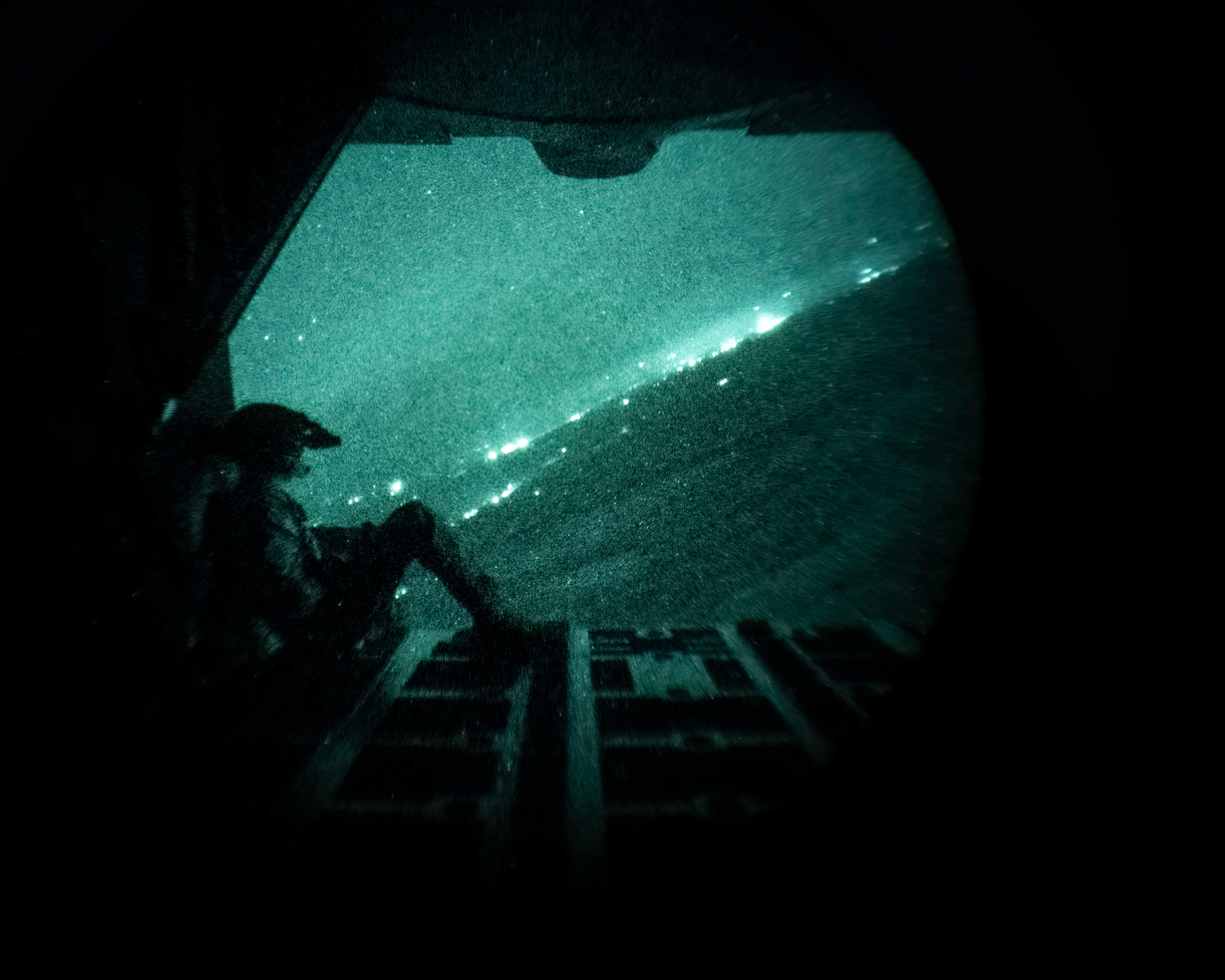
How the US Military Executed the Venezuela Attack
For adversaries watching from Moscow, Beijing, or Tehran, this operation should be unsettling

I should have known better. I was looking forward to a Saturday off to fix the basement stairs… No writing. No extra-strength Excedrin. Real, physical work!
I even went out to Menards and bought a reciprocating saw for the occasion.
We knew something like this was coming. The slow buildup of high-end, US military assets in the Caribbean felt like more than a show of force and far more than is needed to blow up the occasional fishing boat.
Interestingly, I just wrote an article that pondered the curious arrival of an E-3 Sentry AWACS near Venezuela last week. Now we know why. When you need a multidomain command picture and need to quarterback the movement of dozens of different interagency assets, you need Sentry; or something like it. (Ahem, Wedgetail)
When I was deployed to Ecuador with the AWACS in the mid-2000s (doing counter-drug operations with Joint Interagency Task Force South), we used the Sentry’s maritime function to track drug boats and planes and hand that information off to the US Coast Guard. In my article, I assumed (wrongly) that’s what this Sentry was doing down there this time.
Okay, I’m officially back at my desk scanning the feeds and calling my contacts. The stairs will have to wait until next weekend.
Here’s what we know:
According to reporting now echoed across multiple outlets, US forces captured Nicolás Maduro and his wife overnight in Caracas, then flew them to the USS Iwo Jima (LHD-7) before onward movement to the United States.
That sentence still reads like a chapter from Tom Clancy’s Clear and Present Danger. And yet here we are.
I’m going to keep this tight on the military mechanics, the force package, and what the restraint tells us. I’ll credit The War Zone for being early in flagging Iwo Jima’s central role and the broader force posture that made this possible.
What we can say with confidence so far
The public narrative, stitched together from US statements and multiple reports, looks like this: months of planning, a narrow window, a rapid “snatch” mission at a heavily protected residence, and a fast exfiltration under fire.
Thank to reporting by the New York Times, we know the CIA has been on the ground in Venezuela for some time. They were almost certainly collecting the intelligence necessary for this exact operation.
US officials described a five-hour operation with more than 150 aircraft launching from roughly 20 bases across the Western Hemisphere, with a helicopter-borne ground force as the core maneuver element.
If those numbers are accurate, this was not a raid. This was a joint campaign compressed into one night.
Start with the centerpiece: USS Iwo Jima.
A quick aside: When I was in high school in Texas, I was a member of the Air Force junior ROTC. We were invited to march in three Mardi Gras parades in New Orleans, and we stayed aboard the USS Iwo Jima while we were there.
A Wasp-class LHD is a Swiss Army knife that swims. It gives you a flight deck, fuel, maintenance, command spaces, medical capacity, and the ability to surge rotary-wing sorties without asking anyone’s permission to use their runway.
If you want to push helicopters into a denied or semi-denied area and pull them back out fast, a big-deck amphib is the kind of platform you park nearby.
That matters because the reported “tip of the spear” was US special operations aviation. Multiple reports point to a large contingent of 160th Special Operations Aviation Regiment or SOAR helicopters, also called the Night Stalkers, involved.
The 160th’s whole personality is flying low, at night, in bad weather, into places that don’t want them there, and bringing your people home anyway.
For reference, it was the Night Stalkers who played a critical role in the raid that killed Osama bin Laden (Operation Neptune Spear).
I’ve personally ridden with the Night Stalkers at Fort Campbell while in the Army… They can do some crazy shit with helicopters. I should note that I was not special forces, I was just hitching a ride as a grunt.
In Venezuela, those helicopters carried US Army Delta Force soldiers along with FBI agents who would perform the actual snatch (or kill if Maduro resisted).

Some readers might be wondering what the difference is between Delta Force and a group like the US Navy SEALs.
Well, first of all, SEALs always have a promising career in Hollywood waiting for them after their service… Or a lucrative book deal. Fucking prima donnas.
Delta are the “quiet professionals”.
Jokes aside, Delta Force and SEAL teams are both elite Tier 1 special mission units under JSOC, handling complex counterterrorism, hostage rescue, and direct action missions, but differ in their backgrounds and specializations. Delta excels in land-based, covert operations, while SEAL Team Six (DEVGRU) retains maritime roots, training SEALs for sea-based operations.
SEALs could have easily performed this operation and they may have been involved, but my initial sources are telling me it was Delta.
Reports from multiple outlets confirm that FBI Hostage Rescue Team (HRT) agents, physically executed the takedown of Nicolás Maduro inside Caracas.
That pairing, America’s most elite special mission unit (Delta) and its most capable federal law enforcement strike team, is unusual but not unprecedented.
It signals one important thing: Washington wanted Maduro alive and in custody, not vaporized.
Delta Force, formally known as 1st Special Forces Operational Detachment-Delta (Airborne), is the Army’s top-tier counterterrorism and direct action unit. Their bread and butter isn’t messy firefights or holding ground, it’s surgical raids, high-value target snatches, and hostage rescue under conditions that would make most mortals short-circuit.
If a door needs breaching in a palace defended by an armored brigade, Delta is who goes through it.
The FBI’s Hostage Rescue Team, meanwhile, exists in that strange intersection between domestic law enforcement and tactical counterterrorism. They’re federal agents first but trained to the same operational standard as their military counterparts.
When American leadership needs a mission with law enforcement optics like arrest warrants, indictments, legal custody, the HRT adds the thin blue veneer that separates an extradition from an invasion.
In practice, the operation probably looked like this: Delta cleared the perimeter and neutralized armed resistance. HRT followed close behind, securing the detainees and beginning immediate chain-of-custody procedures to satisfy Justice Department requirements.
The Night Stalkers with their Delta/FBI contingent were supported by an impressive stack of US military hardware: F-22s, F-35s, F/A-18s, EA-18s, E-2s, B-1 bombers, Sentry, and “numerous” remotely piloted aircraft.
F-22s are air dominance and high-end insurance. They deter or swat down any manned aerial response, and they do it before the other side’s pilots finish their climb.
F-35s are the quiet burglars. They sniff emitters, map threats, and cue strikes. If you want to dismantle air defenses quickly, you bring the jet that was built to hunt radars. We currently don’t know how many air defense systems the F-35s removed, but I’m sure we will learn more in the coming days.
F/A-18s and EA-18Gs are the Navy’s workhorses for strike and electronic attack. The Growler exists to turn an air defense network into a migraine.
An E-2 Hawkeye is the Navy’s “baby Sentry” airborne battle management. It gives the air picture, deconflicts assets, and helps keep fratricide from becoming the main headline.
B-1s presence signals: if you escalate, we will flatten the area. They also provide standoff fires and a psychological effect that Venezuelan air defenders will be aware of.
E-3 Sentry is the quarterback.

Reporting mentioned SPACECOM and CYBERCOM “layering effects” to create a pathway overhead. This is telling: it suggests a blend of jamming, network disruption, and perhaps cyber actions against sensors and command links. You don’t need to destroy every radar if you can blind the picture, confuse the chain, and keep it that way for the one-hour window you need.
Reportedly, the helicopters flew in at about 100 feet over water on the way to Venezuela.
That is classic low-observable-by-physics flying. Radar horizon is a cruel thing. Sea clutter is a gift. Terrain masking buys you minutes, and minutes are the difference between a “surprise” and a “running gun battle through a city.”
When the formation hit the last terrain that had been hiding them, the assessment was that surprise held. That is the whole game in raids like this.
If surprise collapses early, you start spending lives to buy back time.
Trump described a “fortress-like” house and a steel “safety space,” and said US forces had blowtorches and other tools ready if Maduro made it inside.
That implies rehearsals against hardened doors, contingency planning for a barricade scenario, and a ground force configured for rapid breach. That also implies they wanted him alive. If the mission were kill-focused, the safe room becomes a tomb, not a problem set.
Why the restraint is real, and why it was still violent
Two things can be true at once.
First, the reporting emphasizes that the US prepared for “lethal” follow-on options, yet took Maduro and his wife into custody, with claims of no US fatalities and only limited injuries, plus a helicopter hit but still flyable. That indicates discipline in the objective.
Second, the official description includes “multiple self-defense engagements,” suppressive fire during exfiltration, and a deliberate dismantling of air defenses for safe passage. That is not a gentle arrest. That is controlled violence.
So why capture instead of kill?
Because capture buys you three advantages a body never will.
It buys intelligence. A live detainee can be exploited for networks, finances, and command structures.
It buys legitimacy, or at least a legal storyline. US officials have pointed to indictments in New York, and they are framing this as law enforcement supported by military force. Hence the FBI tagalong presence.
It avoids martyr-making. Killing a leader turns them into a symbol. Capturing them turns them into a defendant, which is less romantic and more effective.
Personally, I think this showed a tremendous amount of restraint when a Predator drone could have simply dropped a Hellfire missile into Maduro’s bedchamber.
The operational lesson: America still does “joint” better than anyone
If the reporting that more than 150 aircraft launched from roughly 20 different bases holds up, then this was not just a successful raid. It was a logistics and command-and-control flex that very few countries could even attempt, let alone pull off in one night.
That scale matters, not because of the raw number of aircraft, but because of what it implies about coordination, trust, and institutional muscle memory.
This kind of operation is a rolling catalog of failure points.
Miss one timing window and helicopters arrive before electronic warfare coverage is in place.
Lose one datalink and air defenders get a glimpse of something they were never supposed to see.
Misjudge weather by a narrow margin and low-level flight turns from stealthy to suicidal.
Add urban terrain, dense civilian airspace, and a hostile capital city, and the margin for error shrinks to something measured in seconds, not minutes.
What makes it impressive is not that the US can fly a lot of airplanes. Plenty of countries can do that. It is that those airplanes belong to different services, operate under different authorities, launch from different sovereign territories, and still arrive on time, on task, and mutually supporting.
Fighters sanitize airspace. Electronic attack blinds radars. ISR platforms stitch together a real-time picture. Tankers quietly keep everyone fed. Rotary-wing aircraft slip through gaps that were deliberately opened and then deliberately closed behind them.
That does not happen by accident. It happens because joint operations in the US military are not an aspiration. They are a habit.
Decades of training, planning, and frankly bureaucratic pain have gone into making sure the Army talks to the Air Force, the Navy talks to Space Command, and Cyber Command does not do something clever that accidentally gets someone killed.
Every service knows how to plug into a common architecture without trying to dominate it.
And this is where the phrase “integration” starts to feel inadequate.
Integration sounds static, like wiring systems together and hoping they cooperate. What happened here was dynamic. Effects were layered in real time, adjusted on the fly, and synchronized down to the minute. This was orchestration under pressure, with real people, real aircraft, and real consequences if anything slipped.
There is also a restraint embedded in that complexity that is easy to miss.
This was not a saturation strike or a show of overwhelming firepower for its own sake. The force package was large because it had to control escalation, not trigger it. Air defenses were dismantled just enough to protect the helicopters, not enough to flatten the country.
Firepower was available, but tightly leashed. The mission design assumed that surprise was more valuable than destruction, and that precision mattered more than dominance.
That balance is hard. It requires confidence in your systems and your people. It requires commanders who trust that subordinates will execute without freelancing, and political leadership willing to accept that the cleanest outcome is not always the loudest one.
Many militaries can punch hard. Very few can punch precisely while keeping every other fist clenched.
For adversaries watching from Moscow, Beijing, or Tehran, this is the part that should be unsettling.
Not the number of aircraft, but the ease with which they were synchronized. This is what a global expeditionary force looks like when it decides to act deliberately, quietly, and with intent. The gloves come off in planning. The rules stay on in execution.
And surprise, once achieved, is treated as a finite resource to be protected at all costs.
That is the real lesson. The United States did not just conduct a raid. It demonstrated that when it chooses to, it can align air, land, sea, space, cyber, intelligence, and law enforcement into a single coherent action without telegraphing the punch.
That capability is not flashy. It does not trend well on social media. But in military terms, it remains one of the most decisive advantages on the game board.
The Russia, China, Iran angle: expect the propaganda package by morning
Let’s clear this up straight away: Maduro was a bad dude. He was recognized as Venezuela’s legitimate ruler only by Russia, China, Iran, and other jerkoff regimes. While nearly every country in Western Europe, Canada, the US, and the UK refused to acknowledge his presidency due to the 2024 election controversy.
You’re going to hear a lot of commotion in the press in the next few days that is going to say that his capture was a bad thing.
Whether the Trump administration acted legally is beyond the scope of this analysis. Let the right-wing and left-wing media outlets duke it out in the public sphere. My focus is on the military side and, by all accounts so far, these men and women seemingly performed their roles exceptionally well.

But be aware…
Even if Moscow, Beijing, and Tehran had zero love for Maduro personally, they love one thing more: a narrative that says the US acts like an empire and everyone else just “responds.”
Here are the Kremlin talking points you should expect, because they are predictable and lazy.
They will call it an illegal kidnapping, a sovereign violation, and regime change at gunpoint.
They will staple it to Iraq, Libya, and Panama, then pretend Ukraine is the same category.
They will also try the moral judo move: “See, the West does it too.”
Now the part that matters: the comparison is flawed, even if it lands emotionally with some audiences.
Russia invaded Ukraine, tried to erase it as a state, annexed territory, and has run a documented campaign against civilian infrastructure.
A targeted snatch operation, justified or not, is not the same as a genocidal war of conquest. Those two aren’t even in the same universe, let alone same category.
It does not excuse Moscow’s behavior. It does not launder Mariupol, Bucha, or the missile terror campaign into “normal great power conduct.”
Propaganda works when it compresses complexity into vibes. Your job as a reader is to refuse the compression.
Here’s the uncomfortable part for everyone.
A spectacular raid like this can produce two opposite effects.
It can deter. It shows capability, reach, and the ability to impose costs.
It can also make paranoid states more paranoid. That includes Russia, which already sees CIA ghosts in every shadow and has a long history of turning ambiguity into worst-case assumptions.
If you want a recipe for bad decisions, give a nuclear-armed leadership a reason to believe decapitation operations are on the menu everywhere.
Trump also stated in his press conference that the US will “run” Venezuela “until such time as a safe, proper and judicious transition can take place.” Jesus… did we learn nothing from Iraq? The last time we were successful at running a country not our own was 1945. Everything since has been a shit show.
Wait, I promised myself no politics. Eject! Eject! Don’t get pulled in!
Militarily, this operation, as described, looks like an airborne special operations raid wrapped in a full-spectrum joint bubble: stealth, electronic attack, command-and-control, standoff firepower, cyber and space effects, and a maritime launchpad that keeps the whole thing independent of host-nation politics.
Politically, it will generate noise. Moscow will lie about it. China will file a complaint with the United Nations. Some commentators will confuse “looks similar” with “is the same.” They will be wrong.
From the military angle, the headline is simpler: the US just demonstrated it can reach into a defended capital, isolate a target, and leave with him alive. That is restraint with teeth, not teeth without restraint.
Слава Україні!


I hope this article didn't come across as flippant or disregarding the potential illegality of US actions. I wanted to focus on the military execution (based on what we know so far) mainly because a larger discussion around what this means for allies and adversaries deserves its own dedicated article, maybe even a book.
So, let me be clear. This operation is fresh. Emotions are running high. US allies have a lot of uncertainty because the predictable, stable United States of yesteryear is now gone. We are now in an era of a nation loosening its moral restraints, that also happens to have a very powerful military - not a great combination.
I am an old school global security wonk. I believe in the post WWII global order, honoring our alliances, respecting international law, and holding enemies accountable. Jesus this sounds like I'm running for Congress. Please feel free to comment your concerns about what appears to be an alarming action by the United States. Just remember, that my focus was on the safe execution of a complex mission by the men and women of my armed forces; and I'm proud of their performance.
And if they wanted to, they could use those resources to help Ukraine to defeat Russia.
But America is now on the side of Putin’s Russia. And whoever offers the most potential reward to Trump and his corrupt oligarch supporters