Hunter Wolf is the US Army’s Newest Ground Robot - Just Don't Call it a Robot
Lessons from Ukraine applied to a Western maneuver force

When I was in high school, I read a sci-fi novel called Cold Allies by author Patricia Anthony.
Released in 1993, the book depicts a near-futuristic world war where an Arab National Army invades Europe amidst ecological collapse, while the combatants simultaneously come to terms with alien visitors who decide that global war is the best time to stop by and say hi.
I still remember this book distinctly for one reason: The American way of warfighting was completely remote-controlled. No human soldiers.
Keep in mind, this was the roaring 90s; UGV’s were pure sci-fi, so the fact that one of the American characters controlled a ground-based combat drone with virtual reality goggles was completely fresh.
(This book actually made me want to buy the Nintendo Virtual Boy, until I tried a demo in Toys R Us in 1995. That thing gave me a headache.)
We’re creeping closer to Anthony’s fictional world every day.
In case you missed it, Ukraine just used unmanned ground vehicles to help seize a Russian position without sending infantry directly into the kill zone. No human soldiers! That’s a real milestone, and it deserves the attention it got.
What it doesn’t deserve is the usual burst of overheated coverage about “robots” taking over the battlefield.
Small gripe here, but that word is doing a lot of damage. To most readers, “robot” implies autonomy, a machine thinking and acting on its own.
That’s not what we’re talking about here. “Unmanned ground vehicle,” or UGV, is the uglier term, though it’s the more honest one.
A UGV may be remotely operated, partially automated in narrow functions like navigation or obstacle avoidance, or, someday, fully autonomous. Those are very different categories, and a lot of the press has been steamrolling right over that distinction and confusing the hell out of the public.
Anyways, Ukraine’s recent UGV success is incredible, but Ukraine is solving one battlefield problem. The US Army is trying to solve another.
Ukraine is fighting a brutal war of attrition along a heavily surveilled static line, where sending a machine forward instead of a soldier can mean the difference between holding a position and losing another squad.
The US Army is built around maneuver warfare, speed, depth, and keeping formations moving across large distances.
Same family of technology, different battlefield job.
Which brings me to an interesting UGV story coming out of Fort Polk, or Fort Johnson, wait, I mean back to Fort Polk, (I wish they’d pick a name) where the Army is grinding through what unmanned ground systems look like inside a maneuver force.
I’ve been to Fort Polk twice. The first time was in high school, when my Air Force JROTC unit drove from Dallas to compete in an obstacle course competition. I don’t remember my time on the course. I do remember learning a valuable lesson about stopping too suddenly after extreme physical activity.
I puked my guts out.
Nobody told me you’re supposed to walk for a while (after sprinting for an hour) to bring your heart rate down slowly. Common sense, you say? Apparently not… lol
The second time was in 2000, when I went back as a light infantryman with the 101st Airborne. JRTC, the Joint Readiness Training Center, is where Army units go to find out whether their nice clean tactics can survive mud, confusion, sleep deprivation, and an opposing force that knows the terrain better than they do.
A capability that looks impressive in a demonstration means shit. A capability that survives JRTC starts to become real.
That’s what makes the Army’s work with unmanned ground systems there worth watching.
As of now, American military doctrine is still built around maneuver, speed, mass, and combined arms effects at depth. The Army wants to dislocate and collapse enemy formations.
Granted, the US may be forced into an attritional fight, like Ukraine’s, at some point in the future, but for now, that difference changes the robot requirement completely.
In Ukraine, a ground robot may need to creep forward through an exposed strip of battlefield and complete a narrow task under constant enemy observation.
In a US Army infantry context, a ground robot has to move with the force, support tempo, extend operational reach, and reduce the number of soldiers doing dangerous but necessary support work.
Less dramatic than “robot captured trench,” sure, but potentially far more consequential in a future US fight.
Meet the Hunter Wolf
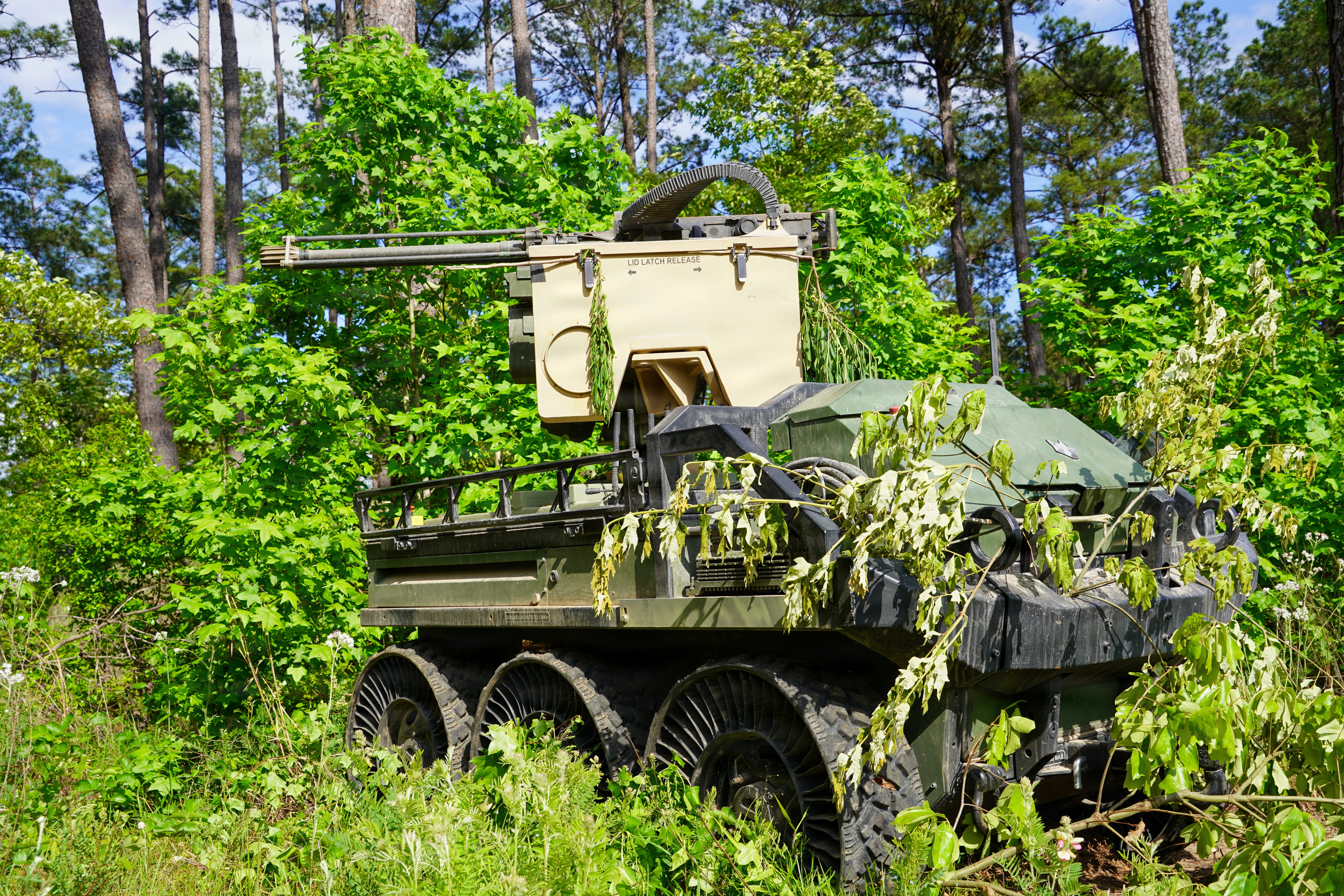
The Hunter Wolf is the Army’s selected Small Multipurpose Equipment Transport platform; a hybrid-electric 6x6 unmanned ground vehicle built to carry serious loads over rough terrain and keep pace with maneuver forces.
In this video, a Hunter Wolf unmanned ground vehicle assigned to Charlie Battery, 3rd Battalion, 320th Field Artillery Regiment, 3rd Mobile Brigade, 101st Airborne Division (Air Assault), holds a steady overwatch position with a mounted remote operated .50-caliber machine gun traversing its sector during a combat simulation exercise at the Joint Readiness Training Center, Fort Polk, Louisiana, April 13, 2026. The Hunter Wolf platform has been selected by the US Army for the Small Multipurpose Equipment Transport (S-MET) program. (US Army video by Master Sgt. Anthony Hewitt)
Depending on configuration, it can haul north of 2,200 pounds, with some variants pushing toward 2,800. It offers long off-road range, a silent-mobility mode that would make any infantryman jealous, steep grade performance, pivot turning, and onboard exportable power.
It’s also certified for transport aboard V-22s, C-130s, C-17s, and C-5s.
Hunter Wolf is already pushing well past the old “robot mule” concept. For years, a lot of unmanned ground vehicle discussion basically amounted to this: what if the robot carried the rucksacks?
Trust me, this might not sound revolutionary to a non-combat arms POG flying a desk at the Pentagon, but I’ve had my knees give out while carrying too much weight and had to be MEDEVAC’ed out by Blackhawk at, yep, you guessed it, JRTC Fort Polk. But at least I didn’t puke.
If I had a mechanical beast-of-burden to carry my machine gunner’s 2,000 rounds of 7.62 ammo, I wouldn’t have gotten a free helicopter ride and six months of physical therapy.
Still, the Hunter Wolf gets more interesting when you stop thinking of it as a pack animal and start thinking of it as a mobile node for payloads, power, sensing, and security.
It can carry ammunition, water, batteries, sensors, and weapons. It can feed power to the systems mounted on it. That means it’s not just reducing soldier load, it’s extending the operational life of sensors, remote weapons, and forward positions without requiring more humans to solve the problem.
That’s a meaningfully different battlefield role.
In this video, US Army Soldiers assigned to Charlie Battery, 3rd Battalion, 320th Field Artillery Regiment, 3rd Mobile Brigade, 101st Airborne Division (Air Assault), transport cargo using a Hunter Wolf Unmanned Ground Vehicle (UGV) during a combat simulation exercise at the Joint Readiness Training Center, Fort Polk, Louisiana, April 13, 2026. The Soldiers utilized the UGV to move several Pelican cases across rugged terrain, simulating logistics support in a contested environment. (US Army video by Spc. Mariam Diallo)
The radar changes the story
The real signal that this platform is evolving beyond a cargo hauler is what the Army has started pairing with it.
Mounted with Echodyne’s EchoShield radar, the Hunter Wolf starts being a moving sensor platform that can contribute to local surveillance and airspace awareness while the formation advances or holds.
EchoShield is a software-defined, pulse-Doppler 4D radar built around an electronically scanned array. It gives a unit the ability to detect, track, and update moving objects with enough speed and precision to see in a chaotic tactical environment.
The specs are impressive. Wide field of view, fast update rates, the ability to track a large number of objects simultaneously, and the capacity to push target data into larger networks.
It’s designed for static, portable, and on-the-move employment. The advertised detection ranges are significant for both perimeter surveillance and counter-drone work.
Now, spec sheets have lied before, defense marketing has never been a monastery of self-restraint, and real-world performance will take hits from clutter, terrain masking, weather, and the general chaos of combat.
Still, even with that degradation factored in, this kind of radar gives a small unit something it routinely lacks at the edge of a formation: persistent, machine-driven surveillance that doesn’t get tired, doesn’t get distracted, and doesn’t fall asleep at a critical observation post at 0300 because it was on its fourth consecutive night shift. I’ve known soldiers who could have used this coverage.
Ukraine’s drone war has proven that logistics routes, support areas, ammunition points, temporary halts, and exposed flanks are all part of the kill chain now. There are no rear areas anymore; just places that haven’t been hit yet.
A platform like the Hunter Wolf, especially with onboard sensing, gives commanders a way to push that security bubble outward without immediately adding more human exposure to do it.
Tack on a .50-caliber remote weapon station and the concept takes another step.
Now the Hunter Wolf can do three jobs simultaneously: haul sustainment loads, extend the unit’s sensor horizon, and provide local security.
That combination is what makes it doctrinally interesting. It helps a commander solve the ugly little tactical equations that otherwise cost time, manpower, and risk.
Do you send soldiers forward with resupply, or keep them back to secure the route?
Do you post someone on an exposed flank to watch for infiltrators and drones, or accept a blind spot and hope nothing crawls through it?
Do you burn combat power protecting support movement, or gamble and keep moving?
A platform like this doesn’t magically eliminate those choices. But it does give commanders a better set of tools to work through them.
One Hunter Wolf moves cargo. Another sits in overwatch, radar scanning, weapon oriented toward likely threat avenues. The Army imagery from the April JRTC rotation appears to show exactly that logic; one platform hauling, one covering.
The Hunter Wolf doesn’t need to replace infantry to be relevant. It only needs to reduce how often infantry are burned on tasks that machines can handle well enough.
On modern battlefields, useful tends to outlast glamorous by a wide margin.
The Army’s problem is not Ukraine’s problem
This is where the Ukraine comparison requires some discipline.
Ukraine’s robot employment is shaped by attrition, static exposure, and the hard demographic reality of replacing losses in a prolonged war. The US Army’s problem set is different: it’s trying to preserve ops tempo across a dispersed maneuver fight while reducing exposure to drones, indirect fire, and an increasingly transparent battlefield.
That means American unmanned ground systems need to keep pace with formations, cross difficult terrain, integrate into command structures, survive electronic warfare, and remain useful when networks degrade.
That’s a harder engineering problem.
A robot assisting a limited assault across open terrain is one thing. A robot supporting a fast-moving combined-arms force across wide expeditionary distances is something else entirely.
None of this means the Army has cracked unmanned ground warfare.
Terrain remains a serious obstacle. Human legs still go places that wheels and tracks hate. A robot that performs beautifully in a training field can become a liability in dense jungle, urban rubble, mountain trails, or the kind of mud that swallows vehicles whole.
The Army doesn’t get to choose only the battlefields where robots feel comfortable.
The electromagnetic environment is another problem. Any platform dependent on continuous communications is vulnerable to jamming and disruption.
Russia and China both understand that. So do smaller adversaries with increasingly common access to electronic warfare tools.
True autonomy would reduce that dependence though meaningful battlefield autonomy in chaotic terrain under fire is still a long way from ready. Civilian self-driving systems already struggle with traffic cones, bad weather, and edge cases in environments designed specifically for cars. A battlefield is worse in every possible way, with the added feature that the enemy is actively trying to break your machine.
Then there’s the human problem, which is always the real problem. Technology gets fielded faster than doctrine can absorb it. Units need clear procedures for tasking, control, handoff, recovery, and engagement authority.
They need to know what happens when the link drops, who decides whether to risk the platform, and how much trust to place in the machine during movement and contact.
This is where the US can really learn from Ukraine’s pioneering work with UGVs alongside human soldiers.
What the real lesson looks like
Ukraine has shown that any machine capable of absorbing danger in place of a soldier deserves serious attention. That lesson is real.
The mistake is assuming it ends there.
What matters for the Army isn’t whether it can recreate Ukraine’s exact robot assault on another battlefield.
What matters is whether it can develop unmanned systems that support maneuver, extend sensing, protect exposed routes and flanks, reduce support burdens on infantry, and preserve combat power on a battlefield where anything visible is targetable.
That’s why the more revealing robot story may be the one unfolding at JRTC right now. Because it’s asking the harder question: what does a genuinely useful battlefield robot actually look like for the US Army?
The Hunter Wolf doesn’t answer that completely.
The technology is imperfect.
The doctrine is still being written.
The vulnerabilities are obvious.
But it points toward a more serious future than the old robot-mule pitch ever managed. It suggests the Army is starting to think of ground robots less as gimmicks and more as components of a wider tactical system.
That’s the part worth watching.
Слава Україні!


Hi Wes, just thinking about a future between to equally capable armed forces, say USA and China, not too far in the future, against the trajectory of Ukrainian R&D and application- this type of vehicle/ weapon will be obsolete. What will be the game changer is the weapon that escapes the Ukranian type of trajecory, upward, out of the box, re-thinking of the current fluid paradigms. Give the hunter wolf ability to fly, to move and react at high speed, or just hovering in place for hours, give it lazers, 360 sight, infused with AI but at command of a human being.
War is a terrible business.
Good write-up. Glad you weren't the skinny guy in the photo who is trying to show non-existent biceps.
I've wondered, when devising new battlefield vehicles, does the military just work up all-terrain dry season, woods, hills, winter and mud or something else? In case of a real ground war they can't assume that Louisiana is their default for design.