


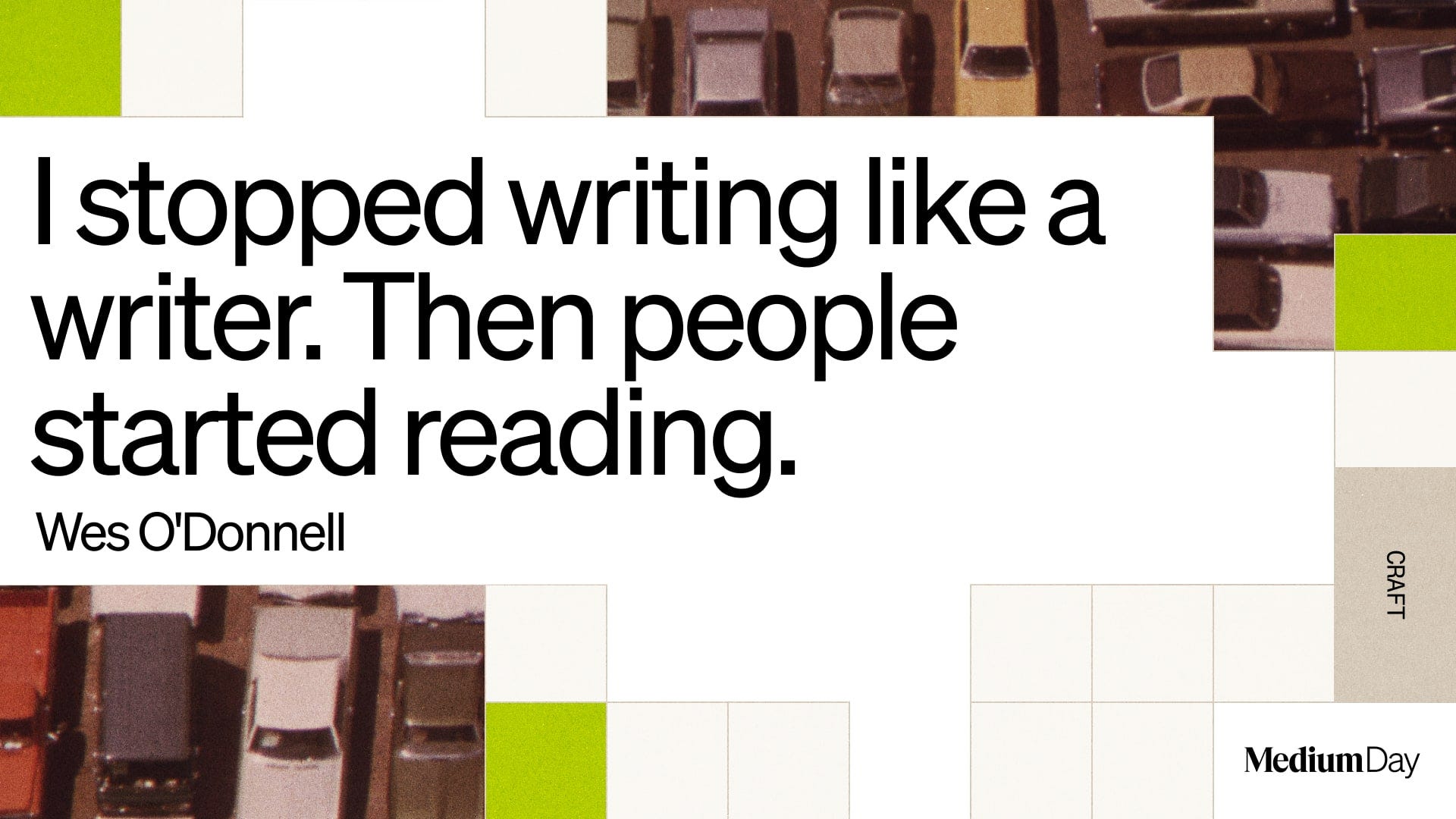
There are a lot of different ways for a writer to find their “writer’s voice.” On Friday September 18, I’ll be hosting a session at Medium Day 2026 about how I found mine, the journey that got me there, and six questions to ask yourself… (a ‘voice audit’ of sorts), that will help you dial it in.
I’m not a coach.
I’m not a guru.
I will never try to sell you courses.
I typically never write about writing. But I think this is a good opportunity for aspiring writers to learn how their human “voice” can really help their work stand out in the age of slop.
I’ve been writing professionally (for money), since 2015, and on Medium since November of 2018. From a purely technical perspective, my writing back then was on point; I knew how to structure an argument, I could write clean sentences, and I could sound polished, measured, and credible.
My mentor was the incomparable writing instructor Shani Raja, former editor for Wall Street Journal. He now publishes courses on Udemy. (highly recommend)
But at the time, I also sounded like every other competent person with a keyboard and a Mocha Cloud Macchiato from Star-bizzle: Just fine.
After Russia’s full-scale invasion of Ukraine in 2022, that changed.
I stopped writing like someone trying to prove he could write, and I started writing in a conversational voice. That shift took me from a few hundred followers to hundreds of thousands across several platforms.
And it all started at Medium. This Friday, I want to talk about what changed for me.
Medium Day is Medium’s free, live, virtual gathering for writers, readers, and people who still believe the internet can occasionally be used for something better than doomscrolling, the inexplicable antagonization of Canada, and Google Gemini summaries.
This year, it runs on Friday, September 18, from 8 a.m. to 8 p.m. EDT, entirely on Zoom.
It’s FREE
You’ll need Zoom, but you don’t need a paid Zoom account. The free version works fine.
Wait Wes, why should I listen to you?
By 2015, I was trying to take writing seriously. I had opinions, experience, and a dangerous amount of [over]confidence. What I didn’t have yet was a fully formed voice.
I was still writing toward credibility, which is different from writing from it.
When I started writing on Medium in 2018, I treated it like a proving ground. I wanted the work to be smart. I wanted it to be clean. I wanted it to be taken seriously.
That helped me become a better writer, sure. But it also taught me the limits of polish. Polish can remove mistakes. It can also remove your fingerprints.
Back in those days, Medium used to have roving editors stalking the platform like a pack of gray wolves and would occasionally ask to republish one of my better articles to larger in-house publications like GEN, OneZero, or An Injustice.
They would offer around $200 for this which, at the time, was the best feeling in the world.
I was big into cybersecurity writing back then and one of my early republished articles was a piece where I interviewed NASA to see if it were possible to hack into a spacesuit. NASA wisely declined to comment but several cybersecurity firms were confident they could do it.
Ugh, I’m getting off topic.
For the most part, that early work was bland with only rare glimpses of my personality coming through to the page. I should have picked up on it at the time, but looking back now, I see that it was only the articles with my real voice peeking through miniblinds that ever got picked up by Medium’s editors.
Take this completely respectable sentence from a blog post a VPN provider paid me real money to write back in 2020:
“For at least 12,000 years, humans have been living alongside cannabis. From the invention of agriculture thousands of years ago to today’s technological innovations, technology and cannabis are synergistic.”
Oh. My. God. I actually used the word ‘synergistic.’
Then February 2022 arrived.
I had been covering Ukraine before the full-scale invasion. In 2019, I interviewed five Ukrainian soldiers who were already fighting Russians in the Donbas. At the time, I called it “Europe’s forgotten war.”
I have close friends in the military who had traveled to Ukraine between Russia’s invasion of Crimea and the Donbas in 2014 and the full invasion in 2022 to train the Ukrainians in modern Western warfighting doctrine.
So, when Russia widened the war in 2022, I had faces, voices, and lives in my head.
Then the Russian war crimes started appearing in public view.
That hit something very specific in me. I’m a veteran. I served as a US Army infantryman and later in the US Air Force. Watching a larger military brutalize civilians because its leader believed history owed him an empire offended every American soldier instinct I had.
Of course, I know the US military isn’t perfect. But I also know from first-hand experience the steps that the US military takes (or at least used to) to avoid civilian casualties.
So, I wrote angry…
Here’s an example from 2022:
“President Putin has made a fatal mistake: he believed his own hype and drank his own vodka-spiked Kool-Aid. Now, his invasion is producing the exact opposite result from what he intended. Europe is unifying. Ukraine is holding. And the shirtless equine aficionado is about to learn what happens when his corrupt army of grifters and malingerers goes up against Ukrainian ingenuity.”
That’s a hell of a lot more interesting to me than the cannibis piece.
Some of those early pieces after the invasion were close to rants.
But they weren’t empty rants… They were rants with reporting, military context, legal caution, and enough tactical detail to pick apart the invasion force piece by piece.
That’s when I started to understand something about voice:
Emotion isn’t the enemy of serious writing.
Sure, untested, raw emotion can make writing sloppy. But disciplined emotion can make writing clear. Things like anger, grief, awe, disgust, hope, and even sarcasm can all tell the reader why the subject matters, as long as the writer still respects evidence.
For me, anger opened the door. Expertise kept the piece standing.
My work became sharper, more direct, more conversational, more trusted, and more recognizable. People knew they were reading a Wes O’Donnell piece without looking at the byline.
I doubled down on my knowledge of military technology and carried that voice from Medium into Substack and YouTube.
And the strange part is that once I stopped trying to sound like a writer, the more people started treating me like one.
So why attend Medium Day? Well, besides all of the other brilliant people who will be offering their insights for free, my session is more than just “come hear my story, bro.” It’s a Craft session. People will leave with something they can use.
Title of my talk:
I stopped writing like a writer. Then people started reading.
Core lesson:
Technical skill makes writing clean. Voice makes writing trustworthy.
In my 30-minute session, I’ll talk about the gap between technically good writing and writing that sounds unmistakably like you. I’ll use my own before-and-after as the case study, then walk attendees through a six-question voice audit they can use on their own drafts.
The goal is simple: find the sentences that are clean, polished, and forgettable, then revise them until they carry judgment, lived experience, and a real human pulse.
This session is for writers who know their sentences are fine and suspect that ‘fine’ is the problem. It’s for anyone who has ever reread a draft and thought, yes, this is clear, but I could’ve been replaced by AI.
I don’t think every writer needs a war to find their voice. That would be a terrible professional development plan.
But I do think every writer eventually faces the same choice: You can keep writing technically competent sentences that prove you know how writing works (in an age of AI where synthetic writing is getting more proficient, no less).
Or… you can let readers see how you think on the page.
That’s what I’ll be teaching at Medium Day. I hope to see you there.
Register at MediumDay.com. My particular talk is from 4:00–4:30 PM EDT on Friday, September 18, but be sure to check out all the amazing topics from other speakers.
Remember, you have life experiences that are completely unique to you. People want to read that personality on the page.
Stay frosty.
Wes