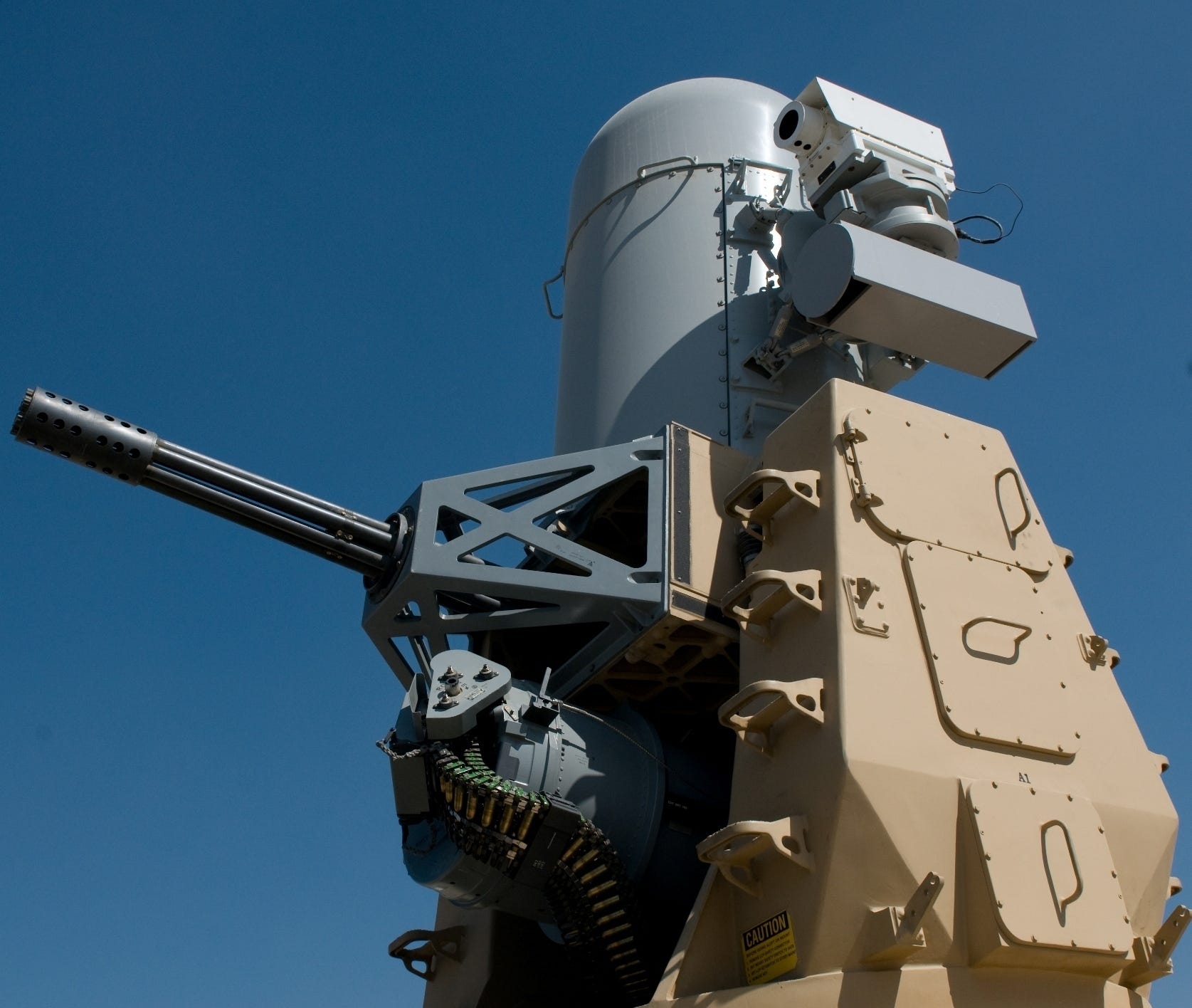
Iran War - Why is This Vulcan Cannon Losing the Drone Fight in Baghdad
C-RAM isn’t obsolete. It’s just highly inefficient on its own.

Here’s an ugly truth about the weapon system currently standing watch over the US embassy in Iraq: C-RAM (Counter Rocket, Artillery, and Mortar) was never built for this fight.
It was built to swat mortar rounds… And it’s pretty good at that.
What it isn’t good at, what it was never designed to be, is your primary line of defense against low-flying, wave-after-wave, dirt-cheap Iranian kamikaze drones. Asking C-RAM to carry that load is like using your kid’s super soaker to put out a house fire. Fucking bonkers.
I know how that sounds counterintuitive. A slow, low-flying drone should be easier to kill than a mortar round, right?
And to be clear, it can still hit the occasional Shahed. You can see a lot of videos coming out of Baghdad where you hear the Vulcan cannon ripping the night apart, and in some cases, knocking down a Shahed.
David Hambling over at Forbes wrote a solid piece on this topic.
Hambling’s main arguments are sound. But there’s a piece of the Baghdad story he didn’t nail, specifically around a Saab radar that reportedly got destroyed at the US Embassy.
I’ll get to that. First, let’s talk about why the gun itself is already in trouble before anyone starts blowing up its sensor network.
C-RAM Was Born for a Different War
The land-based Centurion C-RAM, essentially the Phalanx Close-In Weapon System dragged ashore and bolted to a trailer, came out of the Iraq and Afghanistan problem set from the early 2000s.
The threat then was rockets, artillery, and mortars hammering US forward operating bases.
Raytheon still describes the land system in exactly those terms. The Missile Defense Advocacy Alliance notes it was operationally deployed across Iraq and Afghanistan, where its sense-and-warn network logged more than 2,500 rocket and mortar attack warnings over the course of the war.
That mission profile is the whole shebang, because mortar rounds are a radar operator’s dream compared to Shaheds.
A mortar follows a ballistic arc. Once the radar gets a track, the math gets super clean. It’s a small, fast object on a predictable path. The system doesn’t need to solve an Agatha Christie novel. It needs to solve a simple geometry problem.
That’s what C-RAM was built around. God bless Sir Isaac Newton.
A Shahed is different: It’s slow. It’s low. It’s annoying in the specific way that only a $20,000 drone can be when your interceptors cost a whole lot more.
(By the way, a C-RAM is about $10-$12 million apiece, not counting ammo).
A Shahed can dogleg. It can skim rooftops. It can thread terrain, buildings, roads, and every piece of radar garbage that accumulates near the ground.
For a radar nerd like me, a mortar round is like an inbound baseball: predictable with minor deviations at the end. A Shahed is like a drunk guy on a Kawasaki Ninja cutting through a Walmart parking lot at 2 a.m., with no lights on: unpredictable with the possibility for major deviations the whole time.
To be sure, low altitude has always been a tactic, and in Iran, it’s been deliberately weaponized.
The fundamental issue is ground clutter.
At low grazing angles, radar energy bounces off terrain, trees, vehicles, power lines, buildings, and everything else the earth has rudely left in the way.
A drone’s radar return is competing with all that noise simultaneously. At 50 to 200 meters altitude, small drones can be buried in clutter that’s orders of magnitude stronger than the actual target signal.
What’s worse, slow-moving drones can fall into the same velocity spectrum as swaying trees, traffic, and birds. The filtering problem becomes genuinely hard.
Shaheds exploit exactly this environment. Shahed-136-class drones have a small radar cross-section and a low flight profile, and their terminal approach often drops even lower to squeeze through the gaps. Their radar visibility is roughly comparable to a large bird.
C-RAM can’t kill what it can’t confidently track.
And a low, slow target drifting through ground clutter is a fundamentally different radar challenge than a mortar shell dropping in on a predictable Newtonian arc. This is also why Ukraine’s counter-drone doctrine keeps pushing toward layered sensing.
Radar alone isn’t enough. You want electro-optical and infrared. You want acoustic detection. You want passive RF when the drone is emitting. You want a fused picture from multiple sensor types.
A single radar-guided Vulcan gun is useful, and to be honest, kind of cool looking. But it’s certainly not magic, and it was never supposed to be.
Even if C-RAM tracks perfectly, it runs into a second wall.
The Phalanx and Centurion C-RAM carry roughly 1,500 to 1,550 rounds, fed into a six-barrel 20mm Gatling gun that fires at up to 4,500 rounds per minute.
Let’s do that math.
A 1,500-round magazine sounds like a lot until you realize the gun can empty it in less than 30 seconds of sustained fire.
Usually the system fires in three to five-second bursts to conserve ammo, but the bucket is still finite, and every burst pulls from it. Iran’s attacks are specifically designed around this. You don’t need every drone to get through. You need enough drones to force the defender to spend rounds, split the fire control solution, and create a window where the next wave arrives while the gun is empty, reloading, or already committed to a different sector.
Reloading isn’t instant either. Older Phalanx versions could take 10 to 30 minutes to swap magazines. According to Hambling’s piece, Block 1 improvements dropped that to under five minutes.
“Under five minutes” sounds fantastic in a Raytheon brochure for an Army Colonel who just wants to sign the contract so he can get to happy hour on time. In a mass drone event, five minutes is a very long time to be defenseless.
Maybe if the US had fifty of the Centurion systems surrounding the embassy, the math would start to make sense. Which raises an interesting question… How many ground-based systems does the US actually have in its inventory?
It appears that only 32 have been manufactured since 2005, and ten of those went to the UK… so the answer is not a lot.

The Giraffe Story: What’s True, What’s Missing
Now let’s talk about what happened at the US Embassy in Baghdad, because the reporting on this has been half right.
Anadolu Agency reported that a drone hit a US Saab Giraffe 1X radar at the embassy and described it as part of the site’s C-RAM and C-UAS sensor network. I still use “reportedly” when writing about it, since no US official has confirmed it on the record.
But the open-source evidence is credible enough to discuss; especially since the DoD hasn’t been reporting equipment losses like they used to, back when we had decent comms out of the Pentagon.
The Giraffe 1X is a small, 3D multi-mission radar. Saab markets it for force protection, ground-based air defense, and counter-UAS.
It can support C-RAM sensing and warning. If one was sitting on the embassy rooftop, it was almost certainly part of the sensor architecture for detecting drones and short-range threats. Losing it definitely matters.
But losing the Giraffe doesn’t mean the C-RAM gun goes blind.
The Phalanx and Centurion C-RAM are self-contained radar-guided systems.
Raytheon describes Phalanx as a rapid-fire, computer-controlled, radar-guided gun designed for close-in defense on land and sea.
The Missile Defense Advocacy Alliance is even more direct: the Phalanx has its own search radar and tracking radar, allowing it to operate independently. That’s the whole design philosophy. It’s a self-contained terminal defense system.
The Giraffe feeds the broader picture; it doesn’t feed the gun directly.
What a realistic base defense architecture probably looked like before the strike is something like this: the Giraffe providing wider-area surveillance and earlier warning, the C-RAM handling the local terminal defense layer with its own organic radar, and possibly additional sensors and command-and-control nodes layered in.
So, what’s the real-world impact of losing the Giraffe? Meaningful, but specific.
Early warning takes a hit. The broader base loses a useful sensor for seeing threats sooner and from farther out. Track quality across the defended area degrades. The terminal layer, already stressed, already wrong for the threat, absorbs more of the burden.
That’s bad. Not catastrophic in the narrow gun-goes-blind sense, but bad in the way that makes an already hard problem harder.
So, is C-RAM failing?
It depends on what you mean by failing.
If you mean useless: no. There are videos out of Baghdad where you can hear that Gatling gun ripping the night apart, and in some cases, it’s knocking Shaheds out of the sky. That’s not nothing.
If you mean capable of reliably defeating massed low-flying drone raids by itself: no. It was never built for that, and the physics and the magazine math are not on its side.
Hambling’s core argument is that C-RAM is being asked to perform a job outside its design envelope against a threat specifically engineered to expose its weaknesses. That’s accurate. What he doesn’t fully address is the Giraffe; specifically, that losing that radar hurts the sensor layer more than it blinds the gun.
C-RAM isn’t obsolete. It’s insufficient on its own. Those are different things, and the difference matters for how you fix the problem.
What Actually Works
The ship-based Phalanx CIWS is actually quite good as a last line of defense. This is thanks to the relative flatness of the ocean and lack of ground clutter. I mean… if we’re being technical, (and I always try to be), there is sea clutter in the form of waves, rain/weather, and surface reflections (multipath).
These reflections could obscure small, low-flying, or low-RCS (Radar Cross Section) targets by producing high-intensity noise that masks the target signal.
But relative to the land version, it’s an easier problem to deal with.
The bigger issue is layers. Ukraine figured this out years ago and paid for the lesson in blood and infrastructure. You don’t build your air defense around one exquisite system.
You build layers:
Early warning.
Multiple sensor types fused into a common picture.
Cheaper intercept methods for cheap threats.
Interceptor drones.
EW where applicable.
Short-range missiles like APKWS.
Visual observers.
Acoustic detection.
Lasers eventually.
Microwaves eventually.
Basically, you need enough redundancy that one leaker, one reload cycle, or one destroyed radar doesn’t become a catastrophe.
This comes down to the difference between a mortar, which is a math problem, and the Shahed, which is a systems problem. Dirty targets, deliberate saturation, and an adversary who’s done the math on your magazine capacity.
A 20 mm Vulcan cannon (the same gun found on an F-16) mounted on a swiveling base is a hell of a final layer. It just shouldn’t be your entire plan.
Does the US have any “layers” around the US embassy in Iraq?
Well, that’s the big question, I suppose. We don’t have visibility into that at the moment, but I bet they’re thinking seriously about it now. Especially when embassy staffers expected C-RAM to protect them and discovered that, in fact, C-RAM is just a super soaker in a house fire.
Слава Україні!


Good stuff Wes. Appreciated.
If only there was an ally that desperately needed to figure out how to defend against these drones within last 4 years...