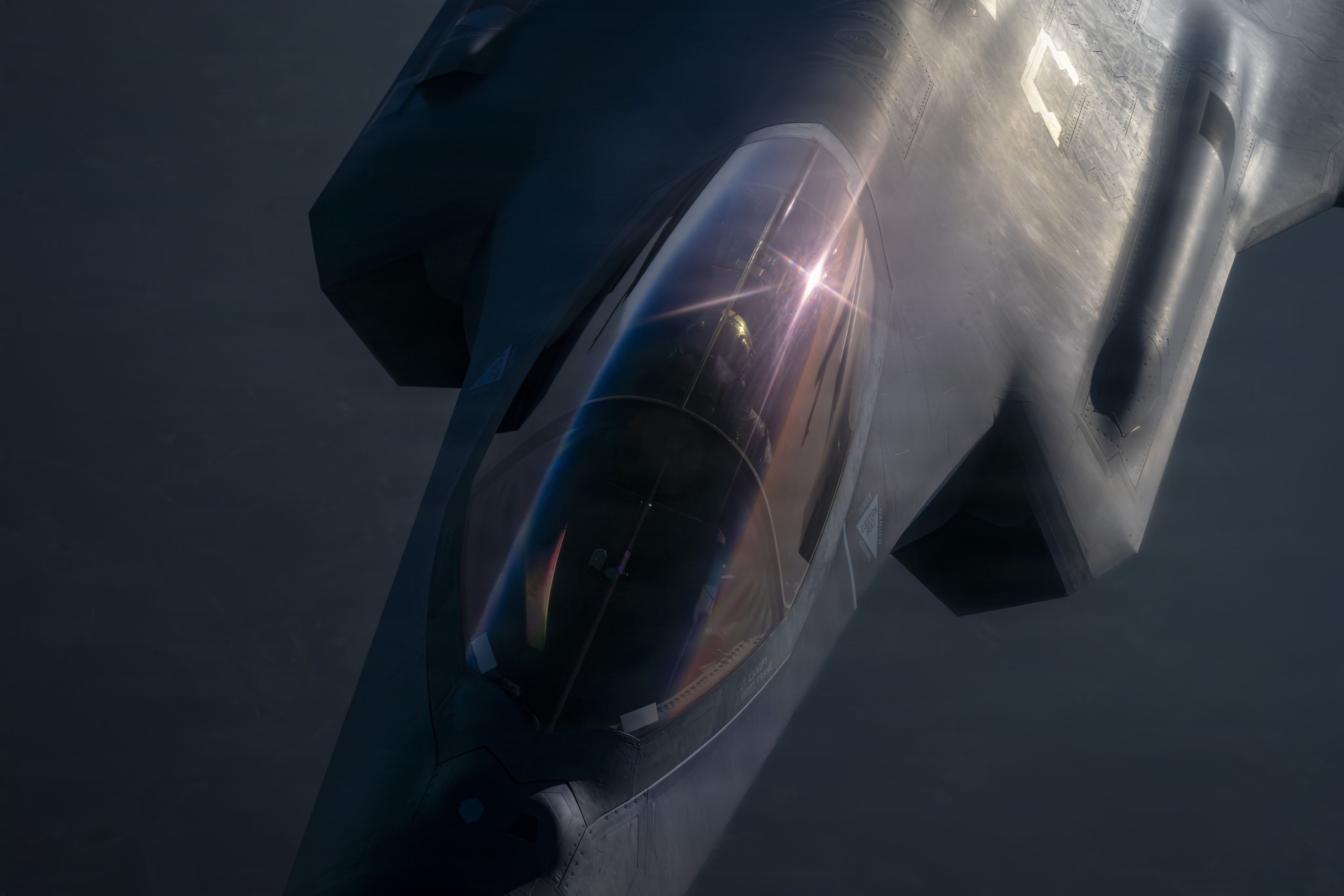
Is the F-35's New Radar Secretly a Microwave Weapon? The Cooling Numbers Say Maybe
The F-35's missing radar might be a preview of the next air war

Does your country fly the F-35? Or will you soon?
Well, boy howdy, do I have some exciting news for you! The F-35’s new nose-mounted radar may double as a top secret directed energy weapon!
Or it could be a nothing burger…
I know, that’s unsatisfying. Let me explain:
The United States Marine Corps has just accepted delivery of six spankin’-new F-35 stealth fighters, each one worth roughly a hundred million dollars, with a chunk of lead ballast bolted into the nose where the radar is supposed to go.
Not a downgraded radar, mind you. Not an older radar. But no radar at all. Dead weight, installed to keep the jet’s balance right, on the most expensive weapons program in human history. At least it has that new jet smell.
That fact broke loose during Senate testimony last month, and almost immediately a more exciting theory attached itself to it.
What if the radar isn’t just late? What if the reason it’s so hungry for power and so hard to cool is that it isn’t really a radar at all, but a secret directed-energy weapon, a microwave gun in the nose designed to fry enemy electronics out of the sky?
There’s some genuine science behind the idea, and I want to walk you through it honestly, because there’s a real and important story buried in here.
What actually happened in that hearing
On June 23, Marine Corps Lt. Gen. Gregory Masiello, who runs the F-35 Joint Program Office, sat in front of the Senate Armed Services Committee and got cornered by Senator Mark Kelly, an Arizona Democrat and a retired Navy fighter pilot who knows exactly which questions to ask.
Kelly walked him right up to it: “The Marine Corps has been accepting airplanes with no radar in them, correct?”
“We have accepted six aircraft for the Marine Corps that do not have a radar installed,” Masiello answered. “That is correct.”
The jets are F-35Bs, the short-takeoff-and-vertical-landing variant, built earlier this year and flying acceptance tests since February with ballast in the nose instead of a sensor.
They can fly training sorties but they can’t fight, because a stealth fighter that can’t see is an airshow bird.
And this isn’t the end of it… The program office confirmed to The War Zone that Air Force and Navy jets will start arriving in the same radarless condition later this year, and Breaking Defense has reported that essentially all new American F-35s delivered from this fall onward will show up blind until the new radar catches up.
The radar everyone’s waiting on is the Northrop Grumman AN/APG-85, and the first production units aren’t expected until 2028.
If your country is waiting for F-35s, it will almost certainly arrive with the older APG-81 radar, not the APG-85 we’re talking about today. Also, even if APG-85 becomes technically available, the US may not export every mode or electronic-attack capability to every partner.
This is where the “directed energy” or high-power electronic attack speculation comes in. A radar mode that can jam, deceive, or potentially damage electronics is exactly the sort of thing Washington may treat like the good bourbon: allies can see the bottle, but not everyone gets a full pour.
As a reminder, here’s the F-35 partner nations: UK, Italy, Netherlands, Australia, Norway, Denmark, Canada, Belgium, Japan, South Korea, Poland, Israel, Singapore, Finland, Switzerland, Germany, and the Czech Republic. Oh, and maybe Turkey eventually.
The boring explanation first
Before we get to death rays, let me give you the actual reason these jets have no eyes, because it’s so mundane that it’s almost beautiful in its stupidity.
The APG-85 is physically a different size and shape than the APG-81 radar it replaces.
Starting with production Lot 17, Lockheed began building F-35s with a redesigned nose bulkhead sized specifically for the new radar.
Then the new radar ran late. And because the old APG-81 doesn’t fit the new mounting, you can’t just drop the proven radar into the hole as a placeholder. The jets were built around a part that doesn’t exist yet, and the part they could substitute doesn’t fit the space.
So finished fighters roll out of Fort Worth with dead weights in the nose to preserve the center of gravity, and everyone waits. A common bulkhead that can accept either radar isn’t planned until Lot 20, somewhere in the 2027-to-2028 window.
That’s it. That’s the whole mystery.
It isn’t stealthy genius or a secret weapon program hiding in plain sight. It’s a hundred-million-dollar aircraft with the situational awareness of my robot vacuum that’s lost its cameras, because two teams (Northrup and Lockheed) building two halves of the same jet fell out of sync on the schedule.
And this sits inside a larger mess worth mentioning: The Block 4 upgrade package the APG-85 belongs to is, according to a Government Accountability Office report from last fall, at least five years behind schedule and more than $6 billion over its earlier cost estimate.
The GAO also found the F-35’s full mission-capable rate, meaning the share of the fleet ready to do every job it’s built for, had slid from 38 percent down to 25 percent between 2020 and 2025.
Masiello disputes the methodology and puts the number higher, but even his rosier figure means something close to half the fleet isn’t fully mission-capable on a given day.
The radarless jets are a symptom of a program straining under its own weight, not evidence of a hidden death ray masterstroke.
Now the interesting part, and it’s more than a rumor
Here’s where the theory comes in.
The most prominent version comes from Bill Sweetman, an aviation analyst who spent a career prying the lids off America’s most classified aircraft programs, the U-2, the Blackbird’s descendants, the “Aurora” spy-plane saga.
When a man with that track record looks at a radar’s power budget and says something’s off, well, the correct response is to listen. Sweetman has been right about hidden capabilities in black programs more often than the official spokesmen who denied them.
His argument hangs on one number from that Senate hearing, and it’s a strange number.
The APG-85, at full capability, will need somewhere between 62 and 80 kilowatts of cooling, against the roughly 32 kilowatts the F-35’s current system can handle. The new radar more than doubles the cooling demand of the entire aircraft, which is why the jet also needs a new engine core and a whole new thermal-management system before the radar can run flat out, none of it arriving until the early 2030s.
This is odd. A stealth fighter’s entire design religion is emitting as little energy as possible, because radiating power is how you get found and killed.
Every instinct baked into the F-35 says “put out less noise.” So why would you build a sensor for a stealth jet that demands more than double the power and cooling of everything else on the aircraft combined?
Detection and tracking, even at greatly improved range against Chinese stealth fighters, doesn’t require that kind of raw wattage.
Sweetman’s read is that the surplus energy isn’t for seeing at all… It’s for hitting.
He argues the numbers make far more sense if the APG-85 is also built to be a high-power microwave weapon, using that big nose array to fire concentrated bursts of radio-frequency energy that overload or physically cook an enemy’s radars, seekers, and electronics at range.
As he put it, this is something that could give Godzilla a round of electroshock therapy at 200 kilometers, not just jam a drone at close range.
Impressive, if true.
The evidence stacks in one direction
Let’s start with the fact that the military has wanted exactly this for decades and has already built working versions.
In 2012, Boeing and the Air Force Research Laboratory flew CHAMP, a missile that crossed the Utah desert and knocked out seven separate electronic targets in a single pass, blacking out their circuits without so much as scratching the buildings around them.
The Air Force’s public roadmap has long called for putting high-power microwave weapons on standoff missiles and, in so many words, on small reusable platforms like the F-35.
This isn’t a capability the Pentagon “might someday want.” It’s one they’ve been openly marching toward for fifteen years, and the APG-85’s arrival lines up with the schedule they themselves laid out.
Then there’s the hardware.
The APG-85 swaps the older radar’s gallium arsenide transmit-receive modules for gallium nitride. Gallium nitride shrugs off heat better, pushes more energy out for the same power in, and works across a wider band of frequencies, which is precisely the toolkit you’d want if your goal were attacking a whole menagerie of different enemy electronics rather than just painting them on a scope.
It’s the exact material science a microwave weapon would call for. On top of that, there have been credible reports for years that even the current APG-81 already has a rudimentary electronic-attack mode, meaning the F-35 has arguably been doing a baby version of this all along, and the APG-85 would simply be the daddy.
And then there’s the tell that I find compelling.
Every single time a senator got near the specifics in that hearing, Masiello retreated to the classified session “downstairs.”
A retired Air Force lieutenant general publicly described the APG-85 as delivering a “dramatic increase” in the ability to deny adversaries the use of the electromagnetic spectrum.
Northrop Grumman calls it, carefully, an “advanced multifunction sensor.” Nobody guards a slightly better radar this jealously. The wall of official coyness is itself a data point, because programs classify capabilities, not disappointments.
If we put the pieces together, a decades-old requirement the Air Force has said out loud, a proven flight-tested precedent in CHAMP, the exact enabling material in the new modules, an anomalous power budget that a pure sensor doesn’t obviously need, a rumored predecessor mode, and a program office that clamps shut the instant anyone asks, and the directed-energy explanation stops looking like a stretch.
It starts looking like the reading that accounts for the most evidence at once.
So let me grade this the way I’d grade my Monday intelligence briefings for my paid subscribers: in tiers of confidence.
Near-certain to certain: the APG-85 is a serious electronic-attack system, not a radar in the old sense. That’s not even really in dispute anymore, just under-reported.
Likely, (and I’d now put money on it leaning this way): it has some sort of directed-energy attack function, maybe a high-power microwave mode that can degrade or damage enemy electronics, even if its full strength waits on the engine and cooling upgrades later this decade.
The power budget, the materials, the doctrine, and the secrecy all point there, and when four independent lines of evidence converge on the same answer, that convergence is worth trusting more than the comfortable assumption that it’s just a really HOT radar.
Still genuinely uncertain: the range and hard-kill punch. There’s a real difference between soft-killing a seeker under favorable conditions and physically burning out a hardened enemy radar at long distance, and where the APG-85 actually falls on that spectrum is exactly what’s locked in the classified annex.
I’m willing to believe it reaches further than skeptics assume, precisely because the cooling numbers are so aggressive, but I can’t prove the top end and neither can anyone writing about it in public.
The one thing I’ll still push back on is the specific claim that the jets are arriving radarless because the thing is a secret weapon.
That part really does trace to the mounting incompatibility and the Block 4 delays, and conflating the two muddies a stronger argument.
You don’t need the delay to be sinister for the radar itself to be extraordinary. The blind Marine jets and the microwave-weapon question are two separate stories that happened to break in the same week, and the second one is the bigger deal by far.
Okay, let’s wrap this up.
Strip away the death-ray framing and what you’re left with is a preview of where air combat is heading, and it’s a place most people haven’t thought much about.
The reason the F-35 needs a new engine and a doubled cooling system is that a modern fighter has quietly become a flying power plant that occasionally shoots things.
The radar, the electronic-warfare suite, the communications, the onboard computing, the AI processors, and yes, potentially the directed-energy systems, all of it runs on electricity, and every watt you generate turns into heat you then have to dump somewhere over enemy territory.
Managing that power and that heat has become the central engineering problem of next-generation airpower, which is why an aircraft’s cooling capacity is now a better predictor of its combat future than the size of its gun.
That’s the shit hiding inside the radarless-Marine-jet story.
The next air war will lean heavily on the platform that can generate the most electrical power and shed the least heat, because that’s what feeds the sensors and the electronic weapons that increasingly decide who sees whom first and whose electronics still work when the shooting starts.
The Chinese sixth-generation fighters that keep showing up in grainy test photos are a big part of why the Pentagon is chasing this so hard, since the whole game now is denying the other side the use of the electromagnetic spectrum while keeping your own.
The turning point is real, and it’s this: the fighter is becoming an electrical weapon, and the APG-85, whatever exactly it turns out to do downstairs in the classified briefing, is the first loud hint of it.
The death ray is informed speculation.
But the electrical future is already here, and it’s expensive, late, and running hot.
Which, come to think of it, is the most F-35 sentence I’ve ever written.
Слава Україні!


Question: Could the F35s be radarless because it is more efficient to obtain detailed sensory coverage from another source and transmit the details to each F35?
Another question: Could the F-35 with new radar provide an enhanced ground attack capability as it would be lethal to troops as well as to electronics?