


Hey friends, something shady is afoot in Washington, and Ukraine is suffering because of it.
When Volodymyr Zelensky said last night that Ukraine had received “no early warning from our partners” before Russian ballistic missiles came screaming toward Kyiv, my first instinct was to assume somebody screwed up.
I spent enough years in the military to know that communications systems occasionally develop a shitty personality disorder at the worst possible moment. Weather happens. Links drop. Server farms get moody. Someone on the midnight staff duty shift sends something to the wrong distribution list.
Military communications failures are rarely as sinister as they look from the outside.
Then I woke up to the Starlink story.
That made the innocent explanation harder to dismiss, because Ukraine has now experienced several strange developments within the same five-day window.
First came reports that Trump administration officials had warned Kyiv it could lose American intelligence support if Ukraine continued attacking Russian oil refineries.
I just posted a video today at noon about this to YouTube:
Then, for two consecutive nights, Ukraine says it stopped receiving the ballistic missile launch warnings it normally receives from its partners.
After that, SpaceX imposed a new speed restriction on Starlink terminals used by Ukrainian forces, apparently without warning the units relying on those terminals for combat operations.
The White House insists intelligence sharing continues.
“We are helping them, and we are sharing intel,” President Trump said.
Sure buddy. That sentence may be technically accurate. But that’s also what bothers me.
Because intelligence sharing is not a light switch. There is no giant lever in the Pentagon labeled UKRAINE INTEL that some staff officer pulls into the OFF position. Intelligence has a lot of different streams, systems, classifications, organizations, and delivery mechanisms. Washington could continue providing Ukraine with enormous amounts of information while slowing, restricting, or withholding one particularly important feed.
This started with the refineries
On September 13, Trump publicly urged Ukraine to stop striking Russian oil refineries. He blamed Ukrainian attacks on Russian refining infrastructure for record American diesel prices, although anyone with a simple chart of “Brent crude year-to-date” can see that the US-led war with Iran is the much larger force moving global fuel markets.
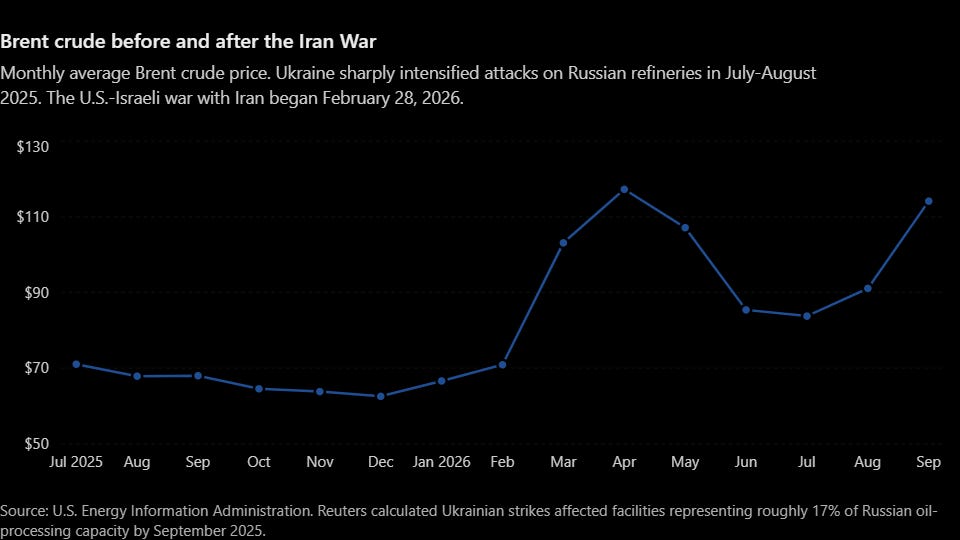
Ukraine kept attacking.
On October 5, Ukraine’s defense ministry claimed its campaign had knocked out 51 percent of Russia’s refining capacity. Vladimir Putin himself acknowledged that the attacks have inflicted an economic cost, amounting to roughly 1 percent of Russian GDP by his own admission.
Then, on October 9, Trump spoke with Putin by phone and announced an arrangement intended to return Russian diesel to global markets.
That same weekend, American and Ukrainian officials met in Miami. Axios then reported that a Ukrainian official said Steve Witkoff and Jared Kushner warned Kyiv that continued refinery strikes could result in Washington cutting off intelligence sharing.
An American official denied that such a threat was made and said the administration had instead urged Ukraine to avoid actions that “hurt American consumers.”
Then the Financial Times reported something bigger:
According to the FT, the Pentagon contacted Kyiv and several European governments on October 10 and 11 and threatened to halt intelligence sharing as well as PURL, the mechanism that allows European governments to purchase American weapons for Ukraine.
“They are calling Kyiv… they are calling everyone,” one official told the paper.
The next day, Trump announced an “energy ceasefire” between Russia and Ukraine.
Zelensky said he learned about it from the Truth Social post.
Ukraine says it has refrained from striking Russian energy targets since then and has said it will honor a genuine reciprocal ceasefire if Moscow stops attacking the Ukrainian grid.
Russia apparently had a different understanding of events. Or no understanding at all.
Two nights of silence
Ukraine’s Air Force says that on October 12 and again on October 13, it received “no information from partners regarding missile launches from enemy territory.”
Presidential adviser Dmytro Lytvyn publicly described two consecutive days without that information as “unusual.”
Then came the attack on Kyiv.
According to Zelensky, Russia launched 39 ballistic missiles and more than 120 drones against energy and critical infrastructure in Kyiv, the surrounding oblast, and Kharkiv. Ukraine’s Air Force reported intercepting only four of those ballistic missiles.
All three of Kyiv’s combined heat and power plants were attacked. About 600,000 people lost electricity. A ballistic missile hit a nine-story apartment building in the Desnianskyi district, where prosecutors said at least three women were killed and 24 other people were wounded, including a seven-year-old girl.
Al Jazeera’s correspondent described an unusually large number of hypersonic missiles directed toward the capital.
Then Zelensky said something that jumped off the screen at me:
“Our system detected these missiles almost as they were approaching Kyiv.”
Ballistic missile defense lives on time.
An Iskander launched from Russian territory can reach Kyiv in mere minutes. Ukrainian ground radars can’t simply peer through hundreds of kilometers of terrain and watch the missile leave its launcher. Radar has a horizon.
The United States has something Ukraine doesn’t: a constellation of infrared early-warning satellites designed specifically to detect the enormous heat signature produced when a ballistic missile’s rocket motor ignites.
That’s the advantage of looking down from space.
For much of this war, American detection has helped provide Ukraine with enough warning for air raid sirens to activate and air-defense crews to prepare. We’re not talking about hours here. Sometimes the warning is measured in minutes.
Those minutes are huge.
A family can move from an apartment into a shelter. A Patriot battery can prepare for an engagement. Commanders can understand what kind of attack may be developing before the missile enters the footprint of Ukrainian sensors.
If Ukrainian crews are first discovering ballistic missiles when those weapons are already approaching Kyiv, the geometry of the engagement becomes extremely hard.
This is where my AWACS experience may be useful, because there’s an important distinction that tends to disappear in online discussions about intelligence: Seeing something and telling somebody what you saw are two separate acts.
A contact someone saw but never transmitted was useless to the fighter pilot who needed it.
The same distinction is at play here. I have no reason to believe American early-warning satellites suddenly stopped seeing Russian ballistic missile launches. I think the more interesting question is what happened after they saw them.
Did the warning fail somewhere in the technical chain?
Or did somebody stop pressing send?
There are innocent explanations
A senior Ukrainian official told the Associated Press that Kyiv had been informed the missing warning resulted from a “failure,” potentially involving weather rather than a policy decision.
I find weather an odd explanation when we are discussing space-based infrared sensors designed to detect enormous rocket plumes, although the warning architecture involves far more than the satellite itself.
I suppose weather could have affected another sensor, communications component, or analytical process.
Without access to the system, I can’t rule that out.
There’s another technical possibility worth considering.
Russia has used S-400 surface-to-air missiles for attacks against ground targets, including 48N6-series interceptors fired toward Ukrainian cities.
Those weapons can follow short, steep trajectories and arrive quickly. Russia also launches surface-to-air missiles routinely as part of its normal air-defense operations, which complicates the warning picture if a system has to distinguish a SAM fired at an aircraft from one being used as an improvised ballistic weapon.
That explanation also has problems.
Nobody has established that converted S-400 missiles accounted for the missing warnings during this particular attack. Russia launched 39 ballistic weapons, including systems described as Iskanders and hypersonic missiles, which should produce the sort of launch signatures American strategic warning systems were built to detect.
And neither weather nor S-400 ambiguity easily explains the timing.
Ukraine says the warnings stopped on October 12. That was the day after the Pentagon finished making calls about intelligence support.
Coincidences happen in war…
Two coincidences deserve your attention.
Then Starlink made it three.
Somebody changed the speed limit
Early this morning, Serhii “Flash” Beskrestnov, an adviser to Ukraine’s defense ministry and one of the people I follow closely on electronic warfare, reported that SpaceX had imposed a new speed restriction on Starlink terminals in motion.
According to Beskrestnov, the Ukrainian military version now stops functioning at approximately 160 kilometers per hour, or around 100 mph.
“Our defense forces did not receive a warning about this limitation, and this led to the disruption of several missions,” he wrote.
Ukraine’s 7th Rapid Reaction Corps reported disruptions at even lower speeds, saying connections were dropping for 10 to 20 seconds while traveling at roughly 110 to 120 kilometers per hour. Some missions reportedly had to be canceled because drones kept flying while their Starlink connections repeatedly disappeared.
There is an important backstory here because the original Starlink speed restriction was actually Ukraine’s idea.
Russian forces had been using smuggled Starlink terminals to provide communications aboard Shahed-type and Molniya strike drones. After a Starlink-guided Russian drone struck a Ukrainian passenger train on January 27, Kyiv asked SpaceX for help shutting down that capability.
SpaceX responded by restricting terminals moving faster than roughly 75 to 90 kilometers per hour.
That was a clever solution. Russian strike drones exceeded the speed threshold and lost connectivity, while Starlink terminals registered to Ukrainian military units were placed on a whitelist exempting them from the restriction.
Mykhailo Fedorov, then Ukraine’s digital minister, publicly thanked Elon Musk and SpaceX President Gwynne Shotwell for acting quickly.
What appears to have changed this week is that the Ukrainian whitelist acquired a ceiling of its own.
Now… to be fair, there may be a perfectly legitimate reason.
Russia may have captured or otherwise obtained access to Ukrainian-whitelisted terminals. If Russian drones had found a way around the original restriction, SpaceX would have good reason to tighten the system again.
Russia has also been actively targeting Starlink infrastructure, including suspected sabotage activities in Europe, so the security problem facing SpaceX is real.
What’s harder to explain is apparently changing the rule without telling the Ukrainian military beforehand.
Combat networks are not consumer phone plans.
If an American company modifies a communications system in a way that interrupts operational drones while those aircraft are already flying missions, coordination is part of the weapon system whether SpaceX likes that description or not.
The Pentagon has paid for Starlink service in Ukraine since 2023. Ukrainian units have incorporated it deeply into command-and-control, reconnaissance, and unmanned operations. Changing a technical limitation overnight without notifying those users would be a remarkable coordination failure.
Unless notification was not the priority.
SpaceX had not publicly explained the change as of the time I wrote this.
What’s changed this time since the intel gap in March of 2025?
When the Trump administration halted American intelligence sharing with Ukraine in March 2025, there was nothing subtle about it: Washington announced the pause. Everybody knew who had ordered it.
Ukraine knew what information it was losing.
Europe knew.
Russia knew.
The policy lasted only a short time, but the mechanism was obvious.
What Ukraine is experiencing now, at least from the outside, looks different.
American officials can truthfully say Washington continues sharing intelligence with Ukraine while individual streams inside that relationship change. Strategic assessments can continue. Satellite imagery can continue. Signals intelligence can continue. Targeting support can continue in some form.
Meanwhile, a time-sensitive ballistic missile warning feed can become intermittent or disappear.
Both can be true.
The same logic applies to Starlink. SpaceX does not have to turn off Ukrainian terminals across the country to affect certain military operations. A technical restriction placed at the wrong speed can interfere with a specific category of drone mission while normal Starlink service continues everywhere else.
That’s why proving “intent” is so difficult.
Within several days, American officials were reported to have warned Ukraine about consequences if it continued attacking Russian refineries.
The administration then announced an energy ceasefire that Ukraine says it had not negotiated.
Ukraine stopped receiving a missile-warning service it had relied upon for much of the war.
Russia subsequently launched a massive ballistic attack on Kyiv.
Then Ukrainian troops discovered that an American-owned communications network central to their drone operations had received a new technical restriction they say nobody told them about.
If I am a Ukrainian commander, I don’t have the luxury of waiting six months for a congressional investigation to tell me whether those events were connected.
I have to plan around the possibility that they were.
That is what military risk management looks like when the consequence of guessing wrong is a missile hitting an apartment building.
There is another political element Kyiv can’t ignore. Trump also said this week that Ukraine should have a new president.
When the president of your most important military partner publicly calls for your president’s replacement at the same moment intelligence warnings become unreliable and a critical communications service unexpectedly changes, suspicion is hardly irrational.
I keep coming back to something I learned in the military that is difficult to put into a weapons roster: reliability is a capability.
For decades, a major part of American power came from the belief among allied militaries that when the shooting started, the enormous American intelligence architecture behind them would work.
Satellites would watch.
Aircraft would patrol.
Analysts would analyze.
Networks would pass warnings.
That confidence allowed allied countries to specialize because they didn’t each need to duplicate every American capability. The United States provided much of the nervous system connecting allies together.
That trust took generations to build. And we’re watching it burn down in mere months…
And that brings me back to the families in Desnianskyi.
If Washington believes Ukrainian strikes against Russian refineries are harming American interests, then make that argument.
Do it publicly.
Tell Kyiv to stop. Explain why. Let Congress argue about it. Let Ukraine object. Let Americans decide whether protecting Russian refining capacity during Russia’s war against Ukraine is a policy they support.
What should never become ambiguous is whether civilians are still receiving warning that ballistic missiles are heading toward their homes.
If Washington has decided that relationship with Ukraine should change, Americans deserve to know it and protest accordingly.
More importantly, the people waiting for the sirens in Kyiv deserve to know it before the missiles arrive.
Usually, I’d end an article with something snarky, occasionally profound, or, at a minimum, tie back to the beginning of the article so the piece feels like it’s come full circle.
I can’t do that this time…
All I can say is damn those who would help Russia kill civilians; damn them straight to hell.
Stay strong, Ukraine. Слава Україні!
Musk complained Ukraine had gone too far in destroying data centers so this is revenge.
Now people, cancel your Starlink subscription today!!!
Stop using X
Don't by a Tesla
From the New York Times today:
Ukraine said that its military, with no warning, had lost partial access to Starlink, a pillar of its battlefield communications. Kyiv relies on a militarized version of the wireless internet network paid for by the Pentagon. That led Ukrainian officials and analysts to surmise that the restrictions had come from Washington, as President Trump is locked in his latest feud with Ukraine’s leadership.
The Starlink development was interpreted in Ukraine as part of a Trump administration pressure campaign to limit Ukraine’s ability to fight. Mr. Trump is pushing Kyiv to stop attacking oil refineries so that Russia can pump more diesel onto global markets as high prices threaten the prospects of Mr. Trump’s Republican Party in the midterm elections.
“Clearly, this action cannot be a coincidence and is linked to the current political situation,” Serhiy Beskrestnov, a Ukrainian military expert who advises President Volodymyr Zelensky on weapons technologies, wrote on social media about the Starlink restrictions.
SpaceX, which operates Starlink, and its chief executive, Elon Musk, did not immediately respond to requests for comment.
Ukraine was stunned to discover the Starlink restrictions, which it said caused disruptions to several combat operations. The Ukrainian military uses the system in part to guide its ever-growing fleets of drones. The restrictions, Ukrainian officials said, tied Ukraine’s hands while leaving Russia free to wage war.
Sorry but you are hedging your bet too much: this is obviously intent and needs an answer: question is how to work around it…