Lethal Autonomy Review: Frank Kendall’s Warning About Drones, AI, and the End of the Manned Fighter
Frank Kendall ran the Air Force for four years. Now he's written the book on why your favorite jet is doomed.

Author’s note: I get no compensation for reviewing this book, although I did receive an advance review copy that is mine to keep.
Bottom Line Up Front (BLUF): If you‘re a subscriber to me and the types of articles I write, this book is well worth your time.
In his final weeks as Air Force secretary, Frank Kendall left the incoming administration some parting advice: keep buying the F-35, keep upgrading it, and don’t pretend autonomous drones are ready to replace crewed fighters yet.
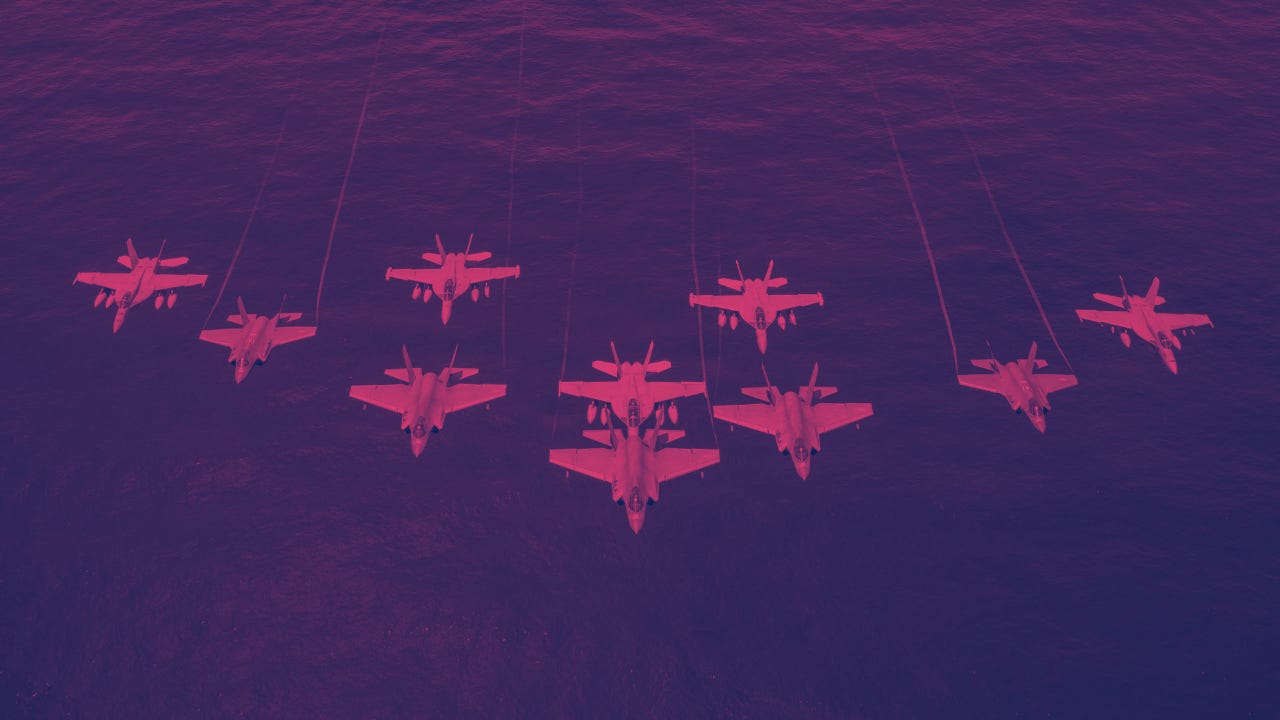
Now he’s a private citizen with a book release on July 7th, and the book, Lethal Autonomy: The Future of Warfare Whether We Like It or Not, argues that the manned fighter, the lone pilot in the fast jet, the whole romantic package we’ve built the Air Force around since before your grandfather was born, is heading for the exit.
That sounds like a contradiction. I don’t think it is.
It’s a timing problem.
More specifically, it’s the difference between managing the force we have and describing the force we’re going to need.
In the early 2020s, a senior defense official had to live in two timelines at once, and they didn’t always agree with each other.
One timeline is today.
Today’s budget. Today’s force. Today’s congressional hearing where a senator from a state that builds landing gear wants to know why you’ve insulted the brave Americans who build those gear. Today’s war plan, which has to work tonight with the force you actually own, not the force you wish you had.
In that timeline, the F-35 is a superb airplane and you defend it, because it’s what your pilots will fly into combat this year and next year and the year after.
The other timeline is the battlefield fifteen or twenty years out. In that one, a lot of today’s beloved hardware starts to look like a very expensive anachronism with Link 16, the kind that still talks beautifully to other antiques while cheap autonomous systems make the cost-exchange math deeply unpleasant.
Kendall the secretary had to manage the transition.
Kendall the author is describing the destination.
That’s what makes the book interesting.
He’s not waving away the current force. He’s warning that the current force has an expiration date, and the people responsible for defending the country don’t get to wait until the label starts peeling off.
Who’s talking, and why you should care
Plenty of people write books about killer robots. Most of them have never had to explain to Congress why a program is four years late and a billion over budget.
Kendall has. He was the 26th Secretary of the Air Force, and before that the Pentagon’s top weapons-buyer under President Obama; yup, his literal job was acquisition.
He’s a West Point grad with a Caltech degree, a former Raytheon engineering executive, and, in a detail I find genuinely charming, a pro bono human rights lawyer and a serious ocean racing sailor.
Admiral James Stavridis (ret), former Supreme Allied Commander at NATO, writes the forward.
So, this isn’t drone hype from a guy who discovered quadcopters at Eurosatory last week. Kendall keeps hammering that autonomy is an organizational, doctrinal, industrial, and cultural problem.
Technologically speaking, the flying robots are the easy part. The hard part is the institution that has to buy them, train on them, and rewrite a hundred years of muscle memory around them.
Indeed, the Department of Defense is right now in the process of running a series of Drone Dominance gauntlets with the goal of buying 200,000 drones over the next two years. The New York Post asked me to make a video for their subscribers on this very topic. My point in the video, and Kendall’s in his book, is that writing a check is the easy part; it’s the doctrine that’s hard.
The spine of the book: range, autonomy, and quantity at cost
Kendall’s whole argument rides on range, autonomy, and quantity at cost. He says the US actually landed on this idea years ago during the Third Offset conversations, the Pentagon’s mid-2010s hunt for the next big technological edge, and then completely failed to turn it into real weapons, real units, or real plans.
This book feels like him trying to finish the homework the building abandoned.
Each word carries weight, so let me slow down on all three.
Range means you stop parking your most precious, hardest-to-replace systems inside the enemy’s missile basket; unless you like losing E-3 Sentry aircraft by parking them within Iranian drone range. (I’m still bitter about this).
If China can reach a thousand miles out to sea, then your carrier sitting eight hundred miles out is just a target with a really good gym.
Autonomy means systems that can keep working at machine speed when the communications get jammed, degraded, or cut entirely. A drone that goes stupid the second it loses its uplink is a drone that dies in the opening minutes. Autonomy is what lets the thing finish the job when nobody back home can talk to it.
Quantity at cost is the one that should make the Pentagon squirm hardest. America has spent decades buying gold-plated platforms, and then clutch their pearls when losing even a few of them in combat creates a crisis.
You can’t run an attrition war on a fleet you bought like fine watches, and I love a good Omega. Kendall’s argument is that the US has to learn to field cheaper systems in real numbers, accept that some of them will have short lives, and stop treating every loss like a national tragedy.
Now, my regular readers know where my head is. I’ve spent the last few years watching Ukraine turn cheap systems into battlefield problems Russia cannot solve without falling back on brute-force stupidity, which, to be fair, is the one commodity Moscow keeps in genuine bulk, along with caviar and Novichok.
Kendall leans on Ukraine too. It runs through the book as proof that the shift to unmanned, autonomous, attritable warfare has already started, that this isn’t a futurist’s fantasy but a thing happening right now in the mud.
But here’s where he’s careful, and where I think he’s right. Ukraine is a pointer, not a finished model. It shows the direction of travel. It does not show the destination.
The temptation, especially for people who’ve watched a thousand FPV-drone videos, is to assume the future US military just means more trench drones and a bigger 3D-printer budget.
Kendall says no.
Copying Ukraine’s improvised, desperate, brilliant adaptations and calling it modernization would be its own kind of failure. Ukraine is fighting the war it has with the tools it can get. A peer fight with China across the Pacific is a different animal at a different scale, and the US has to think much harder about the force it’s deliberately designing than about the force Ukraine had to MacGyver together under fire.
The lesson from Ukraine is the brilliant logic, not the brilliant loadout.
The land chapter is the most radical thing here
If you read one chapter standing up, make it this one, because it quietly detonates how most people picture ground combat.
Kendall imagines a future where the infantry squad and the manned tank platoon are no longer the basic unit of the close fight. Picture a company commander in this world. When the shooting’s about to start, he doesn’t push soldiers into the first line of contact. He pushes unmanned ground vehicles forward. Those robots carry and release smaller drones. The drones spread out to map the ground, sort friend from foe from furniture, and strike.
The human commander sits a layer back, managing the rules of engagement, the boundaries, the timing, and the question of when to escalate and when to hold.
The human is still in charge. Kendall is firm about that, and systems like the Collaborative Combat Aircraft, the Air Force’s in-development robot wingmen, are built to stay under human supervision while acting with far more independence.
But notice what’s moved: The close-range killing, the knife fight, the part where bodies used to get torn up… drifts away from the human body and onto the machines.
The commander climbs up the kill chain, the sequence that runs from spotting a target to actually shooting it and manages the violence from a distance instead of bleeding inside it.
That’s a profound change.
The air chapter, for those of you who only came for the jets
Jets are sexy. Drone logistics are, tragically, not getting a Michael Bay movie.
So let me make the manned-fighter point sting properly: Pilots are extraordinary, but the problem is everything the airplane has to do to keep one alive.
A crewed fighter is built around a fragile, irreplaceable human, and that human sets the limits on the entire machine.
The jet needs a life-support system, an ejection seat, a canopy, a cockpit, redundant safety margins, and a g-limit set by how much force a human neck and a human bloodstream can take before the pilot blacks out.
Behind that one airframe stands years of training, a flight surgeon, a simulator pipeline, crew rest rules, and the simple fact that the thing can only react as fast as a human can perceive, decide, and move her hand.
The machine, the cause everybody loves, is a tax the airplane pays for the privilege of carrying a person.
An autonomous platform doesn’t get tired. It doesn’t need sleep, food, water, or a pension. It doesn’t suffer trauma or hesitate. It pulls turns that would crush a pilot’s spine, and it decides in milliseconds.
So, when Kendall says the manned fighter is aging out, he’s not insulting the people in the cockpit. He’s pointing out that the cockpit itself, and the whole expensive cathedral of systems built to protect it, has become the most limiting design constraint on a modern combat aircraft.
Frankly, physics doesn’t give a shit how good your top gun is.
The other domains, and I won’t spoil the whole book
At sea, Kendall is skeptical that giant carriers and surface combatants get to keep doing business as usual in a peer fight where missiles are long-ranged, sensors are everywhere, and hiding something enormous has become essentially impossible. This isn’t WWII anymore where, during the Battle of the Coral Sea, two carrier fleets closed to within 70 nautical miles but couldn’t detect each other in the darkness.
Undersea, he’s more careful, because much of that fight is classified, but he still warns that better sensing and AI could threaten America’s submarine advantage. His answer is more unmanned undersea capability before the oceans become a lot less mysterious.
The space chapter may be the most important in the entire book. Kendall argues that America built a massive space economy and military dependency without building a force truly designed to fight for space. China noticed. Of course, China noticed.
Cyber gets similar treatment as coercive warfare against the power, finance, transport, and communications systems that keep a country functioning.
And then Kendall ties it all together with multi-domain command and control, the nervous system that has to connect sensors, shooters, robots, humans, and allies under fire.
His least surprising conclusion is also his most damning: the hardest problems may be bureaucratic, not technical. The machines may learn faster than the institution trying to buy them.
Who should actually read this
Since this is a review, let me save you the bookstore hover.
Defense professionals should read it, because Kendall is describing the procurement problem from inside the machine, with the scars to prove it.
Ukraine watchers should read it, because it explains how the drone war scales up from muddy trenches to great-power conflict, and why scaling it isn’t as simple as buying more drones.
AI skeptics should read it, maybe especially, because the book refuses to treat autonomy as magic and spends some of its energy on the deeply unsexy organizational plumbing.
Anyone interested in the future of warfare and how that will impact the society you live in should read it.
And the fighter-mafia crowd, the true believers in the manned jet, should read it with a strong drink within reach and possibly a stress ball, because Kendall is coming for the cockpit and he’s bringing receipts.
That reminds me of a joke: How do you know when a fighter pilot is at a party? Don’t worry, he’ll tell you…
Read Lethal Autonomy like a warning order, the brief you get before a mission when somebody senior tells you what’s coming and what you’d better start preparing for right now.
It’s serious, comprehensive, and grounded in the rarest qualification in this entire debate: a man who saw the machinery from the inside and spent years trying to shove it toward a future it didn’t want to face.
But Kendall isn’t selling Terminators.
He keeps a human in command throughout, which mercifully dodges the ethics of this argument that ruins half the public conversation. Personally, I used to be very much a “human-in-the-loop” supporter when it came to lethal autonomy.
But I’m coming to the realization that Russia and China will have no such ethical dilemma if giving robots the ability to make the kill decision speeds up the kill chain from hours to milliseconds.
Are we prepared to sacrifice that advantage on the alter of ethical ambiguity? What if it means the difference between your kids speaking Mandarin or English? What happens to ethics when Russian drones start killing members of your family? I’m not making an argument for or against here, I’m seriously asking. These are the debates the West will be having in the next three years.
But what he’s really writing about is force design, decision speed, survivability, and the unsentimental possibility that America’s most cherished platforms have entered their late-career Elvis phase: Still capable of a hell of a show. Just not what they once were, and mildly bloated.
Ukraine and the Middle East already gave us the trailer. Kendall wrote the script for the feature, and the ending hangs on one question: whether the most powerful military on Earth can change faster than its own habits will let it.
No amount of new hardware answers that one.
That’s a question about the institution, and the institution is the slowest-moving target in the book.
Lethal Autonomy: The Future of Warfare Whether We Like It or Not releases on July 7 at your favorite book retailer.
Слава Україні!


Wes, there is an overarching lesson here regardless of what we are discussing: institutional inertia and the desire of institutions and those in it to perpetuate themselves at the cost of needed change and different thinking. There is an organizational psychology that abhors change and seeks to block it out of self interest and fear of loss. Loss of status, jobs, relevance.
It is refreshing to see that someone who knows what they are talking about from inside is willing to come forth and admit the problem. We know that everytime there is an advance in attack method or weapon, it is not long before a counter is developed. A fossilized development and procurement process will not adapt quickly enough. The Navy contains the most fossils. Look at what they keep doing. Even their drone development that we know about is all about bigger and more complex.