Norway Is Drawing a 500-Kilometer Line in the Snow
Norway wants a land-based strike capability that can reach 500 kilometers

Norway doesn’t rattle sabers. It sharpens them quietly and puts them where they’ll be noticed by exactly one man.
This week, Oslo did just that.
Buried inside a $1.88 billion investment proposal to parliament is a decision that would have sounded unthinkable twenty years ago and provocative ten years ago. Norway wants a land-based strike capability that can reach 500 kilometers.
Not for expeditionary wars.
Not for power projection.
For one reason only: to hold Russian military infrastructure on the Kola Peninsula at risk from Norwegian soil.
That is a serious statement, delivered without theatrics.
The Ministry of Defense framed it in sober language. The Arctic security environment has deteriorated. Deterrence needs teeth. The Army needs the ability to strike deep, accurately, and fast.
Defense Minister Tore O. Sandvik called it expensive but necessary, which in Norwegian political language is about as close as you get to pounding the table.
From firing positions in northern Norway, a 500-kilometer weapon reaches Murmansk, Olenya Air Base, and the nerve centers of Russia’s Northern Fleet and the logistics that keep Moscow’s bastion strategy alive in the Barents Sea.
Until now, those targets lived mostly in the realm of allied airpower and submarines. Oslo is proposing to put them inside the engagement envelope of its ground forces.
That changes the map.
For decades, Norway’s land forces were designed to delay, harass, and survive until reinforcements arrived. The assumption was always that deep strike belonged to aircraft and ships.
What Oslo is now signaling is a willingness to collapse that distinction. The Army is no longer just the shield. It becomes a knife.
That matters because of where this would be deployed. Finnmark and Nordland are not abstract locations on a planning slide. They sit uncomfortably close to Russia’s most sensitive military real estate. A mobile, ground-based strike system backed by NATO ISR turns that proximity into leverage.
This is deterrence by geometry.
But the technical path to get there is narrow.
Very few systems genuinely hit the 500-kilometer mark from the ground. Norway has been circling this problem for years through competitions that included HIMARS, Chunmoo, and PULS.
Reality has a way of filtering options. Israeli and South Korean rockets top out below what Oslo wants. Kongsberg’s Naval Strike Missile, even ashore, simply does not reach far enough. The much-discussed Tyrfing missile is promising but lives firmly in the 2030s.
That leaves one realistic candidate today: an American launcher paired with the Precision Strike Missile.
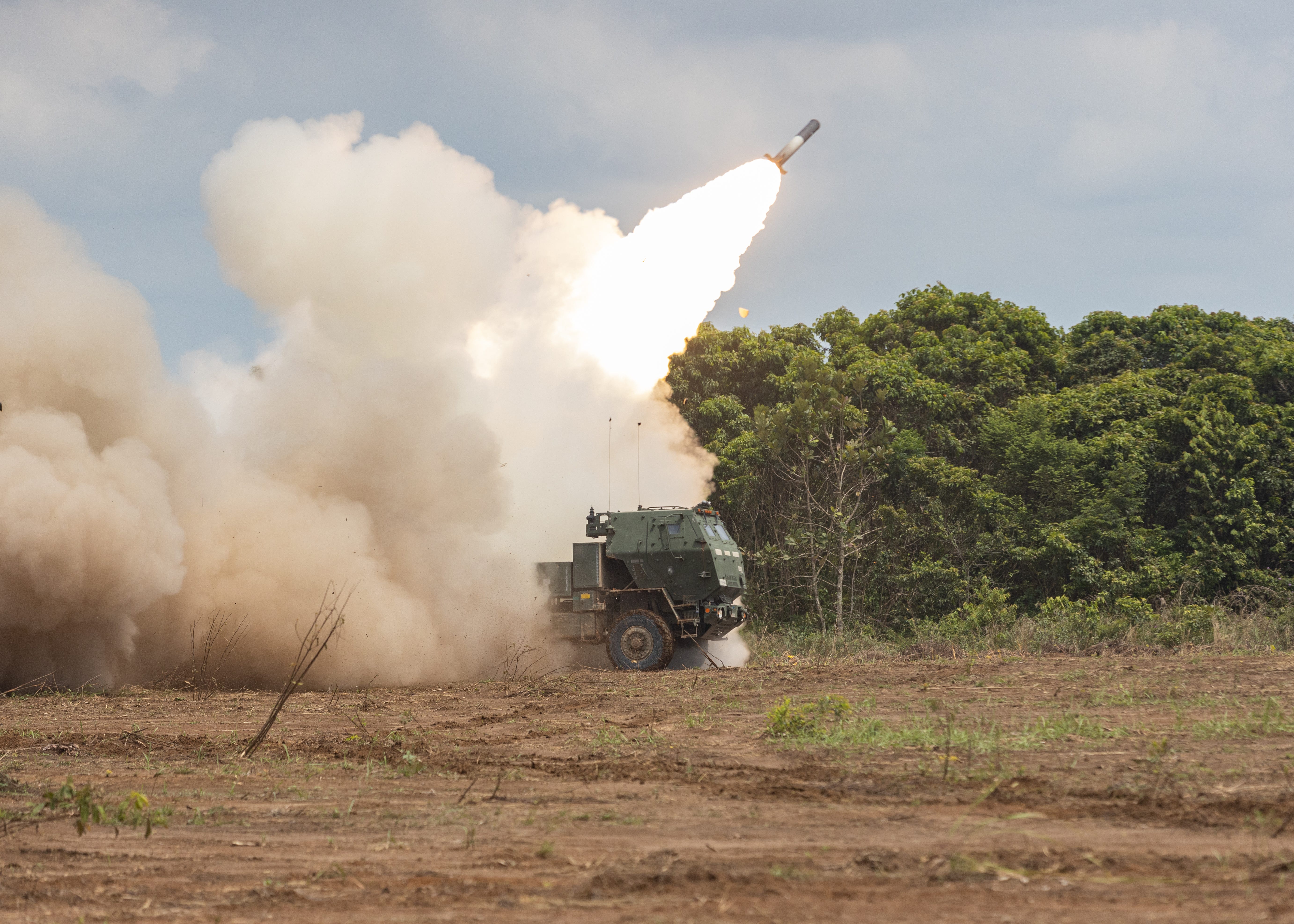
HIMARS with PrSM does exactly what Norway is asking for.
It fits the range requirement.
It plugs directly into NATO fire control and targeting networks.
It complements Norway’s F-35s rather than competing with them.
If Norway buys HIMARS and pairs it with PrSM, Oslo gets something it has never had on land: a mobile, precision strike system that can reach deep enough to put Russian high value infrastructure on the Kola Peninsula under immediate, credible threat from Norwegian territory.
Start with the launcher.
HIMARS is basically a combat pickup truck that went to engineering school. It is a wheeled, road-mobile launcher built to move fast, hide fast, shoot fast, and then disappear before the return address arrives. That matters in the High North because Russia has eyes everywhere. Satellites. Maritime patrol. Long-range drones. ELINT. Any launcher that sits still becomes a problem that solves itself.
But PrSM is what makes this scary. Unlike the older ATACMS model where you got one missile per pod, PrSM is designed so a single launcher load can carry two missiles.
That doubles your ready shots without doubling your vehicles, your crews, or your footprint. That one detail changes the operational math. It lets Norway build real strike density with fewer launchers, which is exactly what a smaller Army needs.
Range is the point of the entire exercise. Norway is asking for 500 kilometers, and PrSM’s baseline performance sits in that neighborhood in open reporting, with future growth planned beyond it.
A 500-kilometer circle drawn from northern Norway starts eating into Russia’s comfort zone. Murmansk-area logistics and command infrastructure sits in the same general box of “targets Russia does not want to lose,” and Olenya has been repeatedly discussed in open sources as a key base tied to Russia’s long-range aviation ecosystem in the north.
The exact target set Norway would nominate is classified, for obvious reasons, but the logic is not subtle.
Now the missile itself.
PrSM is built for precision strike, not area harassment. Think hardened nodes, air defense batteries, airfields, fuel farms, ammunition storage, and the connective tissue that keeps bastion defense running.

That plugs into how Norway already fights. If you want to understand how Oslo would use HIMARS with PrSM, picture a kill chain that starts way above the tundra.
Norwegian F-35s sniff emissions and track movement. P-8s watch the sea lanes and coastline. Coastal radars and allied ISR fill in the gaps. Then the Army provides the punch from land.
One service finds, another fixes, a third finishes. This forces adversaries to defend everything, all the time, across domains.
Positioning is where Norway’s geography turns into a weapon. Finnmark is the obvious headline because it is closest to the border and closest to the Kola problem set. Put launchers in that region and you compress Russian warning time.
You also make Russia spend more resources hunting trucks on Norwegian roads instead of focusing entirely on air and sea.
But Norway does not need to park HIMARS on the border like a tourist taking photos. The smarter play is dispersal across northern Norway, using pre-surveyed firing points, sheltered hides, decoys, and rapid displacement routes that lean on Norway’s road network, terrain masking, and the simple fact that winter is an accomplice when you know how to live in it.
That means you can operate from deeper locations as well, then surge forward when the moment matters, shoot, and roll back into cover. A long-range fires unit can rotate between multiple hides, practice emission control, and use tight communications discipline so Russian sensors see as little as possible until the missiles are already in the air. In other words, it becomes a hunting problem for Russia, not a targeting problem.
There’s another wrinkle for Russia.
A 500-kilometer Army strike tool gives Norway a way to threaten Russian assets without immediately spending scarce airframe hours or risking pilots near Russia’s layered air defenses.
It complements airpower instead of competing with it. It also creates escalation options that are controllable. You can hold targets at risk without crossing a border, and you can do it with a system that can be rolled back into a barn, a tunnel, or a forest hide after launch.
That’s the core of deterrence in the High North. Norway does not need to “win” a land war on the Kola Peninsula. It needs Russia to look at the map and decide that starting one is going to be expensive, messy, and full of unpleasant surprises.
PrSM on HIMARS gives Oslo a way to make that point in a language the Kremlin understands: destroyed infrastructure and broken timelines.
But there is a cost to that choice.
It ties a core Norwegian deterrent capability to American export decisions and production timelines. European governments have grown more sensitive to that dependency.
Norway is no exception. But urgency has a way of clarifying tradeoffs. The Arctic is no longer a quiet flank. Russia’s Northern Fleet is not a museum piece. And Moscow’s behavior since 2022 has erased much of the old comfort with ambiguity.
Zoom out and the picture becomes clearer.
With Finland and Sweden now inside NATO, the alliance is stitching together a continuous defensive belt from the Baltic to the Barents. Long-range fires, layered air defenses, submarines, and fifth-generation aircraft begin to overlap.
Norway’s proposal fits neatly into that logic. It adds a land-based component to a deterrence web that already includes F-35s overhead and submarines below the surface.
From Moscow’s perspective, this is unwelcome math.
A 500-kilometer Norwegian strike system does not mean Norway intends to fire first. It means Russia must assume that assets once considered safely behind the line are now exposed.
That forces dispersal. It forces hardening. It stretches air defense resources already pulled thin by commitments elsewhere.
Deterrence works when it imposes costs before a shot is fired.
Oslo has not picked a launcher yet.
Parliament still has to approve the funding ceiling. Industry still has to compete. Timelines remain late-decade. But the direction is now set in law and budget, not just white papers.
Norway is not trying to win a war in the Arctic. It is trying to make one irrational.
Now, a quiet country just told Russia that the High North is no longer a sanctuary. And it did so without raising its voice at all.
Слава Україні!


it looks like the kremlin made a grevious mistake in invading ukraine, it has instead opened a hornets nest in the process
Excellent and timely analysis as always.