Norway's Quiet 92-Vehicle Gift to Ukraine is More Important Than it Looks
Norway is usually cagey about specifics. So, an official document that names exact vehicle types and exact quantities is a rare little window...

Buried in Oslo’s annual Arms Trade Treaty filing, the document every signatory has to submit listing what weapons crossed its borders, is a plain little inventory: in 2025, Norway handed Ukraine 92 armored-ish vehicles, plus a withheld number of F-16s and an unspecified pile of 81mm mortars.
Everybody’s eyes go straight to the fighter jets, because jets are sexy and a Viper screaming off a runway makes for a hell of a YouTube thumbnail. I get it. Click-through-rate is a real metric.
But the F-16s are the part you already knew about.
The story Norway quietly told this month is the other 92 lines on the list, the armored hardware that decides whether anybody moves at all.
The rare part is the parts list
Here’s why even the boring filing is worth your time. Norway is usually cagey about specifics.
Its packages under the NATO-coordinated PURL mechanism are deliberately kept secret for security reasons, and it won’t even confirm how many F-16s it has sent, citing operational security.
So an official document that names exact vehicle types and exact quantities is a rare little window, the kind of thing analysts normally have to reconstruct from blurry Telegram photos.
For scale, remember what’s behind this.
Norway’s total military support framework for Ukraine in 2025 ran to NOK 72.5 billion after parliament threw in an extraordinary extra 50 billion, and the 2026 plan climbs to NOK 85 billion.
Small country, five and a half million people, writing checks like a nation many times its size. These 92 vehicles are a footnote to the money. (They’re just a footnote that happens to tell you exactly how an army stays standing).
So, let’s open the drawer and go tool by tool. The only question that matters for each one is the question I learned to ask in the Army: what does this actually do for the guy at the front?
The M113: the armored taxi that refuses to die
Twenty M113 armored personnel carriers. The M113 is a Vietnam-era battle taxi, designed back when JFK was in the White House to haul troops, carry the wounded, and do a hundred support jobs nobody films.
Ukraine has taken delivery of hundreds of them from a dozen donors at this point, so twenty more doesn’t, excuse the corporate jargon, move the needle as a number.
What it does is keep the existing fleet alive, because the dirty truth of armored warfare is that vehicles don’t mostly die from drones or ATGMs. They throw a track, blow a final drive, eat a mine, or simply wear out after thousands of hard kilometers, and then they sit until someone cannibalizes them for parts or a replacement rolls up.
Twenty fresh hulls is twenty more squads that get a ride instead of a walk.
Think of the M113 as the Toyota Hilux of tracked armor.
Also, are we ever going to get the Toyota Hilux here in the US? What the hell, man?
The aluminum hull won’t stop a serious anti-tank round, but it will stop shell splinters, shrapnel, the spray of a near miss, small-arms fire on the approach.
That qualifies as protected mobility in my book.
I once criticized the US when it gave Ukraine hundreds of M113s, saying, at the time, they were death traps. I’ve softened my position a bit over the intervening years of war mostly because the threat isn’t a Russian T-72 anymore; it’s a drone.
And having at least a little metal between your head and a Russian drone is a good thing in the moment; even if it means you have to make a hasty exit from your stricken vehicle.
The Iveco LMV: the armored SUV for the dangerous errands

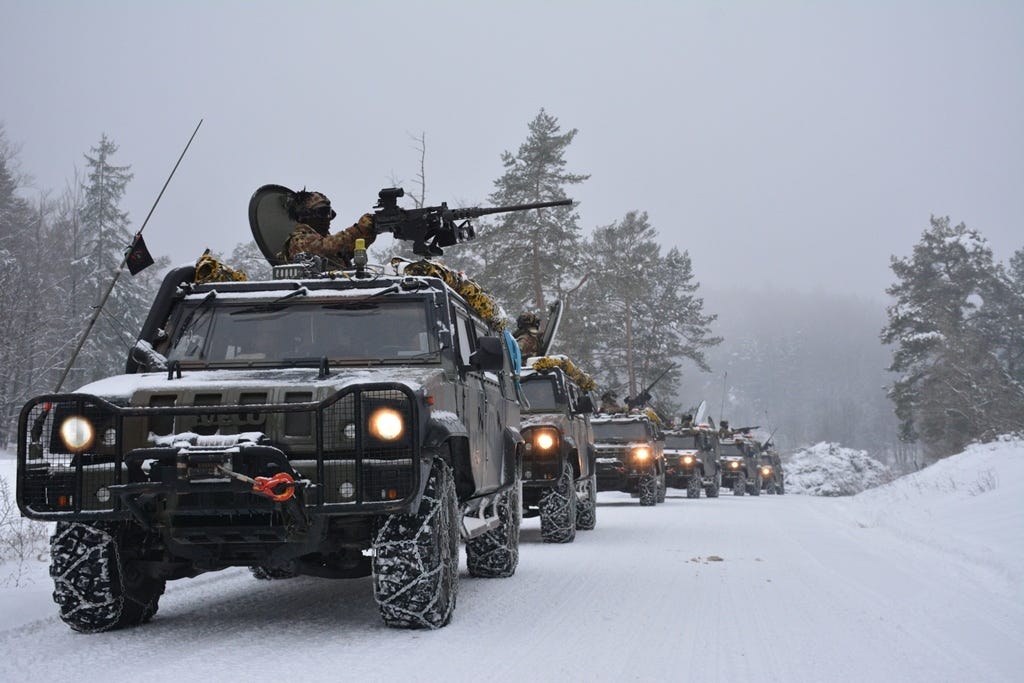
Thirty-three Iveco Light Multirole Vehicles. This is an Italian-designed lightly-armored truck built to shrug off mines and roadside ambushes, roughly an up-armored SUV with a military pedigree, used for patrols, reconnaissance, casualty runs, and shuttling commanders and small teams around a battlefield that is actively trying to kill every one of them.
The whole point of the LMV is the V-shaped hull underneath, a piece of design that deflects a blast outward and away from the people inside instead of straight up through the floor.
That trick, borrowed from the mine-resistant trucks of Iraq and Afghanistan, is the difference between a wrecked vehicle with a rattled but breathing crew and a hole in the road with a memorial next to it.
Thirty-three of them in a single year’s filing is the quiet surprise.
Earlier in the war Norway only copped to a small handful of Ivecos in public, so this reads like a much bigger follow-on shipment than any headline ever caught.
That’s a habit worth clocking with the Nordics.
They announce small and deliver large, which runs exactly backward from how most governments work a press release, where the announcement is enormous and the actual delivery shows up late, short, and missing the ammunition.
Norway does the opposite, and does it without asking for a parade.
The NM189: the armored bulldozer that makes everything else possible

Three NM189 Ingeniørpanservogn engineering vehicles.
Go ahead and try to say that one fast.
It’s a Norwegian armored engineering vehicle, and here’s the part to circle in red: it rides on the chassis of a German Leopard 1 tank, which means it’s wrapped in real tank armor, and it carries a dozer blade up front, a crane boom, and cable winches for clearing obstacles, ripping open enemy defenses, hauling dead vehicles out of the kill zone, and scraping out fighting positions.
Only three of them, and they may be the most consequential machines on the entire list.
Any future Ukraine offensive to take back their stolen land will be a war of minefields, dragon’s teeth, tank ditches, dropped bridges, and vehicles bogged to the axles in mud. Every gorgeous Leopard 2 and Bradley you’ve seen in the highlight reels is useless the second it meets a belt of mines with nobody able to breach it, because the commander’s choices shrink to two bad ones: send infantry forward by hand to clear a path under fire, or stop cold and become a stationary target.
I’ve practiced clearing mines as an infantryman. It is not a fast or fun job for private Joe Snuffy.
The NM189 is the answer to that. It goes first, into the teeth of it, and grinds out a lane so the rest of the force can punch through or pull back.
These are engineering vehicles get no clicks and no glory and never once trend on anybody’s feed.
The SISU XA-185 and XA-186: Nordic workhorses for ugly ground

Eighteen XA-185 SISU carriers and six of the upgraded XA-186. These are Finnish-designed 6x6 wheeled armored personnel carriers, and when it comes to building a vehicle that keeps grinding through mud and snow, I’ll back the Finns against anybody, since they treat conditions that would shut down a NATO exercise as an ordinary drive to work.
The SISU has a party trick the tracked vehicles can’t match: it’ll do highway speed on a paved road, then wade through a swollen river crossing or a churned-up field that would swallow lesser trucks, all on the same tank of diesel.
Wheels instead of tracks means cheaper to run, easier to fix, and far gentler on a crew’s spine over a long road march, which counts for more than romance when the actual mission is shuttling people and supplies across a front the size of a country, in the dark, every single night, while drones hunt the roads overhead.
A vehicle that breaks down in that environment is a stranded crew lit up on someone’s thermal camera.
The SISU’s whole virtue is that it tends not to break.
The NM204/M125A: small-unit firepower on tracks
Twelve NM204/M125A self-propelled mortar systems, which is basically an M113 with a mortar mounted inside on a rotating platform. This one is my sleeper pick for the most useful item per unit on the whole list.
A mortar is indirect fire, meaning it lobs a bomb up in a high arc and drops it onto a target you can’t see directly, over the hill or behind the treeline, as opposed to direct fire, where you shoot straight at something in your sights.
Mortars are the infantry’s own “pocket artillery,” the heavy punch a small unit carries with it instead of begging for from somebody twenty miles back.
Bolting that capability onto a tracked vehicle unlocks the single move that keeps mortar crews alive in this war: shoot and scoot. You fire your rounds, then you displace… fast.
Picture the two versions side by side. A dismounted crew hears the warning, grabs a forty-pound tube and a baseplate and the remaining rounds, and tries to run on foot while fire is already inbound.
The mounted crew drops the last round, buttons up, and simply drives away behind armor.
I’ll take option B please.
Oh, the filing also confirms F-16 fighters and 81mm mortars, but Norway withheld the exact counts on both.
Oslo originally announced six F-16s back in 2024, and reporting since has pointed to a substantially larger number actually flowing, though the government won’t confirm a figure.
Fine. But notice that the only items Norway blacked out are the famous ones, while it cheerfully listed every mortar carrier and bulldozer by serial type. The boring stuff is the stuff they’ll tell you about.
Why the boring drawer wins
Step back and look at what these 92 vehicles add up to: It’s a deliberate sweep across the connective tissue of an army.
Protected transport to move people.
Engineering vehicles to make movement possible in the first place.
Light armor for patrols and command.
Mobile mortars for fire support that can run before it gets hit.
This is sustainment.
Nobody scores a dramatic Hans Zimmer soundtrack over a mortar carrier. Nobody prints a recruiting poster of an engineering vehicle clearing a lane. And yet this is precisely the hardware that keeps an army fighting after the F-16 flyover ends and the camera crews go home.
Wars get headlines for the trophy weapons. They get won or lost on the socket-wrench stuff, the protected mobility and the breaching gear and the shoot-and-scoot mortars that let a tired squad move one more time and hold one more day.
Ukraine needs ten thousand boring, reliable, ugly machines that start every morning and get the work done. Norway, quietly, sent another 92 of them, and then filed the paperwork like it was nothing.
That’s how you actually help a country survive a long war.
Слава Україні!


Great and useful reality check
Good coverage