


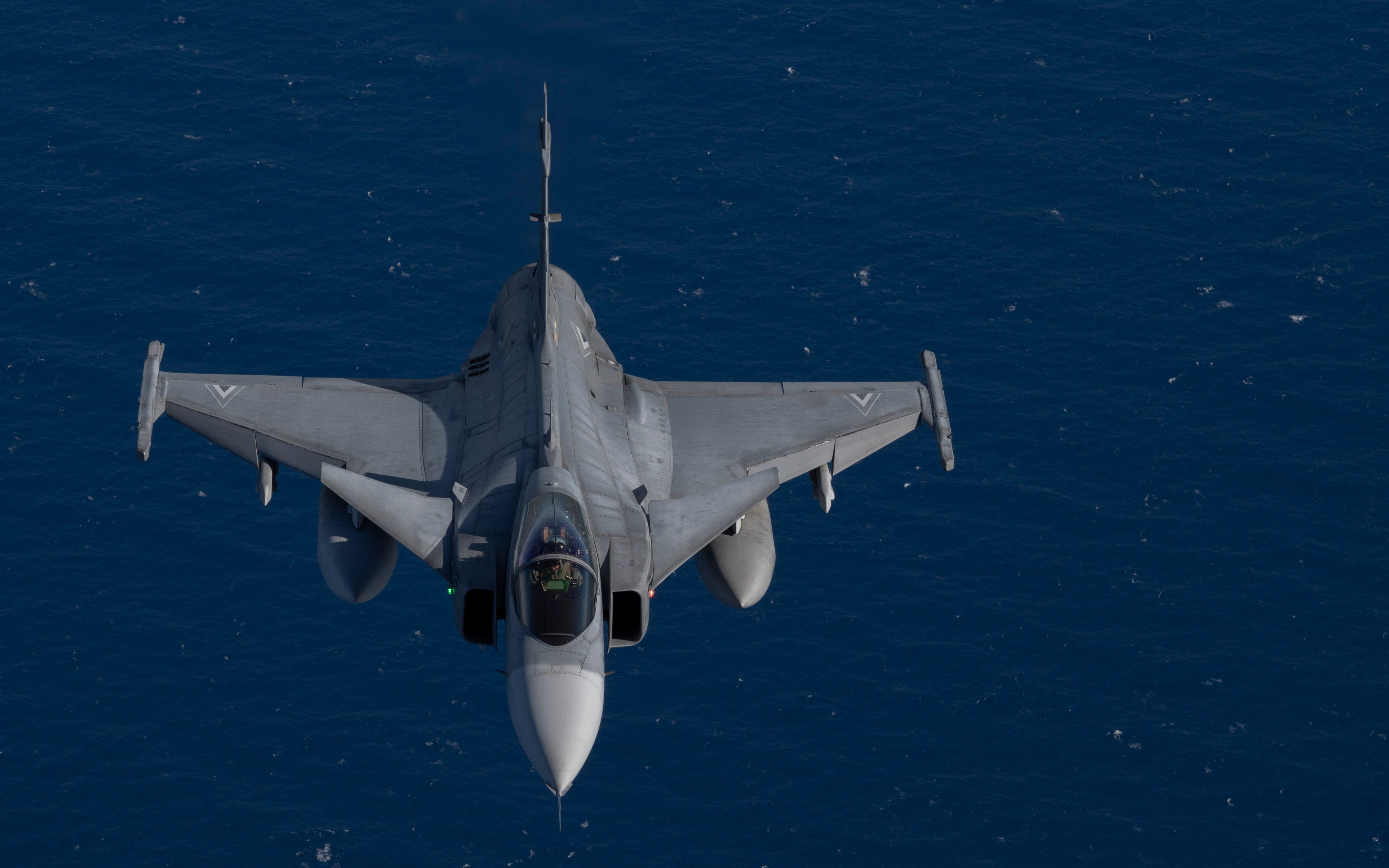
This one’s a bit of a stream of consciousness column today because I’m trying to mentally work through a problem while writing, rather than coming in hot, with my conclusions drawn.
I’ve been a big fan of the Swedish Gripen for years, so when I heard that a Swedish pilot had failed to shoot down a Russian cruise missile over Poland on Friday, my gut reaction was “oh come on.”
My working headline was “The Gripen Whiffed.”
Longtime readers would’ve been shocked, because I’ve praised Saab so often, I’m surprised nobody’s accused me of being ‘on the take,’ (to borrow some dirty-cop slang).
Let’s get into it.
Here’s the morning: On November 20, a pair of Swedish JAS 39 Gripens were flying under NATO command over eastern Poland while Russia ran another huge missile and drone attack on Ukraine.
Polish radar flagged eleven objects that might cross into their airspace.
Three did.
One was a suspected Kh-101. The Gripen pilots had a “condition-based order” from the Combined Air Operations Centre in Uedem, Germany, which means NATO had cleared them to kill the thing only once a set of boxes got checked.
One Gripen moved to intercept, but he couldn’t positively identify the target. The weather was rough, and neither his own eyes nor the jet’s electro-optical sensors could give him the confirmation he needed. He held fire and at about 6:36 a.m. that morning a Kh-101 came down in a field near Nowy Lipowiec. Fortunately, nobody was hurt.
So, I have questions, and I’m going to walk you through them. Why didn’t the pilot shoot?
Bad weather is the answer you’ll read in the news.
Okay fine, but I also want to know, was it the older Gripen’s sensors? Was it the rules of engagement? Was it NATO’s faltering nerve? Each one has its place here.
Was it the airplane?
The Gripens Sweden sent are the older C/D generation. They carry the PS-05/A radar, which uses a mechanically scanned antenna, so the dish physically swivels to look around, versus the electronically scanned AESA radar in the newer Gripen E that steers its beam without moving a thing.
Newer is better. Easy column to write. Blame the old radar, praise be to the Gripen E, let’s break for lunch.
Except the PS-05 is no slouch. In December 2025, The Aviationist interviewed Swedish Air Force Colonel Carl Bergqvist about exactly this. Bergqvist said NATO had asked whether Sweden could handle hard targets like low-signature cruise missiles, and that the Swedish Air Force built its own test targets and confirmed the older Gripen could detect and engage things with Kh-101-like characteristics.
So, the Swedes specifically checked whether that old mechanically scanned radar could handle the exact target that showed up over Poland. The answer was yes.
Would a Gripen E or an F-35 have done better? Maybe. More sensors, an infrared search-and-track, distributed cameras, a fuller picture of the sky. But nobody’s established that fancier hardware could’ve satisfied the NATO conditions in Friday’s weather, and here’s the part that really deflates the hardware argument: the two Polish F-16s up there didn’t fire either.
Neither did the Patriots on the ground.
You had Polish F-16s, the Swedish Gripens, a Swedish Saab 340 early-warning plane, a Dutch tanker topping everybody off, and ground-based air defense all pointed at the same sky.
An impressive pile of military hardware, and none of it fired.
A Kh-101 flies low and subsonic, somewhere around 700 to 900 kilometers an hour, and it’s shaped to be hard to see on radar.
Poland’s defense minister said Friday’s missile spent about three minutes in Polish airspace. Three minutes is roughly what my microwave wants for a frozen burrito. But the Kh-101 can cover 45 to 48.5 km (about 28 to 30 miles) in three minutes.
In that window a fighter has to get into position, nail the identification, satisfy the weapons-release conditions, and actually fire, at night, in bad weather, after a mission that needed aerial refueling.
So, no. It wasn’t the airplane. The airplane did everything but the one thing nobody would let it do.
Was it the rules?
This feels familiar… Let’s go back to July 30. Another Kh-101 crossed into Poland during an attack on western Ukraine. Radar caught it around 3:40 a.m., an F-16 went to look, and six minutes later the missile fell in a field near Tarnawa-Kolonia, about 100 kilometers inside the country.
