


Hey friends,
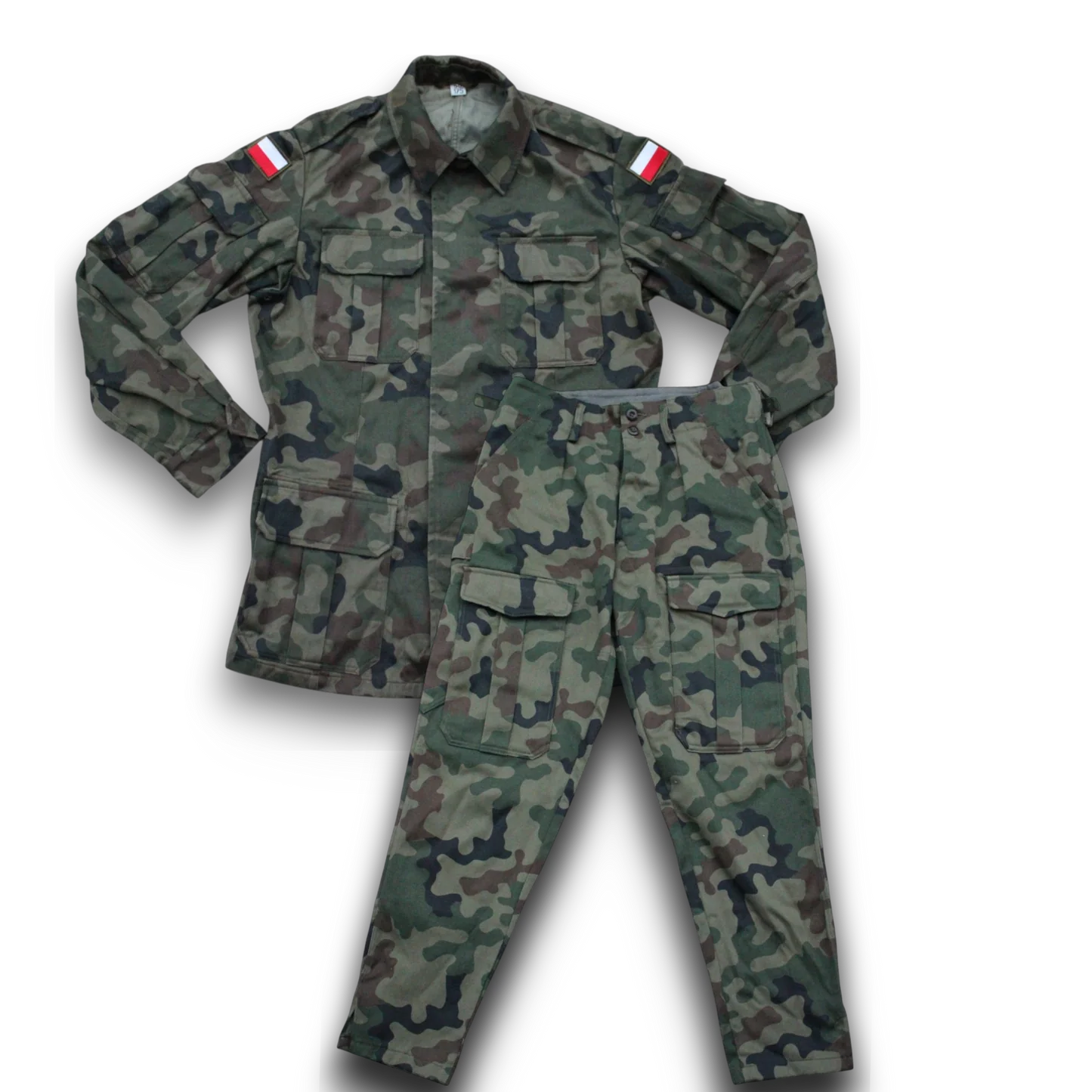
Picture a Polish infantryman in 1993.
He’s wearing the brand-new wz. 93 Pantera uniform, probably has some face paint smeared across his cheeks, and he’s walking into a forest somewhere east of Warsaw carrying entirely too much shit.
His camouflage has a fairly straightforward job. There is another human being out there, and that guy has eyes.
Maybe he even has binoculars. Maybe a rifle scope. Night vision exists, although in 1993, the good stuff is expensive nowhere near as widely distributed as it is today.
I understand that world because I lived in a version of it from the late 90s to the late 2000s.
When I was in the Army infantry, my woodland BDUs were mostly trying to fool some dude across a field with a pair of binoculars. My personal contribution to “advanced signature management” was a unique face pattern I invented with a two-color camouflage stick that smelled terrible and tasted worse.
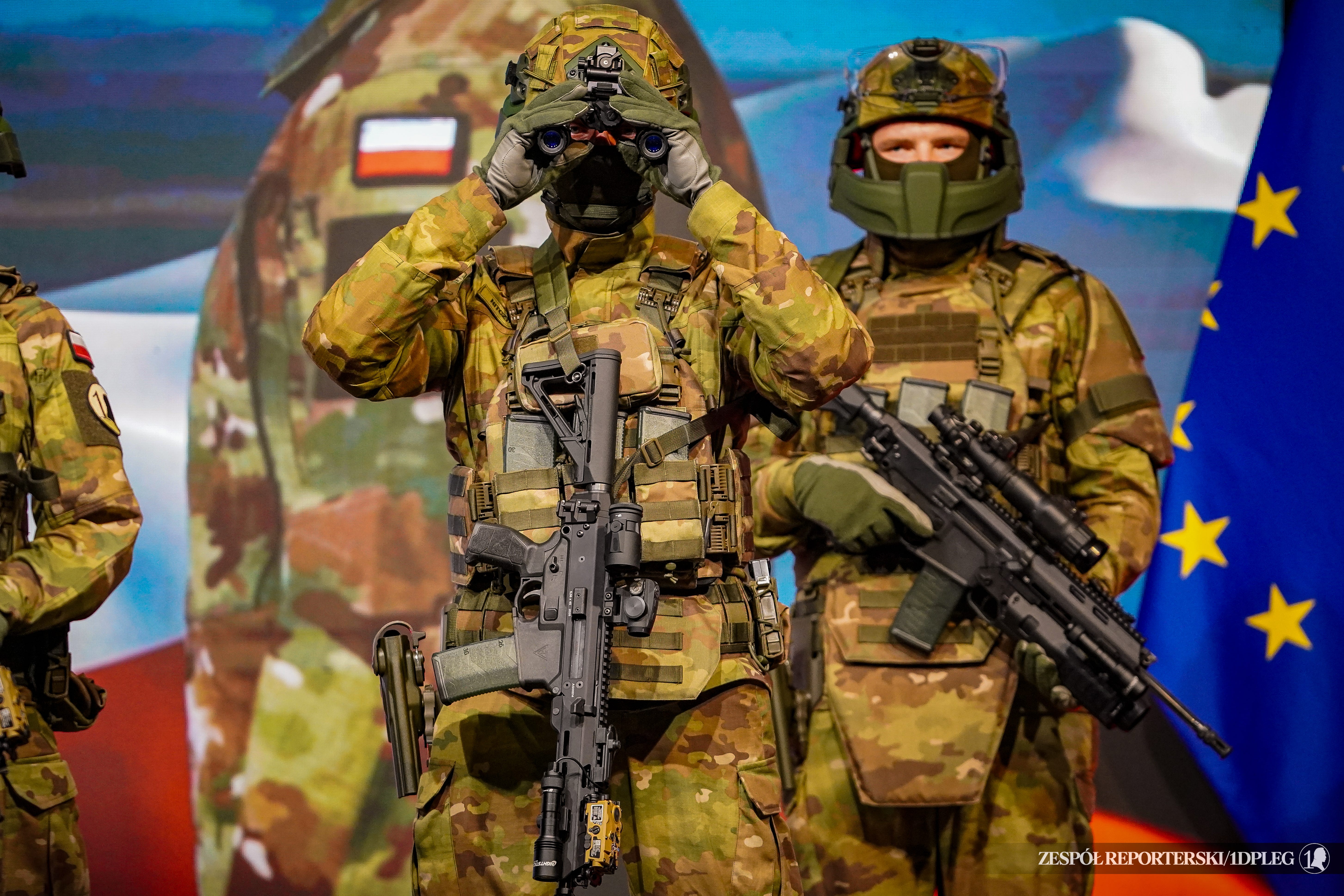
Thirty-three years later, Poland is finally replacing Pantera.
The new pattern is called K-03 “Ryś,” Polish for lynx, and the Ministry of National Defense unveiled it Monday at the headquarters of the 1st Legion Infantry Division in Ciechanów.
My first reaction was blasé.
Armies love new camouflage patterns. They look great in photographs, somebody gets to unveil a mannequin, and every private immediately begins wondering whether supply will issue him trousers in the wrong size.
“How do you only have 48 longs in stock?! Who in the hell do you know who has a 48-inch waist and stands seven feet tall, you muppets.”
So, I figured this was mostly a uniform story.
Then I got to the night-vision testing.
Poland says Ryś is roughly one-third harder to detect in daylight than Pantera. More interestingly, Polish officials claim it was almost twice as difficult to detect at night as MultiCam. The military says it tested the pattern in different terrain, seasons, weather conditions, and observation environments.
Now I was interested, because Poland is talking about something much more consequential than whether one shade of green looks better next to another shade of green.
The thing hunting the infantryman has changed.
A soldier can now be watched from above by a quadcopter with a 4K camera. After sunset, another drone can take over. Night-vision devices are everywhere. Thermal imagers are dirt cheap. Reconnaissance drones can loiter for hours now.
It’s not that the Polish forest has suddenly become more difficult to match.
The observers have gotten much better.
Human eyes see only a narrow chunk of the electromagnetic spectrum, roughly 400 to 700 nanometers. Violet lives down at one end. Red sits at the other.
Traditional camouflage works inside that little window.
Designers choose colors that resemble the terrain, vary the size of the shapes, manipulate contrast, and try to break up the outline of the human body. Ryś still does all of that. It uses five colors chosen around Polish terrain, along with irregular shapes, different pattern scales, and softer transitions between colors.
Then you put on night vision and everything gets weird.
Image intensifier tubes don’t stop seeing when visible red ends. They can pick up near-infrared energy farther out, roughly toward 900 nanometers depending on the equipment.
Vegetation behaves differently there also.
A healthy green leaf absorbs a lot of visible red light because chlorophyll is busy doing chlorophyll things. In the near-infrared, however, the structure of the leaf reflects strongly. ISR people call the sudden increase in reflectance the “red edge.”
This can make vegetation look surprisingly bright through the right sensor.
Now imagine I dye a uniform the perfect shade of forest green.
Standing ten feet away at noon, you might lose me completely.
When I first got to Fort Benning, Georgia, I entered a unit called Reception Battalion. That’s where you in process into the Army before moving on to real basic training: Dental work, vaccines, issued uniforms, ID card, dog tags, all the things.
When my group first got our uniforms I remember running out to the tree line like giddy children asking, “can you see me?”
But if that dye in the uniforms behaves differently from the leaves in near infrared, I can become a man-shaped patch that doesn’t belong there as soon as you look through night vision.
That is why military camouflage is a textile-engineering problem as much as an artistic one.
The manufacturer has to worry about what the fabric reflects at wavelengths the soldier wearing it can’t see.
The military has known about this for a long time. I remember the Army warning us about starching BDUs because starch could affect the uniform’s infrared properties.
We starched the hell out of them anyway because our first sergeant couldn’t see near-infrared reflectance at formation, but he could absolutely see whether you had a crease.
What has changed since then is how often soldiers encounter the sensors capable of exploiting those differences. Night vision was just starting to become affordable when I started my military career. Today you can put an infrared-capable camera on a drone that costs less than most used cars.
That makes Poland’s claim about MultiCam worth examining.
About that MultiCam claim
Poland says Ryś was almost twice as difficult to detect at night as MultiCam.
I am immediately suspicious whenever somebody tells me their new defense product is “twice as good” at anything.
That doesn’t mean I think Poland is making the result up. It means I want to see the test.
