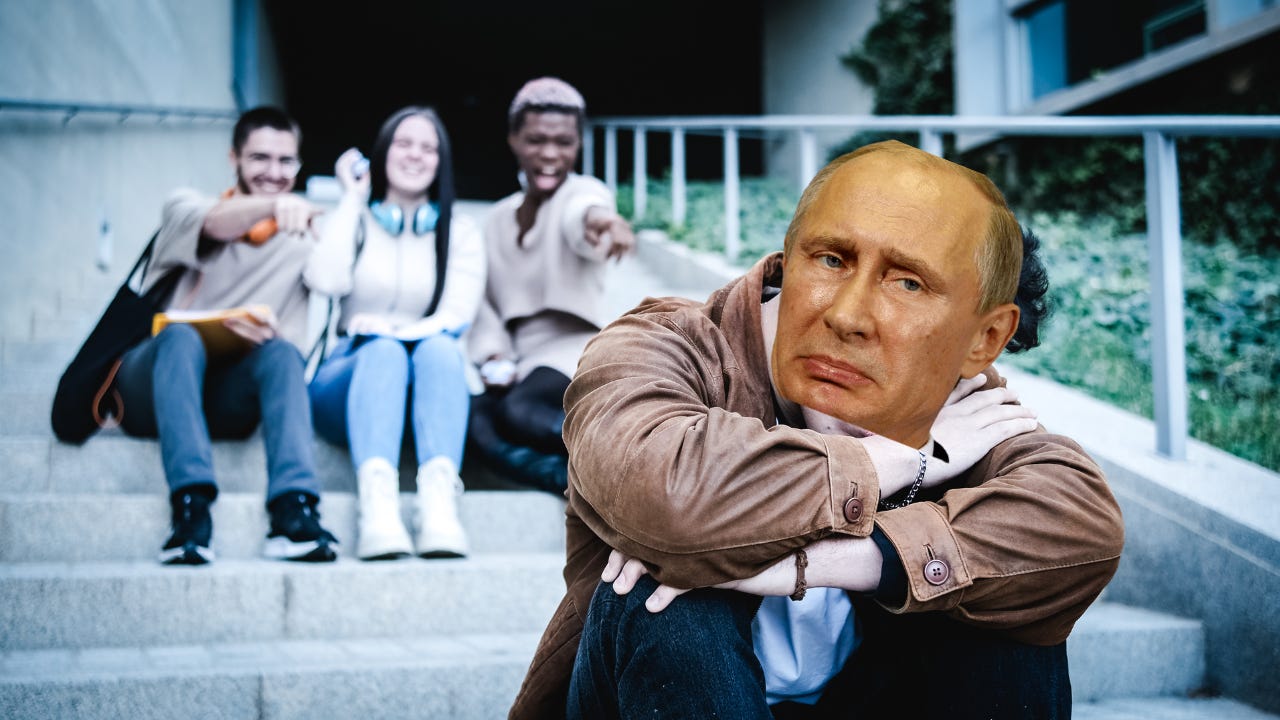
Putin’s Quickly-Shrinking Circle of Friends
Aw, Putin is sad...
No matter where you stand on the US strikes in Iran, we should all agree on one thing: Hurting Iran hurts Putin. A hurt Putin is good for Ukraine (and Europe more generally).
Putin has built his foreign policy the way a certain type of mid-level mafia boss builds friendships.
You don’t get allies, you get dependents.
You don’t get partners, you get clients.
You don’t offer ideological values, you offer protection, weapons, money, disinformation, and the quiet promise that Moscow will keep your enemies away if you stay useful.
“Hey, uh, maybe you buy the Su-57 or we come in and start breaking things, eh? Bada bing, forgitaboutit.”
That model looks impressive on The Sopranos. It looks less impressive when the phone rings and you can’t do anything to help.
Over the past 15 months, Russia’s “friends” have started falling off the board in a way that strips the paint off the Kremlin’s brand.
In December 2024, Syria’s Bashar al-Assad was deposed and ended up in Russia, with the Kremlin confirming asylum.
In January 2026, President Donald Trump announced the capture of Venezuela’s Nicolás Maduro following a US operation, an event that has since been treated as a real policy and legal problem by serious institutions, not as a social media rumor.
And in the last 72 hours, Reuters and other outlets have reported that Iran’s Supreme Leader Ayatollah Ali Khamenei was killed in US-Israeli strikes, triggering a succession crisis in Tehran and forcing Moscow into public condemnation that reads like moral outrage written by the world’s most unserious editor.
Putin’s Russia is watching its network of friendly regimes shrink, and it has fewer tools than it pretends to have to stop the bleeding.
Russia sold the idea that it was a great-power umbrella.
The umbrella is full of holes, and Ukraine is why.
The Kremlin’s pitch has always been simple: Stick with us and we’ll help you survive… We’ll ship weapons. We’ll jam your enemies. We’ll flood your information space with noise. We’ll show up at the U.N. with a veto and a straight face. We’ll keep you in the club of leaders who never have to answer hard questions.
That pitch worked best when Russia could credibly move military mass beyond its borders. Syria mattered because it showed Moscow could deploy, sustain, and protect a client regime while humiliating Western red lines. The Tartus naval facility and the airbase at Khmeimim gave Russia presence in the eastern Mediterranean, plus a staging point for influence operations across the region. That was the brand.
Then Assad fell anyway, and Russia’s position in Syria became a negotiation, not a guarantee. Even the public reporting around post-Assad Syria has centered on Russia scrambling to preserve some footprint as its influence wanes.
Now add Iran. Iran wasn’t just a friendly regime. It was a functional wartime partner. Iran helped Russia solve a specific battlefield problem in Ukraine: mass strike drones.
Shahed-131 and Shahed-136 designs shaped the war’s nightly rhythm and forced Ukraine to spend scarce interceptors and manpower on cheap, repeating threats. Iran gave Russia a fellow sanctioned state with deep experience in evasion, proxy warfare, and operating under economic pressure.
So, when Khamenei gets killed and Iran enters a leadership crisis during an active conflict, Russia loses more than a pen pal. It loses predictability.
Khamenei’s death is Iran’s gravest crisis since 1979, and the key point is not that the regime instantly collapses. The key point is that the system enters a succession scramble, and succession scrambles always create openings for internal power struggles, security force competition, and policy discontinuity.
That’s a problem for Moscow because Russia’s “friendships” rely on continuity.
Russia doesn’t do alliances like Norway. It does alliances like a protection racket. That only works if the protected regime stays stable, stays aligned, and stays able to trade.
And there’s real money on the table.
Russian and Iranian officials have publicly put the annual trade figure around $4.8 billion for 2024. If Iran’s leadership crisis turns into regime instability, sanctions tightening, or a sharp internal pivot, that trade becomes fragile.
It might not bankrupt the Kremlin by itself. But it will remove one more pillar from a network that Russia uses to compensate for its loss of European markets.
Sanctions have already done damage to Russia’s traditional energy revenue streams. Russia redirected exports to China and India, relied on a shadow fleet, accepted discounts, and still took a revenue hit compared to pre-war levels.
That’s the economic background music behind everything else. When your revenue is constrained and your war consumes hardware at industrial scale, your ability to bankroll friends collapses.
Which brings us to the core problem: Russia can’t be everyone’s weapons locker anymore...
(Except for maybe the venerable Kalashnikov).
Ukraine has turned Russia into a wartime consumption machine. Moscow is burning through drones, missiles, artillery ammunition, armored vehicles, and trained (and untrained) manpower at a pace that makes foreign commitments feel like royal luxuries.
Even back in early 2024, Reuters cited Western officials saying Russia’s domestic ammunition production was insufficient for its needs in Ukraine and that sanctions were undermining its ability to produce and repair systems due to restricted access to components.
Whether you trust Western officials or not, the strategic effect is visible. Russia has to prioritize Ukraine. And that squeezes everything else.
This is why the “what does friendship with Russia look like” question is suddenly so sharp.
If you are an authoritarian leader watching Venezuela’s Maduro get hauled into US custody, watching Assad lose power and end up depending on Moscow for asylum, and watching Tehran’s supreme leader get killed in a strike Russia can’t deter, the lesson isn’t that Russia is impotent.
Everybody already knew Russia was impotent. Read my article Hard Times in Russia as Viagra Supply Cut Off
The real lesson is that Russia may be unable to deliver the one thing it sells: protection.
That’s a catastrophic brand problem for Putin.
Because Russia’s protection model is already competing against two other models that look stronger right now.
The first is the US model, which is blunt, openly hostile, expeditionary, and backed by global logistics.
The world just watched the United States military take down two long-time enemy regimes with minimal losses, within 60 days of each other; almost making it look easy. This isn’t the 2003 Iraq invasion US military anymore. This is what a $1 trillion per year military looks like in action. God help us all if it becomes any more politicized. No single party should wield that tool.
The second model is the China model, which is quieter and more economic. Beijing doesn’t promise to save you in a firefight. It promises loans, infrastructure, trade, and political cover. That is often more useful to regimes that fear riots and budgets more than bombs.
Russia is stuck between them.
It can’t outspend China and it’s a minor regional power compared to the United States military. Ukraine has turned a decently-sized Russian military into a regional brawler bleeding and limping in public.
This is where Putin’s reaction to Khamenei’s killing becomes revealing. Putin condemned it as a “cynical” murder and that the Kremlin said it remained in constant contact with Iran’s leaders while blaming “outright aggression.”
That’s rich coming from this f*cking guy.
That language is just bad theater... Like a high school play of Hamlet. Russia is trying to project moral authority because it can’t project deterrence.
Sorry Vlad, Russia hasn’t had moral authority since March 1917.
And every other capital notices.
That’s how great-power reputations die. Not in one dramatic defeat, but in a sequence of “wait, they couldn’t stop that either?” moments.
Maduro is another one of those moments. Maduro’s capture in Caracas sends a message that geography isn’t safety and that Russia’s support doesn’t guarantee survivability. Russia can denounce it, threaten consequences, and wave flags. That doesn’t change the fact that the client is gone.
Iran is the biggest hit, because Iran wasn’t a client. It was a partner of necessity.
It’s still early in Trump’s operation, but if Iran’s leadership crisis leads to reduced coordination, disrupted weapons cooperation, or tighter constraints on how Tehran can support Moscow, Russia loses one of its most useful wartime pipelines.
It also loses a route of influence toward the Gulf, where Iran has long been a central actor in pressure, disruption, and maritime risk. Even if Russia doesn’t control the Strait of Hormuz, it benefits when partners can shape the environment there.
If Tehran’s regime becomes unstable or inward-looking, that leverage shrinks fast.
The biggest irony is that Putin wanted a return to the glory days of imperial Russia, seeing himself as the next Peter the Great. Instead, Putin’s quagmire in Ukraine and worsening decisions on the world stage will see him preside over the biggest weakening of the Russian state since 1989.
So, what happens next?
Russia will try to do three things at once.
First, it will pretend nothing has changed. That means more propaganda about multipolarity, more talk about Western “illegal aggression,” and more performance outrage from officials whose country has been illegally occupying and striking its neighbor for four years.
Second, it will attempt to hold the remaining network together with whatever it still has: intelligence support, cyber tools, diplomatic cover, and selective weapons shipments when possible.
This will be uneven because Russia’s production and supply chains are still under pressure from wartime demand.
Third, it will lean harder into the one arena where it can still move the needle: sabotage, subversion, and proxy escalation. When you can’t protect your friends openly, you try to punish your enemies indirectly. That is classic Kremlin behavior, and it’s cheaper than rebuilding an industrial base.
The conclusion for Putin is that his “axis” is becoming a set of disconnected problems. Syria is no longer a stable anchor. Venezuela is now a warning label. Iran is in flux. Russia’s war in Ukraine is still consuming the resources that would normally fund foreign adventures.
North Korean dictator and disgusting man child Kim Jong Un has got to be wondering if friendship with Moscow is worth the collateral damage at this point… He has to be thinking that if Iran and Venezuela’s leaders can be toppled, what’s stopping Trump from attempting a hat trick?
This is the part that should matter to Ukraine, and it’s why Ukrainians are watching events like Khamenei’s killing with something close to satisfaction.
Ukraine has spent years absorbing the downstream effects of Iranian assistance to Russia, especially in the drone war. When the partner state that helped feed those attacks gets hit hard, it feels like the world finally noticed the supply chain behind the misery.
Putin built a foreign policy around the image of strength. Ukraine turned that image into a live demonstration of limits.
Now, one by one, the “friends” who were supposed to prove Russia’s power are proving something else: Russia can still break things like an ill-mannered toddler, but it can’t reliably shield the people who bet their survival on Moscow.
That’s what diminishing friends looks like. Not loneliness… Exposure.
Слава Україні!


Good read. This all started in 1973 after the Yom Kippur War when Kissinger pried Egypt out of the fingers of the Kremlin followed by the Berlin Wall, the failure of the USSR, and in rapid successiuon -- Syria, Venezuela, Iran, and, soon, Cuba.
Putin has taken some bold risks that his army cannot back up.
The best world result is a defanged Russia, a broke Russia, and a dismembered Russia -- meaning subdivided into 5 European sized states.
On the grand scheme of things losing Khamenei hurts Putin.
But in the short to medium term, does it?
The U.S. is expending a lot of hardware. We had already stopped directly supplying Ukraine, but doesn’t this impact the supply from European partners because they won’t be able to backfill Patriot missiles and other US supplied weaponry?
Also, the U.S. is concentrating its satellites over Iran which seems like it would impact the information we are collecting over Ukraine.