


Russia loves a costume.
Sometimes it is a “humanitarian convoy” full of ammunition. Sometimes it is “little green men” who just happen to have brand-new rifles and mobik haircuts.
Now it is “scientific” underwater drones that just happen to be perfectly suited to mess with undersea cables and pipelines in the Baltic Sea.
If you live around the Baltic, this is not a theoretical problem. Cables and pipelines sit on the seabed like exposed arteries. They were never laid down with defense in mind; such armoring or hardening against intentional sabotage would likely be prohibitively expensive for these companies’ shareholders to stomach.
Cables are hard to guard in the traditional sense, easy to blame on “accidents,” and politically annoying to respond to because everybody wants proof before they start throwing accusations across NATO press podiums.
The first submarine cable to use fiber optics was TAT-8, which went live in 1988. It reached speeds of 280Mb per second.
Today, the fastest cable is the newly completed transatlantic cable called Amitié. Funded by Microsoft, Meta, and others, it can carry 400 terabits of data per second.
This free, interactive cable map by research firm TeleGeography shows all 380 undersea cables that carry over 99.5% of all transoceanic data, running for 750,000 miles across the ocean floor.
As reliant as we have become on undersea cables, TeleGeography reports that there are over 100 cable breaks per year.
In developed countries, these breaks go largely unnoticed because of redundant systems.
But in some places, a single fiber cable can supply internet for millions of people.
In 2011, an elderly Georgian woman was scavenging for copper to sell as scrap when she accidentally sliced through an underground fiber cable with her spade and cut off internet services to all of neighboring Armenia.
As Georgia provides 90% of Armenia’s internet, the woman’s unwitting sabotage had catastrophic consequences, plunging 3.2 million people into internet darkness.
Fishing trawlers, anchors, earthquakes, and deep ocean currents are also often responsible for cable breaks. Hell, even sharks take a bite out of them from time to time.
Russia understands this dynamic weakness. Russia has been exploiting it for years. The only thing changing is the tool set.
Now, Defense Express, via legendary Navy researcher H.I. Sutton, is reporting the Rubin Design Bureau’s new family of underwater vehicles, Argus-D, Argus-I, and the Octavia docking station, reads like a brochure for oceanography.
It also reads like a shopping list for sabotage.
The clever part is not the technology. The clever part is the framing. Russia is building an ecosystem, not a single drone. That matters because seabed work is rarely a one-and-done sprint. It is preparation, placement, verification, and then either a trigger or a repeat visit. If you can do that quietly, you can turn cables into hostages without ever firing a shot.
Start with Octavia, because Octavia is the enabler.
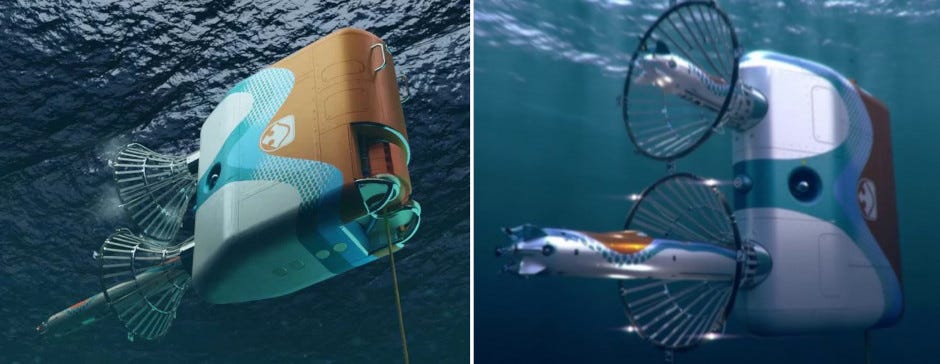
Octavia is described as a stationary underwater docking station. Picture a seabed “garage” with two ports, planted on the bottom, where other unmanned underwater vehicles can dock, recharge, upload data, and receive new tasking.
That sounds boring until you remember what it solves: time and distance. A drone that has to drive out from shore every time, do the job, and drive home is limited. A drone that can hop between underwater pit stops becomes a much more persistent problem.
It also changes attribution.
If a country finds a suspicious unmanned vehicle near a cable, the immediate question becomes, “Where did it come from?” An underwater dock makes that question harder. You are no longer hunting a single vehicle. You are hunting a support node that can sit quietly until needed.
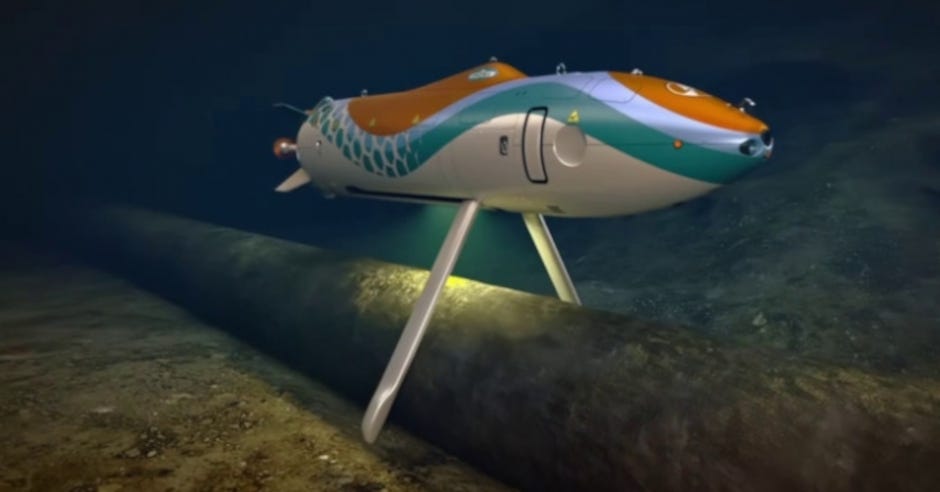
Then you have Argus-I, the “Inspector.”
Officially, it inspects pipelines for leaks. It has extendable sensor booms and a design meant to straddle a pipeline as it moves along, collecting data.
That is exactly the kind of platform you would want if your public story is, “we are protecting infrastructure.” It is also exactly the kind of platform you would want if your private mission is, “we are mapping infrastructure.”
