


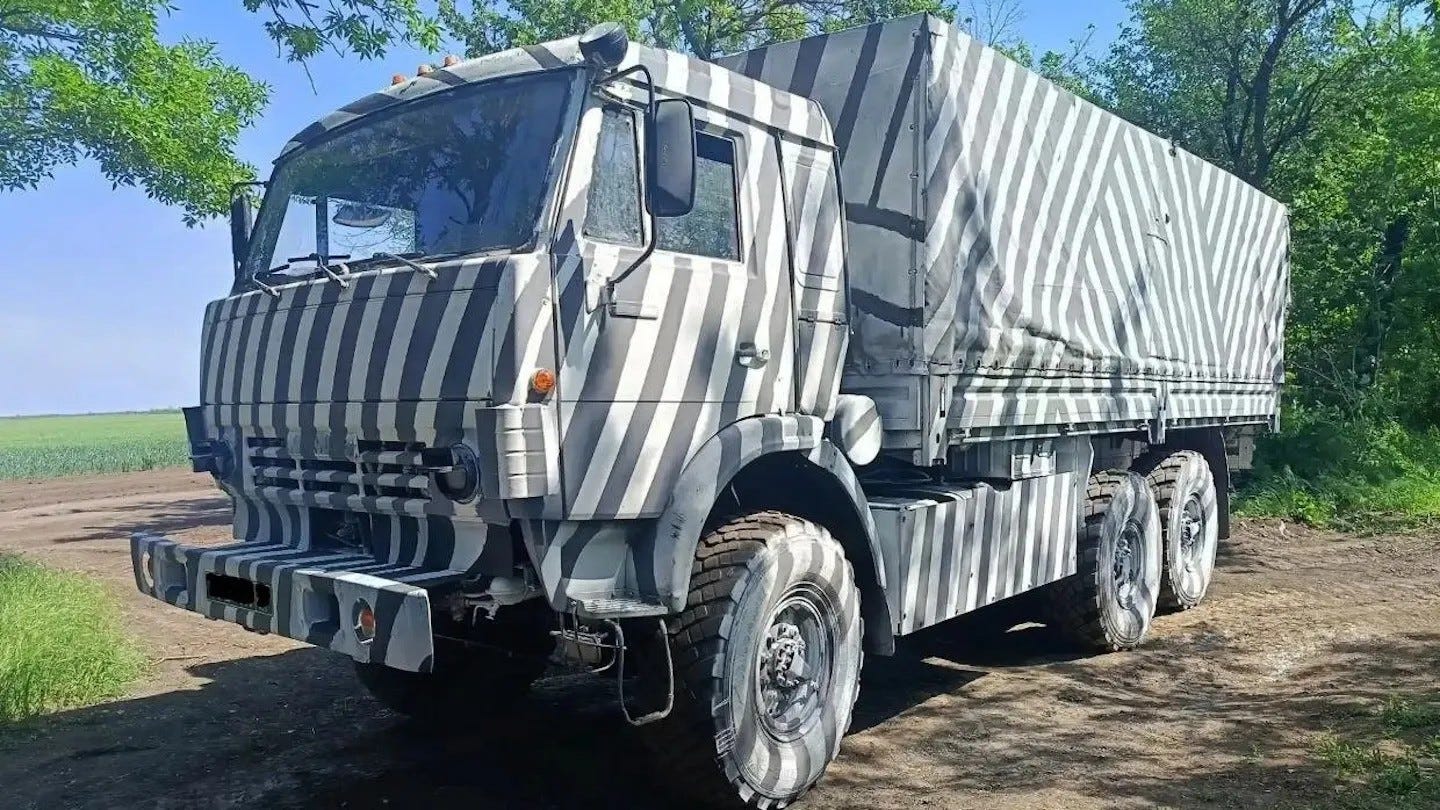
Over the past couple of weeks, images have surfaced on Russian and OSINT social media channels showing Ural and KamAZ heavy trucks covered in bold black-and-white patterns.
Not normal camouflage.
The opposite of normal camouflage.
These trucks are painted to stand out, with high-contrast stripes running across body panels, the cab, the cargo bed, and even the wheels and tires.
There are actually two patterns making the rounds: a zebra-style scheme of broadly straight lines, and a more organic, swirling, leaf-like design.
The white appears to be applied right over the standard dark green base.
Your first instinct is to laugh; mine was too. It looks like the motor pool lost a bet. But the logic behind it is a genuine window into where this war is going.
The Telegraph and a few other outlets ran with headlines suggesting Russia has found a clever way to beat Ukraine’s AI drones. That’s too strong.
They’re not beating AI with these patterns and I’m going to explain why.
Where the Zebra Idea Came From
My audience is likely well aware that this paint scheme isn’t new. It’s about 109 years old.
During the First World War, German U-boats were sinking Allied ships at a rate that threatened to starve Britain out of the war.
In 1917, a British marine painter and naval officer named Norman Wilkinson came up with a counterintuitive answer. You couldn’t make a ship invisible on the open ocean, so don’t try. Instead, paint it in bold, clashing geometric blocks of color, mostly black and white, in patterns designed to break up the ship’s outline. They called it dazzle camouflage.
And I sincerely hope when Wilkinson unveiled dazzle for the first time, someone in the crowd said, “It’s jazzy, it’s snazzy, it’s a regular humdinger!”
