


NATO has more water than ships… And it’s a bit of a problem.
With thousands of miles of coastline, crowded shipping routes, undersea internet cables, pipelines, offshore energy infrastructure, and naval approaches to monitor, Russia only needs to find the sections that aren’t being watched at the moment it decides to act.
For a Russian naval commander, that task is exceedingly easy at the moment. But a Danish company is trying to change that.
Now, I’m not a Navy Puke, but I have it on good authority that crewed ships remain pretty important.
A manned frigate can identify a contact, launch a helicopter, board a vessel, escort shipping, and defend itself. But it can also cost hundreds of millions of dollars, require human crew that need pesky things like food and rest, and many ships may spend substantial portions of their service life training, maintaining equipment, or refueling.
There simply aren’t enough of them to park one beside every internet cable, wind farm, harbor approach, and shadow-fleet route from the Baltic to the North Atlantic.
Sure, aircraft cover distance quickly, though they eventually run out of fuel. Most satellites revisit rather than stare. Coastal radar can leave huge gaps beyond the horizon or behind terrain. A manned patrol ship can remain on station, though assigning a high-end combatant to watch one patch of water for weeks is an expensive use of a scarce hull.
That’s the gap uncrewed surface vessels are beginning to fill.
And why not? Uncrewed military ground vehicles in Ukraine get a lot of press, loyal wingmen autonomous fighters are the bleeding edge in air war, and Ukraine’s kamikaze USVs have put tens of thousands of tons of Russian junk on the bottom of the Black Sea.
But what about thousands of uncrewed floating sensor nodes spread across vast stretches of ocean? Sounds to me like a great idea.
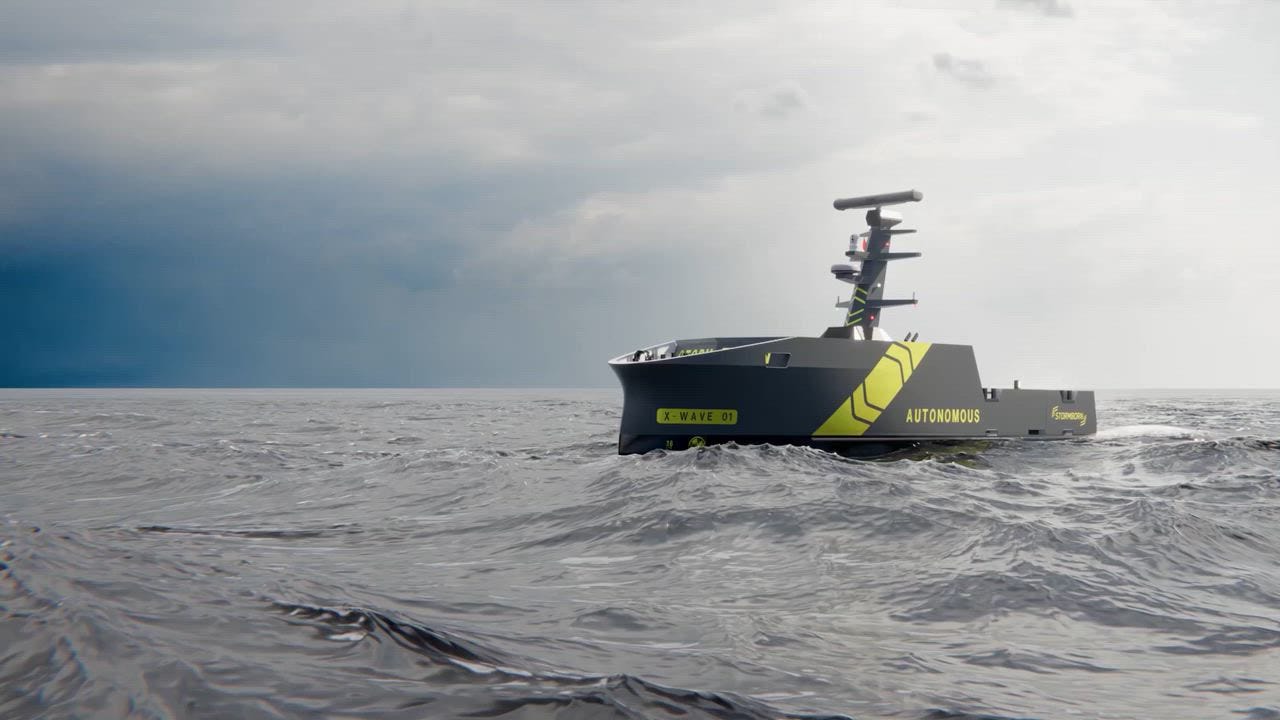
Stormborn’s X-Wave 01 is a persistent sensor node: small enough to tow by road, cheap enough to deploy in numbers, and designed to remain offshore far longer than a crewed patrol vessel can without rotation.
Its job is to sit there like flotsam (or jetsam) and watch.
When X-Wave sees something interesting, it passes the problem to people and platforms better equipped to respond.
On June 25, this model received its first public Russian inspection.
It sounds like the start of a joke: A Russian corvette carrying roughly 100 sailors approached a Danish vessel carrying none. The Russians were scratching their heads in confusion while the Danes were enjoying a kaffepause in the control room.
The Danish vessel recorded the Russian warship, the sailors moving across its deck, the helicopter parked aft, and the small quadcopter the Russians launched to inspect X-Wave.
The Russians, meanwhile, received an unobstructed look at the radar mast, cameras, antennas, hull, and communications equipment aboard one of Europe’s newest autonomous maritime surveillance platforms.
Then the two vessels went their separate ways.
If you think about it, the Russians showed an amazing amount of restraint; their navy is typically reckless to a fault. I’m surprised they didn’t make up some BS excuse to board and inspect the Danish vessel.
This encounter may have been one of the more revealing naval events in the Baltic this summer.
Here’s exactly what happened:
On June 25, the Danish-built X-Wave 01 was operating approximately 30 kilometers southeast of Bornholm. Its owner, the maritime technology company Stormborn, had placed the uncrewed boat in an area where Denmark’s existing coastal surveillance coverage was limited.
The vessel sat at anchor with its Automatic Identification System, or AIS, transmitting normally. Its sensors were running. Its operators watched from a control room ashore.
Then the Russian Baltic Fleet corvette Soobrazitelny, hull number 531, approached without broadcasting its own AIS position. The Project 20380 warship passed within roughly 200 meters and launched a small quadcopter that examined the Danish vessel at close range.
Stormborn says its system detected the corvette with radar, identified it with electro-optical and infrared cameras, detected the Russian drone through radio-frequency sensors, and forwarded the collected information to the Royal Danish Navy.
