Russia Now Arming Shaheds With MANPADS
Here's how Ukraine can adapt

Russia just turned the Shahed into a flying booby trap.
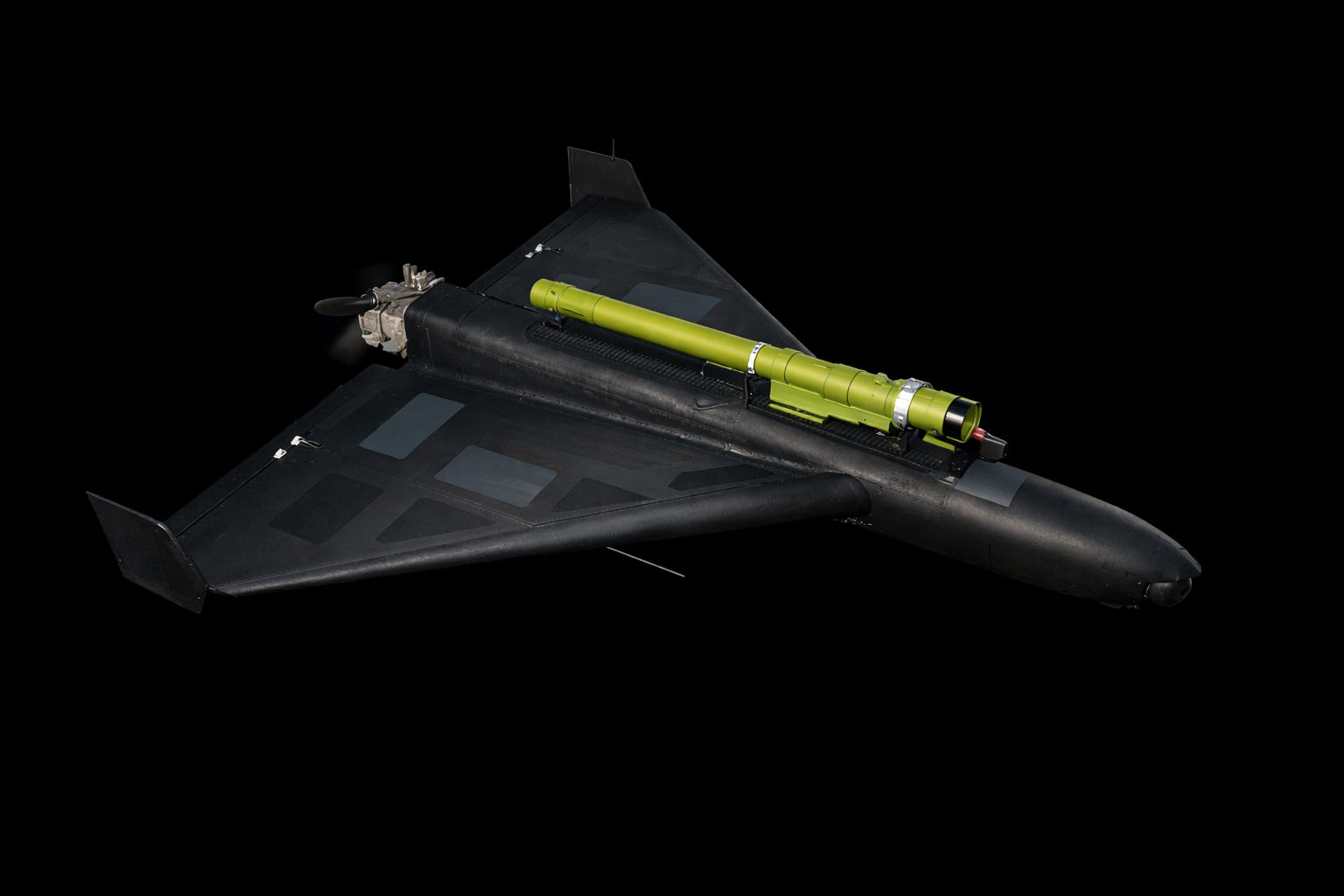
Ukraine’s military intelligence says a new Geran-2 “E” variant (Shahed in Iran) has shown up with a Verba MANPADS strapped to the airframe and a full-sized strike warhead still riding shotgun.
I’m actually surprised the Russian Aerospace Forces (VKS) came up with this idea; I would have expected them to strap a human conscript to the top and armed him with a MANPAD.
Seriously, though, the point is simple: Ukraine has gotten very good at hunting Shaheds with aircraft and helicopters, so Russia wants those hunters to start thinking twice.
Let’s break down what exactly this new monstrosity is and how Ukraine can plan around it…
Note: I use “Geran-2” and “Shahed” interchangeably throughout the article. I don’t know why my brain does this. If I had an editor, she would probably yell at me. As you were.
This Geran-2 “E” is meant to be manually flown in real time.
It uses a Chinese optical camera in the nose and a mesh modem for the link, so an operator can steer it like a remote-controlled landmine with wings. When the operator sees an aircraft or helicopter, they kick off a two-step process.
Servo one starts the chemical battery and the nitrogen cooling for the missile seeker. Servo two opens a protective cover once the seeker is cold enough to work.
Quick aside: The Verba seeker is trying to spot a relatively small, moving hot source, like an engine or exhaust plume, against a background that can be noisy as hell in IR terms. If the detector starts warm, you get more internal thermal noise and more “false signal” from the seeker itself. Cooling drops that noise floor so the seeker can discriminate a real target and hold a stable lock.
That is why systems like Verba use a cooling system, and why HUR described the sequence with a nitrogen cooling cylinder and a battery being activated before the cover opens. The operator is basically “waking up” the seeker and chilling it to operating temperature so it can see cleanly.
On a normal shoulder-fired launch, this whole ritual happens in the operator’s hands: power up, cool the seeker, wait for readiness, then try for lock. On the Shahed hack-job, Russia had to mechanize the same steps with servos. That is why you see that staged sequence.
Anyways, the Verba launches with its trigger held down with cable ties, (which is a very Russian sentence), so the missile fires as soon as the seeker locks.
But this is not a one-and-done “launch the missile and the drone is spent” gimmick. HUR says the Verba version keeps a proper main warhead on the drone, and the recovered example carried a TBBCh-50M thermobaric payload.
So, the drone can take its shot at the aircraft and still continue toward its original ground target if it misses or if the operator never gets the angle.
Russia has tried this lane before. In December, reporting and Ukrainian disclosures pointed to Shahed-family drones fitted with an R-60 air-to-air missile, the old AA-8 Aphid.
The Verba swap looks like a refinement rather than a brainstorm. The R-60 was designed for jets that can provide a clean launch environment, decent speed at release, and aircraft wiring that plays nice with the missile.
A Shahed gives you none of that.
It is slow, it is low, and it vibrates like a cheap guitar string. The missile still might work, but its effective envelope shrinks when it leaves the rail from a sluggish drone instead of a fighter doing fighter shit.
But the Verba is built for ugly, low-altitude realities.
Its engagement range in the neighborhood of 6 km and its ceiling around 4.5 km, with a seeker designed to better handle countermeasures than older MANPADS.
If you want to threaten helicopters and low-flying tactical aircraft that are chasing drones at night, that is a more natural fit than bolting on an aircraft missile from the 1970s.
This is aimed at a very specific Ukrainian success story: airborne Shahed hunting.
Ukraine has leaned on helicopters as drone interceptors, especially at night, using machine guns, miniguns, and air-burst style rocket tactics when available. Ukraine has also used fighters in the drone defense fight, including F-16s armed with APKWS II laser guided rockets, and it has done so under brutal constraints.
Reuters reported on the risks Ukrainian pilots face when they have to get close and use guns because missiles and ground-based interceptors are scarce. Close range is exactly where a MANPADS-on-a-drone becomes a problem.
A Shahed with a Verba does not turn into a fighter. It turns into an ambush.
The drone does not need to patrol the sky. It just needs to be in the right place at the right time, with the operator staring down the camera feed, waiting for the silhouette of a helicopter or a jet to slide into the missile’s line of sight.
That is why the manual control piece matters more than the missile mount itself. This is Russia trying to put a human in the loop right at the point where Ukraine used to be able to count on Shaheds being dumb, predictable, and defenseless.
So, what changes for Ukraine’s F-16 tactics?
First, distance becomes religion. If the intercept profile relies on guns, it relies on closing inside a few kilometers, often closer. That is well inside Verba territory, especially if the fighter comes in low and lines up behind the drone along a predictable pursuit curve.
An infrared MANPADS does not announce itself the way a radar-guided threat might. The warning can come very late. The missile can be in the air before the pilot understands what the drone is carrying.
Second, geometry starts doing more work than bravery. Fighters will want offset intercepts, higher-altitude look-down, and attack angles that reduce the time they spend directly in the drone’s forward field of view.
The operator has to see you, has to slew the drone, has to run the seeker cooling sequence, then has to wait for lock.
The cooling part takes the most time. That creates a small window where the drone operator has to anticipate the intercept, start cooling early enough, and then get the target into the seeker’s field of view for lock before the opportunity passes.
The whole Russian setup screams “timing window.” Ukraine can exploit that with approach geometry, standoff shots, and unpredictable intercept profiles.
Third, countermeasures stop being a comfort blanket.
Verba is marketed and described as a “modern” MANPADS with improved seeker capability and better resistance to common decoys than earlier generations.
Flares still matter, and disciplined flare programs save lives, but the assumption that a few hot rocks will always break lock is not a plan. That pushes fighters toward standoff kills where possible.
If the choice is a gun pass that risks a MANPADS shot versus spending a missile, the missile starts looking cheaper than an aircraft and a pilot.
Helicopters have it worse, because physics hates them.
A helicopter on Shahed duty often has to get close enough to make its guns count. It also has to live in the altitude band where MANPADS thrive. It cannot simply climb above the engagement ceiling and ignore the threat.
If Russia can place these MANPADS-armed drones along likely helicopter patrol routes, the helicopter crews may have to push farther out, change routes more frequently, or shift to engagement methods that keep more separation.
There is also the ugly psychological effect.
If you are a helicopter crew that has spent months turning slow drones into scrap metal at night, and someone tells you the next one might shoot back with a seeker that was built to murder helicopters, your pucker-factor goes way up.
Russia does not need to shoot down a lot of aircraft to win something here. If it forces Ukraine to pull helicopters off certain corridors, or forces fighters to burn scarce missiles instead of cannon rounds, it gets the result it wanted.
So, I guess the next question I would ask is, “How many Verba’s does Russia have available?”
Unfortunately, nobody outside Russia’s procurement vault can give you a clean, defensible number for “how many Verba MANPADS are in storage and stockpile,” because Moscow does not publish current inventory totals, and the people who do know are not exactly live-tweeting warehouse audits.
What we do have are a few hard breadcrumbs:
Russia’s Chief of the General Staff, Valery Gerasimov, publicly cited “Verba – 801” as equipment received over a five-year period in remarks dated November 7, 2017. That’s the closest thing to an official quantity that’s ever slipped into daylight, and it’s typically interpreted as 801 Verba systems delivered into Ground Forces channels by that point.
Open references that compile Russian statements echo the same baseline: by April 2017, “sets” had been delivered, and by November 2017 the tally had reached 801 systems, with deliveries continuing afterward.
After that, the public trail goes deliberately vague. Russian state media has acknowledged ongoing deliveries of Verba to air defense units across multiple military districts, but without numbers.
So, what does that mean for “stockpile” today (January 2026)?
It means the minimum defensible statement is: Russia had at least hundreds of Verba systems in the force by 2017, and procurement continued beyond that point.
The maximum honest statement is: the current total could plausibly be in the low thousands, but nobody can prove it from open sources without stepping into pure speculation territory.
Two extra wrinkles matter if you’re thinking operationally about the Shahed-with-MANPADS development:
First, “stockpile” is not one number. You have launch/grip units, missile rounds in tubes, IFF and support gear, training sets, and then the messy reality that a lot of MANPADS are issued forward rather than sitting neatly on pallets.
Second, Russia’s broader MANPADS inventory is almost certainly dominated by older families (Igla/Igla-S and legacy types), with Verba as the newer system that’s been gradually replacing them.
Even if Verba numbers are limited compared to older stocks, Russia can still play games with MANPADS availability by mixing types, cannibalizing parts, and reallocating rounds.
My point is that if this proves effective, Russia could fly Shaheds with this configuration more or less indefinitely.
Still, none of this makes Shaheds “air superiority” assets.
Russia is still trying to terror-bomb cities with Mario Cart drones because it cannot achieve strategic effects on the battlefield fast enough. This is a defensive adaptation bolted onto an offensive terror tool.
It also signals something else: Russia is watching Ukrainian innovation closely, and it is trying to respond at the same speed, with the same kind of improvised engineering. The difference is Ukraine improvises to survive. Russia improvises because it keeps running into problems it created.
Ukraine’s best counter is the one it has been building anyway: push the intercept job away from manned aircraft whenever possible.
Ukraine has expanded interceptor drone programs precisely because they offer a cheaper, scalable way to kill Shaheds without burning high-end missiles or risking pilots and crews. Reuters has reported Ukraine moving into mass production of interceptor drones, with leadership pushing for output on the order of hundreds per day and aiming higher.
If you can meet a Shahed with a cheap interceptor drone at distance, the Verba gimmick becomes irrelevant. A MANPADS cannot scare a machine that does not care about dying.
There is one more layer to this story, and it is the part Moscow hopes you ignore. HUR published these details through the War&Sanctions portal for a reason.
The same disclosures about the Geran-2 “E” point to a supply chain stitched together from foreign components, and the portal catalogs a long list of electronics and subcomponents tied to multiple countries.
HUR also flagged a Murata inertial module that was introduced for civilian automotive uses and is now helping guide a weapon that tries to freeze a city in January.
Russia can bolt a Verba to a drone because it can still get foreign parts.
That is the quiet scandal under the loud headline.
So yes, the Shahed can now “shoot back,” at least in a narrow sense.
It changes tactics.
It increases risk.
It forces Ukraine to spend more money and more attention on what used to be the cheap layer of the fight.
It also tells you Russia expects this war to keep going.
That part is true.
The part Russia keeps misunderstanding is the ending. Ukraine will ultimately win this war, because Russia still thinks cable ties count as an industrial strategy.
That’s it for today friends. Stay frosty.
Слава Україні!


Sounds farfetched, there must be oh so many ways this can go wrong. The operator failing his window, the straps nor releasing quickly enough etc. but this war has shown that farfetched projects my work, so I guess it is possible. Still they will soon use up all their Verbas if they send 200 per night. So whether this really works in practice I don’t know. But the threat might be enough as you say. The Ukrainians might have to change their tactics. Could be expensive.
too many ducks have to be in a row for the manpads to be sucessfull, ok it may take down one or two helies but thats its lot