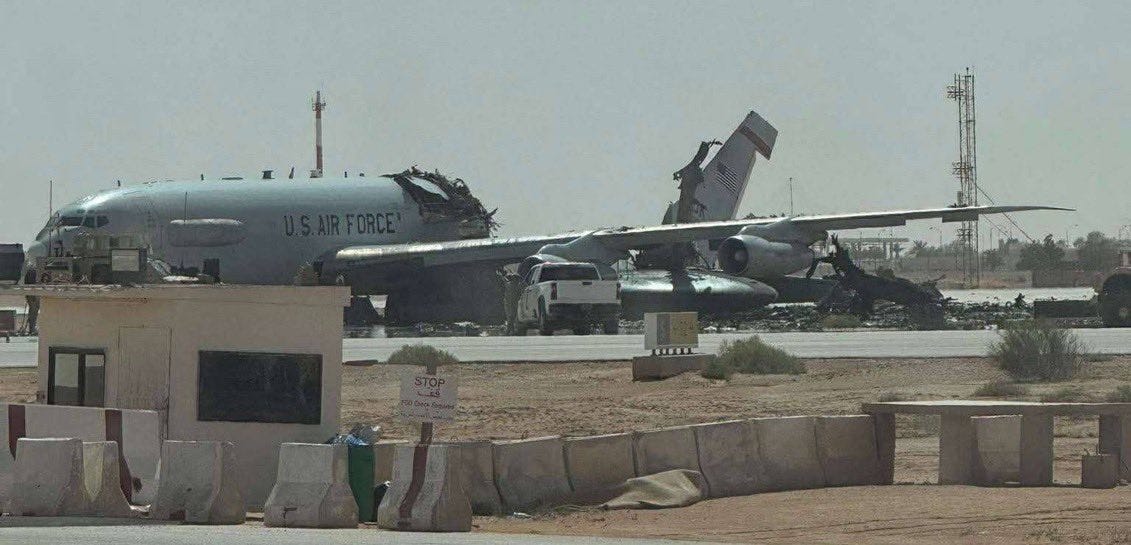
Russia Probably Helped Iran Kill the AWACS, but the Scandal is That We Made It So Easy
What bothers me most here is that we have seen this movie already... In Russia.
I’m pissed. A national strategic asset, that I personally had my hands on to keep fully mission capable, is now a smoldering wreck.
I have questions too… Zelensky claims that Russia helped Iran target via satellite. How do they know for sure? Which weapon did Iran use to hit the rotodome so precisely? Where were the air defenses around Prince Sultan Air Base (PSAB)? And most damning, why was an AWACS parked in the open 350 miles from Iran?
Let’s analyze.
The destroyed AWACS was hit precisely in the rotodome which means either Iran got really lucky or knew exactly where to hit to effectively make the AWACS non-mission capable.
Zelensky told NBC that Ukrainian intelligence saw Russian satellites image Prince Sultan Air Base on March 20, 23, and 25, just before Iran attacked the base on March 26.
He said he was “100%” certain Moscow was sharing that intelligence with Tehran. NBC couldn’t independently verify the underlying Ukrainian assessment.
Still, the claim itself is serious, specific, and extremely plausible.
How did Ukraine know?
First, let’s explore how Zelensky was “100% certain.”
There are a few ways Ukraine could know this:
The first is that satellite passes are simply predictable.
If you know the orbit, you can know when a satellite is overhead or when it has an opportunity to collect. Space situational awareness systems do this all the time.
The US Defense Intelligence Agency (DIA) has situational awareness sensors that can predict when satellites pass overhead, which is the basic logic here. If Ukrainian intelligence tracks Russian imaging satellites and sees repeated collection windows lining up over Prince Sultan on March 20, 23, and 25, that alone is already suspicious.
The second is signals intelligence. A satellite communicates with ground stations, transmits data, and is part of a broader command-and-control architecture.
Intelligence services can sometimes infer tasking or collection activity through intercepted telemetry, associated uplinks, ground-station activity, or other supporting emissions.
I have not seen public proof that Ukraine used SIGINT in this specific case, so I would classify this as a plausible intelligence method, not a confirmed one.
The third possibility is partner reporting. Ukraine receives intelligence from multiple European partners, and modern intelligence-sharing is often fusion rather than one service heroically discovering one thing alone.
If a partner with more developed space tracking or satellite characterization capabilities tipped Kyiv off that Russian birds were repeatedly covering Prince Sultan, that could easily end up in Zelensky’s daily Presidential brief.
His own description to NBC sounds like a finished intelligence product.
Zelensky explicitly described the repeated imaging passes as meaningful based on Ukraine’s prior Russian experience: once can mean preparation, twice can mean rehearsal, three times can mean attack planning.
That does not prove causation, but it does suggest Ukrainian intelligence is not merely logging satellite passes. It’s matching those passes to previous strike behavior and building a predictive pattern model from experience.
That’s exactly the kind of thing a war-hardened intelligence service gets good at.
Wait, so why didn’t the US see this?
It may not be that Ukraine saw it and the United States didn’t. It may be that Ukraine interpreted it differently, flagged it faster, or was more willing to say it out loud.
The United States has better raw space awareness than Ukraine. If this really involved repeated Russian satellite collection opportunities over Prince Sultan, the US had the technical ability to know that.
The question is whether anyone treated those passes as actionable warning instead of background noise.
Ukraine also has a different mindset right now. It is a country under constant reconnaissance and constant attack. Its intelligence services are primed to see repeated enemy collection as part of an immediate strike sequence, because that’s been their reality for years.
The US, by contrast, may have had the data without the same urgency attached to it.
Big bureaucracies do this all the time. They collect the signal, bury it in the noise, and wait for a memo to wander through six offices before anybody says, “Hey, maybe this shit matters.”
There’s another possibility too: compartmentation.
The US intelligence system is enormous, though that does not mean every warning gets fused cleanly into operational force protection in time.
One part of the system may have seen Russian collection activity.
Another part may have been watching Iranian missile prep.
Another may have been tracking drone threats.
If nobody stitched the whole picture together fast enough, then the base commander still lives in the dark. Supposedly, AI will help with this in the future if it’s not doing so already.
There’s also the political angle. Ukraine has an incentive to surface Russian-Iranian cooperation because it supports Kyiv’s broader argument that these are not separate wars and that the US should stop treating the Middle East and Ukraine as disconnected theaters.
Trump, on the other hand, may have reasons to stay quiet even if he strongly suspects the same thing. Publicly admitting that Russia helped Iran target a US strategic asset would spoil Trump’s relationship with his sugar daddy.
So, the US may have had the technical visibility, Ukraine may have had the sharper pattern recognition, and somewhere between collection and warning, the American system either hesitated, underweighted the threat, or intentionally failed to act on it.
If lives had been lost in this strike, I would be calling for heads to roll.
What weapon did Iran use?
Okay, let’s talk about the strike itself. The Aviationist blog claimed that the strike was performed by an Iranian ballistic missile.
Ehh, maybe…
Somebody either had very detailed targeting, very good terminal guidance, or both.
When I first saw the damage, I was pretty sure it was a guided attack drone simply because the rotodome is what you would aim for if you were flying a drone into an AWACS target.
But a ballistic missile remains entirely plausible if Iran had good enough pre-strike reconnaissance (from Russia), because a parked E-3 is a large, soft target and the rotodome is especially vulnerable to blast and fragmentation.
At this stage, the public evidence is strong enough to say the hit appears unusually well targeted, but not strong enough to say with confidence which weapon actually delivered the kill to the rotodome.
For people who don’t live in the weeds on this stuff, the rotodome is the giant disc mounted on top of the E-3. That’s the radar. That’s the reason the aircraft exists.
Hit the fuselage and you’ve damaged an old Boeing 707. Hit the rotodome and you’ve gone for the brain stem.
Funny story: In tech school for the AWACS at Shepard AFB in Texas, several of us convinced a newbie airman fresh out of high school that the rotodome detaches itself from the aircraft during flight, and flies around like a flying saucer, while gathering intelligence.
Ahem… He believed us. Then I felt bad for hazing and told him not to be so gullible.
Previously, at Keesler AFB in Mississippi, I had convinced a new airman that when you burn information to a DVD-ROM, the disc actually gets heavier.
He believed me also.
I know, I was an asshole. I’m more mature now.
Okay, what about the failure of US air defenses at PSAB?
If Russia helped Iran with the kill chain, this was not just an Iranian strike. It was a cooperative targeting effort against a US strategic air asset.
This is important because cooperative kill chains are harder to defend against than single-actor threats. One side collects. One side plans. One side shoots. Suddenly you are not dealing with one country’s strike package. You are dealing with a network.
The deeper issue, though, is not Russia. It’s us.
The real scandal is that an E-3 was sitting there to be hit in the first place.
The United States still acts like certain assets are protected by category.
Big assets.
Important assets.
Strategic assets.
Somewhere in the institutional brain there is still a stupid little fairy tale that says if a platform is important enough, the enemy will either fail to hit it or avoid trying.
That fairy tale died in Ukraine.
It died when Russia started losing aircraft on supposedly safe bases.
It died when cheap drones and long-range strikes turned rear areas into conditional spaces instead of sanctuaries.
And apparently, some people at Prince Sultan never got the memo.
Prince Sultan Air Base is a major facility. It hosts US forces and Saudi troops. It has enormous strategic significance. If an E-3 was destroyed there, then one of three things happened:
The base defenses were not good enough for the threat.
The base defenses were good enough on paper and failed in practice.
Or the enemy found and exploited a gap that should have been obvious to anyone who has paid even casual attention to how Iran, Russia, and Ukraine have all been fighting.
Pick your poison. None of them taste great.
And yes, the obvious question is the right one: why wasn’t there a defensive umbrella at Prince Sultan strong enough to stop a drone or missile from getting anywhere near that aircraft?
You can’t tell me the United States understands the modern threat environment, then show me an E-3 parked in a zone where Iranian missiles, drones, or both can still get through and hit the one part of the aircraft that matters most.
That’s a force-protection failure, a planning failure, or a command failure. Maybe all three went out drinking together. Wait, never mind. Saudi is dry as a bone, no alcohol for miles.
Defending every square foot of every base is hard, yes. But that is exactly the point. If you know the defensive problem is hard, then maybe, just maybe, you do not park one of your most valuable airborne radar platforms in a place where the enemy can get a shot at it on the ground.
Disperse it.
Harden it.
Deceive around it.
Move it.
What bothers me most here is that we have seen this movie already.
We have watched Russia lose strategic aircraft because it treated the rear as safe. We have watched Ukraine prove that no base inside threat range gets to pretend geography is armor.
We have spent years listening to people in think tanks and uniforms talk about the vulnerability of fixed bases in the Pacific and the Middle East like they had discovered fire.
Then an AWACS gets smoked on the ramp, and everyone suddenly acts like the enemy invented audacity last Tuesday.
C’mon, man… This was predictable.
That’s what makes it so bad.
The E-3 strike is not just about one aircraft. It is about the entire class of high-value airborne enablers the United States depends on.
AWACS, tankers, battle-management platforms, intelligence aircraft, all the systems that make the rest of the force coherent and effective. These are the things that let modern American airpower fight like a network instead of a collection of expensive individual machines.
They are also enormous, visible, and increasingly vulnerable if you leave them in the wrong place.
That is the lesson here… Not that Iran got lucky. Not that Russia may have helped.
Those matter, sure as fuck. But the real lesson is uglier. The United States still has not fully internalized what the drone age and the missile age have done to rear-area assumptions.
And now an E-3 is gone.
I personally worked on this now-destroyed aircraft. Tail number 81-0005; we called it “Balls five” (because of the string of zeros before the five). Every Sentry has its own personality and quirks. Each flies a little differently. You get attached. That’s why this one hurts.
I imagine it feels similar to a crusty old sailor watching his ship from his time in the Navy get decommissioned.
So yes, I think Zelensky is probably right. I think Russia likely helped Iran with the targeting picture. The repeated imaging pattern makes sense. The strike outcome makes sense. The broader Iran-Russia relationship makes sense. The cooperative kill-chain logic makes sense.
But even if every last detail of the Russian role remains murky, one fact is already crystal clear: An American AWACS died on the ground in a threat zone where it should have been treated like a crown jewel and protected accordingly.
That mistake should scare people more than Iran and Russia working together.
Слава Україні!


We are so unprepared for modern warfare.
When I heard about that strike, I turned the air blue! WTF? was the nicest thing I said.