


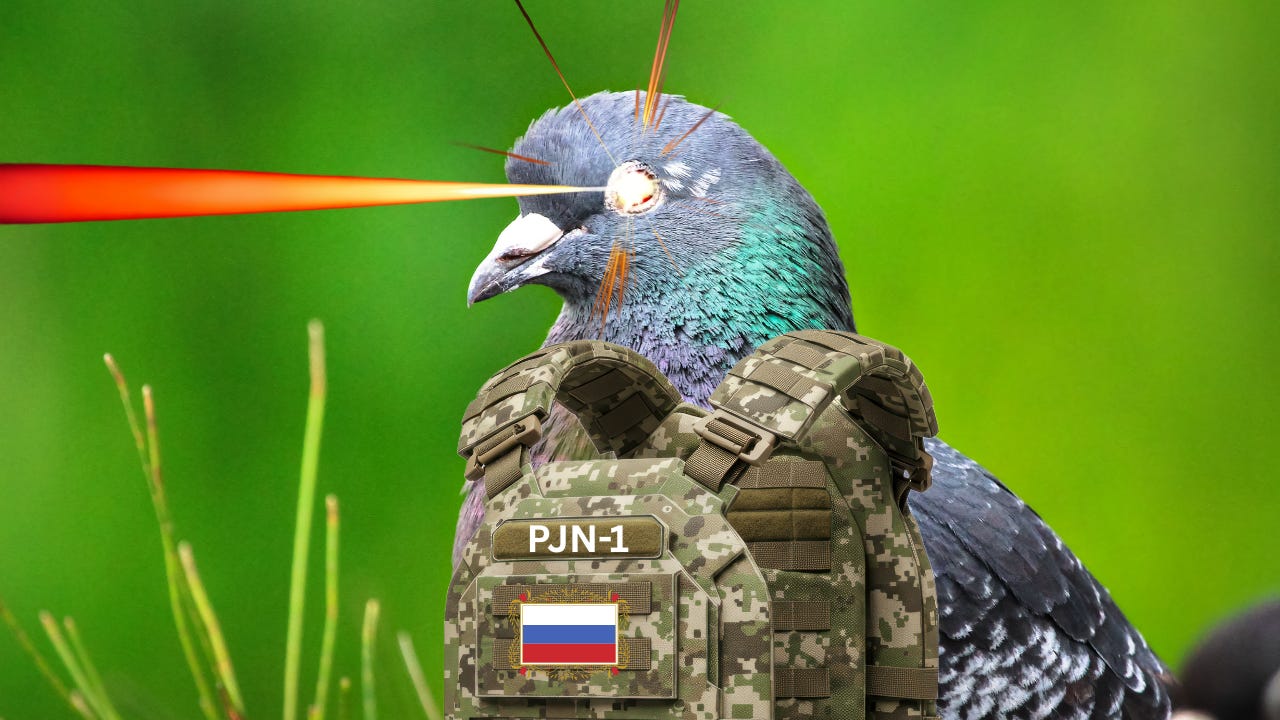
Russia has built a lot of things over the last four years. Mass graves, sanctions lists, a reputation for turning basic logistics into dumpster fire. Now, add one more item to the inventory: “cyborg” pigeons.
Yes, pigeons.
For thousands of years, pigeons have been war technology.
Before radios, before satellites, before the modern obsession with “networks,” armies still had the same basic problem: you can’t coordinate anything if you can’t communicate. You can have the best cavalry in the world, the sharpest artillery, the most disciplined infantry, and it all falls apart the moment orders and information can’t move faster than the enemy.
That’s where pigeons earned their keep.
Not as a novelty. Not as a cute footnote.
As a real, working part of state power.
The basic advantage was simple. A pigeon doesn’t need a wire. It doesn’t need a signal tower. It doesn’t care that the enemy cut the telegraph line.
It can cross terrain that chews up messengers and ignores checkpoints, ambushes, mud, and sabotage. If you had a trained bird and a message canister, you had a way to push information through chaos.
That mattered in the ancient world and it still matters now. The medium changes. The logic stays.
There are credible accounts of pigeons being used as messengers in the ancient Mediterranean and Near East, and by the time you get to classical and medieval periods, the idea is fully mature: trained birds, established routes, trusted handlers.
If you’re running an empire or a city-state, you don’t always need a genius invention. You need something reliable that works every day. Pigeons did.
Fast forward into the industrial era and they don’t disappear. They scale.
During the Franco-Prussian War in 1870–71, Paris was effectively isolated. The French used pigeons to carry messages in and out of the besieged city, including microfilmed dispatches.
Then World War I turns pigeons into formal military assets. They were issued, trained, and used under fire because battlefield communications were fragile and the front was a meat grinder.
Radios were still crude, wires were constantly cut by shelling, runners got killed, and sometimes the only thing that could get through was a bird that didn’t care about a barrage.
World War II keeps the practice alive. Again, not because generals were sentimental about birds, but because real combat is brutal on communications. Pigeons were used for message carrying in contested environments and for specific missions where other methods risked interception or failure.
