


Okay, I owe my paid subscribers an exclusive article today, so here it is. I already published a free article today (which I normally don’t do on the same day so as not to bombard your email inbox), but I wanted to get that free religious piece out quickly.
On a side note, do paid subscribers see when an article is exclusive just for you? Or do the paid articles look just like free articles from your paid point of view? I’m just curious. Let me know in the comments.
Let’s jump in.
Russian milbloggers are kinda freaking out over LUCAS, and we need to talk about it.
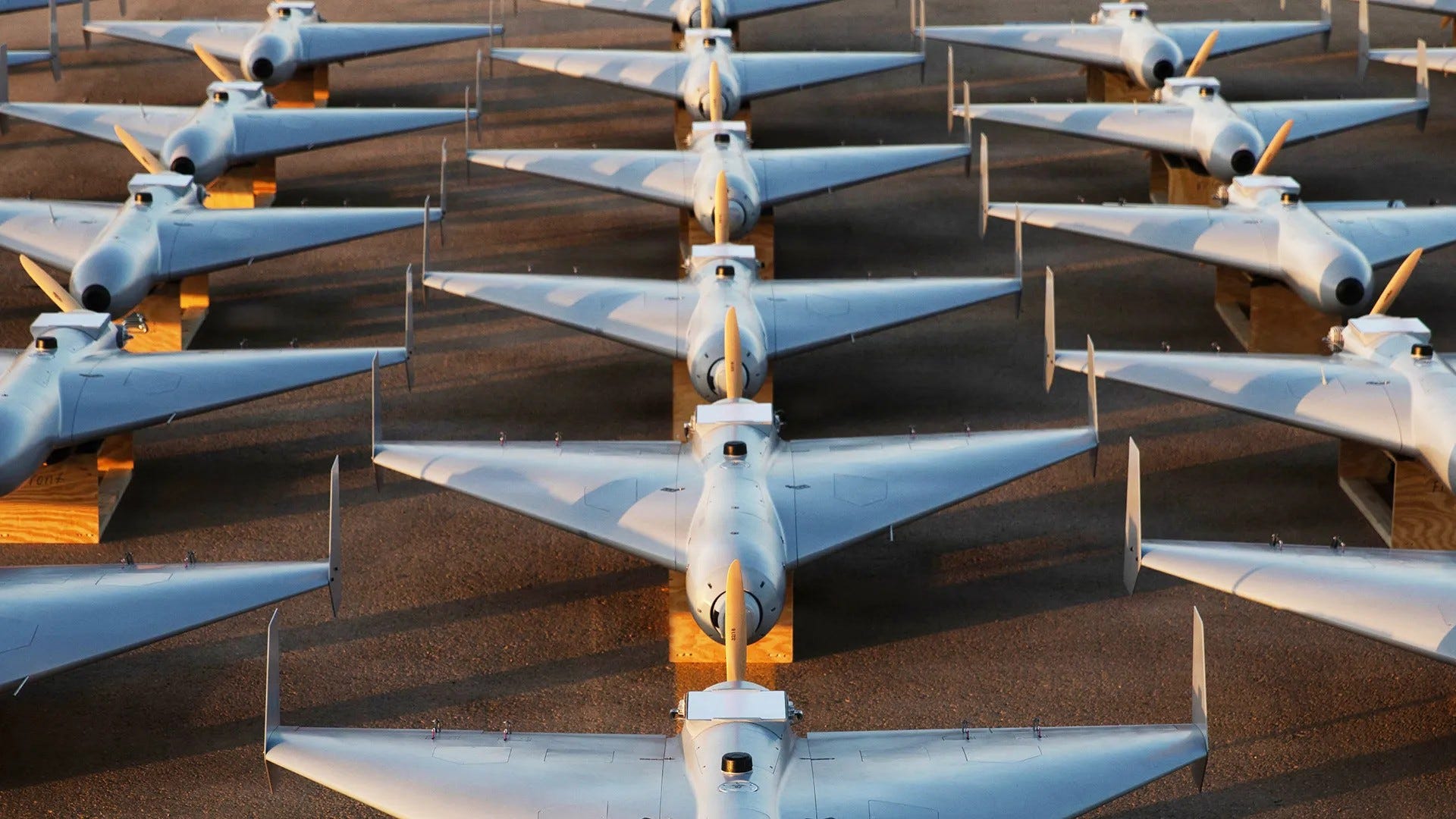
There is a particular flavor of irony that only exists in modern warfare, and it tastes something like this: Iran spent years supplying Russia with Shahed drones to rain down on Ukrainian cities. America watched, studied, actually learned, and reverse-engineered the design.
Then America used that same design to strike Iran directly.
This is impressive for no other reason than this is the fastest the Pentagon has ever moved on anything, since the urgency of WWII.
Welcome to Operation Epic Fury and the combat debut of LUCAS, America’s newest one-way attack drone; and the weapon that is currently keeping Russian military bloggers, my counterparts, up at night.
What exactly is LUCAS?
LUCAS stands for Low-cost Uncrewed Combat Attack System. It is built by SpektreWorks, an Arizona-based defense company, and it costs approximately $35,000 per unit.
For comparison, a single MQ-9 Reaper drone runs between $20 million and $40 million. LUCAS is, in other words, the Costco version; except instead of bulk paper towels, you’re buying a flying explosive with a 500-mile range and a payload roughly equivalent to twice the explosive yield of a Hellfire missile.
We’ve all seen this design before… It’s approximately 10 feet long with an 8-foot wingspan. It weighs 180 pounds at maximum takeoff weight. It can be launched from catapults, rocket-assisted ground systems, trucks, or, as of December 2025, directly from the deck of a Navy ship.
That ship was the USS Santa Barbara, an Independence-class littoral combat ship operating in the Arabian Gulf.
LUCAS saw its first combat deployment on February 28, 2026, when CENTCOM’s Task Force Scorpion Strike launched the drones against Iranian targets as part of Operation Epic Fury.
CENTCOM confirmed the historic first use with characteristic understatement: “These low-cost drones, modeled after Iran’s Shahed drones, are now delivering American-made retribution.”
I’ll be honest: as a defense journalist, I smiled when I read that. The Pentagon didn’t even bother to hide that we copied the hell out of Iran’s design.
Now, we don’t actually have a count of how many LUCAS drones the US military has its hands on right now, but we know that the US is on track to have 340,000 units by 2028.
The Lineage: From Tehran to Kyiv to Arizona
Iran’s Shahed-136 is a delta-wing, one-way attack drone that Tehran has been exporting to Russia since 2022 for use against Ukraine. The Shahed became notorious for its role in Russia’s campaign of terror against Ukrainian cities: cheap, expendable, and produced in sufficient volume to overwhelm air defenses through sheer attrition.
Ukraine’s defenders have shot down thousands of them. Russia keeps sending more.
The US military dissected a Ukrainian-captured Shahed drone and quietly handed it to SpektreWorks for reverse engineering.
SpektreWorks had already been building a Shahed-inspired target drone called the FLM 136 for threat emulation training… essentially building fake Shaheds so American forces could practice shooting them down.
The leap from “training target” to “actual weapon” turned out to be a shorter distance than anyone anticipated.
LUCAS was unveiled at a Pentagon showcase in July 2025, less than eight months before its combat debut. That timeline would be considered laughably optimistic in traditional Pentagon acquisition culture, where it typically takes longer to agree on a procurement strategy than it took SpektreWorks to build, test, and field an entirely new weapons system.
The government owns the intellectual property for the LUCAS design outright, which is somewhat rare and means multiple manufacturers could produce it simultaneously if demand required.
