


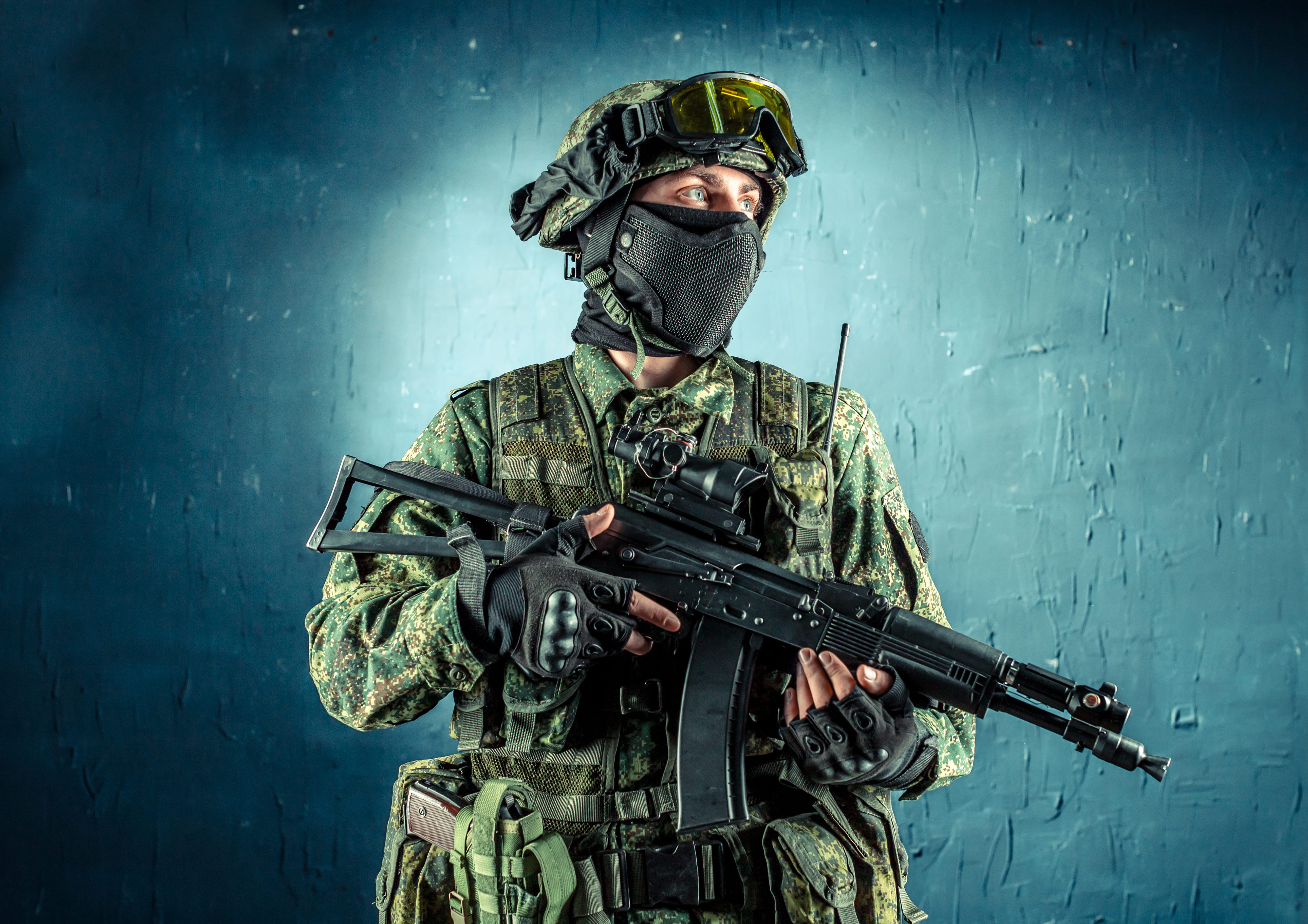
Nearly five years of war have gutted Russia’s armored formations and exposed its command failures, and they’ve also produced a military with hard-won experience that most of NATO has never had to earn. How dangerous would it actually be against Finland, Poland, or the Baltic states?
Hey friends, for today’s paid subscriber piece, I want to examine two versions of the Russian military: The one that’s been crippled in Ukraine, and the one that’s learned invaluable lessons in modern war and threatens NATO.
In the last days of February 2022, commercial satellites photographed a Russian military convoy stretching roughly 40 miles along the highways north of Kyiv. It was supposed to be the steel fist of one of the most powerful land armies on Earth, rolling toward a capital the Kremlin expected to take in a few days.
Instead, it just sat there.
Trucks ran out of fuel, vehicles broke down in the mud, and command posts couldn’t talk to the units they were supposed to be commanding.
Ukrainian Javelin teams gleefully picked at the column while Russian soldiers wandered off looking for food. Within a few weeks, the internet was full of videos of Ukrainian farmers towing abandoned Russian tanks away with tractors, and by early April, the entire northern force had retreated in humiliation.
I’ll admit, I laughed.
In fact, I spent most of 2022 writing on Medium about the tactical and strategic mistakes Russia was making through the point-of-view of an Army infantryman who watched that convoy the way a mechanic watches somebody try to change their oil with a garden hose.
It looked like Putin had believed his own marketing hype, and part of me assumed I was watching the ceiling of Russian military competence; the best Moscow could ever do.
But fast forward to November 2026. Russian drone teams now hunt Ukrainian supply trucks as far as 100 kilometers behind the front line. Fiber-optic-guided drones, (originally a Russian invention), stalk roads that Ukrainian logistics crews used to consider safe.
Russian factories turned out more than seven million artillery shells, mortar rounds, and rockets last year. And intelligence services across northern Europe are publicly warning that this army, the same one that couldn’t organize a leisurely three-day drive to Kyiv, could pose a real threat to NATO within a few years.
Which is it?
Russia the incompetent, bumbling force that’s accumulated a million casualties and lost all its tanks?
Or Russia the lethal foe who will try to take the Baltics in the next few years?
Well, the answer is that both stories are true. Russia’s military has become far more dangerous at certain kinds of fighting while staying really bad at others; and if NATO wants to deter it, we need to understand exactly where that line runs.
The army that looked best in parades
To measure how far Russia has come, we need a baseline, and February 2022 is a good starting point.
Russia went into the invasion near the peak of its post-Soviet strength.
A decade of military reforms and oil money had bought it relatively large inventories of modernized tanks, armored vehicles, artillery, and air-defense systems.
Its professional “contract” formations had trained for years, some officers had combat experience in Syria, and Moscow planned for a short war, something closer to a forceful regime change than a real fight.
Then the Ukrainians made the Russian military do things its highly scripted exercises had never seriously tested, and the whole edifice started cracking.
Let’s start with logistics.
Historically, the Russian military depended heavily on railroads to move enormous quantities of fuel, ammunition, food, and spare parts.
That system worked well when troops operated near established railheads, but once Russian columns pushed deeper into Ukraine, everything had to be transferred onto trucks. And Russia simply didn’t have enough of them to sustain the speed and scale of its invasion.
Part of the problem was that Moscow had planned for a quick victory. According to a later RUSI investigation, Russian planners expected the initial invasion to succeed within roughly ten days. Its battalion tactical groups carried enough supplies for only a few days of sustained fighting and depended on regular deliveries from higher-level logistics units.
When Ukraine didn’t collapse, Russian commanders discovered that their supply arrangements were woefully inadequate for the war they were now fighting.
Then there were the maintenance problems.
Years of inadequate investment, poor oversight, and corruption had left parts of Russia’s vehicle fleet in questionable condition. Trucks suffered mechanical failures, tires deteriorated, and vehicles broke down without sufficient spare parts or recovery equipment nearby. Meanwhile, Ukrainian forces attacked vulnerable supply convoys, destroyed bridges, and disrupted rail connections.
Russian troops had advanced into territory they couldn’t reliably supply, along roads they hadn’t secured, against an enemy they had expected to surrender.
The result was almost comical, if you could ignore the suffering the invasion was causing. Russia had tanks that could destroy targets several kilometers away, yet some couldn’t travel another two kilometers because nobody could deliver the diesel.
Then there’s command and control, the military’s term for who makes decisions and how those decisions reach the people doing the fighting.
Russia ran a heavily centralized system in which junior officers waited for orders from above, and when communications broke down, units froze. Generals ended up near the front trying to unjam things personally, and Ukraine killed a huge number of them.
Russia also failed to win control of the sky. It never suppressed Ukraine’s air defenses well enough to let its aircraft roam freely, and I can tell you that when you don’t own the air, everything on the ground gets harder and more expensive.
Russia’s stock of ready, modern armored vehicles was arguably at its peak in early 2022. Its overall military power was not.
It had all that equipment and very little ability to use it well. Today it has burned through much of that equipment, but it also has years of combat experience, a much larger force than it started with, and drone production on a scale nobody imagined in 2022.
Four years of learning the hard way
Russia didn’t improve evenly or in a straight line. It got better the way a drunk man gets better at a bar fight: by taking an enormous number of punches to the face and slowly figuring out which ones to throw back.
The short-war fantasy collapsed in 2022.
Moscow lost major formations and much of its best equipment, then called up roughly 300,000 reservists in its September mobilization to plug the holes.
In 2023, Russia rediscovered something its Soviet predecessors knew well: it’s very good at defending prepared ground. Dense minefields, layered trench lines, artillery, attack helicopters, and electronic jamming chewed up Ukraine’s summer counteroffensive.
The same army that couldn’t maneuver its way to Kyiv proved it could dig in and hold.
By 2024, attrition had become the main strategy.
Russia bolted guidance kits onto old Soviet dumb bombs, turning them into glide bombs that could be lobbed from beyond the range of most Ukrainian air defenses. It ramped up drone production, expanded its electronic warfare and threw waves of infantry at Ukrainian positions, accepting staggering losses in exchange for a few villages at a time.
In 2025, its drones pushed deeper, hunting transportation, communications, and troop concentrations well behind the front, and fiber-optic guidance gave them a way around Ukrainian jammers.
By 2026, you had an army that could endure almost anything… but still couldn’t break through.
The Royal United Services Institute in London has tracked this evolution closely. A July analysis by Fabrizio Minniti and Giangiuseppe Pili argued that Russia adapts quickly at the tactical and technological levels but slowly at the organizational level, and that Moscow is building a way of war around endurance and mass more than speed and precision.
Their summary of the difference between Russia and the West is one of the best single sentences I’ve read about this war: “The West seeks to shorten wars; Russia prepares to outlast them.”
The most capable Russian units are now dangerous in ways the 2022 army wasn’t.
They’ve learned to tie reconnaissance drones, electronic warfare, artillery, glide bombs, and loitering munitions into what militaries call a reconnaissance-strike complex. Think of a hunter with binoculars sitting on a ridge, on the radio with a sniper a mile away, except the binoculars are a swarm of cheap drones, the sniper is an artillery battery or a kamikaze drone, and the delay between spotting a target and killing it has shrunk from hours to minutes.
The quality varies wildly from one Russian formation to the next, and coordination is still uneven, but at its best, the system works.
The industrial numbers are sobering too.
Estonia’s foreign intelligence service reported in February that Russian factories produced more than seven million artillery shells, mortar rounds and rockets in 2025, roughly seventeen times the pre-invasion level, and it assessed that Russia can likely rebuild part of its strategic artillery reserve even while fighting in Ukraine.
Lithuanian intelligence says Russia’s monthly output of long-range attack drones has gone from about 500 to somewhere between 5,000 and 6,000. On top of its own production, Russia has received millions of shells from North Korea and Iran.
Then there’s the air.
Ground forces have absorbed most of the punishment, but RUSI warned earlier this year that Russia’s aerospace forces, including its fighters, long-range bombers, and integrated air defenses, pose a greater threat to NATO now than they did in 2022, because combat has taught them things peacetime never did.
But, the capability that unsettles me most is the least flashy.
In September, RUSI published an analysis by Roger McDermott arguing that Russia’s most dangerous adaptation is its growing ability to recover. Russian forces have learned to restore damaged command posts, logistics, and targeting networks while the fighting continues.
True, the restored systems are usually slower and clumsier than the originals, but they work well enough to keep fighting.
McDermott’s phrase for it is that Russia is “learning to degrade without ceasing to function.” He argues NATO should measure success by how long a Russian function stays broken, not only whether a target was destroyed.
That’s the kind of experience no peacetime Baltic Sentry NATO exercise can reproduce.
So, a NATO staff officer planning against a future Russian opponent should not picture the confused air assault troops at Hostomel in 2022. Some Russian units have now spent years fighting under constant drone surveillance, getting hit, and rebuilding under fire; and they’re quite good at it.
That deserves respect, even from people like me who have made a career out of lampooning the Russian MoD.
What Russia still can’t do
Now, the alarmist version of this analysis leaves out the part where Russia remains bad at some very important things.
The same RUSI analysis that credits Russia’s tactical learning describes its command system as the main bottleneck, and the reasons are political, not technical.
Initiative at lower levels is treated as a risk to the regime, so officers get rewarded for obedience instead of judgment. Russia also lacks a truly professional corps of noncommissioned officers, the sergeants who run the day-to-day business of an army.
I’ve written extensively about this. Anyone who’s served in Western military knows NCOs are the backbone of the force.
A good platoon sergeant can make a mediocre lieutenant look like George fucking Patton, and a missing one can turn a talented lieutenant into a nervous wreck.
Without that layer, Russian junior officers are overloaded, senior officers get pulled toward the front, and reporting up the chain gets distorted by people afraid to deliver bad news.
Minniti and Pili put it excellently: “Russia’s military rigidity is not a military problem. It is a political solution.”
Nailed it.
