


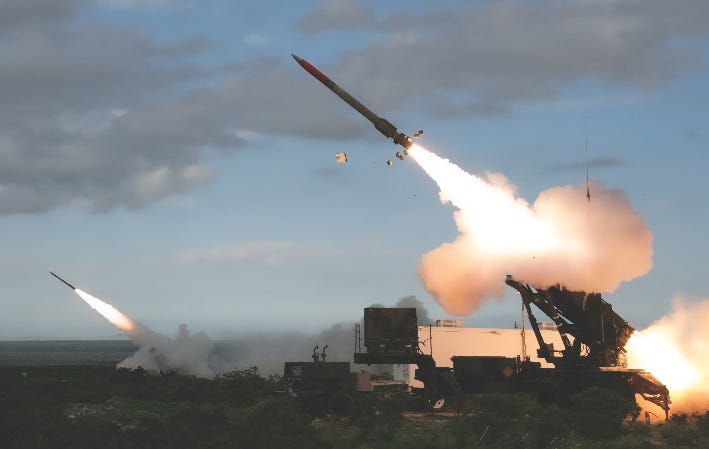
For decades, NATO and the West feared and respected the lethality of Soviet surface-to-air defenses. But, knowing what we now know about the unprofessional state of the Russian military, are such fears grounded in reality?
Ukraine’s recent strikes deep into Russian territory suggest that Russian air defenses may not be as functional as the West once thought.
On May 1st, 1960, a U-2 spy plane flown by American pilot Francis Gary Powers was shot down while performing photographic surveillance over Soviet airspace.
The U-2 has an operational ceiling of 70,000 feet or 21,300 meters. At that height, American military planners were certain that nothing the Soviets had could reach it.
But a few years earlier, in 1957, the Soviets had begun the development of the S-75 Desna, a surface-to-air missile system with an operational altitude of 82,000 feet.
The S-75 was so lethal in fact, that in addition to shooting down Powers’ U-2, the salvo also shot down one of the Soviet MiG-19 fighters pursuing Powers. The Russian pilot, Sergei Safronov, was killed.
Actually, the S-75 was the most prolific air defense system in history.
Between 1958 and 1964, US intelligence assets located more than 600 S-75 sites in Russia. These sites tended to cluster around population centers, industrial complexes, and government control centers.
What’s more, these systems were sold to most Warsaw Pact countries and were also provided to China, North Korea, and North Vietnam.
The system was also deployed in Cuba during the Cuban Missile Crisis, where it shot down another U-2 (piloted by Rudolf Anderson) overflying Cuba on October 27, 1962.
During the Cold War, Soviet air defense attained legendary status.
These strides in weapons development in Russia prompted numerous changes in US surveillance and strike doctrines.
The United States began emphasizing high-speed, low-level flights for its previously high-altitude nuclear bombers. It also pushed the US into faster development of supersonic aircraft like the F-111, and accelerated US satellite projects, like the Corona spy satellite.
The fear of Soviet-made anti-air systems ultimately sent the US down the path of stealth technology; a capability that was first shown to the world during Operation Desert Storm.
But today, Russian air defense is a shadow of its former self. Ukraine routinely violates Russian airspace… Airspace once believed to be impenetrable.
To add to Russia’s problems, Russia’s most-fielded S-400 interceptor uses fragmentation, not hit-to-kill technology. This directly limits its effectiveness against ballistic threats.
Let’s investigate:
Here’s the chief issue: Western intelligence suspected the primary S-400 interceptor missile, the 40N6, was fragmentation, not hit-to-kill technology. But you never get perfect certainty without either (a) a manufacturer cutaway sheet that says it in plain language, or (b) recovered hardware and a teardown.
Russia does not exactly run a transparent program office.
I recently had a drink with an old Air Force friend, who now works at the Defense Intelligence Agency (DIA). He confirmed the 40N6 was fragmentation.
So, let’s start here.
The S-400 “Triumf” was supposed to be Russia’s ace card, the crown jewel of the Kremlin’s anti-access strategy. It is supposedly a missile system so dangerous and so capable that it could deter NATO by reputation alone.
Western analysts used to tread lightly around it. Armchair generals called it “NATO’s worst nightmare.” India bought it. China bought it. Turkey risked getting booted from the F-35 program just to get their hands on it.
But here’s the kicker: the entire thing may be built on a 30-year-old lie. Or, at the very least, an illusion so outdated it belongs in a museum, right next to a VHS tape of My Cousin Vinny and Saddam’s last Scud.
Over the years, Russia certainly implied that their S-400 interceptors were based on hit-to-kill. Or, at a minimum, falsely claimed that 40N6 could reliably hit Western ballistic threats.
Sorry, Maury, the lie detector test determined that was a lie…

The Fragmentation Fiasco
If the 40N6 interceptor missile uses fragmentation, this means the S-400 can’t reliably intercept ballistic missiles.
Not because of range. Not because of radar. Because of physics.
So, let’s explore the difference between fragmentation and hit-to-kill in air defense.
