


When I was in the infantry, few things could ruin an otherwise decent evening quite like being told to set up the godforsaken camouflage net.
The Army called them “camouflage screening systems,” which made them sound more sophisticated than they were. In practice, you had an enormous pile of netting, fiberglass poles, plastic spreaders, and related chotchke that would send even the most Zen among us into a fit of rage that could end marriages.
The net would inevitably catch on an antenna, somebody would misplace a pole, and the entire enterprise would take about three times longer to assemble than anyone had planned.
Taking it down at three in the morning, in the rain, after two days without sleep, was an equally character-building experience.
So, when I saw that an American company had developed a camouflage net held aloft by four drones, my first thought was that somebody had finally figured out how to make the process even more complicated.
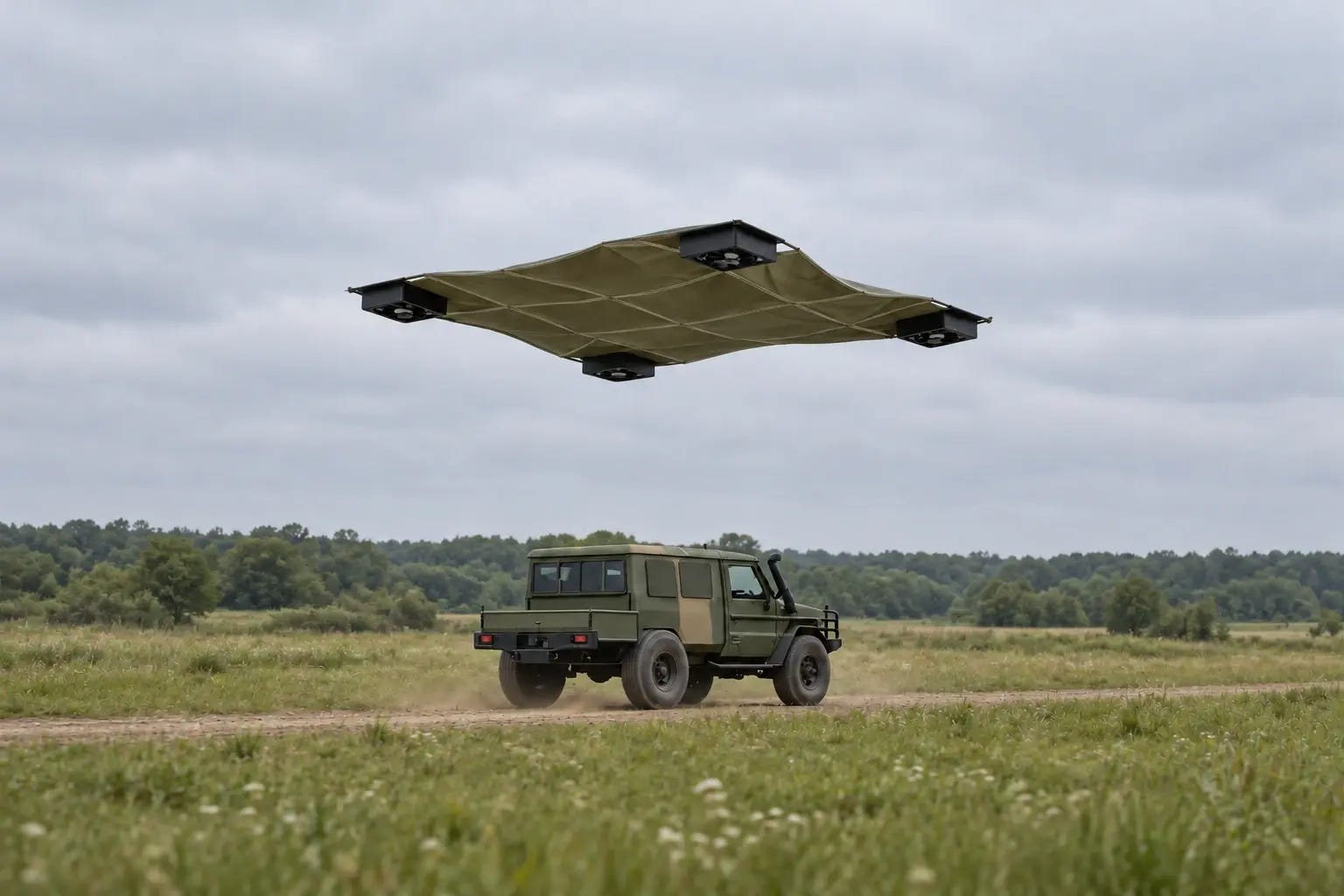
The company is Vigil Autonomy, a small Austin-based outfit founded by Matt Goodman, an engineer with an impressive amount of experience in robotics and computer vision. In October, Vigil introduced Air Cover, an autonomous camouflage system that uses aerial lift units to position a large membrane above military vehicles, equipment, or personnel.
Wait, personnel? You mean we finally get to fight in the shade?
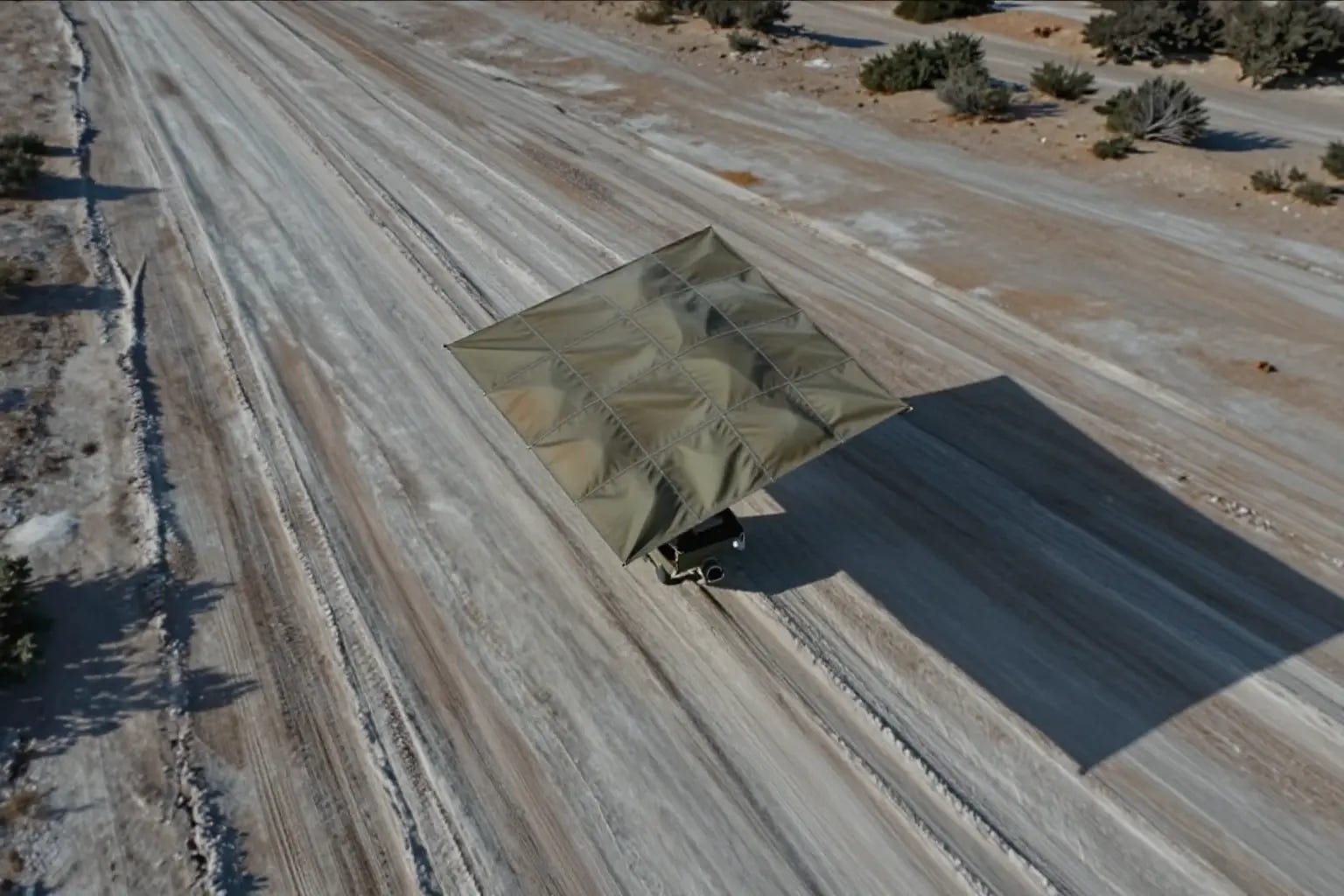
The company says its software can reposition the canopy relative to whatever it’s protecting. It can also move the camouflage away from the original position and potentially create a decoy somewhere else.
The promotional imagery looks like a Humvee parked beneath a floating picnic shelter, which I suspect would have made quite an impression on my old First Sergeant.
I was skeptical.
For one thing, Sweden’s Saab has been making excellent camouflage systems for decades. Its Barracuda family already addresses much of the multispectral surveillance problem that Vigil says it’s trying to solve.
For another, attaching four aircraft to something that normally works just fine with a few poles seems like an excellent way to introduce maintenance problems that camouflage nets never previously had.
Still, Ukraine has made a habit of finding military applications for technology that looked ridiculous the first time somebody demonstrated it. We’ve watched commercial quadcopters become precision weapons, remote-controlled boats destroy warships, and agricultural equipment evolve into battlefield hardware.
There’s probably room for a flying tarp somewhere in that collection.
I wanted to understand where…
The Swedes got here a while ago
I have a soft spot for Swedish military engineering.
Sweden has roughly ten million people, yet it produces its own fighter aircraft, submarines, armored vehicles, artillery, and an impressive collection of technologies designed to make those systems invisible.
Saab’s Barracuda camouflage business has been around since the 1970s, and its Mobile Camouflage System, or MCS, gives us an obvious comparison with Vigil’s new invention.
Barracuda MCS consists of specially engineered panels fitted to the exterior of a vehicle. Unlike the old overhead nets I remember fighting with, the system stays attached while the vehicle moves.
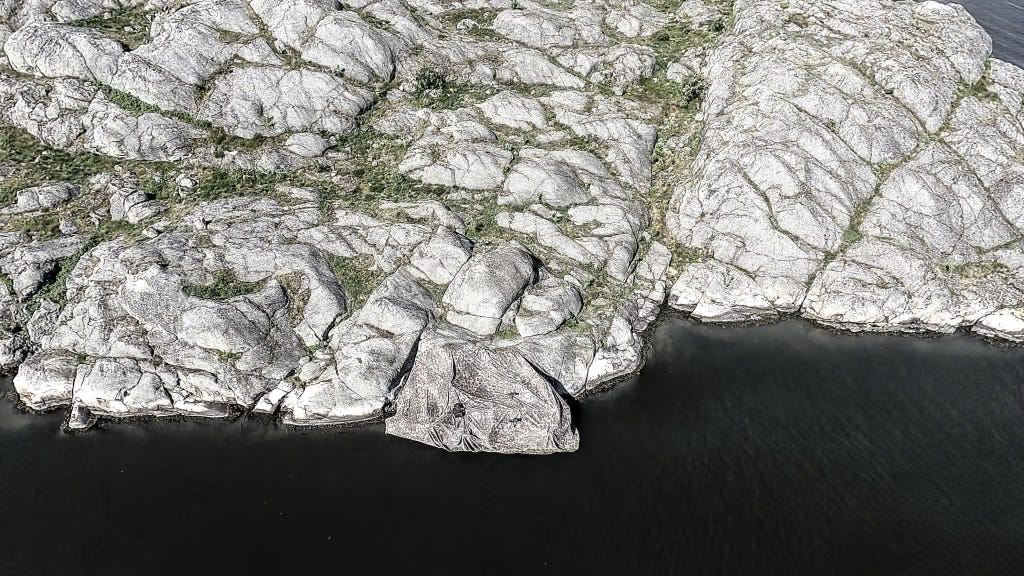
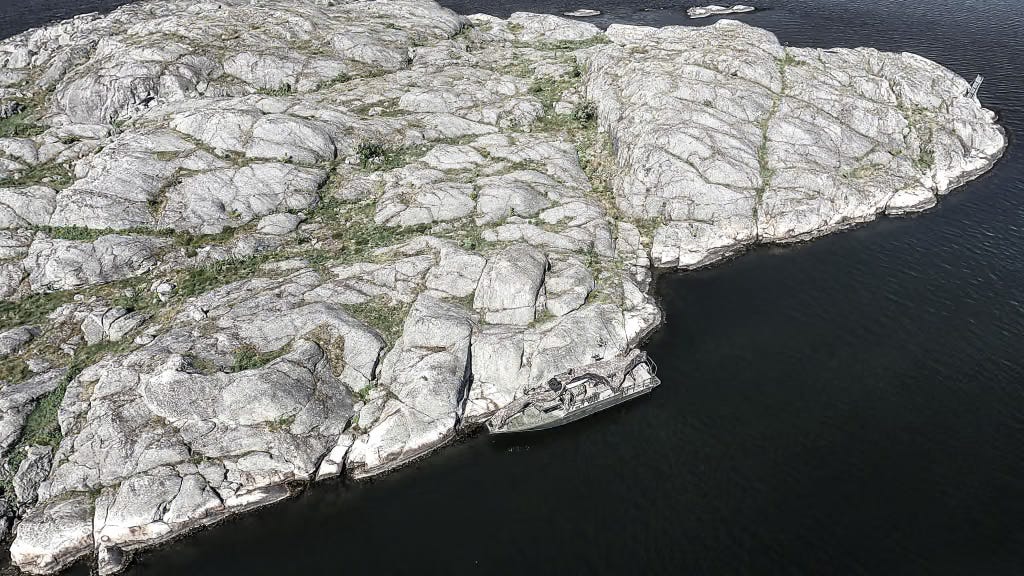
There aren’t any poles to retrieve or fabric sheets to wrestle into a storage bag every time the crew needs to relocate.
The material is designed to reduce a vehicle’s visibility across several parts of the electromagnetic spectrum, including visible light, near-infrared, shortwave infrared, thermal infrared and radar. Saab also manufactures stationary camouflage systems, including the Ultra-Lightweight Camouflage Net System, or ULCANS, for concealing equipment and positions.
And this technology has been tested in circumstances somewhat less forgiving than a manufacturer’s presentation.
In 2014, the US Army evaluated Barracuda MCS on two M1A2 Abrams tanks at my old stomping ground, Fort Benning, Georgia. Staff Sgt. Joel Moore, an Abrams instructor involved in the testing, reported that an equipped tank became extraordinarily difficult to recognize through thermal sights at approximately 200 meters.
The system didn’t eliminate the vehicle’s heat. It altered the signature enough that the crew observing it couldn’t easily identify a tank. At one point, a camouflaged Abrams approached within roughly 200 meters before observers noticed a couple of indistinct hot spots.
The crews also reported that temperatures inside the equipped vehicles were about ten degrees Fahrenheit cooler. Spend an August afternoon inside an armored vehicle in Georgia and you’ll appreciate that tidbit.
I think the thermal performance is worth explaining because there’s a common misconception about what camouflage can actually accomplish.
A thermal camera measures infrared radiation. It can reveal temperature differences between a vehicle and its surroundings, which makes operating engines, exhaust systems, road wheels, and warm armor blaze like the Eye of Sauron.
A good thermal camouflage system can obscure some of those surfaces, alter how the remaining radiation appears, and break up the recognizable pattern.
The vehicle may still be visible, although the operator has a harder time recognizing it.
Radar creates another set of problems.
Synthetic aperture radar, or SAR, transmits radio waves and uses the returning energy to construct detailed images of the ground. Large metal vehicles are great radar targets because their geometry and materials can produce strong reflections.
Reducing those reflections requires different engineering from making something less recognizable to a thermal camera. The properties of the camouflage material, its shape, and its relationship to the vehicle all affect the result.
Saab has spent decades working on these problems.
Vigil says Air Cover provides infrared and radar signature management, although it hasn’t published independent measurements showing how effectively the system performs against either sensor type.
I would be interested in what an airborne SAR sees when the canopy is viewed obliquely rather than from directly overhead. A membrane covering a vehicle from above may leave big portions exposed to sensors looking from the side.
That brings me back to the four drones.
Saab already sells camouflage that can travel with an armored vehicle, and its stationary nets can hide equipment at temporary positions. Vigil presumably understands that.
So, I went looking for the part of Air Cover that might justify the additional machinery.
The company’s specifications contain an interesting detail: Air Cover apparently doesn’t need to remain airborne all the time.
Vigil describes persistent deployed concealment with optional active lift. Ukrainian reporting on the system also indicates that it can operate in a stationary configuration with the canopy secured to supports.
The company advertises three sizes: A small 2-by-2-meter version is intended for personnel, a 3-by-3-meter version for small units, and a much larger 10-by-10-meter system for vehicles and equipment.
That last canopy covers 100 square meters, approximately 1,076 square feet.
For context, that’s larger than most NYC apartments, and somebody wants to hold it up with four flying machines.
Vigil lists active-flight endurance targets of four hours for the smallest configuration, three hours for the middle version, and two hours for the largest. The maximum stated operating altitude is ten meters.
I’d love to see those numbers demonstrated.
Two hours of flight with a large flexible canopy is an ambitious engineering proposition, particularly if the aircraft are battery-powered and operating in anything resembling ordinary battlefield weather. The company hasn’t provided enough information about membrane weight, power systems, or test conditions to establish how those endurance targets would translate into operational performance.
It also hasn’t explained publicly exactly how the canopy remains supported during extended stationary use, or how the transition between stationary and airborne configurations works.
That’s a big deal because occasional powered repositioning would make a bit more sense than requiring four drones to hover over a truck throughout an entire mission.
And it might have a useful application in Ukraine.
Getting out of the truck has become a dangerous occupation
Military camouflage has always mattered, of course. Soldiers have been disguising vehicles, equipment, and positions since long before anybody thought to put a thermal camera on a kid’s toy.
But the surveillance problem has changed.
A vehicle traveling along a road several kilometers behind the front can be observed by reconnaissance drones, tracked through subsequent movements, and attacked with FPV drones or artillery in short order.
The changes to Ukrainian logistics have been extraordinary.
During 2025, Ukraine’s State Special Transport Service installed more than 534 kilometers of anti-drone protection over roads. By May 2026, Defense Minister Mykhailo Fedorov reported that more than 1,170 kilometers of frontline logistics routes were protected.
There’s obviously a difference between overhead anti-drone netting intended to physically obstruct an attacking aircraft and a multispectral camouflage membrane intended to make something harder to detect. But both reflect the increasingly desperate effort to protect vehicles from aerial threats.
Imagine a Ukrainian logistics crew arriving at a temporary ammunition transfer point. The truck needs to stop, unload supplies, perhaps refuel, and get moving again before somebody on the other side notices the activity. If the crew uses a conventional overhead camouflage net, soldiers may have to climb out, position supports, spread the material, and secure the arrangement.
Then they have to reverse the process before departing.
All of this happens while a Russian drone could be watching.
An automatically repositioned canopy could have YUGE value during short stops, particularly if it reduces the amount of time soldiers have to spend exposed outside a vehicle.
I’d want to know how the system deploys, though.
Vigil hasn’t published a validated deployment time, and that figure could determine whether Air Cover has any advantage over existing equipment.
A canopy that can conceal a stationary vehicle in seconds would interest me. A system requiring several minutes to launch, stabilize, and position four drones before providing useful cover presents a different proposition.
The crew might finish unloading before the camouflage gets organized.
There’s another practical issue that doesn’t get much attention in promotional videos. Some of the most dangerous moments for a military vehicle occur as it stops or begins moving again. If soldiers have to wait for the camouflage system to finish a complicated recovery procedure before they can leave, the equipment may create a new vulnerability.
And I haven’t even mentioned the wind yet.
Is it weird that I get irrationally annoyed by the wind? I mean, a windy day can seriously put me in a bad mood for the rest of the day. Curious if this is just me, or if anyone else shares this ancraophobia?
Anyways, I have spent enough time around aircraft to know that manufacturers generally prefer demonstrating them on days when the weather is mild.
A 100-square-meter fabric canopy is going to have some, ahem, interesting aerodynamic behavior.
For perspective, a breeze of approximately ten meters per second, about 22 miles per hour, produces dynamic pressure around 60 pascals. If a solid 100-square-meter surface were presented squarely to that airflow, the resulting force could reach several thousand newtons.

True, a horizontal canopy doesn’t present its entire area perpendicular to a horizontal breeze, and camouflage fabric is often porous. Its actual aerodynamic loads depend on shape, porosity, tension, and how the material deforms.
But that’s where the engineering gets complicated.
A flexible canopy can billow and change shape as wind moves across it. One corner might experience a different load from another, requiring the aircraft to make constant adjustments to maintain position.
Now put the arrangement above a moving vehicle.
A truck traveling 25 miles per hour creates substantial relative airflow even when the surrounding air is calm. Add gusts, uneven terrain, braking and turns, and the flight-control system has a great deal to manage.
I would love to see what happens when the driver unexpectedly changes direction.
There’s also the possibility of losing one of the four lift units. Depending on how the canopy is supported, the failure could destabilize the membrane, pull on the remaining aircraft, or cause part of the structure to collapse over the equipment underneath.
Maybe Vigil has a clever control system that manages these failures gracefully. Its background in robotics and autonomy suggests the company is at least thinking about problems of this sort.
We haven’t seen enough technical evidence to evaluate that.
The manufacturer hasn’t published maximum wind tolerance, vehicle tracking speed, membrane mass or independent performance results.
Those omissions leave a fairly large hole in any serious assessment of Air Cover’s usefulness during movement.
I know it sounds like I’m shitting all over this new product. I want to be clear here that I love new battlefield tech and without people like Matt Goodman and Vigil, we’d still be fighting with the Sopwith Camel. It’s just that extraordinary claims require extraordinary evidence.
Which brings us to the feature that initially struck me as something of an afterthought.
Vigil says the system can leave the vehicle behind and become a decoy.
That caught my attention.
An automated system capable of relocating convincing decoys could save soldiers the trouble of repeatedly constructing false positions by hand. Ukraine has already shown how valuable it can be to make Russia waste expensive weapons against inexpensive targets.
Whether four drones are the most economical way to accomplish that remains an open question.
Vigil hasn’t published pricing, and I couldn’t find an announced military procurement contract or independently validated operational evaluation as of November 2026.
That’s another reason I’d like to see this concept tested in Ukraine.
Ukrainian units have become exceptionally good at identifying weaknesses in military equipment, often because the Russian military provides fairly immediate feedback.
A system that works on a quiet test range in Round Rock, Texas may behave differently in a Ukrainian field where electronic warfare is common, artillery is landing nearby, and everyone is trying to leave before the next FPV drone arrives.
I would also want Vigil to run Air Cover against Saab Barracuda under the same test conditions. Start with an uncovered vehicle, install the Swedish camouflage, then repeat the measurements with Air Cover.
Thermal and radar results would tell us something useful.
Deployment time and recovery time would tell us even more.
And then I’d ask a Ukrainian logistics crew which system they would rather have when they need to move at 0300.
When I was a young infantryman, I would have gladly traded my 1998 Pontiac Firebird with a 29 percent interest rate for a camouflage net that sets itself up. I suspect most infantry veterans would say the same thing, especially the ones who have spent a freezing night fumbling with fiberglass poles and tangled fabric.
If somebody had demonstrated a net that automatically deployed over our vehicle, I would have been downright euphoric.
If he then explained that we needed four drones, four sets of motors, batteries, flight-control software, and a charging arrangement before we could pack up and leave, well, I can already imagine my platoon sergeant’s expression.
Слава Україні!
My combat experience is limited to water balloon fights, but I was just wondering if a drone hovering over a tank or maybe even attached to it can spot and attack incoming drones either with its own sensors of with sensors on the vehicle. Somebody must already being doing or working on that if I'm thinking of it. Oh- and I was also in some vicious pea shooter battles.
OK … so where is the boat?
Or is there no boat to be seen? 🤔