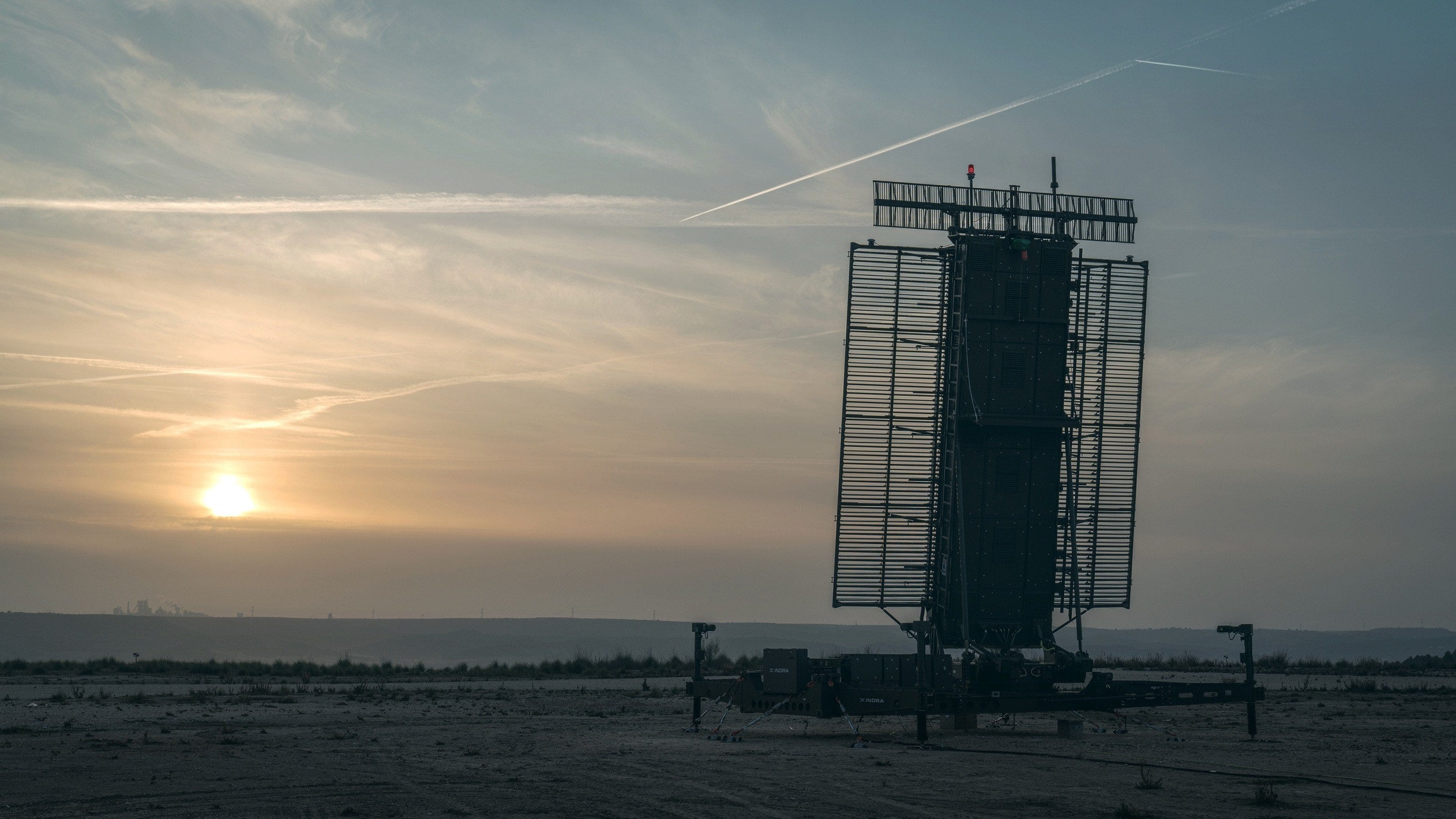
Spain Approves Delivery of Indra's Excellent LTR-25 Radar to Ukraine
Another step toward closing the damn skies
If there is a lesson to be driven home during Ukraine’s current energy crisis, it’s the importance of closing Ukraine’s skies.
Of course, Russia’s strikes against heating in the dead of the Ukrainian winter, with the sole intent to inflict civilian suffering, have officially been called a “crime against humanity.”
But rather than holding out hope that Russia will suddenly wake up one morning with a conscience, the quickest path out of this misery is shooting down every single piece of Russian junk that enters Ukrainian airspace.
Now, Spain just signed off on something Ukraine needs to help with that very task.
Madrid’s Council of Ministers approved a €37 million deal with Indra to manufacture and deliver a Lanza Long-Range Tactical Radar 25, the LTR-25, plus logistics support through December 31, 2026.
Spain did not announce a delivery date but based on the language of the logistics support contract, I would put this delivery between April and June of this year.
This might not be as sexy as an offensive weapon system. But this sensor that changes how Ukraine sees the sky and how quickly it can respond to the next wave of Russian drones and missiles.
What the LTR-25 actually is
The LTR-25 is a three-dimensional long-range air-surveillance radar in the L-band, roughly 1 to 2 GHz.
L-band sits in a sweet spot for long-range detection and resilience in ugly environments. It tends to perform better than higher-frequency systems when weather, clutter, and electronic warfare try to turn your picture into static.
Indra describes (PDF Warning) the LTR-25 as a solid-state radar using a “3D pencil beam technique” with fully digital beamforming.
Pencil beam is a simple phrase that hides a lot of value.
It means the radar can focus energy into a narrower beam, then steer that beam electronically and shape it digitally. The payoff is better accuracy, better discrimination, and better performance against targets that are small, low flying, or trying to blend into ground clutter.
The other key phrase is “3D.” Older radars can tell you direction and distance. A true 3D radar gives altitude as well, and Indra says the LTR-25 provides target coordinates including altitude.
This is pretty standard these days because modern air defense is a geometry problem. If you do not know where the target is in three dimensions, you cannot cue interceptors efficiently. You end up wasting time and missiles.
Ukraine has no time to waste, and it definitely does not have missiles to waste.
Janes reports the LTR-25 has a range up to 240 nautical miles, about 444 kilometers. Other reporting rounds this to “over 450 km.”
Either way, we are in early-warning territory, not point-defense territory.
What does that look like on a Ukrainian map? It means an LTR-25 deployed well behind the front can still see deep into the approach corridors Russia uses for cruise missiles, aviation, and many drone routes.
It also means Ukraine can see the shape of an incoming strike earlier, which buys the most precious commodity in air defense: minutes.
Minutes are the difference between a SAMP-T battery that gets cued and a SAMP-T battery that gets surprised. Minutes are the difference between dispersing aircraft and watching them burn on the ramp. Minutes are the difference between an energy node surviving the night or freezing a city again while Moscow congratulates itself for attacking women and children.
Indra’s own material and open descriptions emphasize the LTR-25’s deployable nature. It can be transported in two trucks and is air-transportable in a single C-130-class aircraft.
Assembly or disassembly can take about two hours with a trained crew. Forces News reports that once the RAF’s LTR-25 arrives in a new location, it can begin transmitting within four hours.
Russian forces hunt emitters. If a radar sits in one place and radiates on a predictable schedule, it becomes a target for drones, cruise missiles, and the long, petty arm of Russian reconnaissance.
Ukraine has built a style of air defense that prizes survival. Sensors disperse, move, and go quiet when they need to. Shooters relocate. Crews work fast. This is one of the key lessons taught to Ukraine by US trainers between 2016 and 2022: Mobility as protection, EMCON, or emissions control, and deception operations like simulating radar signatures in false locations.
Ukraine took this doctrine and made it their own with improvements based on the war they’re actually fighting.
The LTR-25 fits that doctrine.
It gives Ukraine a radar that can move, reappear, and keep feeding the network without being a permanent billboard that says “please hit me.”
The counter-countermeasure
Every serious radar spec sheet eventually turns into a discussion about electronic warfare, because modern combat is a fight over the electromagnetic spectrum.
Radars in the Lanza family can include electronic counter-countermeasures, anti-clutter capability, and digital signal and data processing, with some variants also offering tactical ballistic missile detection and tracking.
That is the polite technical way of saying this radar is built to keep working when someone is trying to blind it.
Russia jams, spoofs, and floods the spectrum. It does it from aircraft, from ground systems, and sometimes with the subtlety of a drunk guy shouting into a megaphone.
Ukraine has learned to live inside that mess. A long-range radar that can resist clutter and interference, and still provide usable tracks, adds stability to the entire air-defense picture.
You will see “tactical ballistic missile detection” attached to the Lanza family in multiple places, and Indra marketing for the radar line points in that direction.
Indra’s own LTR-25 brochure explicitly lists “TBM detection and tracking” as a capability. In plain English, that means it can (at least in some scenarios) detect a tactical ballistic missile, maintain a track, and generate useful track data.
Separately, NATO has a certification/testing track for deployable air-defense radars (DADR) that includes tactical ballistic missile detection and tracking. Indra’s LANZA DADR variant has publicly been described as passing those NATO TBM detection/tracking tests. (That speaks to the family’s maturity in that role, even if any given customer configuration can vary.)
So, the radar can help Ukraine see ballistic threats sooner, track them more cleanly, and hand off better data to the systems that actually shoot.
When we think about yet another manufacturer’s equipment entering into Ukraine’s zoo of air denial coverage, it’s totally fair to ask how all of these systems possibly work together to create a unified defense picture…
Ukraine does not have the luxury of one neat, uniform architecture where everything comes from the same factory, speaks the same digital language, and shows up with the same training pipeline.
Ukraine is fighting with what it can get, when it can get it, and from whoever is willing to send it. In any other military, that would be a recipe for confusion and friendly fire.
In Ukraine, it has become one of the most impressive integration stories of the modern era.
Ukraine’s air defense looks like a coalition museum exhibit, and I mean that as a compliment.
Soviet legacy systems still fill gaps because they exist in quantity and crews know them.
Western systems add accuracy, better seekers, better resistance to jamming, and a steadier supply of modern missiles.
Man-portable systems and mobile fire groups cover the cheap end of the problem, because you cannot spend premium interceptors on a $20,000 drone forever without going broke.
Then you add Ukraine’s own growing ecosystem of sensors, software, and local innovation, and suddenly you have a living network rather than a pile of separate launchers.
A layered air defense network needs a few things to function:
It needs early warning. It needs track quality good enough that shooters trust what they’re seeing. It needs a way to distribute that picture quickly to units that might be dispersed, moving, and operating under jamming. It needs discipline, because the quickest way to lose an air defense war is to have everybody shoot at the same target while the next wave walks in behind it.
Oh, and it needs flexibility, because Russia does not strike one way. It mixes Shaheds, cruise missiles, ballistic missiles, decoys, and electronic attack and it changes routes constantly to find seams.
Ukraine has built a system that can do all of that while using equipment from different countries, different vintages, and different philosophies of warfare. That alone is hard. Doing it while fighting every night is absurd.
This is why a long-range radar like the LTR-25 matters beyond its raw range number.
A radar like this is not just a sensor; it is an organizer.
It helps unify the picture. It helps turn a collection of batteries into a coordinated defense. It lets Ukraine push cues down the chain so the right layer engages the right threat.
Guns and cheap interceptors take the first shots when they can. Medium-range systems handle what slips through. High-end missiles stay reserved for the targets that actually require them.
That prioritization is survival. It is also strategic math.
Russia wants Ukraine to spend itself into exhaustion. It wants Ukraine firing expensive missiles at cheap drones until the magazines are empty and the budget is broken.
Ukraine’s layered network is how it refuses that trap. It turns scarcity into a managed problem instead of a panic response.
And here is the thing that should embarrass Moscow more than any destroyed drone.
Ukraine is doing this while under constant attack, while Russia has had decades to build a modern integrated air defense enterprise on paper.
Ukraine built an improvised, multinational, constantly evolving network that works in real combat. Russia built corruption, and then acted surprised when it did not stop Ukrainian drones and missiles from entering their airspace.
The LTR-25 strengthens the “see” layer, and that lifts everything above it.
It helps against cruise missiles because cruise missiles are a detection and tracking contest. Russia relies on low altitude flight profiles, terrain masking, and mixed salvos to confuse defenders.
A long-range 3D radar improves early track formation, and early track formation improves every downstream decision. You can position mobile fire groups more intelligently. You can allocate scarce interceptors to the right threats. You can reduce the odds that a high-value missile gets wasted on a decoy while the real threat slips through.
It also helps against drones, including the Shahed family, but in a different way than people assume. Shaheds are slow and loud, and Ukraine already kills plenty of them with guns and short-range systems. The problem is scale. Russia sends them in waves. It sends them at night. It uses them to drain defenses and then follows with missiles.
Long-range radar does not make Shaheds easy to shoot.
It makes them easier to manage.
It provides earlier awareness of corridors and densities, which lets Ukraine shape the defense. That reduces panic launches. It reduces confusion. It improves the odds that cheaper layers of defense get the first shot, not the most expensive ones.
Spain’s radar is also a political statement
Zelenskyy and Spain’s Prime Minister Pedro Sánchez announced in late 2025 that Ukraine and Spain would pursue joint work with Spanish defense firms to supply long-range radars, and Spain’s government publicly discussed major support packages that included air defense.
This deal looks like a concrete delivery from that lane of cooperation.
For Ukraine, it is capability. For Spain, it is industrial commitment.
The LTR-25 is a solid radar system that, at least in my mind, represents another concrete step toward the ultimate goal of closing Ukraine’s skies.
Ukraine needs repeatable advantages that add up: earlier warning, cleaner tracks, better cueing, survivable sensors, and more resilience under electronic attack.
Spain is delivering exactly that.
Russia’s air campaign relies on saturation, ambiguity, and exhaustion. The LTR-25 attacks the second and third parts of that equation.
It clarifies the sky. It buys time. It reduces waste.
And every time Ukraine gets a little more time, the Kremlin gets a little less certainty.
That is a trade I will take all day.
Слава Україні!


I want to see a European union that stretches from Ukraine to British Columbia.
it is about time spain brought something positive to the table