


I can’t remember when it happened… But sometime in the last three years, I became a Saab fanboy. That is to say, I’ve seen so much high technology coming out of Sweden over the past few years, I became smitten; like Pepé Le Pew chasing after his beloved cat.

Here’s another fantastic piece of Swedish technology.
There’s a certain moment in war when the smartest militaries pivot. They stop polishing legacy hardware and start building machines that feel like they were smuggled in from ten years ahead. Sweden just reached that moment.
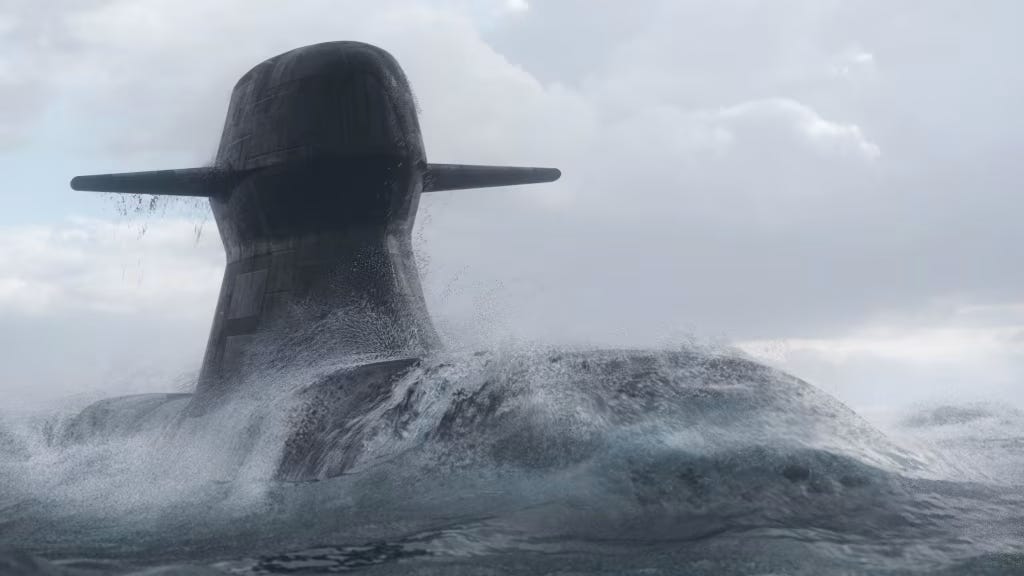
Saab has unveiled what it calls the world’s first fifth-generation submarine, the A26 Blekinge-class. Other countries claim “next-gen” labels for marketing fluff. Sweden is quietly doing the work. And if you know anything about undersea warfare, the A26 should make you sit up a little straighter.
It’s not nuclear. It’s not titanium. It’s not trying to impress anyone with raw tonnage.
The A26 is something different: a platform meant to thrive in the messy, surveillance-dense battlespace the rest of the world is stumbling into. It’s a submarine designed for a future where stealth isn’t an adjective, it’s oxygen.
And it arrives at a moment when NATO’s northern flank matters more than ever.
Before we get into the “fifth-generation” claim, and what that term actually means, let’s start with why Sweden thinks the world needs one.
The Return of the Silent War
What makes the Baltic such a cruel arena is the compression of every variable that normally gives submarines room to breathe.
Shallow depth works against you. Acoustic conditions shift by the hour. Civilian traffic clutters the water column. The Russians have shown a propensity for passive sensors, hydrophones, and underwater drones to make the place feel less like an ocean and more like a security checkpoint.
That is the world the A26 is entering: a knife fight in a phone booth, where brute-force survivability means far less than managing signatures with surgical finesse. In this setting, the old Soviet and Russian doctrine of “hide by going deep” collapses. There is no deep. There is only clever.
Even surface assets feel the squeeze. Long-endurance drones loiter overhead. Maritime patrol aircraft sweep repeatedly. Satellites stare down at telltale wakes and thermal anomalies. A submarine that can’t mute its own existence becomes a liability before it ever leaves port.
This is why Sweden’s naval thinkers stopped trying to build a smaller version of someone else’s submarine and instead built something tailored to their neighborhood.
It’s a conventional boat that behaves like a ghost, refuses to be pinned by sonar curtains, and can shift from reconnaissance to sabotage to strike missions without compromising its stealth profile. It’s the maritime equivalent of reshaping the battlefield instead of merely surviving it.
And the timing matters.
Finland’s entry into NATO closed the Baltic Basin in a way Moscow never planned for. Kaliningrad is now a fortified island with NATO sensors to the north, west, and east. Any Russian fleet movements require threading a needle under constant surveillance. A platform like the A26 doesn’t just exploit Russia’s vulnerability; it amplifies it.
