


When I was in high school, I read a chilling and memorable sci-fi novel called Cold Allies by author Patricia Anthony.
Released in 1993, the book depicts a futuristic world war where an Arab National Army invades Europe amidst ecological collapse, while the combatants simultaneously come to terms with alien visitors who decide that global war is the best time to stop by and say hi.
Although the author’s pacing was inconsistent, the writing rough around the edges, and the aliens poorly defined, I still remember this book distinctly for one reason: The American way of warfighting was completely remote-controlled.
Keep in mind, this was the roaring 90s; we didn’t have Reaper drones or Global Hawks yet in large numbers, so the fact that one of the American characters controlled a ground-based combat drone with virtual reality goggles was completely fresh.
(This book actually made me want to buy the Nintendo Virtual Boy, until I tried a demo in Toys R Us in 1995)
That future has finally arrived… Without the aliens.
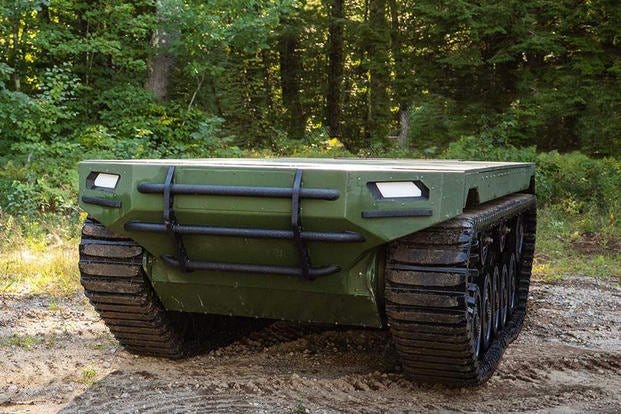
After taking disciplined notes of the ongoing ground war in Ukraine, Sweden has just become the first European customer for Textron’s RIPSAW M3 unmanned ground vehicle, a tracked robot that weighs as much as a loaded Bradley turret and hauls over two tons of cargo.
On paper it is a logistics UGV. In practice it is Sweden putting real money behind a bet that heavy ground robots will matter in the next war.
At the same time, Ukraine is proving every week that the most useful unmanned ground vehicles are the size of a riding mower and cost less than a used Honda. Those little tracked runts are running ammo, dragging wounded, and getting blown to pieces by FPV drones for a fraction of what a single RIPSAW will cost.
In fact, statements from Ukrainian commanders say Ukraine aims to field around 15,000 ground robotic systems by the end of 2025, planning targets as high as 30,000 units over the next year or two to replace high-risk human tasks like logistics, casualty evacuation, mine clearing, and some combat roles.
So which vision wins: the robot tank, or the disposable robot mule?
That is where this gets interesting.
Meet Sweden’s New Six-Ton Mule
The RIPSAW story starts like a lot of American defense tech: two brothers in Maine wanted to build something that scared the neighbors.
Mike and Geoff Howe’s original RIPSAW was basically a remote-controlled hot rod on tracks. It was fast, loud, and absolutely not built with Swedish procurement officers in mind. The US Army took notice in the early 2000s and commissioned experimental variants. Textron later bought Howe & Howe, cleaned the program up, and turned the RIPSAW line into a family of unmanned ground vehicles that range from “big remote-control toy” to “uncrewed tank with a 30 mm cannon.”
The M3 sits right in the middle of that family, like an angry middle child waiting for his time to shine.
On the spec sheet, it weighs around 5,900 kilograms and can carry more than 2,200 kilograms of cargo on its flatbed. Top speed is about 48 kilometers per hour, which is respectable for a robot that could give a city bus a complex about its weight. It is built on rubber tracks, has a modular architecture for payloads, and can be armed if someone feels like bolting a remote weapon station on top, although Sweden’s contract is explicitly framed around a “transport” configuration.
In other words, Sweden did not buy a killer robot. Sweden bought a robot pack mule that can be armed later if the mood changes.
Textron’s press line is predictable: the M3 is ideal for extreme terrain, harsh weather, and high-latitude environments.
Hmm. It’s almost as if that marketing copy was written specifically for the Nordics. You are talking about a region with deep forests, boggy lowlands, rocky coasts, and winters that try to murder your fuel lines.
If you wanted a testbed for heavy UGV logistics in a snowy NATO frontline state, I suppose you would target Sweden with your marketing dollars.
Sweden’s Problem Set: Snow, Distance, and Russia
Marketing cynicism or not, Sweden does have an actual need here…
Since joining NATO, Sweden’s mental map of war has shifted north and east.
The scenarios that keep Stockholm awake are not urban riots in Malmö. They are Russian pressure in the High North, deep mischief in the Baltic, and the nightmare of a crisis that stretches Norway, Finland, and Sweden across one giant land corridor of logistics misery.
