Ten Weapons at Eurosatory 2026 That Prove War Has Completely Changed
Almost every serious system on display is an answer to a question the war in Ukraine asked out loud
I was thinking recently about the good ole pandemic days; ah, what a simpler time…
At the time, I was writing for military and cybersecurity magazines about whether NASA spacesuits can be hacked and hypersonic tomfoolery.
Six years ago, a defense expo like this was mostly about better armored boxes. Things like thicker protection, a nicer turret, an upgraded engine, a fire-control system with a new acronym.
The headline acts were tanks and infantry fighting vehicles, things that go very high and very fast, and the unspoken assumption underneath all of it was that war would look roughly like it always had, just with more cowbell.
Then 2022 happened.
Then Operation Spiderweb.
Then a year of Russian glide bombs and Ukrainian refinery strikes and FPV drones turning hundred-dollar quadcopters into tank-killers.
Then the Gulf woke up to Iranian missiles in March. And the entire defense industry got the same text message at the same time, written in other people’s blood.
You can read that message on the Eurosatory floor this year.
Almost every serious system on display is an answer to a question the war in Ukraine asked out loud:
How do I shoot from farther away so I don’t die?
How do I kill cheap drones without going bankrupt?
How do I send a robot instead of a soldier?
How do I keep my tank’s roof from becoming a Thermador pizza oven set to “broil?”
Back then, I also used to write listicles, like “Top Ten Gifts for Veterans!” In that tradition, I’ve put together a hand-picked list of ten weapon systems emerging this year at Eurosatory in Paris, and every one of them is really a story about how much war has changed since 2020.
1. KNDS LORAS: Tube artillery wants to be a rocket
The strongest single reveal of the show, in my humble opinion. KNDS unveiled LORAS, a 155mm artillery demonstrator built around a long 58-caliber gun, mounted on the tracked RCH 155 with its unmanned turret.
The pitch is reach: around 60 kilometers with a new high-explosive round, and up to 100 kilometers with precision or special ammunition, while staying compatible with NATO’s 155mm standard.
A hundred kilometers from a conventional cannon shell is the kind of range that used to belong exclusively to rockets and missiles. The Ukraine lesson driving it is simple: artillery dies in counter-battery duels, and the gun that shoots farther shoots first and lives longer.
LORAS is tube artillery trying to buy rocket range without paying rocket prices on every single shot. In 2020, nobody was building this. In 2026, it’s the headliner.
2. MBDA-Safran Thundart: France builds its own deep strike
France used the show’s opening day to announce it had selected the MBDA-Safran Thundart for its deep-fires competition, replacing a sad little fleet of nine aging LRU rocket launchers.
Thundart, which I’m pretty sure was also a character from ThunderCats in the 1980s, is pitched at 150 kilometers, rides on an 8x8 launcher carrying eight rockets, and is explicitly designed to be scaled up and extended, with a path toward the 1,000-kilometer-plus Land Cruise Missile.
The strategic story here is sovereignty.
Most of NATO answered its rocket-artillery problem by getting in line at the American HIMARS counter like everyone else at the procurement buffet.
France looked at that line and said, “Absolutely not, mon amie! We shall go our own way, merci.” And then decided it wanted a deep-strike capability it controls end to end, built in Europe, not dependent on anyone’s export approval.
That instinct, build it yourself so nobody can switch it off, is one of the loudest themes of the entire post-Trump era.
3. Soframe-Thales X-Fire: shoot, scoot, survive
Another French deep-fires entry, X-Fire sits on a Daimler Zetros 8x8 truck and is built around modular missile pods designed to take weapons reportedly reaching out to 1,000 kilometers.
The numbers that actually matter, though, are the small ones: crew reload in under eight minutes, displacement in under one minute.
That’s the whole drone-war doctrine compressed into a spec sheet.
On a battlefield saturated with reconnaissance drones and loitering munitions, a launcher that sits still is a launcher that becomes a smoke column. X-Fire is engineered around the assumption that the enemy will find you fast, so your only survival is to be gone faster.
Cold War artillery could afford to linger, smoke a stale Russian cigarette, and haze the new conscript in the unit before moving out. Modern artillery has the life expectancy of a fruit fly if it stops moving.
4. MBDA Land Cruise Missile / NCM Mk II: precision at continental range
MBDA showed, for the first time as a complete system, its ground-launched Land Cruise Missile built around the new-generation Naval Cruise Missile Mk II, with ranges beyond 1,000 kilometers.
The upgrades are a checklist of lessons from electronically contested combat: a new infrared seeker, improved electro-optical navigation, and hardened GNSS and inertial navigation for a battlefield where GPS gets jammed, spoofed, and generally turned into a liar.
MBDA paired it with cheaper one-way effectors built for saturation, which is the other half of the modern equation.
You still want a few exquisite 1,000-kilometer missiles for the hardest targets and a flood of cheap one-way drones to soak up the air defenses on the way in.
High-end and low-end, sword and shield, because Ukraine proved you need both.
5. ARQUIMEA’s layered counter-drone interceptors: the Shahed lesson went shopping
Spain’s ARQUIMEA unveiled a multi-layer counter-drone system built around autonomous interceptors, with a family of effectors tuned to different speeds and ranges, the Q-SLAM and Q-FOX series.
Detection, identification, tracking, interception, all stacked into one architecture.
This is what the Shahed war looks like when it goes shopping. Russia and Iran spent three years teaching the world that cheap mass drones overwhelm any defense built around a handful of expensive missiles, because you run out of million-dollar interceptors long before they run out of fifty-thousand-dollar drones.
The answer being built across Europe now is layered, autonomous, and cost-conscious by design.
In 2020, “counter-drone” was a niche line item.
In 2026, it’s a product category with subcategories.
6. Thales RapidStriker: the cheap middle layer
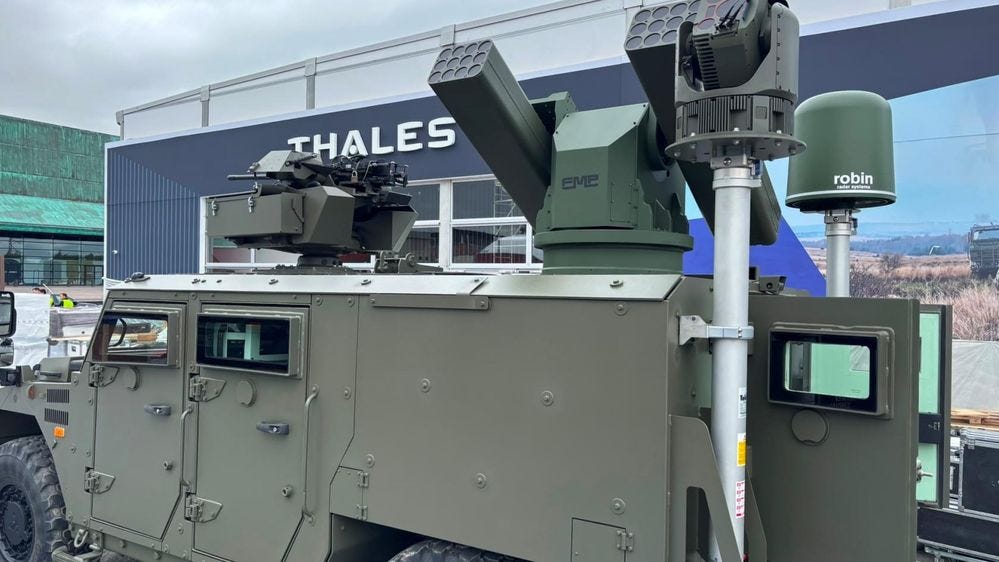
Thales rolled out RapidStriker, a mobile short-range air-defense and counter-drone system using 70mm rockets.
Unglamorous, but I still want one in my driveway, if my HOA would allow it.
Europe has a gaping hole in the middle of its air-defense stack, the zone between a soldier with a machine gun and a battery firing missiles that cost more than the building the drone was about to hit.
Guided 70mm rockets are an attempt to fill that gap with something affordable enough to use every single night, because drone defense built only around exquisite interceptors works right up until the moment your defense budget discovers it has not, in fact, struck oil.
7. Milrem THeMIS and HAVOC: let the clankers take the first hit
Estonia’s Milrem showed a robotic ground ecosystem: the tracked THeMIS fitted with a counter-drone weapon station using a 30mm cannon and specialized ammunition to swat drones beyond 1,000 meters, alongside the larger HAVOC 8x8 robotic combat vehicle that can carry cannons, short-range air-defense missiles, and electronic warfare gear.
This is the “robots absorb the risk before soldiers do” entry, and it’s one of the most important shifts of the whole post-2022 period.
The logic of the modern battlefield, where everything that moves and emits gets seen and hunted, points relentlessly toward putting machines in the most lethal positions and keeping the humans further back, making decisions instead of making targets.
We talked about this with the uncrewed-vehicle trend in Ukraine. Eurosatory is where it becomes a catalog you can order from.
8. Nammo’s Orca strike drone with the N7 warhead: the one that isn’t vapor
Norwegian ammunition company Nammo unveiled a modular strike system pairing Orca’s MRM2-10 drone with a 66mm N7 anti-tank warhead that the company says punches through more than 450mm of rolled steel armor.
But here’s the detail that separates this from showroom vapor: the N7 has reportedly already been sold to Ukraine in six-figure quantities. Dayam!
That’s the tell. A lot of what gets unveiled at these shows is a beautiful render, a logo, and a catered lunch, with the actual hardware arriving sometime around the heat death of the universe.
A warhead already in Ukrainian hands by the hundred thousand is a product that has met the enemy, which in 2026 is the only review that counts. The drone-plus-shaped-charge pairing is the single most consequential weapon of this war, and now it’s a modular product line.
9. The post-Ukraine tank: KNDS CAPINT and the Leonardo-Rheinmetall concept
KNDS showed CAPINT, its proposal for France’s next main battle tank, built on an enhanced Leopard 2A8-based chassis with the unmanned ASCALON turret, designed for increased firepower, open digital architecture, counter-drone systems, and connectivity with robotic wingmen.
Leonardo and Rheinmetall, separately, displayed a new tank concept with a 30mm remote weapon station specifically meant to swat down drones diving from above.
The tank is not dead, despite a thousand breathless think-pieces declaring it so.
But it is being forced to evolve fast, and the thing reshaping it is the FPV drone. Suddenly every tank designer on earth is thinking about high-angle threats and onboard drone defense. A tank that talks to robotic wingmen and shoots down quadcopters is a different machine than the one showed off in 2020.
10. Esh-Tech DroneLite: shooting drones with light
The wild card.
Israeli startup Esh-Tech is showing DroneLite, a pulsed laser counter-drone system aimed at small drones, claiming it runs on only 4 kilowatts, mounts on a vehicle, and destroyed 20 drones in testing last year, with a first operational system planned for October 2026.
Big caveat: startup laser claims need independent verification the way a parachute needs a second look, and “we destroyed 20 drones in our own testing” is a sentence that has preceded a lot of disappointment.
But the reason it’s on this list anyway is the economics. A laser’s shot costs roughly the price of the electricity to fire it, which against a swarm of cheap drones is the holy grail.
If even a modest version of this works, it attacks the exact cost problem that defines the drone war. That’s worth watching, with one hand on your flask of skepticism.
What the Floor Is Telling Us
Step back from the individual systems and the pattern is impossible to miss. Look at what’s not the headline anymore. Nobody’s leading with a slightly roomier APC, a slightly improved rifle optic, or a new ramjet cruise missile. The energy of the entire show has moved to four places: shooting from farther away, killing cheap drones cheaply, sending robots instead of people, and building it all in Europe so nobody can turn it off.
Every one of those four is a direct transcription of a lesson someone learned the hard way since 2020.
Now count the flags on that list of ten.
The lone outlier is an Israeli startup.
Go down the entire list of the most interesting, most war-relevant systems at the show, and you will not find a single American prime contractor headlining one of them.
Now, I’ll be fair, because cheap shots are beneath me, (just kidding, I love cheap shots).
Most of that is the venue. Eurosatory is a European land-warfare show in Paris, and the American giants play their home games at AUSA and Sea-Air-Space, where they roll out the x-ray vision, the stealth fighters, and the exquisite missiles they still genuinely dominate.
Nobody should pretend the US defense industry is washed up. For now, it owns the air, the sea, and space in ways Europe can only envy.
But the deeper story survives the caveat, and it’s uncomfortable for Arlington.
The American primes built their empire on a specific model: enormous, exquisite, expensive platforms delivered on decade-long timelines with price tags that require their own zip code.
That model was unbeatable in the world it was built for. It is a poor match for a war that iterates monthly, rewards cheap mass over gold-plated perfection and punishes anything that takes ten years and a billion dollars to field.
While the primes were polishing the next generational platform with a 2035 delivery horizon, the actual revolution in deep fires, counter-drone, and battlefield robotics got seized by European firms responding to a war on their doorstep, and by American startups like Anduril and Helsing that don’t carry the same institutional weight around their ankles.
That’s the quiet bombshell in this trade show.
The war started reshuffling the deck of who builds the weapons.
The companies that ruled the last era of warfare are not automatically going to rule the next one, and the floor at Eurosatory 2026 is the first real evidence that the agility advantage has shifted toward the people closest to the fighting and the people unburdened by the old way of doing business.
Слава Україні!


It’s not just that the USA is now untrustworthy. The evidence from the Gulf shows that the US military and defence sector have learned little or nothing from 4 years of conflict in Ukraine.
A combination of complacency and overwhelming arrogance.
It now has little to offer Ukraine and should be charged top dollar for Ukraine’s expertise. Assuming Trump and his stooges can be trusted not to pass it across to their friends in Moscow.
I seem to remember that the Abrams main battle tank when it first came out in the 80s I think had the ability to fire its main gun on the move. Whatever happened to that technology, has it improved, and can it be used on a modern battle field to counter drones so that "shoot and scoot" just becomes "keep scooting!"