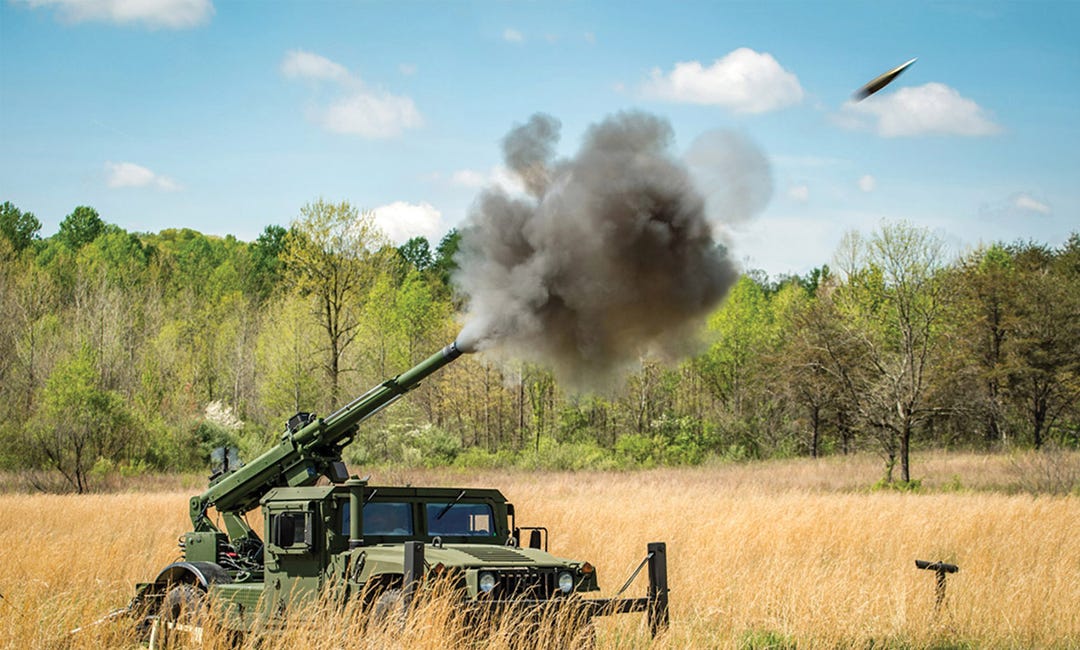
The Artillery Revolution Nobody Noticed: Soft Recoil Technology in Ukraine
Ukraine is testing a Humvee with a howitzer bolted to its back. That sounds ridiculous but the engineering that make it possible are rewriting what artillery can be.
A 105mm artillery cannon mounted on a Humvee sounds like something my butter bar lieutenant would have proposed after three Rip-Its. And for most of military history, physics, and any sane brigade commander, would have killed that idea before it left the wire.
You can’t put a full-sized artillery piece on a light tactical vehicle. The recoil forces would turn the chassis into pile of scrap after the third volley.
Plus, anybody inside would look like that scene from Ace Ventura 2:
Newton’s second law doesn’t negotiate.
And yet… someone figured out how to cheat.
The result is the 2-CT Hawkeye, a 105mm howitzer mounted on an M1152 Humvee, developed by AM General and Mandus Group, and currently operating in the most artillery-intensive wars since good ole dubbya dubbya two.
Ukraine has been running it in combat since spring 2024.
AM General’s program director Mike Evans confirmed the deployment at the US Field Artillery Association’s Fires Symposium in May 2024: “We recently put a 2-CT Hawkeye system into Ukraine. We shipped it in April. It’s going into combat to test on live targets.”
Wait, 2024? It’s now 2026; why haven’t we heard more about this?
That’s precisely why I’m talking about it today.
The lack of news about its success or failure in Ukraine tells us something.
So let’s jump in:
Soft Recoil Technology, or SRT, is how you put a massive gun on a light hummer.
When a cannon fires, the explosion that sends the round downrange also sends an equal and opposite force straight back through the gun. That’s recoil. Managing that force is the central engineering challenge of every artillery system ever built.
The heavier and more powerful the gun, the more recoil it generates, and the more structure you need to absorb it without destroying the platform underneath.
This is why traditional artillery is gi-normous!
The M777 lightweight towed howitzer, specifically designed for portability, still weighs 4,200 pounds. The M109 Paladin self-propelled howitzer weighs about 62,000 pounds. The German PzH 2000 is roughly 55 tons. The French CAESAR is considered exceptionally light for a wheeled 155mm system and it still weighs 18 tons.
Every one of those weight numbers is partly a consequence of the recoil management problem. You build the structure big enough to absorb what the gun produces, and then you build it a little bigger for the margins and safety.
A Humvee, by comparison, weighs about 5,500 pounds unloaded. Asking it to absorb the recoil of a 105mm cannon is like asking your elderly grandma to tackle a pro NFL player.
The big brains at Mandus Group said: what if we changed when the recoil happens instead of how we absorb it?
The Cheat Code
Traditional artillery fires like this: round ignites, gases expand, projectile leaves barrel, gun slams backward thanks to Newton. All that force arrives at once. The platform has to be stiff enough to take it.
Soft recoil reverses the sequence.
But actually, soft recoil isn’t a new idea.
Engineers figured out the basic concept before the First World War. A 65mm Italian mountain gun used a crude version of it, and that gun was still in service after the Second World War.
In the 1970s, the US Army tried again with the XM204, a lightweight 155mm howitzer program specifically built around soft recoil. It failed.
The German arms museum at Koblenz has the prototype and the museum placard is, by all accounts, not flattering.
The problem was always the same: timing.
When a conventional howitzer fires, the propellant ignites and generates an enormous gas pressure inside the chamber, on the order of tens of thousands of pounds per square inch. That pressure accelerates the projectile down the barrel toward the target.
It also, simultaneously and with identical force, pushes backward on the breech. The gun has nowhere to go, so the recoil mechanism takes the hit.
In the standard systems, it’s a hydraulic or hydropneumatic system, (essentially a very heavy-duty shock absorber), that lets the barrel slide backward over a controlled distance while throttling fluid to slow it down.
The energy gets dissipated through the recoil system, into the mounting, and eventually into the ground.
All of that force arrives in milliseconds. The platform doesn’t experience average force over a long period. It experiences an extremely high force spike, briefly, and the entire structure has to be designed to survive that spike without bending, cracking, or launching itself off the ground.
That’s why artillery carriages are heavy.
That’s also why self-propelled howitzers are the size of small houses.
Every kilogram of mass in the system is there partly because the laws of physics require something to absorb what the gun produces at the moment of firing.
Muzzle brakes help somewhat.
They redirect a portion of the propellant gases sideways and rearward as the projectile exits, partially offsetting the recoil impulse before it reaches the gun mount.
That’s why you see those distinctive lateral blast patterns when a muzzle-braked weapon fires, and why the soldier standing directly beside a muzzle-braked gun is having a bad hair day.

Muzzle brakes reduce total recoil impulse but they don’t change when it arrives. The spike is still there. It’s just slightly shorter.
But soft recoil changes the timing of the whole event. That’s the cheat.
Here’s the mechanism, step by step.
The cannon sits in its cradle held back by a latch, under tension from an internal gas spring. When the fire control system initiates the firing sequence, the latch releases and that spring drives the entire barrel assembly forward along its guides at speed, through a predetermined run-up distance.
At the exact moment the barrel reaches maximum forward travel, the round fires. The propellant ignition now pushes against a barrel that is already moving forward. The explosive force first has to stop the barrel’s forward momentum entirely before it can begin pushing the barrel backward.
According to the underlying patent documentation, nearly half the energy of the firing event gets consumed just stopping that forward motion. The residual rearward travel is then absorbed by a conventional hydropneumatic system.
Peak force delivered to the vehicle: down by up to 60 percent!!!
The physics behind this is Newton’s conservation of momentum, applied in reverse of what most artillery designers before the 1970s assumed was the only option.
You don’t have to build the platform strong enough to absorb the spike if you can split the spike in half before it gets there.
The reason this kept failing for a century was that triggering the round at exactly the right microsecond in the barrel’s forward travel is genuinely hard.
Too early and you’re firing while the barrel is still building speed, which reduces the recoil benefit and can cause dangerous misfires. Too late and you’re firing as the barrel decelerates, same problem in reverse.
The timing window is narrow and the consequences of missing it are big. The XM204 program got close enough that the Army funded it. It didn’t get close enough to work reliably.
21st century electronics solved it.
Sensors, processors, and digital fire control systems that didn’t exist in any practical form in the 1970s can now track the barrel’s position and velocity with sufficient precision to trigger firing at the correct moment in the cycle, repeatedly, under field conditions.
The Field Artillery Association’s own technical write-up on the system describes it directly: “Almost no human labor is involved in the preparation for firing nor displacing.” The gun does the timing itself.
That’s the engineering breakthrough the Hawkeye is built on.
It’s like bending your knees when you jump on the ground; the bending spreads that same total force over a longer movement. Same physics. The soft recoil system bends the gun’s knees before impact by giving the barrel somewhere forward to go before the round fires. (My knees, after two services and a decade of bad decisions, no longer bend the way they’re supposed to. The Hawkeye’s recoil mechanism has me beat on this.)
What that actually means for the lightweight Humvee: It can deploy in under 90 seconds from rolling stop to first round.
It can put 8 rounds downrange in the first three minutes.
It can hit a target 11.6 kilometers away with standard ammunition, or nearly 20 kilometers with extended-range rounds. And it can be driving away before the counter-battery radar finishes its solution.
The old Soviet doctrine, roughly summarized as “park gun, fire mission, smoke a stale cigarette, relocate eventually,” now carries survival odds comparable to standing in the Donbas wearing a reflective vest at midnight.
Static artillery positions die. Heavy tracked systems that take fifteen minutes to unlimber and another fifteen to move are essentially fixed targets.
Ukraine’s artillery survival doctrine evolved accordingly: shoot fast, shoot accurately, and leave before the counter-battery cycle closes. Every Ukrainian artillery crew operating on the eastern front is running some version of this calculation on every fire mission. The question isn’t “can we hit the target.” It’s “can we disappear before the response arrives.”
That’s the battlefield the Hawkeye was built for.
What Ukraine Won’t Tell You, and Why That’s Probably Good
The frustrating reality of covering experimental systems in Ukraine is that Ukraine doesn’t publish Google reviews of prototype artillery.
As of May 29, 2026, there are no major public battlefield reports declaring the Hawkeye either a war-winning breakthrough or a categorical failure. No public after-action reviews. No official Ukrainian statements rating the system against the Caesar or the M777. Operational silence.
That silence is probably a good sign.
Ukraine has a well-documented and unsentimental relationship with equipment that doesn’t perform.
Systems that fail in combat at the tactical level become known. Social media footage surfaces. Milbloggers talk. Ukrainian units share feedback through channels that eventually reach open-source analysts.
If the Hawkeye had been failing catastrophically, three deployments of drone footage and an angry Telegram thread would have surfaced by now.
What we do know: AM General described the system as “combat proven” at AUSA 2024. Ukraine apparently continued using it after initial evaluation. And AM General unveiled a next-generation version at AUSA 2025, upgraded and built around the standard M119 105mm gun, directly citing the Ukraine experience as part of the development process.
Companies don’t build second generations of systems that embarrassed them in their first combat trial.
Who Else Is Paying Attention
In October 2024, Kalyani Strategic Systems, the defense subsidiary of India’s Bharat Forge, signed a multi-party agreement with AM General and Mandus Group to co-develop and co-produce next-generation artillery platforms built around advanced recoil technology.
The agreement explicitly targets both 105mm and 155mm applications.
105mm is the weak sauce. We want the big boy 155mm boom!
That’s the brass ring of soft recoil technology… a significantly lighter 155mm system that doesn’t sacrifice range or payload to achieve mobility. If Mandus’s soft recoil approach can scale from 105mm to 155mm, a significant portion of the NATO artillery weight problem starts looking solvable.
The broader Western artillery world is also moving in the same direction through parallel means. The RCH 155, which I’ve covered, achieves shoot-and-scoot survivability through automation, speed, and a high-mobility wheeled chassis rather than through recoil reduction.
The Archer, the CAESAR, the K9 Thunder in its wheeled variant… they’re all trying to solve the same problem the Hawkeye is solving, just from different engineering angles. The problem is unanimous: heavy, slow, predictably positioned artillery dies. The debate is about which solution to that problem gets there first.
Soft recoil is one answer. It’s not the only answer. But it’s the answer that a Humvee can carry.
But think about what this means at the grunt level…
If you can put effective artillery on a Humvee, you can put artillery anywhere a Humvee can go. Infantry units that previously had to wait for dedicated fire support can carry organic artillery capability. In this sense, infantry school graduates would need an additional five weeks of advanced individual training to become proficient on artillery systems.
The queen of battle (the infantry) and the king of battle (artillery) joined together in a single Military Occupational Specialty.
Small units operating in dispersed, drone-era combat can have guns instead of just calling for fires and hoping something’s available.
Now, artillery that was previously massed in battery positions (that once represented lucrative drone targets) can be dispersed across a wide area, each platform too small and too mobile to justify the ISR investment required to target it.
Ukraine’s drones are now the fastest maneuver element on the modern battlefield. The artillery that supports drone-era infantry will need to be lighter, faster, and more dispersed than the systems it’s currently replacing.
The Hawkeye is a step in that direction. A weird, underpowered, probably underproduced step, but a genuine one.
So, the Hawkeye is the proof of concept. Somewhere between the Humvee with a cannon and the next-generation 155mm platform that doesn’t exist yet, a genuine architectural shift in how armies deploy fires is trying to happen.
Maybe my butter bar lieutenant wasn’t batshit crazy after all…
Слава Україні!


The utility of drones, coupled to new portability of artillery would completely change the battlescape. Expensive systems should be a thing of the past. The potential utility of this tech in tanks would also change tht system to one lighter, more agile and faster.
And, maybe someday those weapons systems can be turned into plowshares, instead of becoming better swords.
Well presented technical information presented in an understandable manner. Much appreciated!