The Men Who Thought Hard Work Would Save Them
What Terrence Malick's movie The Tree of Life understands about failure, fatherhood, and the bargain a lot of men were quietly raised to believe
Quick note before we start. This one’s different from what you probably signed up for.
You’re most likely here for my Ukraine analysis, or my takes on missiles, drones, armored vehicles, and whatever Russia bolted onto a Shahed this week. This essay has none of that. No order of battle. No kill chain. No artillery range table. No German procurement committee turning a simple decision into a hostage crisis.
Today I want to talk about a movie, a father, and the dangerous little myth a lot of us inherited: if you work hard enough, stay disciplined enough, and refuse to soften, life will eventually pay you back.
Normal programming resumes tomorrow.
If you want to skip this one, no hard feelings.
Also, my wife absolutely despises Terrence Malick films because they largely ignore the usual three-act story structure and drift around drunk Russian conscript. Fair criticism.
I watch them alone.
The Tree of Life found me at a bad time in my life.
The movie is already a strange experience when you’re sober.
I was at my lowest point. I’d lost friends in the military; a kind of loss that doesn’t resolve itself so much as relocate, taking up a permanent space somewhere behind your sternum. A business I’d put real work into had recently failed. I had a few habits that were doing what unhealthy habits do, offering relief on credit and quietly mailing the bill, with interest, to a later version of me. And I was close enough to broke that the idea of my three kids growing up the way I did, (dirt poor), caused a significant amount of anguish.
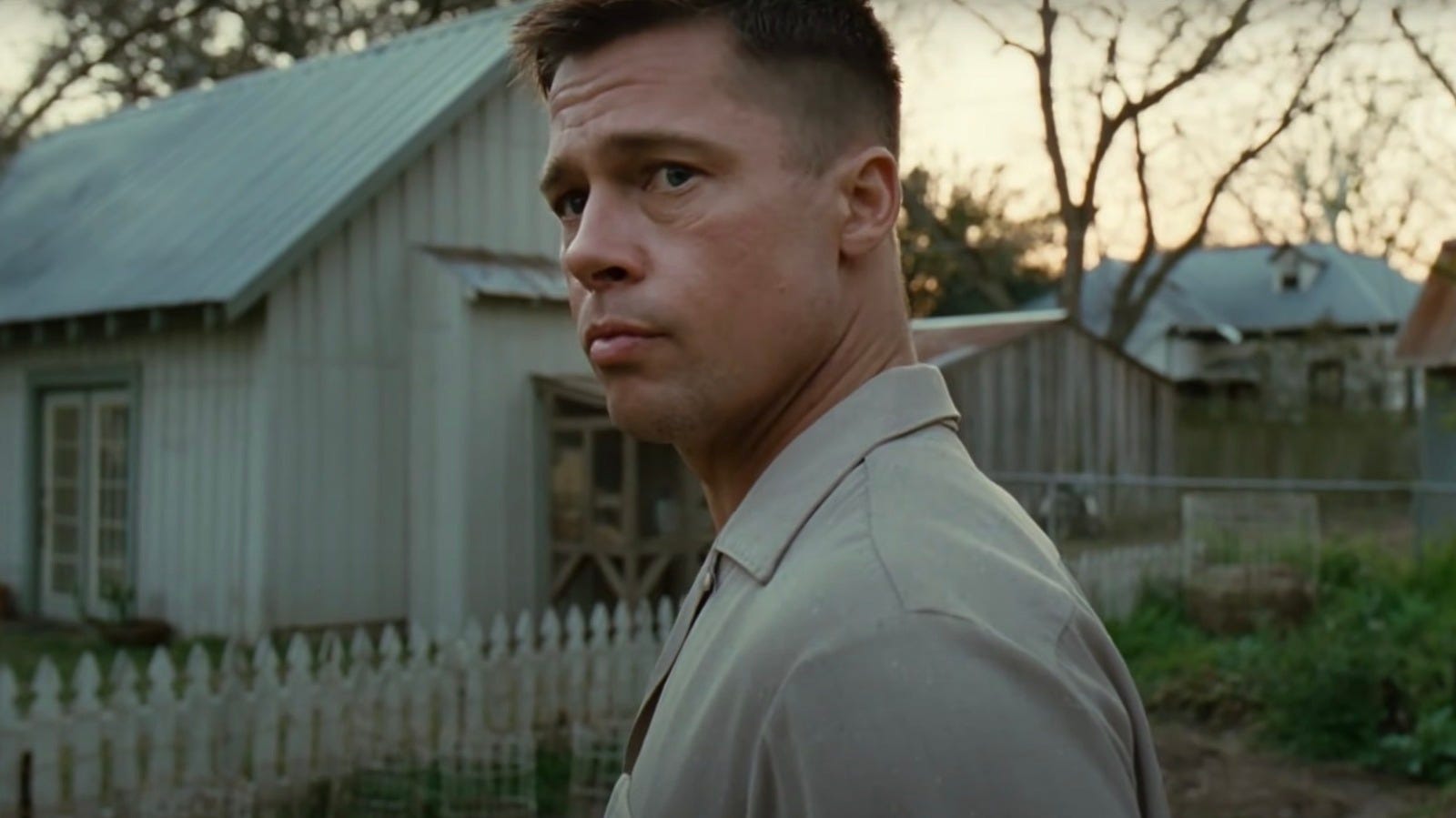
Then I sat down and watched Brad Pitt play a father whose disappointments had started leaking into the people he loved.
In 2011, it landed harder than I expected.
If you haven’t seen the movie, here’s the short version, and I’ll keep it free of the predatory for-profit university graduate-seminar fog these conversations usually attract.
The Tree of Life is Terrence Malick’s 2011 film about a family in 1950s Texas. It moves through memory, childhood, grief, God, creation of the entire damn universe, death, and family life in the way Malick tends to move through things, which is to say not in a straight line and not with much interest in whether the audience brought a plot map.
Here’s the trailer, which actually makes it seem like it will be a normal film:
Brad Pitt plays Mr. O’Brien, a hard, ambitious, disappointed father. Jessica Chastain plays his wife, a gentler presence in the home. Sean Penn plays their oldest son, Jack, both as a child and in flash-forwards as an adult still trying to understand what childhood did to him.
The thing that cut deepest for me, at the time I first watched the film, was the father’s failure.
Or, more specifically, it was what failure did to him.
Mr. O’Brien isn’t a movie villain. Malick is too honest for that, and life is too complicated for that. He’s a recognizable man. If you grew up around a certain model of masculinity, you know him.
Maybe you were raised by him.
Maybe, on your worst days, you worry you’re becoming him.
He’s a man organized around discipline, ambition, and control.
He believes in a bargain so deeply that he never examines it, because to him it isn’t a belief, it’s just how the world works.
Work hard. Impose order. Deny softness. Sacrifice now. And life, being fundamentally fair to serious men, will eventually reward you.
I grew up in Texas, which means I didn’t have to imagine this man. I had him in the family album. My paternal grandfather, the man who raised me as his son, was a Texas figure straight out of the same hard catechism: work harder than everyone, keep your word, carry your own weight, never flinch.
He did everything the bargain asked of him, in the order it asked, and he still ended up declaring bankruptcy.
I think about him now more than I realized. Here was a man who’d kept his half of the Greatest Generation’s deal down to the last decimal, and the deal simply didn’t keep its half back.
Watching Brad Pitt’s jaw tighten over a failed venture, I wasn’t watching a stranger in 1950s Texas. I was watching my own grandfather, and the quiet wreckage a good man carries when the world hands back a verdict he can’t appeal.
The cruel part is that he’s a believer; both Mr. O’Brien and Grandpa O’Donnell.
He’s not a cynic who games the system. He buys the promise at an emotional level. If you’re talented and disciplined and willing to give up comfort, success is supposed to come. So, when it doesn’t, he can’t shrug it off as bad luck or bad timing or an indifferent universe.
He has no language for that. He turns the blame inward and outward at the same time, and he ends up feeling humiliated, cheated, and exposed all at once.
He’s a man perpetually auditioning for his own worth.
That’s the engine of his sadness and his ambition gives his engine an infinite fuel supply. He keeps reaching, keeps pushing, keeps trying to prove his life amounts to something, and every missed break becomes another piece of evidence that maybe he’s ordinary. Maybe he misjudged himself. Maybe he handed his family all that pressure and severity in exchange for a payout that was never coming.
For a man built the way he’s built, that’s catastrophic. So, he doesn’t dare think it. He acts it out instead.
He has talent. He loves music. He has inventions. He has dreams. He wants greatness, or at least evidence that his life wasn’t normal. He wants the world to look at him and confirm what he already suspects about himself: that he was meant for more.
He can’t master the market. He can’t master his career. He can’t master luck, timing, class, money, or the quiet sense that life has downgraded him without giving him a hearing.
So, he masters what he can.
Control becomes the one thing he can still produce, so he produces it in bulk at home, on the people least equipped to refuse delivery.
That is how public disappointment becomes private tyranny.
But no man walks through his own front door and thinks, I failed today, so now I’ll be hard on my family. He walks in frightened that his life is sliding somewhere he can’t follow, and he grabs onto whatever he can still grip. The tragedy is that the thing he grips is usually a person.
In the movie, his sons absorb his moods. His wife has to build her whole day around his volatility. And the most devastating detail Malick includes is that the father isn’t consistently cruel… He’s sometimes warm, sometimes proud, sometimes playful, and then suddenly humiliating and impossible, with no reliable warning between the two.
That’s terrifying…
That inconsistency is worse than plain meanness, because it fuses love and fear together until a child can’t pull them apart. It’s much easier to process straightforward cruelty than to process love that keeps arriving wrapped in razor wire.
I watched that, broke and grieving and tired of my own shit, and I understood the temptation from the inside. Not because I had a family I was crushing, but because I could feel the gravitational pull of his logic.
I understood, in my own body, how a man starts measuring his worth by what the world has refused to give him, and how that measurement can poison every room he walks into.
I want to be careful here, because the absolute worst thing I could do is use the people I’ve lost as set dressing for an essay.
But the grief mattered to how the film landed.
By the time I watched it, loss had already stripped away whatever illusions I’d been carrying about fairness and control. I’d learned, in the most permanent way there is, that you can do everything right and still lose people who deserve decades more than they got.
The father in The Tree of Life spends the whole movie trying to dominate uncertainty, trying to discipline and out-work and out-tough a world that ultimately answers to none of it.
I was watching that fantasy from the other side of it. Uncertainty had already walked into my life and taken whoever it wanted, and no amount of hardness had slowed it down by a single second.
I was starting to realize that I had quietly believed some inherited version of his bargain. Work harder. Be tougher. Don’t bend, don’t soften, don’t fail where people can see it, and you’ll be safe.
Then adulthood arrived and informed me, with its usual faux warmth and Temu professionalism, that the meritocracy I’d been promised was largely a story that we tell tired people to keep them tired.
What I recognized in Brad Pitt’s face was not a man exactly like me. It was the man I could become if I kept handling disappointment the way he did. A man who carries his frustration into every room like a seeping gas leak and then wonders why the people closest to him learn to hold their breath.
The unhealthy habits were just the leak finding its easiest exit.
Early in the film, Chastain’s voice tells us there are two ways through life. The way of nature and the way of grace. Malick is using those words to draw the moral map of the entire film.
Nature is will, appetite, competition, self-assertion, and survival of the fittest. It wants to win. It wants security. It wants to force a shape onto the chaos before the chaos can swallow it. That’s the father’s whole country. He teaches his boys that the world will eat them alive if they aren’t tough, that they should hit back, stand first, never let anyone get the better of them.
Grace is the other thing entirely. Openness, mercy, receptivity, and love. The mother lives there. She moves through the film like someone who understands that life is fragile and somehow holy even when it’s hurting her, and she isn’t naive about it. She just isn’t organized around conquest.
Malick’s brilliance is that he refuses to call nature a lie. The world really is hard. The father isn’t hallucinating the danger. People really do get crushed. The problem is that Mr. O’Brien believes struggle is the whole truth, the only truth, and he builds an entire theology of manhood on it.
He thinks grace is for people who can afford illusions. He thinks tenderness is a luxury that gets your sons killed.
So, when his career fails to pay out, his operating system has no fallback.
Success was supposed to prove the sacrifice meant something.
Without it, he’s stranded. He can’t surrender to grace, because he spent his whole life calling it weakness, and now nature has failed to deliver the one thing it promised.
He’s a man trapped between two laws, unable to conquer and unable to kneel.
I knew that trap. I’d been living in a smaller, quieter version of it for a while.
So he keeps pressing down on the only battlefield he still controls.
His home.
Professional failure is already painful. It gets worse when a man turns it into a verdict on his worth.
I think a lot of men understand this more than we admit.
We were raised on some version of the bargain. Maybe it came from fathers. Maybe from coaches. Maybe from the military. Maybe from church. Maybe from school. Maybe from the general American background radiation that says hard work will save you if you just keep going and don’t complain too loudly.
Some of that advice is useful.
Discipline matters. Nobody gets very far by waiting for rescue.
But the bargain becomes dangerous when it turns work into identity and failure into shame.
That is where men get into trouble.
If your worth depends on winning, then every loss becomes a personal indictment.
If your identity depends on providing, then financial instability feels like moral collapse.
If you were taught that softness is weakness, then fear has to come out disguised as anger.
If you believe love means preparing people for pain, you may start causing pain and calling it preparation.
Mr. O’Brien loves his sons. That’s what makes him tragic. If he didn’t love them, the movie would be easier. He wants them strong. He wants them ready. He wants them protected from humiliation.
He gives them humiliation as training.
That’s how broken doctrines reproduce themselves. They arrive as advice. As discipline. As toughness. As “this is for your own good.”
A lot of damage has worn that uniform.
The Tree of Life doesn’t let him off the hook, which is why I trust it.
Plenty of people suffer disappointment without making their families live inside it. Plenty of men fail professionally without turning the house into a pressure chamber. Understanding a man doesn’t acquit him.
Malick knows that.
But the film also refuses the cheap satisfaction of flattening him into “bad father” and walking away feeling superior. That would be easy. But it would also be dishonest.
He is loving and destructive. He is sincere and damaging. He wants to protect his children and wounds them in the process. He is a man with real gifts and real failures, and the failures travel farther than he understands.
That is closer to life than most movies want to get.
By the end, the film doesn’t demand forgiveness. It reaches for mercy, which is harder.
Mercy doesn’t pretend the damage didn’t happen.
Mercy sees all of it.
Then mercy sees the frightened man underneath. The man who believed a lie because better men than him had believed it first. The man who thought hardness would protect him from shame, loss, death, and meaninglessness. The man who spent his life trying to win a war that couldn’t be won by force.
I didn’t walk away from The Tree of Life comforted. I walked away exposed.
The film showed me something I needed to see: failure can become contagious if you don’t handle it honestly. It can spread through your habits, your relationships, your temper, your self-respect. It can make you hard in ways that feel like strength until someone else has to live under them.
I’m in better shape than I was when the film found me. The grief sits in a different place. The habits sit in a different place. The money fear no longer has the same command authority it once had.
But I don’t write this like a man who solved the problem.
I write it like a man who survived enough of it to name it clearly.
That is a different thing. A more honest thing.
The Tree of Life understood something before I was ready to admit it: a man can love his family and still make them live inside his disappointment.
It understood that ambition can curdle into control. It understood that professional failure can become moral failure if you carry it home often enough. It understood that the doctrine a lot of us inherited had a fatal flaw.
The doctrine said hard work would make us safe.
Safe from what?
Death?
Shame?
Loss?
Failure?
The quiet terror that maybe life won’t reward us in proportion to what we endured?
Good luck. None of those wars are winnable by force, and a lot of us spend years learning that the hard way. Sometimes we make the people nearest to us pay our tuition.
My grandfather kept his half of a bargain the world didn’t honor. So did a lot of men. So did I, for a while. Maybe you have too.
That’s why Brad Pitt’s character hurts so much. He is not some distant father from a strange art film about 1950s Texas. He is the man a lot of us were warned by, raised by, loved by, feared, pitied, or nearly became.
The movie looks at him clearly. Then it asks the question he never could:
If hardness didn’t save you, what will?