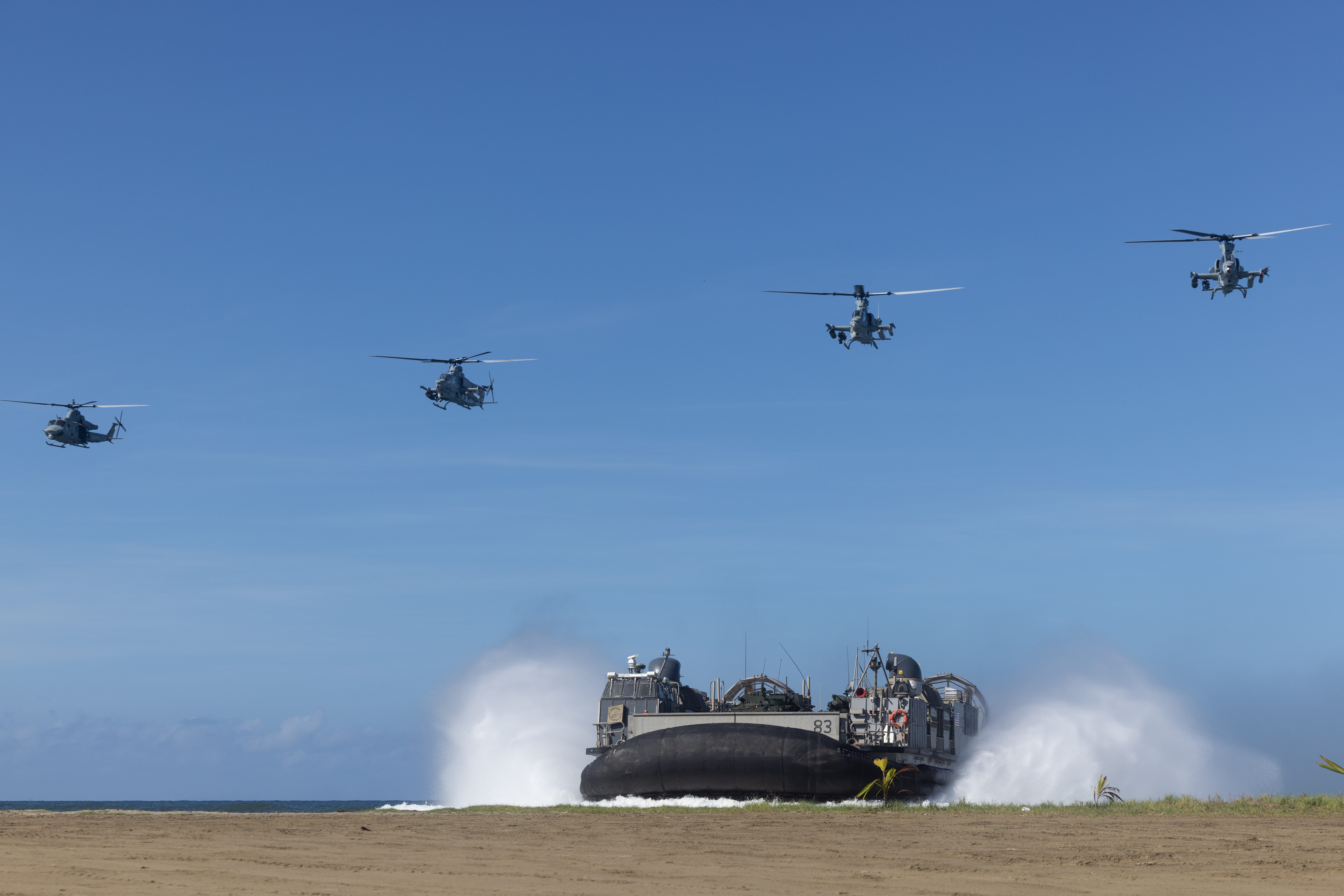
The Pentagon Is Quietly Planning for Cuba
Do we really have to invade everything? Asking for a friend.

Okay sports fans, break out a cigarro and put on some I Love Lucy; we might be going back to Cuba.
Wait, Wes! Back to Cuba?
Yep. Because the first invasion went so well. I have no doubt that this time, the Cuban people will almost certainly rise up and take back their island. They just need a little help from Uncle Sam, a few trillion pesos, and a dozen secret-squirrel special operators who definitely have lucrative careers in Hollywood once they retire.
Wow, I just had the strangest sensation of Déjà vu.
Oh well, we’ll just use the same playbook we used in 1961...
Scratch that. My editor is telling me on Slack that we should definitely NOT do that.
No problemo, Señor. Let’s dust off the old Desert Storm invasion manual. The Iraqis were pretty sick of Saddam’s shit, and we went in and [checks notes]... Ah, I see they didn’t actually rise up, even with our superb military assistance.
Huh. Okay, 0 for 2, but hang with me here. We went into Afghanistan and liberated millions of people from the oppressive Taliban regime. Even the mighty Soviet machine couldn’t achieve what we did! We seized the country so quickly it made Moscow rewrite their history books.
One sec. My editor is pinging me again.
What’s that? The Taliban currently control Afghanistan? All of it? Every square inch?
Well, they left eventually, so... no? They never left?
Of course I knew that. OF COURSE I know US history.
Well, you can’t fire me, because I quit!
Hi. I’m back.
I’m sorry you had to see that. I’ve had some water and I’ve reminded myself that independent writing is a noble profession that occasionally requires admitting that we have a very specific and consistent track record when it comes to regime change operations, and that track record is not exactly a 1992 Dallas Cowboys highlight reel.
Actually, there are only two examples, out of around ten, where the US (kind of-sort of) affected regime change successfully post-WWII:
In Panama, the US invaded to remove Manuel Noriega. A lot of Panamanians hated him already, and there was real public support for his removal. Once the invasion shattered the regime’s coercive machinery, local resistance to Noriega effectively collapsed and civilian support for the post-Noriega transition was strong.
The US military did the heavy lifting. The population’s role was more political and social than battlefield-decisive.
Grenada is another partial example. After the murder of Maurice Bishop and the rise of the Revolutionary Military Council, many Grenadians were deeply unhappy with the regime.
When the US invaded, there was broad popular relief rather than mass resistance.
Again, though, it wasn’t a classic bottom-up civilian uprising that defeated the government. The regime fell because US forces crushed it, while the local population mostly welcomed the outcome.
But what you mostly find is a parade of cases where Washington hoped local civilians would do one thing, did not fully understand what those civilians actually wanted, and then acted surprised when the whole operation wandered off into occupation, insurgency, civil war, blowback, or some humiliating hybrid of all four.
I know this sounds cynical… To be clear, I SUPPORT our military. As a multi-branch veteran, I want the best for our armed forces. The military completely changed my life; it freed me from poverty; it gave me purpose and direction.
But I protest the way the military is being used.
It just so happens to be currently run by a hyper-aggressive “we’ll take whatever we want” mindset. The whole point of being a great power is that we don’t always have to use force. There is such a thing as restraint.
When you start to recognize, in your own government, the Russian way of warfighting, it may be a sign that we’re on the wrong track…
So, what’s this about Cuba?
Ah yes…
USA Today published an exclusive this week: the Pentagon is quietly ramping up planning for a possible military operation in Cuba, pending a directive from President Trump.
Where are they getting their information?
Two anonymous Pentagon sources.
An official boilerplate Pentagon non-denial that said nothing while technically saying something.
And Trump himself, who told reporters on April 13th, “We may stop by Cuba after we’re finished with this,” gesturing vaguely at the ongoing Iran conflict like a man walking through Home Depot and admiring the spring flower selection.
The sourcing is thin, as USA Today acknowledges.
But Trump’s own public statements close most of the credibility gap. This is a president who said he expects to have the “honor” of “taking Cuba, in some form,” and added, helpfully, “Whether I free it, take it … I think I can do anything I want with it.”
When the post-Iran Commander in Chief is saying that out loud on White House property to reporters with functioning recording devices, calling it rumor starts to feel like editorial malpractice. A defense journalist writing off that quote as idle speculation is the same thing as seeing smoke coming from the radar system and assuming someone’s vaping. Nah, bro. That mother f*cker’s on fire!
At this point, we should believe Trump when he says he wants to use the military to do something crazy.
So, let’s take it seriously and think through what this would actually mean.
If you’ve been here a while, you know the drill. I wrote something similar before the Venezuela operation, then for the Greenland operation, and again before the Iran attack.
So, settle in; I’m well-caffeinated today.
We’ve done this before. It did not go well.
On April 17, 1961, roughly 1,400 CIA-trained Cuban exiles landed at the Bay of Pigs. If you’ve never looked at a map of that operation, do yourself a favor and pull one up, because the geography alone will tell you a lot about how un-seriously the planners were taking contingency planning.
The brigade hit a swampy, remote stretch of coastline and immediately ran into coral reefs that the CIA’s own maps had apparently misidentified as SEAWEED.
That was before anything went wrong on purpose.
Within seventy-two hours, the operation had collapsed completely. No popular uprising materialized. Air support was cancelled at the last minute by Kennedy, who was trying to preserve plausible deniability on an operation that had approximately zero plausibility of deniability.
The brigade was captured, and the most charismatic president of the 20th century was left holding a geopolitical disaster.
Kennedy took full public responsibility, his approval rating went down, and then up again, because Americans apparently have an accountability kink.
The core assumption was that the Cuban people would rise up against Castro the moment outside forces arrived.
They did not…
They watched.
They smoked.
They shook their heads and said, “No me’ gusta…”
Some of them actively fought against the invaders. The Agency’s confidence in a popular uprising had not been based on, in the formal intelligence community sense of the term, “evidence.”
In reality, it had been based on what we would today call “vibes.”
Great for AI-coding. Apparently not great for invading Communist strongholds.
Fast forward to today: The Trump administration executed a covert extraction of Venezuelan President Nicolás Maduro from his compound in Caracas on January 3rd.
Thirty-two Cuban military personnel guarding Maduro were killed in that operation.
Then came some joking/not joking Greenland remarks.
Then came the Iran campaign.
Now Pentagon planners appear to be turning their attention ninety miles south of Florida.
Venezuela. Iran. Cuba? Greenland?
The military math is not the hard part
Brian Fonseca, director of the Jack D. Gordon Institute for Public Policy at Florida International University and one of the more credible Cuba military analysts working today, is blunt about the battlefield calculus: “This will be a very easy military victory, but a far more difficult political victory.”
He is almost certainly right on both counts, and the “easy military victory” part deserves more examination than it typically gets, because the how of it tells you a lot about the what comes next of it.
Cuba’s military equipment is in deteriorated condition that would be comical if the strategic implications weren’t so serious. Decades of sanctions, Soviet-era hardware aging past any reasonable maintenance schedule, and an economy so strained that the island is experiencing sustained blackouts and fuel shortages have left the Cuban Armed Forces in extremely poor shape by any conventional measure.
We’re talking about an institution whose most sophisticated air defense systems are vintage Soviet equipment that were already fifty years old when I was eating MREs in the field.
The Cuban Air Force has aircraft on its rolls that have not flown operationally in years, maintained not for combat readiness but because removing them from the inventory would require paperwork.
Here’s a fun PDF from the CIA, previously marked as Top Secret, now released, that shows the state of the Cuban military as of 2003.
The Cuban officer corps also presents an interesting variable. Fonseca has noted that officers are unlikely to fight hard for a regime they do not believe in, and a government that cannot keep the lights on has a credibility problem that extends into the barracks. In other words, the Cuban military is in such poor shape, it makes Venezuela look like a veritable superpower.
So, the shooting, if it happened, would probably be short. Cuba may very well be one of America’s regime-change success stories. The problem is everything that comes after the shooting.
What the operation would actually look like: The Venezuela template
Here is where things get interesting, because the Venezuela operation gives us a much more useful reference point than the Iran campaign does.
Iran is big, loud, and involves conventional force packages against an adversary who can do real damage to the US military.
Venezuela was different. Venezuela was quiet, surgical, and designed to achieve a specific objective: the physical removal of one man from one location, rather than a broad campaign to degrade military infrastructure.
Cuba, at least in the early phases, looks more like Venezuela than it looks like Iran.
Ninety miles. That is the distance from Key West to Havana, which is shorter than my drive from Grand Rapids to Chicago and considerably more geopolitically significant.
This proximity fundamentally changes the logistics equation in ways that planners at MacDill Air Force Base, home of SOCOM and CENTCOM, are almost certainly working through at this moment.
The opening phase would almost certainly be JSOC-heavy. Joint Special Operations Command and its subordinate units like Delta Force and SEAL Team Six’s DEVGRU in the lead have the targeting packages and the operational template for operations that look like Venezuela.
Small elements, mission-specific, with a defined objective set and a very short timeline measured in hours rather than days. The Maduro extraction lasted approximately forty-five minutes from first breach to exfil.
Cuba is a larger and more complex target environment, but the template is the same: identify high-value leadership nodes, isolate them, and either neutralize or capture them before the broader Cuban military apparatus can organize a coherent response.
Air support for the opening phase would flow out of Florida without breaking a sweat.
Homestead Air Reserve Base sits at the southern tip of Florida, a thirteen-minute flight from the Cuban coast at cruise speed for an F-16.
MacDill gives you more fighter capability.
Eglin and Hurlburt Field in the Florida Panhandle are home to Air Force Special Operations Command, including the MC-130 variants that insert and extract special operations forces in denied environments and the AC-130 gunships that have been the most popular overhead presence in every American small-footprint operation since Grenada.
The AC-130J Ghostrider in particular, a platform that can put 30mm cannon, 105mm howitzer, and precision-guided munitions on target while maintaining communications and ISR functions simultaneously, is exactly the kind of asset that turns a special operations raid into something with real staying power if things go shitty.

At sea, the Caribbean is not a challenging operational environment for the United States Navy. An Amphibious Ready Group with an embarked Marine Expeditionary Unit gives you a self-contained invasion force of roughly 2,200 Marines with aviation and logistics support that can be positioned off the Cuban coast with minimal fanfare.
MEUs operate this way routinely, and a naval presence in the Caribbean would not by itself constitute the kind of visible signal that activates every foreign intelligence service in the hemisphere.
Carrier strike group support is available within forty-eight hours from the Atlantic Fleet.
The Navy’s surface-to-air missile umbrella would neutralize Cuba’s already-marginal air defense capability so quickly that Cuban air defense commanders would spend more time confused than engaged.
The 82nd Airborne Division out of Fort Bragg is the conventional follow-on force that would matter most if the operation expanded beyond its initial SOF footprint.
The 82nd is the Army’s designated crisis response force; their entire institutional identity is built around the ability to put a brigade in the air within eighteen hours of a warning order and have boots on the ground within ninety-six hours of a presidential decision.
For a target ninety miles from Florida, the logistics are almost insultingly favorable compared to what the 82nd routinely trains for. You would not need to establish a complex air bridge through multiple theater waypoints. You would need to point them south and tell them to pack light.
Greenland would actually be a harder target than Cuba, logistically speaking.
There is also one piece of terrain that does not appear in most invasion planning discussions but should: Guantanamo Bay.
The United States already has a military installation on the eastern tip of Cuba, complete with airfield, port facilities, and infrastructure. Whatever people think about Guantanamo’s other uses over the past two decades, as a logistics node for a Cuba operation it is a pre-positioned asset sitting inside the objective area.
That is not nothing.
The part nobody wants to plan for
Post-conflict Cuba would require the United States to do several things simultaneously and competently, which is a combination that American administrations across both parties have struggled to produce in environments considerably less complicated than a Caribbean island nation with sixty-five years of revolutionary political culture and an exile community in South Florida that would arrive with opinions. Whew…
Washington would need to impose order quickly enough to prevent score-settling and looting.
It would need to identify and legitimize opposition leadership with actual popular support rather than simply the loudest voice among the exile community in Miami, which has its own political gravity that does not always align with conditions on the ground in Havana.
The Cuban-American community in Florida has been the most influential external constituency in US Cuba policy for six decades, and their preferences have not always matched what actual Cubans living in Cuba want.
That gap tends to become extremely visible approximately seventy-two hours after a regime change.
Washington would also need to manage the Cuban Armed Forces as a political institution, not merely dismantle them as a military target.
An armed organization with no paycheck and no mission is a different kind of threat than a shooting war. We tried the “dissolve the military and see what happens” approach in Iraq in 2003.
Who was the genius who thought disbanding the massive Iraqi army would turn out well? Did you think they would just fuck off and go play Xbox?
In reality, the result was a disbanded army with weapons, grievances, deeply ingrained factional loyalties, primed for radicalization, and nowhere to go.
The subsequent decade of Iraqi instability was not unrelated to that decision. Fonseca has been arguing publicly that the Cuban military is central to any viable transition and cannot simply be wished away.
That analysis is sound and it is also the kind of analysis that gets produced before an operation and then filed in a drawer during an operation.
There is also the population question.
Cuba has approximately eleven million people.
Haiti, for comparison, has roughly twelve million, and American interventions there, in 1915, 1994, and the ongoing disaster of post-earthquake reconstruction, have not produced outcomes that anyone is eager to replicate.
The idea that Cuba is somehow simpler because it is geographically closer and politically legible to the Florida exile community does not survive contact with the actual complexity of Cuban civil society; which has been shaped by six decades of revolutionary institutions, rationing systems, neighborhood surveillance committees, and a public health infrastructure that, whatever its other failures, has produced one of the highest physician-to-patient ratios in the Western Hemisphere.
You don’t walk into that and replace it with something functional in the two-week window that American political attention spans typically allow before the next thing.
The operating environment is already brittle
One last piece of context that tends to get buried in the invasion coverage is the current state of Cuba itself.
The island is under severe internal strain of a kind that has not existed since the Special Period of the 1990s, when the Soviet Union collapsed and Cuba lost roughly eighty percent of its import capacity overnight.
What’s happening now is arguably worse in some respects, because in 1990 the regime still had ideological cohesion. What exists today is institutional inertia masquerading as ideology, which is a much more fragile thing.
This creates a paradox that anyone who has studied intervention knows well: A brittle target might be an easy target. But it also produces a fragile post-conflict environment where outside actors have very little margin for error before instability compounds.
The country you walk into and the country you are trying to leave behind stable are not necessarily the same country.
To be fair, USA Today also reported that the US and Cuba have acknowledged early-stage discussions aimed at finding a way out of the current crisis, and that in March the two countries were exploring a possible economic deal.
Whether that diplomatic track survives the current pressure or gets overtaken by events in the Pentagon planning shop remains an open question.
Also, “diplomatic track overtaken by events in the Pentagon planning shop” is, I would note, a phrase that covers a remarkable amount of American foreign policy history if you read it charitably.
I believe modern world history can be defined as “days of peace and years of war.”
Actually, that’s a great future title for a book I should write. Let me ping my editor real quick… Oh that’s right. He fired me, erm, I mean, I quit. Shit.
So here’s what to watch for
Fonseca’s read on the current moment is that this may be more military signaling than actual operational intent.
I think that’s generous given what we’ve seen in Iran. But still, I should note that the Trump administration has not built a public legal or rhetorical case for an imminent Cuban threat, which has been the standard pre-operational argument for past interventions.
The Venezuela operation had its sham BS narco-terrorism scaffolding. The Iran campaign had its own artificially constructed framework, however contested.
Cuba doesn’t have that architecture in place yet, and you generally need some version of that architecture to give the DOD lawyers something to work with.
But Trump has demonstrated a willingness to move quickly when he decides to move. “I can do anything I want with it” is not the language of a president who is thinking about this abstractly over a long planning horizon. It is the language of a man who has already decided he wants the thing and is working backward from the outcome to the mechanism.
After Venezuela and Iran, we should take any threats to Greenland or Cuba very seriously.
Whatever is being planned now is presumably being generated by this administration, for this president, on a ninety-mile target that has frustrated American policy for sixty-five years.
The military assets can handle it. The geography is favorable. The Cuban military is in no shape to offer meaningful conventional resistance. Every variable that planners can control points toward a short, successful kinetic phase.
It’s the variables they can’t control that have a way of writing their own history. In which case… Hegseth, you got some ‘splaining to do…


When people talk about invading Cuba I remember this quote from David Halberstam's book The Best and the Brightest:
"There were men who opposed the invasion or at the very least were uneasy with it and, to a degree, they were the same men who would later oppose the Vietnam commitment. One was general David M. Shoup, Commandant of the Marine Corp. When talk about invading was becoming fashionable, General Shoup did a remarkable display with maps. First he took an overlay of Cuba and place it over the map of the United States. To everybody's surprise, Cuba was not a small Island along the lines of, say, Long Island at best. It was about 800 miles long and seemed to stretch from New York to Chicago. Then he took another overlay, with a red dot, and placed it over the map of Cuba. "What's that?" some one asked him. "That, gentlemen, represents the size of the island of Tarawa," said Shoup, who had won a Medal of Honor there, "and it took us three days and eighteen thousand Marines to take it." He eventually became Kennedy's favorite general.
I wish Shoup could talk to Trump. Probably be a waste of time.
Sorry Wes - 2 examples where USA successfully managed regime change post war:
Iran 1953. Ousted a democratically elected regime that wanted to nationalise oil production.
Chile 1973.
So USA does manage successful regime changes. (the first one was aided by us Brits). (but "Are we the bad guys?")