


This article is one of three weekly exclusive articles (Sundays, Mondays, and Wednesdays) for my paid subscribers. Thank you for continuing to support independent, approachable military analysis with a heavy dose of pro-Ukrainian sentiment and a side of anti-authoritarian humor.
Hey friends.
Some readers may see this as another criticism of the American defense establishment.
It is.
But that criticism comes from loyalty, not cynicism.
I want the United States to succeed. I want American troops to enter the next war with equipment that works, stockpiles that exist outside a requirements doc, and factories that can replace losses before the enemy can exploit them.
Sometimes supporting the institution means telling it, truthfully, that it’s on the wrong path.
The United States still has enormous advantages in engineering, capital, research, and military experience. But those advantages aren’t self-executing. They can be squandered through complacency, bad contracting, fragile supply chains, and acquisition timelines built for a slower century.
Call it tough love if you like.
I’d rather criticize these weaknesses now than explain them after American service members come back in a flag-draped box.
Let’s get into it:
The United States Army spent $469 million building a state-of-the-art artillery factory in Mesquite, Texas; about ten miles from where I grew up. Nearly two years later, that factory has produced exactly zero artillery shells that meet contract specifications.
Zero.
Not “fewer than expected.” Zero, on a product the Army has manufactured continuously since before your great grandfather was drafted.
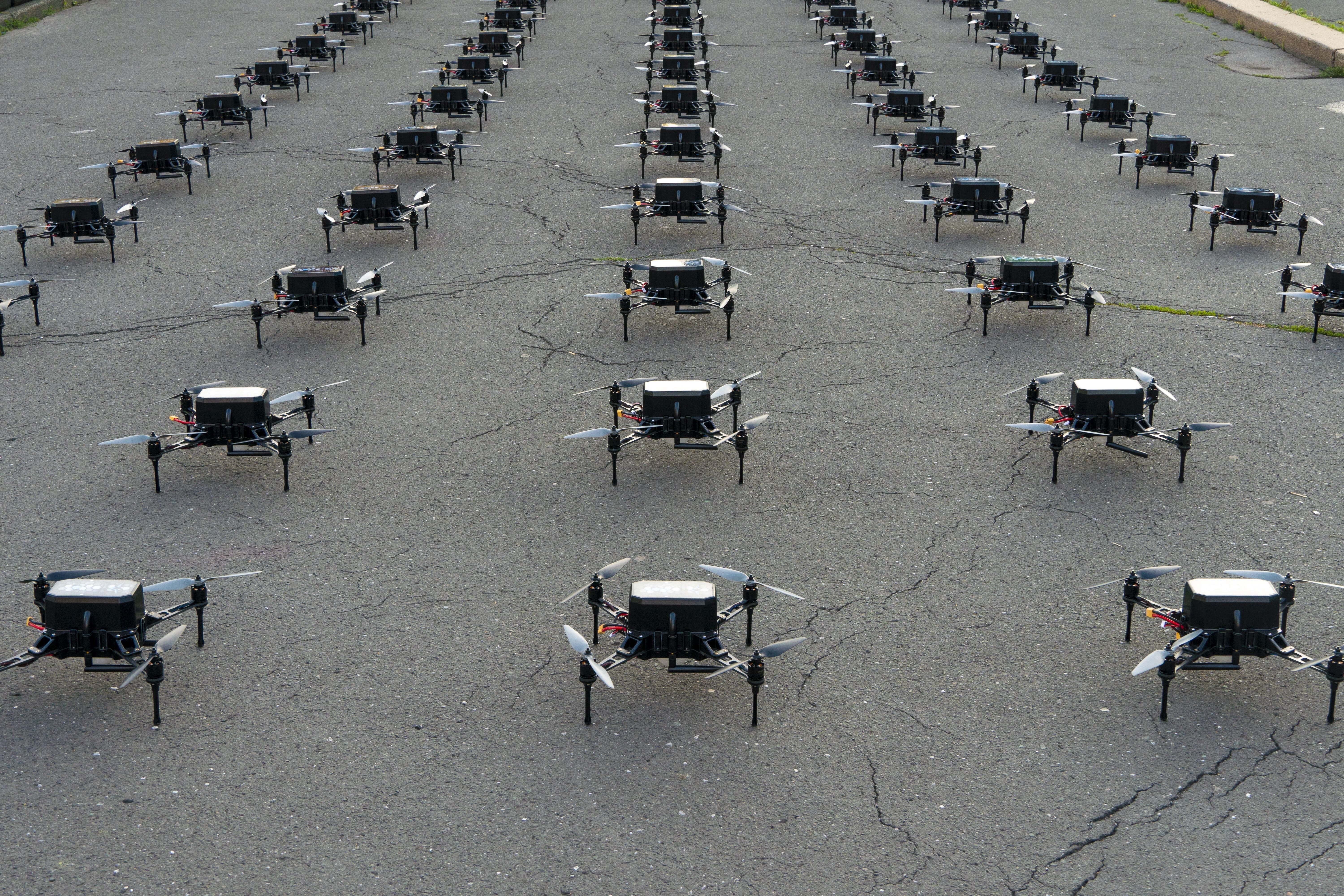
Keep that number in the back of your head because we’re about to talk about a much harder problem. Washington now wants American industry to build roughly 340,000 small attack drones inside two years.
If the country just proved it can’t reliably forge a steel shell whose design, metallurgy, and purpose have been settled science since the Wilson administration, what exactly makes anyone confident it can mass-produce a flying computer that has to out-think an enemy who’s rewriting the rules of the fight every few weeks?
The shell America still can’t build
Let’s start with what actually went wrong at Mesquite.
The Army’s target was 100,000 rounds of the 155mm M795 shell per month by October 2025, the standard artillery round fired from howitzers across the entire NATO alliance. As of this past March, total national output sat at 36,000 rounds a month, less than half the goal, and a new Pentagon Inspector General report just laid out exactly why.
The Mesquite facility, operated by General Dynamics Ordnance and Tactical Systems, was supposed to contribute 30,000 of those rounds every month using “high levels of automation” and “digital data capture.”
Instead, the Army let the contractor try to adapt old machinery built for the M107, a shell that dates back to 1958, to instead crank out the newer M795, which flies about six kilometers farther and packs a heavier charge.
Army officials called it a “high-risk, high-reward opportunity” and accepted that risk anyway. The reward never showed up. The equipment never produced a single projectile body that passed inspection, and the Army finally ordered the plant to stop spending money entirely in August 2025.
Here’s how it normally works: Steel gets forged and machined into a projectile body, that body gets inspected, then it moves to a separate facility to be packed with explosives and assembled into a finished round.
Fail at step one and nothing downstream matters, no matter how much explosive-packing capacity you’ve built. The Army had actually planned for plenty of that downstream capacity. It just couldn’t feed enough steel bodies into it.
Real manufacturing capacity exists the day a production line starts reliably spitting out parts that pass inspection, and not one day before.
Mesquite failed at that test using a shell whose specs, metallurgy, and purpose have been settled and unchanging for decades.
Small attack drones remove none of that difficulty. They add software, batteries, radio-frequency engineering, foreign-sourced electronics, and an enemy who studies every video of your product and adjusts within the week.
To be fair to Washington, and I want to be fair here, the drone plan isn’t reckless. It’s a genuine attempt to learn from Ukraine, and in several places it shows real thought.
The program is called Drone Dominance, roughly $1.1 billion aimed at building a demand signal strong enough to convince American manufacturers to invest in real tooling and suppliers instead of pitching prototypes to nobody. I’ve just made a video for the New York Post that is currently in the review stage that covers the drone dominance program.
It runs in phases the Pentagon calls Gauntlets, competitive live-fire evaluations where actual military operators fly the drones through realistic mission profiles.
The first Gauntlet, held at Fort Benning in February and March, put 25 companies through strike scenarios across open terrain and simulated cities, and eleven winners walked away with a combined $150 million to build 30,000 drones, at a price the Pentagon is trying to push down from roughly $5,000 per unit toward $2,300 by the later phases.
A new Gauntlet is scheduled roughly every six months, the vendor pool narrows with each round from 25 companies down to as few as three or five by the final phase, and the total target across all four phases sits at approximately 340,000 aircraft by 2027.
Give credit where it’s due. Operators, not contracting officers, do the testing.
Plus, losing a competition in one phase doesn’t disqualify a company from the next.
The drones are meant to actually get flown, crashed, and expended in training rather than sealed in a warehouse. That’s a real improvement over how the Pentagon has historically bought things, and it shows leadership genuinely absorbed part of the Ukraine lesson.
What it hasn’t fully absorbed yet is the harder part.
