


Hey friends.
I hosted a video for The Sun last week about the ground robots used during Operation Vivaldi, and I have to admit, I went into the story thinking the robots were the story.
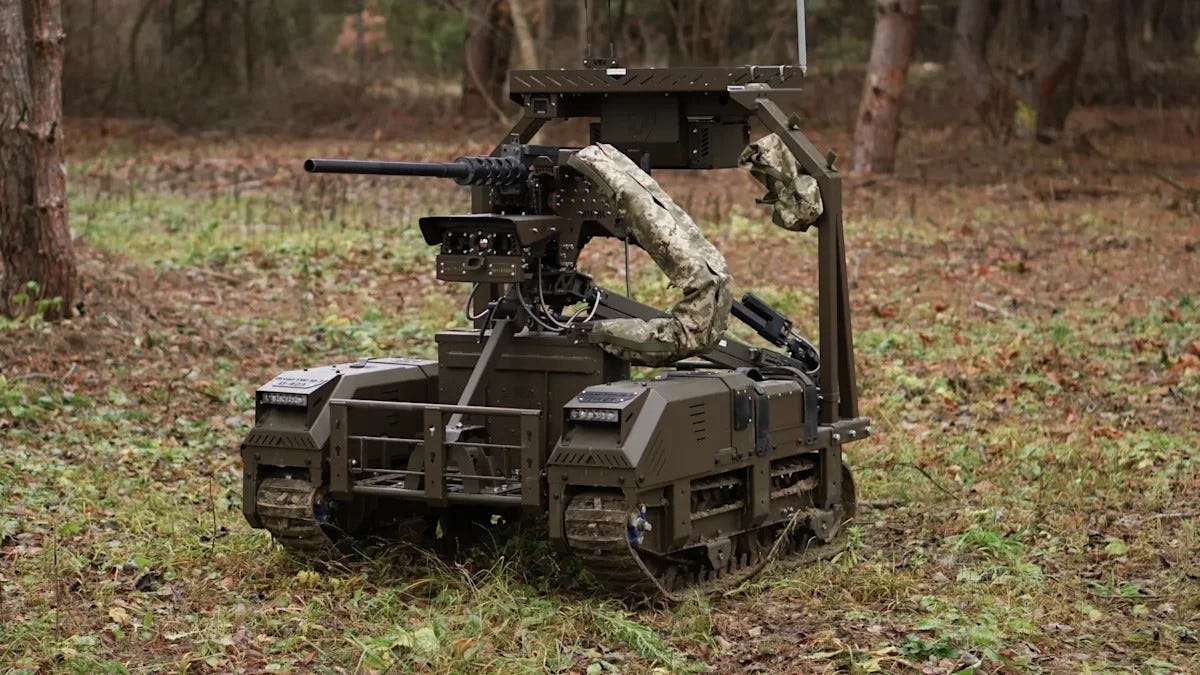
It was hard not to. Ukraine’s 3rd Army Corps had heavy bomber drones carrying kamikaze ground vehicles more than 10 kilometers behind Russian lines, setting them down where nobody expected an attack, and then letting the little terminators go hunting.
The corps called it a “world first…” That’s catnip for me.
The hook, “Ukrainian murder bots delivered by bomber drone behind enemy lines” is the equivalent of tempting me to snort a line of coke with Ryan Reynolds in the back of an Uber on our way to meet Mark Carney; how could I refuse?!
Then I found a number buried in the 3rd Army Corps’ own reporting that changed the hook for me: Its electronic-warfare units say they disrupted more than 20,000 Russian drone missions during Operation Vivaldi.
That was the moment I realized I had been chasing the shiny object.
The bomber drone carrying a ground robot is a very clever trick. The electronic-warfare campaign that helped blind a Russian force to the entire offensive operation, whose entire defensive system increasingly depends on drones, is a much bigger deal.
Bigger still, how Ukraine was able to coordinate what is essentially a combined arms operation built for the future, without Russia getting the initiative.
Now we have something worth digging into.
What happened north of Lyman
Since late spring, Russian forces had been grinding forward in northern Donetsk, using the now-familiar pattern of sending small groups through gaps, tree lines, ruined villages, and weak seams in Ukrainian positions around Lyman.
The 3rd Army Corps, commanded by Andrii Biletskyi, responded with a phased counteroffensive it keeps calling “seasons,” which, I presume, is a deliberate nod to eighteenth-century Italian violin music.
The first season cleared roughly 75 square kilometers of Russian infiltrators.
The second pushed Ukrainian forces back into Shandryholove and Derylove and secured Drobysheve.
The third phase, announced on September 28, retook Ridkodub, Nove, and Katerynivka. The corps says the total recovered area across all three phases reached 176 square kilometers, with more than 250 Russian soldiers captured and roughly 5,000 Russian casualties inflicted.
Russian military bloggers have also acknowledged Ukrainian advances back toward the Zherebets River, and ISW described parts of the operation as a limited mechanized maneuver supported heavily by drones and ground robots.
“Limited” is a useful word here.
One hundred seventy-six square kilometers isn’t exactly a Thunder Run. In fact, it’s a relatively small patch of ground.
But it’s also one of the few places in 2026 where a Ukrainian formation has managed to steal the initiative from Russian forces that had spent most of the year setting the tempo.
That makes the method more interesting to me than the acreage.
The electronic-warfare crews went after Russia’s drone network.
Heavy bomber drones carried Hryphon strike robots, built and operated by the NC13 unit, deep into the rear.
During the third phase, the 3rd Assault Brigade took two old Soviet BTR armored personnel carriers, converted them into unmanned vehicles, stuffed them with explosives, and sent them toward Russian positions near Nove and Katerynivka.
According to the corps, Russian troops initially thought reinforcements were arriving.
Ahem, they were not, in fact, reinforcements.
The BTRs drove into fortified positions and detonated.
At the same time, Ukrainian forces ran a deception operation designed to pull Russian reserves toward a false axis of attack.
The corps also claims it destroyed drone launch sites belonging to Rubicon, one of Russia’s most capable drone formations, and forced Rubicon elements to withdraw from the sector.
Then, after the jamming, drones, decoys, robot bombs, artillery, and deception had done their work, the infantry moved in.
God loves the infantry…
