


This article is one of three weekly exclusive articles for my paid subscribers. Thank you for continuing to fund independent military analysis with a heavy dose of pro-Ukrainian sentiment and a side of anti-authoritarian humor.
I just read a piece arguing that Ukraine’s Leopard 2 tanks haven’t performed “up to expectations” against Russia.
On the surface, the numbers are hard to ignore:
Current Oryx public visual-confirmation data, Ukraine has lost at least 107 Western-supplied tanks, if we count Leopard 1, Leopard 2 variants, Sweden’s Strv 122, Challenger 2, and M1A1 Abrams.
But here’s what analysis almost always gets wrong: the Leopard 2 isn’t failing because tanks are obsolete. It’s struggling because a weapon system is only effective inside the battlefield it was designed to fight on.
“Tanks are Obsolete!” makes for a great, clickbait-y headline.
Here’s a news flash: Leopard 2s also struggle when used in submarine warfare…
When you drop a Leopard 2 into a NATO-style combined arms assault, with artillery suppression, engineers, air defense, electronic warfare, infantry to protect it, tank logistics, and at least temporary air superiority, and you have a terrifying machine doing exactly what it was built to do.
Drop that same tank into a transparent battlefield full of mines, fiber-optic FPVs, loitering munitions, drone swarms, and no friendly air umbrella, and the problem isn’t the tank.
The problem is that the entire system the tank depends on never showed up.
That’s the question NATO needs to be asking right now.
What happens to Western warfare when air superiority doesn’t show up?
The Assumption That Built a Doctrine
To understand why Ukraine is such a disorienting experience for Western defense planners, you have to understand what NATO spent three decades believing about modern war.
It goes something like this: before the first armored column moves, the air campaign clears the way.
Leadership decapitation.
Debilitating cyberattacks.
Runways get cratered.
Air defense networks get dismantled (SEAD/DEAD).
Command nodes go dark.
Electronic Warfare bonanza with Growlers and similar aircraft.
Enemy logistics routes (roads and bridges) get destroyed.
We all just got a front-row seat to this exact playbook in Iran. It’s like CENTCOM followed the US War Bible step-by-step.
And then, only then, does the ground war begin, under conditions where NATO’s maneuver forces can actually maneuver.
If your airpower is good enough, everything else falls into place… At least, this is the way the USAF thinks about it.
I stopped typing and just spent 45 minutes looking through all of my books for an Air Force warfighting doctrine manual I was issued in 2007; it’s quite small and meant to fit in a uniform pocket. I didn’t find it, which means that I need to seriously organize these books into some kind of system.

Anyways, Desert Storm in 1991 became the mental template for a generation of Western military thinking.
Thirty-eight days of coalition air operations preceded the ground campaign. Iraq’s integrated air defense system was dismantled. Iraqi armor moved and died. Coalition armor moved and won. The hundred-hour ground war felt almost inevitable because the air campaign had already hollowed out the opposition before a single Abrams crossed the berm.
NATO internalized that model so completely that the assumption of air superiority became nearly invisible; a given rather than a variable.
The doctrine, the procurement, the training, the expected order of battle: all of it quietly assumed that the hardest part would already be solved before the tanks rolled.
Now, keep in mind that the rest of NATO, with minor tweaks unique to each country, adopted this American model; especially the UK, Canada, France, and Poland.
But Ukraine just spent four years demonstrating what happens when the hardest part never gets solved.
Ukraine isn’t the first battlefield to punish this kind of assumption. It’s just the most technologically spectacular 4K ultra high-definition version of a problem that keeps returning.
World War I is the original data point. The firepower revolution of machine guns, artillery, barbed wire, overlapping defensive fields, outran every attempt at mobility. Armies could still attack. They just paid in bodies for every kilometer. The battlefield rewarded depth, concealment, artillery endurance, and logistics. It punished movement without suppression, and it punished commanders who thought group courage could substitute for fires.
World War II invented maneuver because tanks, radios, motorized logistics, close air support, and operational planning restored the ability to move and exploit. The early German successes weren’t about some mystical superiority of the tank, (although that helped). They were about plugging the tank into a system that could move, communicate, concentrate, and exploit collapse before the defender could react. The tank alone was just a loud metal coffin with ambition. Inside the system, it was decisive.
The Soviet Eastern Front then showed what happens when theater scale and industrial capacity overwhelm operational genius. Maneuver became attrition when the armies were enormous, the front was vast, and the side that could keep feeding replacements into the furnace outlasted the side that couldn’t. Russia has not forgotten this lesson. Europe seems to have.
The Arab-Israeli Wars showed both sides of the airpower equation in rapid succession. In 1967, air superiority enabled devastating armored maneuver in six days. In 1973, dense Soviet-supplied surface-to-air missiles and anti-tank guided missiles shocked Israeli armor and aircraft in the opening days of the war. The lesson wasn’t that tanks or aircraft were obsolete. The lesson was that combined-arms warfare had become conditional: step outside your protective system, and the battlefield takes you apart piece by piece.
Vietnam offered a different, unconventional flavor of the same humbling: conventional firepower superiority doesn’t automatically translate into strategic success when the opponent refuses to fight on your preferred terms and the political conditions make decisive action impossible.
Each of these wars taught the same underlying principle in different vocabularies. Weapons are only as effective as the system around them. And systems only work inside the conditions they were designed for.
NATO designed its system to keep up with the United States, the most powerful NATO member. The United States, in turn, designed its system for Desert Storm. Ukraine looks nothing like Desert Storm.
The phrase that best captures what Ukraine has become is transparent battlefield.
Across the front lines, you’ll find a drone-driven kill zone extending roughly 20 kilometers in both directions beyond the line of contact. Long-range reconnaissance drones spot movement. Targets are relayed and then struck by precision bombers, kamikaze drones, or fiber-optic FPV systems specifically engineered to resist jamming.
When both sides can see, both sides can strike.
When both sides can strike, movement becomes expensive.
When movement becomes expensive, armies dig.
Once armies dig, mines, drones, artillery, and fortified defensive lines turn what should be a maneuver problem into a grinding engineering problem with a casualty bill attached to every meter.
The Leopard 2 isn’t designed for that. Neither is the Abrams. Neither, for that matter, is the Russian T-90M, which has been turned into burning wreckage by Ukrainian drones, mines, and ingenuity with impressive regularity.
The tank didn’t die in Ukraine. The unsupported breakthrough did.
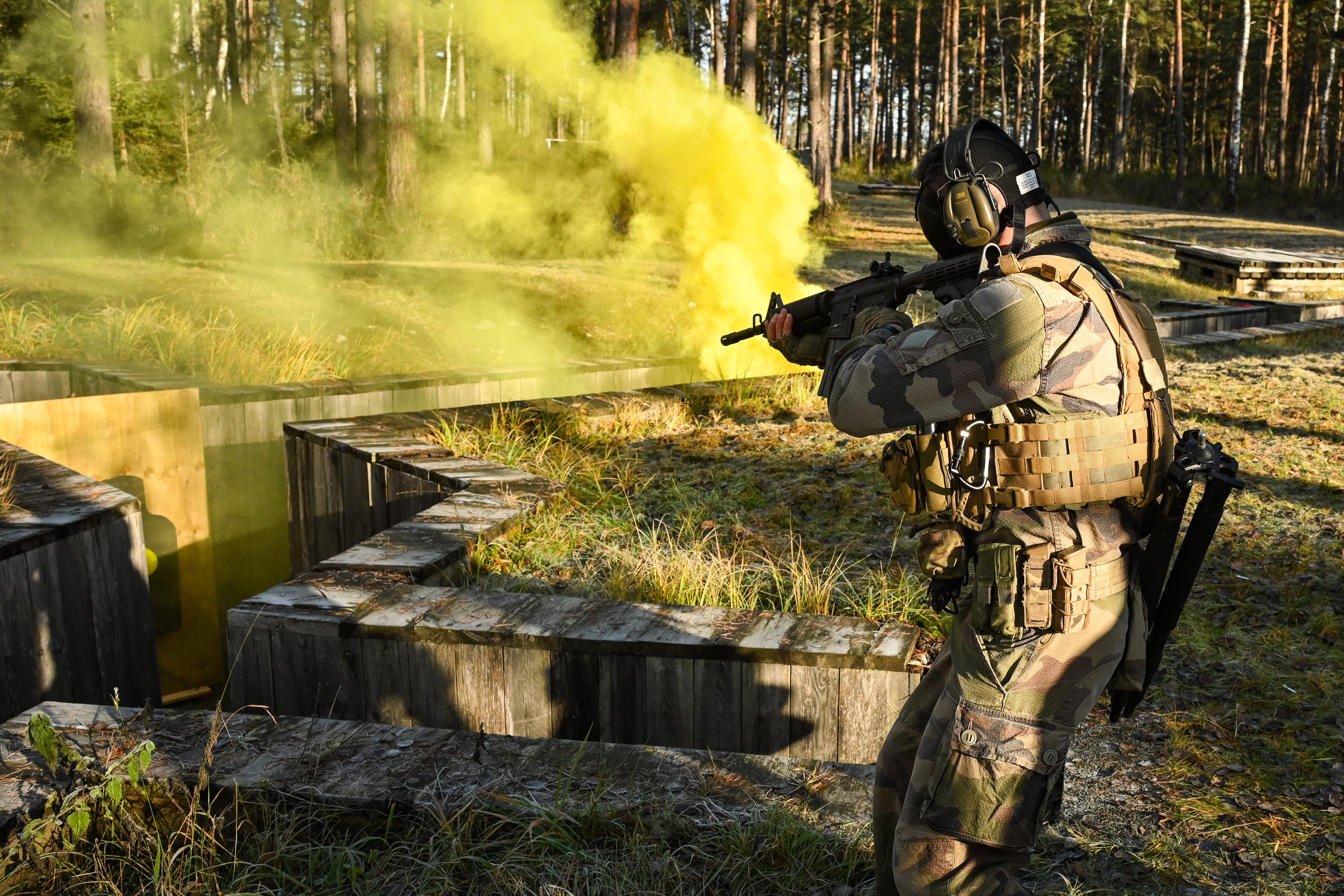
What collapsed the breakthrough isn’t any single weapon. It’s the intersection of six conditions: neither side can suppress enemy ISR, breach minefields quickly enough, protect assault forces in transit, sustain momentum through the defense, or exploit a breakthrough faster than the defender can rotate reserves to seal it. Ukraine has all six problems at once. So does Russia, on its attacking formations.
This is why the war looks like it does. And this is why Europeans need to understand it clearly rather than treating it as a special case or an aberration.
Because it’s not an aberration, it’s a preview.
